On Reading Sermons Online

I preach from a manuscript in the pulpit every Sunday. During the week I carefully craft the words that will be proclaimed and I humbly pray that the Lord will show up through, and even in spite of, my sermons. Personally, preaching from a manuscript allows me to articulate how I believe the Lord continues to speak through scripture without going off on tangents in the middle of the proclamation. Because I use manuscripts, I have a copy of every sermon I’ve ever preached from the first one as a teenager at Aldersgate UMC in Alexandria, VA to the one I preached at St. John’s UMC in Staunton, VA last Sunday.

By my cursory calculations I have preached over 200 times including Sunday sermons, special occasions, funerals, and weddings. Each of these sermons contain, on average, 2,000 words, which added together, comes to about 400,000 words on God’s holy Word. With the exception of funerals, all of these sermons are available to read online at any time via www.ThinkandLetThink.com

And the sad thing is, more people read my sermons online than come to worship on Sundays.

onlinesermons

I spent some time today going over the data points and statistics for the blog and I realized that on any given day nearly twice as many people read my sermon from Sunday than were in attendance in worship. Moreover, if the number of people who read the blog every week attended church on Sunday, I would be leading one of the larger churches in the entire Virginia Conference of the UMC.

I want to be clear that I am humbled by this kind of readership and I hope what I have posted has been fruitful for the people who view this blog. But I also want to be clear about another thing: reading a sermon online is not a substitute for gathering in worship.

Throughout the last century, the American Protestant Church has elevated the role of the sermon to the highest of worship elements. Just look at any bulletin on Sunday morning and the whole service usually builds up to the proclamation, and then people are sent home. More than prayers, and hymns, and God forbid the Eucharist, the sermon has come to define what it means to worship.

On one hand, sermons are important. They are the moment in worship whereby the Word of the Lord is proclaimed in a new and exciting way and becomes incarnate in the way that we live out what we hear. But the sermon is unintelligible without the rest of the service. The prayers and the hymns and the silences are what lend light to the words striving to resonate with God’s Word. What we preachers offer from the pulpit mean little, if not nothing, without the other parts of the worship experience.

Additionally, the sermon should not be the pinnacle of worship, but instead one of the integral parts that make the totality of worship life giving and fruitful. To equate all of worship with a sermon prevents the Holy Spirit from moving among the people in such a way that they can respond to God’s great word. To equate all of worship with a sermon implies that our words about God are more important than God’s Word about us. To equate all of worship with a sermon makes the preacher the focus of the worship rather than almighty God.

I am grateful that thousands of people have read this blog over the last few years. I am hopeful that the words found here have given life and meaning to the people who read them. But more than that, I hope these words have inspired people to gather with other Christians at least once a week. What we do, and who we are, is made incarnational in the practice of worship, not by reading sermons online.

Startup Stock Photos

The Good, The Bad, and The Ugly (of Annual Conference)

Every year the Virginia Annual Conference of the United Methodist Church meets for holy conferencing. This is an event whereby lay and clergy representatives from the entire conference meet to discuss pertinent matters facing the denomination in our particular geographic locality. Additionally, the Conference has a memorial service for clergy and lay representatives who have died in the previous year, we learn about campaigns and initiatives like “Imagine No Malaria”, we celebrate the licensing, commissioning, and ordination of clergy, and we worship together.

Every Annual Conference is filled with moments of holiness in addition to sinfulness. We are a church of broken people; therefore we fall prey to our own desires and forget to pray for God’s will to be done. At times, our “holy conferencing” brings out the best in us and the worst in us. Below are three categories of experiences I had from last weekend. And let’s go backwards…

2016AClogocolornoflame

The Ugly

After joining together in one voice to proclaim the powerful and dynamic hymn “And Are We Yet Alive” (The traditional first hymn to be used since nearly the beginning of the Methodist movement), we jumped right into the business of Annual Conference: The presentation of the Rules Committee. This makes complete sense of course, we need to re-establish the rules of conference every year before we get to the important stuff, but this year we spent the first 45 minutes of our time as a denomination arguing about the color of our name badges.

Depending on one’s conference relationship, there are areas that are forbidden from being voted upon. For instance: last year I was a provisional elder which meant that I could not vote during the clergy session, or on constitutional amendments. But now that I am “an elder in full connection” I am granted to the right to vote in the clergy session and on constitutional amendments. In order to streamline who can vote on what, different name badge colors were distributed. And this resulted in chaotic responses in the forms of Robert’s Rules of Order. Specific representatives (both lay and clergy) were livid not about their name badge color, but that the conference did not trust them to know what they could and could not vote on. (even though it took ten minutes for the clergy to figure out where they had to sit in order to vote during the clergy session [something we do EVERY year]).

During the name badge debate I was sitting next to a couple that were attending Annual Conference for the very first time. I witnessed them shaking their heads in astonishment and disbelief for most of the 45 minutes and when all was said in done I heard them say, “No wonder people complain about coming to this every year.” What does it say about our church to new people when we can go from a beautiful hymn to an argument about name badge colors in the blink of an eye? What does it say about the future of our denomination when our first priority becomes the color of our name-tags?

Later during the conference a motion was made from the floor to propose a resolution regarding the recent tragedy in Orlando, Florida. The resolution called for all churches in the conference to be in prayer for the victims and their families from the shooting, to pray for the greater LGBTQI community, and to pray for our Muslim brothers and sisters so that they might not be lumped into the violent identity of the shooter. While the majority of the conference voted in favor of the resolution, there were a decisive number of people who vehemently opposed it. We might not think alike about the LGBTQI community or the Muslim community, but the least we can do is pray for them in the midst of such a horrific tragedy. So what does it say about our commitment to loving others the way Jesus commanded while some of us would rather remain silent?

Finally, our conference had the good fortune of hearing the proclaimed Word from Rev. Eun Pa Hong who is the senior pastor of Bupyeong Methodist Church in Incheon, Korea. Rev. Hong is one of the most dynamic leaders in Korean Methodism and under his leadership for the past 35 years his church has grown to include 5,500 people most Sundays. Rev. Hong spoke in his native tongue and was translated into English while he preached. And while I walked around later in the day, I overheard delegates complaining about having to listen to someone speak in Korean. What does it say about our church, when some cannot stand to witness the diversity that makes us who we are? What does it say about our future when we’ve forgotten the most beautiful part of the Pentecost story?


The Bad

The church continues to decline: Lack of new professions of faith, lowering numbers of baptisms, and more churches closing. Or to put it the way I heard someone else reflect on it: “Annual Conference is all about death.” The report of the Conference Statistician offers bleak prospects for the future and causes anxiety for those with eyes to see and ears to hear. At the same time we were reminded over and over again about the power of fear, and how is has limited us as a denomination without offering hope for new vitality. The frightening statistic that the average United Methodist invites someone to church once every 38 years was mentioned on more than one occasion without any examples of how this statistic is being combatted.

Moreover, fears about the recent General Conference were made apparent through muffled conversations, uncomfortable responses to the General Conference report, and the apathy toward institutional change. More than ever, Annual Conference focused one what we have to fear, than what we have to be hopeful about; it felt more like crucifixion, and less like resurrection.


The Good

There is nothing quite like singing together in one voice with thousands of other United Methodists. As Garrison Keillor has noted, singing is part of our DNA. And so, when at the beginning of Annual Conference, thousands of us joined together with those faithful words: “And are we yet alive, and see each others face? Glory and thanks to Jesus give for his almighty grace!” you can’t help but feel the Spirit’s presence. When we mourned the loss of life over the last year, when we sat in profound silence in memory of the victims in Orlando, when we watched as new pastors were licensed, commissioned, and ordained, we felt the Spirit’s presence. Worship is always part of the “good” of Annual Conference. In worship we remember that God is God and we are not. In sermons and prayers and hymns we hear God saying, “Yes!” even though our hearts say “No.” In worship we let our baggage and preconceived notions start to fall away and we truly become Christ’s body redeemed by his blood.

Additionally, we celebrated the fruits that came from our commitment to “Imagine No Malaria,” we rejoiced in new faith communities that are planting seeds of faith across Virginia, and we recognized the 20th anniversary of the Order of the Deacon. All of these events witnessed to our commitment to serve the needs of others and the ways that we are making God’s kingdom manifest here on earth.

On Thursday night, before Annual Conference officially began, a group of United Methodists gathered for Pub Theology led by the minds behind the podcastCrackers & Grape Juice.” We met for an informal conversation about theology, toxic Christianity, and the future of the denomination. During that gathering a number of young people made it clear that they believe in the future of the United Methodist Church even while some of us remain anxious. In their willingness to articulate how their local churches helped nurture them in the faith, their witness blessed us all. Later we heard from voices largely missed at Annual Conference and all of us were reminded about the strange and beautiful diversity of this thing we call “the church.” As I was leaving, a young man told me (with a smile on his face), “This is what Wesley must have felt like when he gathered with his friends.” It doesn’t get a whole lot better than that.

On Saturday evening I was privileged to join an Ordination class of some of the most gifted pastors and deacons I have ever met. We submitted ourselves to the yoke of a stole over our shoulders and covenanted to serve the church with all of our hearts, souls, and minds. I witnessed countless people rise when names were read before the conference and I was reminded about the great communal effort required in identifying effective clergy. In the ordination service I saw the bright future for our church; not in our bureaucratic commitments to Roberts Rules of Order, not in our debates about nametag colors, not in our frightening statistics, but in the local church where the heart of God is revealed each and every day.

I have hope for the future of the United Methodist Church because the new clergy leaders believe in the power of the gospel to radically transform the world. They recognize that the local church is where disciples are formed (not Annual Conference). They see the bread and the cup of communion as our spiritual food necessary for the journey of faith. They have given their lives over to this strange and wondrous calling and will bear fruit for years to come.

But most of all, I have hope for the church because it does not belong to us. It belongs to God. The more we remember that we serve the risen Lord, the more we learn to pray for God’s will and not our own, the more our church will become what God is calling us to be: the body of Christ.


The-Good-The-Bad-The-Ugly

Devotional – Galatians 1.13

Devotional:

Galatians 1.13

You have heard, no doubt, of my earlier life in Jerusalem. I was violently persecuting the church of God and was trying to destroy it.
Weekly Devotional Image

“Would you ever prevent someone from receiving communion?” The probing question was asked during a clergy-training event I attended a few years ago. The discussion leader pushed the question back to each of our tables for debate before offering his answer. At my table an older woman made it clear to all of us that children should not be able to receive communion because “they can’t understand it.” A middle-aged man declared that he would not give communion to anyone living in sin, particularly if they were gay. And a younger man shyly offered that he didn’t think it was his responsibility to allow, or prevent, anyone from coming to God’s table.

Each of the tables debated who should be able to receive communion, and the longer we discussed… the louder the room became. Theological and scriptural references were flung back and forth regarding the power clergy hold over God’s table; stories were shared about the merits of refusing to serve communion and the power of offering it to everyone; relational bridges were broken and walls were erected.

The leader let us duke it out amongst ourselves for some time before patiently raising his hand for silence. After waiting for a moment for our attention to move from our argumentative vantage points he said, “Remember this: Even Peter perjured and Paul murdered. God’s love knows no bounds.”

Do we get so caught up with Paul’s letters and his travels that we forget how horrible he was before he encountered Christ on the road? Do we respect his theology so much that it blinds us to the vital narrative of his life?

In his letter to the church in Galatia, Paul specifically addresses his sordid past in order to demonstrate the power of God’s revelation. Only in the transformative and redemptive power of God’s divine love could a man like Paul be moved from murdering Christians to baptizing Christians.

lord__s_supper_by_bclary-d37hhzp

All of us are broken by the powers of sin and selfishness; no one is free from the temptations to take the easy path and neglect to follow the road that Jesus prepared for us. Therefore, it is vital for all of us to remember that church is meant to a hospital for sinners. No matter who we are, and no matter what we’ve done, there will always be a space for us at God’s table. The challenge is to remember that beautiful and graceful truth when we encounter people we deem less than worthy.

Devotional – Isaiah 43.18-19

Devotional:

Isaiah 43.18-19

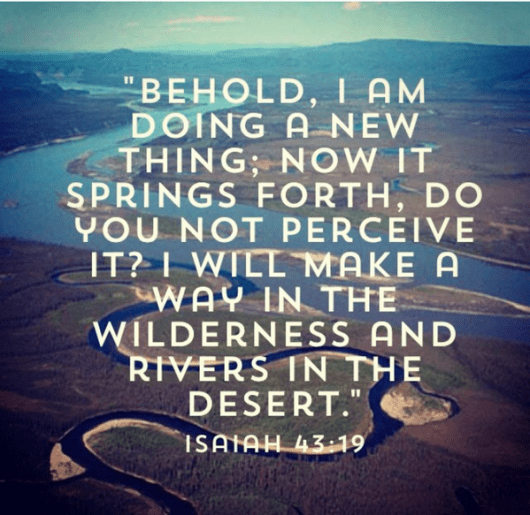
Do not remember the former things, or consider the things of old. I am about to do a new thing; now it springs forth, do you not perceive it? I will make a way in the wilderness and rivers in the desert.

Weekly Devotional Image

On Saturday morning I gathered with a few hundred United Methodists from all over the Virginia Conference for the Bishop’s Convocation on prayer. I was asked to teach a class on spiritual disciplines, but before we broke off into small classes we all met in the sanctuary to hear from our plenary speaker Dr. Fred Schmidt (Reuben P. Job Associate Professor of Spiritual Formation at Garrett-Evangelical Theological Seminary in Evanston, Illinois.)

Dr. Schmidt’s lecture was focused on the need to reclaim a sense of prayerful discernment. He admitted that countless churches will often use prayer in worship, or at the beginning of committee meetings, but rarely do churches actually strive to discern the will of God through their prayers. He set up this distinction by comparing the church of the 50s and 60s to the contemporary church; a half-century ago the church was comfortable with its role in society but as the church has diminished over the decades we have tried to reclaim that popularity. He mentioned that we now have things like “Ashes-to-go” on Ash Wednesday, we hand out coffee in our narthexes, and we fill worship with things like “how to be a better you.” Year after year we initiate new programs in the hope that they will bring us back to the heyday of the church. Then Dr. Schmidt brought the whole point home: “Part of our problem is that we’ve been seeking to rebuild our attendance and influence instead of rebuilding the body of Christ.”

Bc8l84xCAAA2R7Y

The Lord once spoke through the prophet Isaiah and said, “Do not remember the former things, or consider the things of old. I am about to do a new thing;” Many of us fall prey to the temptation to make things “just like they once were” and we want the church to be as popular as it once was. However, God does not call us to be popular. God calls us to be faithful.

This week, let us consider how we can discern God’s will in our lives and in our churches. Instead of just assuming that if we water down our ministries more people will show up in the pews on Sundays, let us earnestly pray and wait for God’s will to be revealed. Instead of limiting our faith to “how to be a better person,” let us earnestly live out our faith and pray for God to make us more like Jesus.

Devotional – Psalm 85.12

Devotional:

Psalm 85.12

The Lord will give what is good, and our land will yield its increase.

Weekly Devotional Image

When I was appointed to serve St. John’s UMC two years ago I asked a number of people about the goals of the church: What do we want to look like in five years? What ministries need greater attention? Where is the church heading? I asked and asked and was surprised to discover that our collective vision did not extend past next Sunday; so long as our doors stayed open, and we had people sitting in the pews, we would be content.

For two years this limited vision permeated everything we did as a church and we have been far more concerned with maintenance than mission. Yet at the same time our church has grown in numbers and faithfulness as we continue to discern the will of God for our lives and for the church. In light of this, I grew so accustomed to the status quo, and the consistent growth, that I neglected to start looking toward the future until I heard a sobering statistic at Annual Conference this year: The average person in a United Methodist Church invites someone to worship once every 38 years.

grow

In the wake of discovering this frightening statistic, I felt convicted by the Lord so start looking further than next Sunday and create goals for our church.

1) We grow in faithfulness by giving time every day to God in prayer.

2) We grow in attendance by inviting people to discover the love of God.

3) We grow in stability by offering our gifts and talents to the Lord.

If the mission of the church is to form disciples of Jesus Christ for the transformation of the world, then it is our responsibility to pray faithfully, invite lovingly, and give generously. We are called to be Christ’s body for the world and are equipped by the Lord to do so.

Our first goal is to grow through prayer so that we might be transformed into better disciples. By giving time to God every day in prayer we will start to see how true the psalmist really was: “The Lord will give what is good, and our land will yield its increase.” The Lord will grow our faithfulness, attendance, and stability so long as we are willing to play a part in this mission as well.

As we prepare to take steps into a new week, let us take time to reflect on the church that God has so graciously given to us. How can we be better stewards of this place? Where is God calling us to serve within the community? What goals do we have for the church?

Devotional – Ezekiel 2.3

Ezekiel 2.3

He said to me, Mortal, I am sending you to the people of Israel, to a nation of rebels who have rebelled against me; they and their ancestors have transgressed against me to this very day.

Weekly Devotional Image

God loves to send people where they least expect. Moses was shepherding when God spoke to him through the burning bush and told him to go back to Egypt in order to lead the people out of captivity. Jonah was minding his own business when the Lord told him to go to Nineveh. Paul was in the middle of his campaign against the early Christians when God told him to go see Ananias in Damascus.

In the United Methodist Church pastors are appointed (sent) to serve different churches. Rather than being interviewed and examined by every individual placement, a bishop (and cabinet) discern God’s will and send pastors accordingly. This style of appointments allows for churches to be challenged by their pastors (and pastors by their churches) because neither of them have a choice in the matter. Yet, I can’t help but imagine that some UM pastors feel like they are being sent to “a nation of rebels” whenever they are reappointed.

Yesterday marked the completion of my second year serving the needs of St. John’s UMC in Staunton, Virginia. I can still recall the first phone call I received detailing my appointment, and I will freely admit they I felt a little uncomfortable about where I was being sent. After all, I knew nothing about the town, the people, or the church.

I can also recall the feeling in the pit of my stomach two years ago when I approached the pulpit to preach for the first time (Between the nerves and the excitement we were lucky that I even made it through a sermon at all). I looked out from my vantage point and saw the people of God gathered together to hear the Word and respond accordingly. To this day I still thank God for blessing us with the Holy Spirit that morning who allowed us to listen, laugh, and love.

jesus-is-lord-graphic

In the beginning of my time at St. John’s I foolishly thought I was bringing something to the church that they previously lacked. I believed that I was the one who could turn the ship around. I expected that I would grow the church, have us start paying our apportionments (in full), and preach in the midst of the rebels. For a time I thought I could be the savior.

I quickly realized that my expectations were way off. Instead of being a prophet sent to the rebels, I myself was a rebel in the midst of rebels. To believe that I could save the church meant that I was putting faith in myself, rather than the Lord. To believe that I had the power to make the church start paying its apportionments meant that I did not trust God to provide. To believe that I could be the savior meant that I forgot that only Jesus is our savior.

If we have done anything to please the Lord over the last two years, it has only come because God gave us the power to do so, and only secondarily because of us (me).

We are all called to go and be Christ’s body for the world in different ways, but it is vitally important for us to remember that we have just as much to learn as we have to teach; that no matter where God’s sends us, we will be transformed just as much as we transform others; and that in the end Jesus is Lord, and we are not.

This week, let us reflect on the places the Lord has sent us to be Christ’s body, and on the people who have been sent to be Christ’s body for us.

Devotional – Mark 4.37-38

Devotional:

Mark 4.37-38

A great windstorm arose, and the waves beat into the boat, so that the boat was already being swamped. But he was in the stern, asleep on the cushion; and they woke him up and said to him, “Teacher, do you not care that we are perishing?”

Weekly Devotional Image

In a few days thousands of United Methodists will gather in Roanoke for Annual Conference. Once a year clergy and lay representatives throughout the state meet for a couple days of holy conferencing in order to prayerfully discern the future of the denomination. Annual Conference provides opportunities for clergy peers to reconnect, lay people to learn about our organizational structure, and helps to reignite the flame of faith in our churches.

The first time I went to Annual Conference was years ago and I was completely overwhelmed. I was a lay delegate for my home church and was supposed to vote on matters of church polity that made very little sense (I didn’t even know what ‘polity’ meant at the time). When I think back on that first conference it felt like a blur and I hope that I voted according to the Lord’s will. However, the one thing I do remember with accuracy was the Statistician’s Report.

Every year the Statistician from the Conference announces our net gain or loss of members over the last 12 months. During my first Annual Conference the Statistician announced that we had grown by ~200 members to which the entire arena erupted with applause. I remember thinking, “200? That’s all? And why is everyone celebrating such a low number for the entire state of Virginia?” I only learned later that it was the first time we had a positive growth in a very long time.

2015-Annual-Conference-Slide

Sometimes when I am sitting at Annual Conference I feel as if the great windstorm is rolling and the waves are beating us down. I listen to report after report pleading for more money, more resources, and more volunteers. I witness people approach the microphones to make comments about other human beings that should have been left in the 1950’s. I meet people from churches that will be closing their doors in the next few years and see the tears welling up in their eyes. I feel like one of the disciples on a boat that is already being swamped.

But then I remember that after the disciples woke Jesus up, he quickly calmed the storm, and then questioned their faith. When we am confronted with the waves of conference we need to remember that Jesus is the one who controls the wind and the sea. When we witness events that make us feel like the ship is sinking, we need to remember that Jesus is the one who walks on water. So long as we keep believing that we control the church, Jesus will keep sleeping in the stern while we run around in fear. We need a change of heart and perspective to remember that Jesus is Lord, not us.

This week, let us pray for the renewal of the church. As delegates gather in Roanoke, let us pray for wisdom and discernment of God’s will rather than our will. And let us all remember that even when the ship of life is being attacked by waves, Jesus is the one who calms the storm, and puts our faith into perspective.

AC-2015-color-logo

Stranger In A Strange Land – Sermon on Ezekiel 17.22-24

Ezekiel 17.22-24

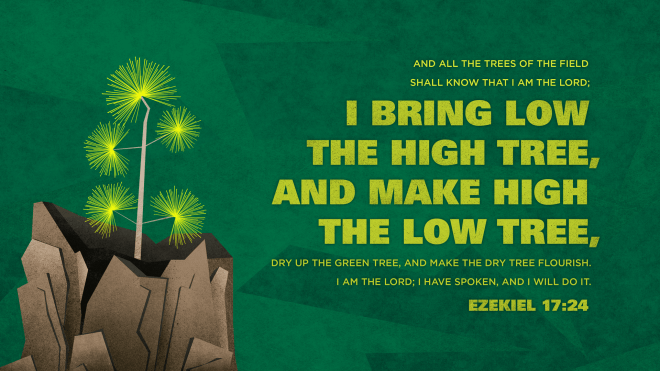
Thus says the Lord God: I myself will take a sprig from the lofty top of a cedar; I will set it out. I will break off a tender one from the topmost of its young twigs; I myself will plant it on a high and lofty mountain. On the mountain height of Israel I will plant it, in order that it may produce boughs and bear fruit, and become a noble cedar. Under it every kind of bird will live; in the shade of its branches will nest winged creatures of every kind. All the trees of the field shall know that I am the Lord. I bring low the high tree, I make high the low tree; I dry up the green tree and make the dry tree flourish. I the Lord have spoken; I will accomplish it.
stranger-in-a-strange-land

During my first year of college I felt like a stranger in a strange land. I grew up in a family that believed in sitting together for dinner every night. I was raised in a church that took the baptismal vows seriously and helped me pursue my vision of ministry. I had friends that supported my belief systems, and wanted me to be happy. I was strongly rooted in my home, and when I left I felt like I was wandering around without a map.

In the beginning, college was completely unlike home. Instead of eating with my family, I was lucky to eat a meal in the dining hall with anyone. Instead of a supportive church, I tried out a number of campus ministries that made it clear that if I wasn’t converting my heathen classmates I had no business being a part of their group. Instead of friends that loved me, I had surface level connections that were based on a system of consumerism more than genuine friendship.

The things I had grown to love (the comforts, the familiarity, and the rhythms) were gone and I felt like a stranger in a strange land.

Imagine, if you can, the prophet Ezekiel sitting by the river among the exiles. They had been taken from their homeland, uprooted, and planted in a new place. Families were separated, homes were lost, and they no longer knew how to worship their Lord. But the Lord continued to call prophets to proclaim the truth, even in the midst of the unknown.

Ezekiel, a prophet to the exiles, declared what the Lord had said. The Lord will take a branch from the full top of a cedar tree and will set it apart. Then the Lord will break off one of the most tender pieces of the young twigs and plant in on a high and grand mountain. The Lord will plant this piece so that it would produce boughs and bear fruit and become a noble tree unlike any other. Under it, in the protection of its shade, every kind of bird will live and find comfort.

All the rest of the trees will know what the Lord has done. Because the Lord brings low the high tree, and makes the low tree grow. The Lord dries up the green tree, and helps the dry tree flourish. The Lord has spoken, and he will do it.

The message is beautiful and hopeful. The poetic language of God’s creation helps us to imagine a mighty cedar giving life and shade to all who are in need. We can almost smell the scent of the cedar wafting through the air as we hear the words. We are reminded of God’s great power in upsetting normal expectations.

But when we remember who the words were for, when we remember the exiles in captivity, the passage becomes all the more powerful.

The remaining faithful had been carried off into captivity in Babylon. Their suffering was great and their questions were many. “Why has the Lord abandoned us?” “When will we return to the great city of Jerusalem?” “Where is the Lord in the midst of our suffering?”

The foundations of their religion were laid waste by a rampaging army. Those who survived would have witnessed the destruction of the temple, they would have smelled the burnt scrolls in the air, they would have heard the screams of fear and suffering.

The new home of Babylon brought subjection, and powerlessness. The people were small in number, weak in strength, and limited in faith.

They were strangers in a strange land.

Yet, in all of the great stories from scripture, a small people, of little account and worth, are the ones chosen by God to do something incredible. Though insignificant by the world’s standards, they were extraordinary in the eyes of God.

In the midst of the unknown, while their fear was real and palpable, Ezekiel shared this tender message from the Lord. I, the Lord your God, am the one who turns things upside down. I will have the final say about what it going on in your lives. You see the powers around you and you believe they have prevailed, but I will make things new, I will plant the seed that gives shade to the tired, strength to the weak, and life to the dead.

Today we are celebrating our graduates, those who have mastered their present set of educational expectations and are moving on to new horizons.

We have graduates from high school that will be entering the new area of the university. We have graduates with Bachelor’s and Master’s degrees that will be entering the new area of the so-called “working world.”

In a few minutes they will stand before the congregation and we will pray for God’s blessing on them in all that they do. But before we send them off, we need to help open their eyes to the truth.

Soon, and very soon, you will feel like strangers in a strange land. No matter how confident you feel taking the next steps in your life, there will be things that happen that shake the very foundation of what you know and believe. You will encounter new and strange ideas. You will miss your friends, and your family, and hopefully your church.

Moments will come that you will ask the same kinds of questions that the exiles did in Babylon: “Why has the Lord abandoned me?” “When will things get back to normal?” “Where is God in the midst of all this?

So, this message from the Lord through Ezekiel is meant for you as much as it was meant for them. God’s message of love and presence and growth is directed to you in a time of new beginnings and uncertainty. Whether you are about to start at a new school or a new job, let these words be comforting and full of life.

The Lord God almighty took a sprig, a tiny and powerless little thing, and planted him in a place called Bethlehem. He grew up as the son of a carpenter and was ignored by most people until he started to give shade to all the birds of the air, when he started inviting the multitudes into the kingdom of God. Through his words and actions Jesus Christ gave hope to the hopeless, strength to the weak, and life to the dead. Through him the people began to know and experience the love of God and the world was turned upside down.
Ezekiel17.24-660x371

Doesn’t all of this sound familiar? The Lord will plant a new tree… just like the sower who goes into the field… just like a tiny mustard seed become the greatest of all the plants. The Lord will make high the low tree and make low the high tree… just like the first shall be last and the last shall be first… just like the poor being welcomed into the kingdom of God and the religious elite were left scratching their heads.

This kind of inversion has been part of God’s great cosmic plan all along and we are still being swept up in it. The Lord calls on the strangers in a strange land to give hope for the world. The Lord uses the weak and least of these to show how the great tree of life in Jesus Christ gives shade and comfort to all of God’s children.

To those who are about to embark on something new: take heart and know that the Lord is with you. Even when you feel lost and alone, you are not. We, the gathered people, are praying for you and will continue to so long as we have life. But more importantly the Lord has faith in you to do incredible things, to help continually turn the world upside down.

To those who remain: look upon these graduates with hope. Because just as the Lord planted Jesus Christ to be a source of hope, the Lord is about to do the same thing with all of them. He will scatter them like seeds in the earth, he will nurture them through the power of his Spirit, and they will stretch out their arms to the world and will be a source of light in the darkness. Wherever they are planted, they will bear fruit for the world.

During my first year of college I felt like a stranger in a strange land. I wanted to cry out to the Lord like one of the lost exiles in Babylon. I felt abandoned, I felt alone, and I felt afraid. Weeks passed and nothing changed, my relationships started to suffer, and I started putting in the minimal amount of effort necessary in my classes. But it was also when I really learned how to pray.

I didn’t read about it in some book about faith, but I read about it in the book of faith. I looked for the times that Jesus prayed. It helped put things in perspective about what I was going through. It didn’t change my circumstances, but it changed me.

Because true prayer is not about asking God to fix something. True prayer is the gutsy willingness to let God be God in your life. So I gave it over, I prayed less like myself and more like Jesus, I prayed for God’s will to be done in my life instead of for my life to get better. But it did.

When we really pray, its not important what we say, but that we let God have time to speak. Prayer is far more about listening than it is about speaking. Prayer is not listing what we want, but a risk of being exposed to what God wants.

Prayer really changes things, and sometimes what prayer changes is us.

prayer-changes-me

So, whether we are about to embark on a new experience in a new place or we are still spreading our roots here in Staunton; whether we are confident in our faith, or filled to the brim with doubt; whether we feel surrounded by discipled witnesses, or feel completely alone. We are all strangers in a strange land.

As Christians we are called to see the world through the resurrection which means we will never feel comfortable where we are. We love our enemies and turn the other cheek. We offer a tenth of our income and pray for the weak. We listen for the Lord and lift up the meek. Being Christian is about living in the tension between what the world explains and what the Lord proclaims.

But with prayer, by taking time to be holy, we start to see the world turned upside down, we experience the beauty of God’s kingdom, and we find rest in the shade of God’s great cedar tree: Jesus Christ. So let us pray:

O Lord, let your will be done, nothing more, nothing less, nothing else.

O Lord, let your will be done, nothing more, nothing less, nothing else.

O Lord, let your will be done, nothing more, nothing less, nothing else.

Amen.

Devotional – John 15.1-2

Devotional:

John 15.1-2

“I am the true vine, and my Father is the vinegrower. He removes every branch in me that bears no fruit. Every branch that bears fruit he prunes to make it bear more fruit. 

Weekly Devotional Image

Sometimes I speak before thinking. The Bishop had come into town to address a gathering of clergy about upcoming initiatives and events in the life of our Annual Conference. We spent a significant amount of time addressing the metrics that all United Methodist Churches are required to measure and report on a weekly basis including: Worship Attendance, Weekly Offering, Professions of Faith, Christian Formation Groups, Mission Giving/Persons in Mission. When the presentation came to a conclusion, the Bishop opened the floor for questions. A few timid hands rose from the pews with standard questions about particular theological issues that the church is still wrestling with, and before I knew it I had my hand sticking straight up in the air and the bishop asked for my question.

I thanked the bishop for taking time to speak with us and then I launched right into my question. It went something like this: “I can appreciate the need to log our metric data every week as we seek to be better stewards of our churches and continue to make disciples of Jesus Christ for the transformation of the world. However, what are we doing about the churches that are no longer fruitful? Are we addressing their negative data? Because I seem to remember a time when Jesus said ‘I am the vine, and my Father in the vinegrower, and he removes the branches that no longer bear fruit.’” At that moment a number of the clergy in the room began to laugh nervously and I continued on, “I’m not kidding around. If we’re serious about living into God’s kingdom here and now, then are we willing to cut off the branches that are no longer bearing fruit?”

The silence that followed was palpable.

The Bishop took his time to address my question and explained that we need to mourn the loss of any church, but the coming reality is that some churches are no longer bearing fruit and we will have to do something about it eventually. I recognize now that I could’ve articulated my question in a gentler fashion, but I still stand by Christ’s words.

28db47277dd96e9320e317029a5112db

In our faith journeys, and in our churches, we tend to desire change by addition while Christ articulated an alternative. If something is not bearing fruit in our churches or in our lives, what would it look like for us to cut them away? The future of our faith and church is largely dependent on our willingness to sacrifice the branches that have continued to wither away while other branches are bearing fruit in other places.

This week, let us take a good look at our lives to see whether or not we are bearing fruit. Let us pray to the Lord for guidance about how we can be better stewards of our churches and bear fruit for God’s kingdom.

Faith Hall of Fame – Hebrews 11.32-40

Hebrews 11.32-40

And what more should I say? For time would fail me to tell of Gideon, Barak, Samson, Jephthah, of David and Samuel and the prophets — who through faith conquered kingdoms, administered justice, obtained promises, shut the mouths of lions, quenched raging fire, escaped the edge of the sword, won strength out of weakness, became mighty in war, put foreign armies to flight. Women received their dead by resurrection. Others were tortured, refusing to accept release, in order to obtain a better resurrection. Others suffered mocking and flogging, and even chains and imprisonment. They were stoned to death, they were sawn in two, they were killed by the sword; they went about in skins of sheep and goats, destitute, persecuted, tormented — of whom the world was not worthy. They wandered in deserts and mountains, and in caves and holes in the ground. Yet all these, though they were commended for their faith, did not receive what was promised, since God had provided something better so they would not, apart from us, be made perfect.

1357372800

Today we conclude our Advent Sermon Series on “New Beginnings.” This is the final Sunday leading up to Christmas day, and over the last few weeks we have prepared our hearts and minds for the coming of God in Christ. We began with Abram being called into a strange land. Next we looked at Samuel being called by name in the temple. Last week we explored Paul’s conversion on the road to Damascus. This morning we conclude by looking at the Faith Hall of Fame from Hebrews 11.

_

And what more should I say? For time would fail me to tell of Fletcher Swink, Sam Stanley, Zig Volskis, Patricia Meadows, and the other pastors — who through faith endured frustrating congregations, proclaimed God’s presence, fought for justice, became mighty in honor, and brought people to the Lord.

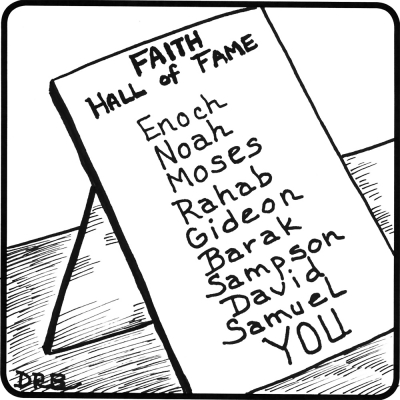
Hebrews 11 contains what I call the “Faith Hall of Fame.” The entire chapter is devoted to the great leaders and prophets from the Old Testament and their willingness to stand up for God even when it meant certain doom. They so fervently believed that God was with them, that they were willing to embark on new beginnings when others refused to obey.

The closest thing we have to a Faith Hall of Fame here at St. John’s can be found in our parlor next to the narthex. Inside you will discover a picture of every pastor that has had the good fortune to serve this church since 1954. From Fletcher Swink to yours truly, every pastor has been framed and dated, hung with care, and honored with a spot on the wall.

Have you ever taken the time to look through the pictures? It was one of the first things I did when I was newly appointed, and frankly the room terrifies me. Whenever I sit in the parlor with a group of people, I feel the heavy gaze of the pastors, they look down from their Faith Hall of Fame, and I can’t help but wonder what they think of me.

Marshall Kirby begged me my first week to give him a picture so that he could put me up with everyone else. I hesitated. For weeks he bugged me about getting the picture, about having it be just the right size and tint to blend in with the others. But I continued to put it off. I kept making excuses about how busy I was, or about the priorities I needed to focus on, but the truth is, I didn’t feel worthy of going on the wall. I had been here for such a short amount of time and felt that I hadn’t done anything that earned me a spot in the Hall of Fame.

When I’m in the parlor, when I experience the St. John’s Hall of Fame, I think about all the things they must have gone through to bring this church to where it is. I think about Fletcher Swink starting the church down the road at the Auto Parts store. I imagine that it required a tremendous amount of faith to believe that God had call him from Durham, NC to Staunton, VA to start a new church; to make something of nothing. How many nights did he pray for God to send him people, how many afternoons did he spend worrying about the new building project, how often did he confront frustrated parishioners about his sermons?

When I’m in the parlor, when I experience the St. John’s Hall of Fame, I think about Patricia Meadows being appointed as the first female pastor. I wonder about how hard she had to work to gain the trust of the people, what lengths she had to go to to reignite the flame of faith. I imagine the deep prayers she offered to God about sending new sheep to her flock, the lonely days of sermon preparation, and the terrifying moments of standing by the graveside with friends and family from the church. How often did she wrestle with her call when she felt persecuted, how many days did she spend praying for the people of our community when they were no longer able to offer their own prayers, how did she feel standing up against the injustices around her?

I wonder about all the pastors of this church, and what they went through for God’s kingdom. What was it that set them apart? What did they do that helped to grow and nurture faith in this community?

Last week I was standing in the parlor, admiring the past, when I realized how similar our Faith Hall of Fame is to the one listed in Hebrews 11.

faith

The people of Israel’s past were not of special value. Gideon was hesitant and timid when he was called by God; Barak had to be shamed by Deborah into fighting for the Lord; Jephthah is remembered mostly for his rash oath; Samson was weak of mind and conscience.

Similarly, there is nothing particularly special about those who have served our church. Though undoubtedly unique, they contained no special powers that set them apart from other clergy. Each of them had strengths and weaknesses that became manifest while they served the church.

Our pastors, and the heroes from Israel’s past, were set apart because they did all things “through faith.” They worked knowing that the real significance of what they had done would never be seen in their own time, but something that would come much later. They suffered through persecution and injustice because they believed in God’s goodness even when the world claimed the contrary.

We remember the ways our pastors have suffered: Angry emails/letters about inappropriate sermons, knowing glances and whispers from the committee members in the parking lot (where the real meetings happen). Shouts and finger pointing during counseling sessions. Years of loneliness serving a church full of people who cannot see the pastor as anything other than pastor. Doubts when preparing funerals for people in the community.

We read about all the ways the faithful of Israel suffered: torture, mocking, flogging, chains and imprisonment. Stoned to death, sawn in two, killed by the sword, wandered about in the skins of sheep and goats, destitute, persecuted, and tormented.

This is what evil does to the good. It attacks at the core of our being, shakes our faith, and  encourages us to doubt. Yet, reading these words and remembering our church’s past should bring us courage and hope. We see in them the willingness of people to go and risk it all for God. Pastors who remained brave and faithful when others tried to break them down. Prophets who spoke the truth when others sought to kill them. We see in them the true courage that faith can develop. 

It only takes a moment to see this tremendous faith in the world today, people standing up against injustice when the world argues the contrary. Consider the droves of people standing with their hands up and holding signs that say “Black Lives Matter” in response to Ferguson. Consider the droves of people standing shoulder to shoulder with the LGBTQ community during Pride marches in response to fanatical attacks against sexuality.

pic_related_120114_SM_Black-Lives-Matter-G_1

We remember and read and see the ways people suffer for God’s kingdom and we commend them for their willingness to go and be grace for the world. God sends into our confused and cruel humanity his messengers and prophets. God sends them into the midst of the wolves so that we might not be left to our evil ways, that we may see in them hope for tomorrow, and in response turn back to the God of mercy.

Yet all these, though they are commended for their faith, did not receive what was promised, since God had provided something better so they would not, apart from us, be made perfect. Whether Gideon, Barak, Fletcher Swink, or Zig Volskis, their completion depends on us. Their faith rested in God who would fulfill his promises. They served the Lord as an anchor cast into the days ahead; faith is built on hope for the future.

Abraham’s faith would have been in vain if his descendants never made it to the Land of Promise. Samuel’s faith would have been in vain if he had not responded to God calling him by name in the temple. Paul’s faith would have been in vain if the resurrected Christ had not appeared to him on the road to Damascus.

Apart from us they cannot be made perfect. The completion of those from the Faith Hall of Fame depends on us. We can fulfill their faith even today by going out and being Christ’s body for the world.

We remember the past of scripture, and the past of our church, but we are not to idealize it. We cannot be blind to the mistakes of those who came before us, or allow the past to fasten its dead hand upon us, binding us down to fruitless ideas, ancient prejudices, and old failures. We look back so that we can look forward. Just because “thats the way we’ve always done it” does not mean “thats the way we must do it now.”

Yet too often we forget how indebted we are to the past. We neglect to remember how faithful Abram, Samuel, and Paul were. We brush aside all the pastors who worked with every fiber of their being to bring about God’s kingdom here on earth. Every good thing that we have and enjoy was consecrated by the sacrifices of the past. We have faith because the people of the past passed it along to us. So today, we in our turn cast our anchors into the future. Without those who are to come after us, without the youth of our church and without the children of our preschool, we shall not be made perfect.

We are who we are because of the past. We will become what God intends for us because of the legacy we pass on to the future. Our new beginning comes when we cast our hope into the future of God’s kingdom, when we stand up for something new and different that breaks from the past, when we take steps in faith knowing that God is with us.

God is with us. In a few days we will gather again to celebrate Christ being born into the world to be God with us. We will look to that lowly manger and remember that God came to dwell among us and encourage us to be brave people of faith who remember the past and cast our hope into the future. Our purpose does not depend on our own power, but on the strength of love that comes from the Lord and in community with one another.

I still feel uncomfortable whenever I’m in the parlor. Sets of eyes follow me from the past, and I see in them everything they went through to bring our church to where it is. I believe in their hope cast into the future. In all of you I see the seeds that they planted long ago that are blossoming into true discipleship today.

I see my picture on the wall and feel unworthy. But that’s when I remember that it’s not about me and it’s not about what I do. It’s about what God does through me. It’s about what God does through you. Amen.