Can I Get A Witness?

Psalm 66.8-20

Bless our God, O peoples, let the sound of his praise be heard, who has kept us among the living, and has not let our feet slip. For you, O God, have tested us; you have tried us as silver is tried. You brought us into the net, you laid burdens on our backs; you let people ride over our heads; we went through fire and through water; yet you have brought us our to a spacious place. I will come into you house with burnt offerings; I will pay you my vows, those that my lips uttered and my mouth promised when I was in trouble. I will offer to you burnt offerings of fatlings, with the smoke of the sacrifice of rams; I will make an offering of bulls and goats. Come and hear, all you who fear God, and I will tell you what he has done for me. I cried aloud to him, and he was extolled with my tongue. If I had cherished iniquity in my heart, the Lord would not have listened. But truly God has listened; he has given heed to the words of my prayer. Blessed be God, because he has not rejected my prayer or removed his steadfast love from me.


What do you want for your funeral? It’s a strange question, and its one we would rather like to avoid if possible. But have you ever thought about what your funeral might look like? What hymns would you want your family to sing? What scripture has meant the most to you in your life? Do you want people to offer testimonies?

Every time I meet with a family to plan a Service of Death and Resurrection I avoid mentioning a time of testimony. I avoid it for a number of reasons including the fact that testimonies are supposed to be about how God has worked in the life of the person now dead, and that rarely happens, you never know what someone might say when they are invited to speak freely from a pulpit, and sometimes you don’t know whether anyone will get up to say anything at all.

To be clear, a lack of testimonial witness on behalf of the gathered body for worship is not an indication that the person lived a flawed or inconsequential life, it usually has more to do with how uncomfortable many of us are with public speaking.

But every once in awhile the family insists on having it, even when I didn’t bring it up. And every time we have a service and the time comes for the testimony, I invite anyone who would like to speak to come up to the pulpit, I sit down, and I pray that God taps on at least one person to come up and say anything, but I am always prepared to make something up on the spot should the pulpit remain uncomfortably empty.

If I were bolder, if I had more faith, I would just say, “Can I get a witness?” and then I would sit down in comfort knowing that God will provide.

8ff3283513b11bafb0653b3170d7d3b2

In Psalm 66 the faithfulness of God is remembered, offerings on behalf of God’s people are made, and then one lone worshipper offers a witness to all who will listen.

Bless the Lord your God! Let the sound of his praise be heard in this place and in all places. Our God has kept us among the living! What a great God is ours who has tested us, laid burdens on our backs, let people ride over our heads, and delivered us through fire and water. We remember, o people, how God journeyed with the people through the valleys of the shadow of death and brought them to the Promised Land. We remember, o people, how God has been with us in the midst of suffering and carried us through to the other side.

And because of what the Lord has done, we will come into this house with our offerings. We will present our money, and our gifts, and our time. Come and hear, all you who fear God, and I will tell you what he has done for me.

The writer describes in great detail the types of offerings made to the Lord, the physical things brought forth as an act of faith. But it is also about far more than that: God’s faithfulness to the people of Israel, God’s faithfulness to us, is the lens by which we interpret our own lives.

God has listened to the prayers of the psalmist; God has listened to us. And because God has listened we must testify.

Can I get a witness?

14890

Witnessing is a taboo thing in the church these days, or at least in the United Methodist Church. There was a time however when worship was all about testimony, moments when the preacher would step away from the pulpit and let the people of God proclaim the glorious works of God to the rest of the people of God.

But today, we don’t have time for any of this witnessing stuff. We don’t want to make people uncomfortable. We don’t want to evangelize anyone. Professional Christians like pastors are the ones meant to testify.

Or, we might say that we don’t want to talk about our faith because it is a private thing. Which is ridiculous since we can only understand and interpret our faith within the faith community.

Over and over again scripture bombards us with the call to testify, to witness, to our story because that is exactly what the bible is. The bible is the witness to the marvelous works of God.

The psalmist witnesses to the truth of God’s reign because the psalmist has experienced it and cannot be kept from proclaiming it. The psalmist has been so transformed by God that the only way to respond is to tell the stories to everyone with ears to hear.

Can I get a witness?

When we are lost and found by God, that is a worthy beginning to our witness. For it is when we are lost that we are most open to the possibility of being found.

And here’s the thing: Testimony, witnessing to God, is not limited to speech about what God has done. Testimony is speech shaped by what God has done. The psalmist witnessed to the works of the Lord and in so doing allowed others, people like us, to hear and even experience what the writer experienced in God.

We don’t care much for the idea of witnessing any more. It no longer matches up with our modern sensibilities, but telling our story is the means by which we come to understand our own faith. When we do it, when we are brave and bold enough to witness, we don’t simply tell what we have already come to believe… it becomes the means by which we believe.

And that is why we witness, that is why we testify, because in so doing we become the very community God has called us to be.

So, can I get a witness?

Seriously this time, who among us will stand to share what God has done for you?


(Time of congregational testimony)


My testimony:

I’ve shared with you on a number of occasions the ways and means by which God called me to spend the rest of my life doing what I do. You’ve heard about the sidewalk square where I fell to my knees and offered my life to God. You’ve been brought into the narrative of being marched to the front of the church as a teenager and attempting to proclaim God’s Word through my first sermon. But I want to testify to another of God’s marvelous works in my life: God sending me here to you.

I never would’ve picked St. John’s UMC in Staunton, VA. Not because there was anything particularly wrong with the church, I just knew nothing about it. When I walked into the sanctuary that first Sunday morning I only knew about 5 of you, and even then I barely knew you. And yet God called me here.

When Lindsey and I arrived, it was really hard at first. We were a young couple plucked out of our community in Durham, NC and planted here. She couldn’t find work. I didn’t know what it meant to do this work. We didn’t make friends with people in the community. And, whether or not either of us would admit it, I wondered if God had called me to the right place.

And I got up in this pulpit every week to proclaim what God had placed on my heart. I prepared for Bible Study. I visited people in the hospital. I sat on the floor with our preschoolers and told them about the bible.

And slowly, you grafted us into the community. As the weeks and months passed we felt more and more connected to the people in the pews this very morning. We loved you, and you loved us. And suddenly, this church became our family. We wept when you wept; we celebrated when you celebrated.

God sent me here to you. And some might say that God sent me here for a reason, that this church needed me. And that might be true. All churches need pastors for different reasons. But for as much as this church needed me, I needed this church.

I know in my heart of hearts that God sent me here in order to rekindle my faith; after spending years reading about God in seminary it was too easy to be cynical about what the church might be. In coming here I needed to rediscover the wonderful power of God made manifest in a community of love that you can never discover in a book on theology; I needed to re-encounter the One in whom we live and move and have our being. And you provided that for me.

And I know in my heart of hearts that the time has come for God to send me to a new place. But when I got the call about moving, it came without knowing who would be the new pastor at St. John’s. And I’ll be honest, I’ve been nervous about it. I love this church because this church has loved me. And I want it to have a pastor that will love it, and receive love from it, like I have.

And today we can finally announce that the new pastor of St. John’s is Rev. Chuck Cole. When I found out Chuck was coming here I knew that God had answered my prayers: Chuck and I were ordained together last June and have interacted a lot before we knew he was coming here. Chuck and his wife Sarah have four children and they currently live in Covington where Chuck is serving two churches. Chuck is full of love for God’s church and I know that he will love this place, and that you will love him.

What has God done for me? God sent me to a church that listened to me, prayed with me, and loved me in spite of myself.

What has God done for me? God is sending me to a new place and is sending a new pastor to the church that I love to continue the good work of the kingdom.

What has God done for you? Amen.

 

132-DSC_0211

The Cole Family

The Mission Of The Church

1 Corinthians 3.1-9

And so, brothers and sisters, I could not speak to you as spiritual people, but rather as people of the flesh, as infants in Christ. I fed you with milk, not solid food, for you were not ready for solid food. Even now, you are still not ready, for you are still of the flesh. For as long as there is jealousy and quarreling among you, are you not of the flesh, and behaving according to human inclinations? For when one says, “I belong to Paul,” and another, “I belong to Apollos,” are you not merely human? What then is Apollos? What is Paul? Servants through whom you came to believe, as the Lord assigned to each. I planted, Apollos watered, but God gave the growth. So neither the one who plants nor the one who waters is anything, but only God who gives the growth. The one who plants and the one who waters have a common purpose, and each will receive wages according to the labor of each. For we are God’s servants, working together; you are God’s field, God’s building.


When I lived in Harrisonburg, I played drums for a worship service that met every Sunday evening. On Sunday mornings the sanctuary would be packed with individuals and families from the community who would listen to the organ, sing from the hymnal, pray from the pews, and worship together. On Sunday evenings however, we would set up for a very different type of worship service: we had two electric guitars, a bass, a drum set, and a couple singers. Instead of suits and dresses most people came as they were, and instead of the sanctuary being packed, we were lucky if there were more people in the pews than in the band.

The basic worship formula included playing four or so songs, reading scripture, hearing a sermon, celebrating communion, and then playing one more song. Which meant that I spent most of the evenings sitting behind a drum kit looking out at everyone else. From this vantage point I quickly learned who always came late, who refused to sing certain songs, who let themselves go and put their hands in the air to praise, and who pretended to pray while they were actually texting someone on their phone.

I had been playing with the band for a while when I started to notice a young man, probably about my age, who walked in during the first song, and left during the last song every week. We had other people show up for one Sunday a month, or would be there for a couple weeks in a row only to disappear for a months at a time, but this guy was there EVERY WEEK.

Week after week I watched him arrive only to depart before I had a chance to talk to him. But, even though we didn’t talk, his faithfulness was palpable. As a college student, he came to worship week after week while others were choosing to put their allegiances in other places.

When the academic year was coming to a close, the leadership team for the service met to discuss changes for the future. It was abundantly clear that we were not growing and we wanted to make more disciples of Jesus Christ so we started discussing ways we could get more people to join us.

I suggested that we speak to the young man who snuck in and snuck out; after all, he showed up more than anyone else, and I thought he would have some ideas for us.

So the next Sunday, we purposefully ended with a song that did not use the drums so that I could talk to him before he jettisoned out of the sanctuary. We met by the doorway and I introduced myself. I explained that I saw him come in every week, and apologized for not doing more to make a connection. I then launched into a dense theological reflection about why we need more people to come to the service and that all of us thought he would be a great person to speak with. He listened as I went on and on until he raised his hand and said, “That sounds nice and all, but I’m not a Christian.”

            “Not a Christian? What do you mean you’re not a Christian? Why have you been here every week if you’re not a Christian?”

            “I don’t feel like I belong anywhere else, and I don’t have any friends.”

eternal-mission-church_620

We, as human beings, want to belong. We want to belong in the worst ways whether we’re in preschool, high school, or it’s been a long time since we’ve been in school. Out of this desire for belonging we join communities: neighborhood associations, sport teams, civic organizations, and even scout troops.

But they tend to disappoint us. We hope for a sense of identity and purpose and community to magically erupt soon after we begin participating, but because people are so focused on themselves, or someone forgets our name, or someone else argues with us over a matter of opinion, we become disappointed and disillusioned. And before long, we fall back into that pit of loneliness.

The same human desire for belonging was apparently true of the folk in Corinth. The church that Paul helped to inaugurate was struggling. The people wanted desperately to belong, to be part of something. And they joined the church, but then (like we always do) they broke up into factions: I belong to Paul, I belong to Apollos, or some other leader.

One need not stretch the imagination to hear the same sorts of declarations in the church today: I’m a Republican, I’m a Democrat. Zig Volskis was the best pastor we ever had. Steve Greer was the best pastor we ever had.

Paul caught word of these divisions and wrote to the church: Who do you belong to? Why are you dividing over issues of leadership? I came to you with the message of Jesus Christ and him crucified, but clearly it did not take root deep enough. So long as you continue to quarrel you will not be ready to be Christ’s church.

Who do we belong to?

We have a book in the United Methodist Church called The Book of Discipline. In it, its paragraph 120 if you’re interested, we have the mission of the church written out plainly for all to read and understand.

mission_umc_logo

The mission of the United Methodist Church is to make disciples of Jesus Christ for the transformation of the world.

Making disciples is at the heart of what it means to be a United Methodist. I mean, its what Jesus calls the disciples to do at the end of Matthew’s gospel: Go therefore and make disciples of all nations baptizing them in the name of the Father, Son, and Holy Spirit.

But making disciples is often confused with filling the pews.

It results in having conversations about how to get more people in the building while neglecting to interact and connect with the people already in the building. It results in infantile discipleship. It results in working for the numbers, and not the kingdom.

And then we’ve got this bit about transforming the world. Is that really our mission? Do we have the church to change the people and the community around us? Should that be our soul purpose? Does the church exist to make the world a better place?

The church is defined by the sacraments of communion and baptism in order to be a community of difference and peace. The church, therefore, is called not to make the world a better place, but to be the better place God has already made in the world.

Of course, the problem is whether or not our experience of the church matches its definition of being the better place.

I suspect that many of you have experienced the church as Paul experienced it: Disagreements, petty arguments, and at times suffocating silence between bickering factions. For some, the pews of the sanctuary are more like walls of division and less like avenues of connection.

If church is the better place that God has already made in the world, then it should, like it was for that young man in Harrisonburg, be the place to cure loneliness. Because loneliness is something all of us have experienced in some way, shape, or form, and is a wound not easily healed.

I spend an hour every week with the youth of our church at our gathering called The Circle. We always have communion and answer questions and study the bible. But we often just talk about what’s going on in each other’s lives. And, without breaking their trust, I’ll tell you: their lives are not easy. There is such a tremendous amount of pressure placed on them by outside forces. They feel compelled and pushed to change their image, the way they talk, the way they think, and even what they believe in order to be accepted.

Some weeks I leave our Circle meeting feeling broken by what they have to endure on a regular basis, only to have a conversation the next day with an adult who is going through basically the same things in a different context.

The world would have us change. Change your image, hide your faults, be someone else.

As Christians, however, we walk with our wounds and our cracks and our brokenness instead of running away from them. We cannot accept who we are until we discover that we are loved by God because of who we are.

The church can be the better place that God has made in the world because the church is the place where we walk with our wounds and loneliness because of Christ and him crucified. The broken and lonely Christ on the cross knows our brokenness and our loneliness. But he also carries our wounds so that we might see the One who truly loves us.

God is transforming the world. God is the one who makes the first last and the last first. God does, and should, get all the good verbs. Our God is a God of action, of change, of transformation. We are the church, we are the vineyard of God’s garden, we plant the seeds, we water the seeds, but God is the one who makes them grow.

You and I, with our sins and our disappointments, with our fears and loneliness, we have a place here. God invites us to the better place where we are welcomed not because we fit the mold, but because we do not fit the mold. We have a place in this better place because we are caught up in God’s great story.

Just look at the cross, consider the waters of baptism. God is made manifest in the world not through the powerful, not through the expectations of the mighty, but through the weak and through the shamed; through babies and wandering Israelites; through tax collectors and fishermen; through a poor rabbi murdered by the state.

This is the better place God has made in the world. And in this place we remember our baptisms, we remember our death to self and our resurrection in Jesus Christ. We remember our baptism and through that water we remember the story of creation, of the flood, of the exodus. We remember that in our baptism we became part of the body of Christ, the church, where we should never be lonely. Where we should never be made to feel as if we are not enough.

In baptism we joined the better place God has made in this world.

Who then do we belong to?

Do we belong to political rhetoric and partisan ideology? Do we belong to church growth programs co-opted by a desire to see more people in the pews? Do we belong to isolationism or interventionism? Do we belong to a world that pressures us to become that which we are not? Do we belong to Paul or to Apollos? Do we belong to the flesh and are consumed by jealousy and quarreling?

No.

            In this better place, we belong to God. Amen.


(With thanks to Jason Micheli, Stanley Hauerwas, and Will Willimon)

On Evangelism or: Why The Church Needs Crucifixion

Matthew 28.19 – Go therefore and make disciples of all nations, baptizing them in the name of the Father and of the Son and of the Holy Spirit.

Evangelism

We sent out hundreds of post-cards over a month ago inviting the entire neighborhood to join us on the front lawn of the church for a free Community Cook-Out. The post-cards were well designed and inviting with all of the necessary information. For a modest price we were able to reach a whole group of people who we would otherwise miss.

This will be our third annual gathering and it has been largely successful. Half of the people in attendance are usually not from the church and we want them to know that we care about the neighborhood we are in. However, on some level, we also want them to know that we love them enough that we would love to have them join us in worship on Sunday mornings.

IMG_1642

Yet, evangelism is not the goal of our gathering. We have not specifically identified key lay people to go around asking people if Jesus Christ is their personal Lord and Savior. We have not prepared pamphlets to hand out describing the eternal fires of hell if someone does not get saved. We have not invited the neighborhood to our front lawn to get them into heaven.

Instead, we hope that by showing them our love, it will somehow draw them into church to discover where that love comes from: God.

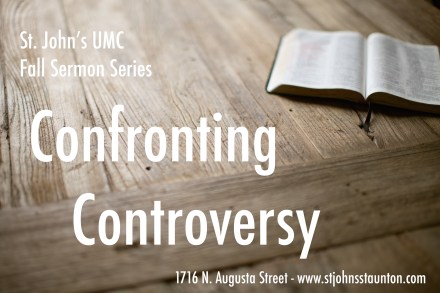
Next week we are going to send out even more post-cards to the local community about our upcoming sermon series titled “Confronting Controversy.” After speaking with a few nominal Christians from the neighborhood about what they want to hear about in church, we synthesized this series to be approachable and life-giving to people who are not currently in the church. The post-card has been well designed with a catchy image and all of the necessary information on the back. We hope that by sending them out, people from the community will join us in worship and discover that what the world thinks about the church may not be the same thing as what God thinks about the world.

controversy

Both of these ventures, a Community Cook-Out and a Controversial Sermon Series, are about trying to grow the church in some way, shape, or form. Many of us call this “evangelism.” But that’s not what evangelism means.

In David Fitch’s recent work Prodigal Christianity, he highlights a moment from his ministry where the church tried to grow and failed:

“When our church, Life on the Vine, was new, we sent out ten thousand postcards to people in our neighborhoods. We artfully displayed a collage of various depictions of Jesus (classical paintings, icons, and European, African, and Asian portrayals) with the question in bold print running across it: “Who is Jesus?” On the back, we invited the neighborhood to have a discussion with us about the question. We were playing off the cultural curiosity around Easter and hope that we could welcome a constructive conversation around the question. The card was not well received. Local “Bible-believing” Christians accused us of straying into relativism with so many different depictions of Jesus. They worried we were losing the truth of Jesus. Meanwhile many others accused us of being intolerant. Were not other religious leaders just as worthy of discussion? We got nasty phone calls asking, “Why are you focusing only on Jesus?” No one, and I mean NO ONE, came to any of our gatherings from this postcard.”[1]

Out of ten thousand postcards, no one came to any of the gatherings. I think a lot of this has to do with our false assumption that just by offering something people will show up. We believe that if we give them an interesting sermon series or bible study people are bound to show up in droves. And if we let them know about it through a postcard we can reach even more people!

These types of evangelism largely fail because we’ve confused evangelism with filling the pews instead of sharing the Good News.

I cringe whenever I encounter an “evangelist” in the midst of life who abruptly asks, “Have you confessed Jesus Christ as your personal Lord and Savior?” Because with their question is the assumption that we have the power to save ourselves, and that they are playing a fundamental role in our salvation. However, Jesus does not command the disciples to go out convincing people to confess him as Lord. Instead he tells them to go and make disciples.

Discipleship formation is primarily about relationships and less about post-cards and Main Street confessions. We become evangelists not when we beg or convince someone to confess Jesus as Lord, but when we intentionally create relationships with individuals through the love that Jesus taught us to live by. We can use sermon series and community events to first bring people into the church, but those types of things will never be enough (by themselves) to evangelize. It takes a willing and loving disciple who sees others not as pew fillers but fellow brothers and sisters in the kingdom of God.

As a gathering church we are called to be confident in God’s love for us, and for us to share that same love with others; “We love because he first loved us” (1 John 4.19). We will grow and bear fruit in the kingdom when love becomes our first priority instead of growth. We have failed to grow not because we have been doing things unworthily, but because we’ve grown bored and unhappy. With churches all across the American landscape floundering under the pressure to grow and remain sustainable, the church falls back to the common tropes of Vacation Bible Schools and Sermon Series assuming they will grow the church.

Can you imagine what the church might look like if Christians were actually happy and excited about being the church? That’s where and when evangelism happens – not in the boredom of another series or bible study, but in the community transformed by joy and sharing that joy.

Evangelism (1)

Evangelism is our call as Christians. We are commanded by the Lord to share the Good News in order to make disciples and transform the world. If we want this kind of dynamic and life-giving evangelism to take place, then we have to be willing to crucify some of our current practices and programs; you can’t have resurrection without crucifixion.

We need to crucify our boring and lifeless activities that we assume will grow the church. Is the annual Cook-Out really sharing the good news with others, or are we doing it to feel good about seeing a lot of people on our property?

We need to ask difficult questions about our programs and whether or not they are designed to evangelize. Are our monthly meetings really about branching out to the community and transforming our cultural landscape, or are we meeting to keep the people already in the church happy?

We need to confront our budgets and demand that they reflect Jesus’ mission. Are we spending our resources according to the great commission, or are we neglecting to be good stewards by wasting our resources of lifeless avenues of ministry?

We need to take a look at our own families and reflect on how we evangelize those closest to us. Are we so consumed by raising our children to choose whether to be Christian or not for their own good, or are we afraid of telling them what we really feel and believe?

What can we crucify in our hearts and in our churches to be resurrected into the kind of evangelists that God is calling us to be?


[1] Fitch, David and Geoff Holsclaw, Prodigal Christianity: Ten Signposts into the Missional Frontier (Jossey-Bass: San Francisco, 2013), 32.

With A Little Help From My Friends

John 20.19-29

When it was evening on that day, the first day of the week, and the doors of the house where the disciples had met were locked for fear of the Jews, Jesus came and stood among them and said, “Peace be with you.” After he said this, he showed them his hands and his side. Then the disciples rejoiced when they saw the Lord. Jesus said to them again, “Peace be with you. As the Father has sent me, so I send you.” When he had said this, he breathed on them and said to them, “Receive the Holy Spirit. If you forgive the sins of any, they are forgiven them; if you retain the sins of any, they are retained.” But Thomas (who was called the Twin), one of the twelve, was not with them when Jesus came. So the other disciples told him, “We have seen the Lord.” But he said to them, “Unless I see the mark of the nails in his hands, and put my finger in the mark of the nails and my hand in his said, I will not believe.” A week later his disciples were again in the house, and Thomas was with them. Although the doors were shut, Jesus came and stood among them and said, “Peace be with you.” Then he said to Thomas, “Put your finger here and see my hands. Reach out your hand and put it in my side. Do not doubt but believe.” Thomas answered him, “My Lord and my God!” Jesus said to him, “Have you believed because you have seen me? Blessed are those who have not seen and yet have come to believe.”

img_1433


Before I became your pastor, I was a pulpit-filler. If a pastor became sick, or was otherwise unavailable to preach, I was tapped on to come up with something to say from the pulpit. A phone call would arrive in the middle of a week, or even on Sunday morning, and I would have to whip something together right quick. For years I took the ”undesirable” Sundays: Memorial Day, Labor Day, Thanksgiving Sunday, and the Sunday after Easter; those Sundays when the regular pastor needed a break.

Every time I was tasked with preaching was an opportunity to grow in my faith while attempting to articular the faith for others.

When I was in college I got the phone call one week to preach for a Sunday evening service. I was fairly familiar with the context because I played the drums for the church every week, but this time they wanted me to come out from behind the drum set to proclaim God’s Word.

At the time I was living with a couple of roommates, but of course none of them went to church. Week after week they would rib me for waking up early on Sunday morning, they would jokingly mock me with questions about God’s presence, and they made sure I knew they thought there were better things I could be doing with my time.

So I thought this would be the perfect opportunity to get them to church.

It was on a Sunday night, so they couldn’t complain about sleeping in. We would be playing contemporary Christian rock songs, so they couldn’t complain about the music. And I was supposed to preach, so they couldn’t complain about it being archaic or a waste of time (I hoped).

I casually invited them to worship while we were having dinner one night; I shared that I was the preacher and that it would be a relatively short sermon, and I made sure to mention that it would really mean a lot to me if they would come.

Under the weight of my communal invitation and guilt, they all came to church that night and sat together in a pew near the back.

The service went well; the music balance was good, and the sermon was short and to the point, and then we moved to the communion table. Our resident pastor began talking about how whenever Jesus gathered with his friends he would breathe new life into them through his words and his presence. And on his final night he took bread, broke it, gave it to his friends and said, “Take. Eat. This is my body.” And then he took the cup and shared it with his friends saying: “Take. Drink. This is my blood.

One by one every person in the sanctuary gathered in the center aisle and started walking forward for communion. The pastor stood next to me holding the bread, and I stood next to her holding the cup and for each person that came forward we said, “The body of Christ given for you.” Or: “The blood of Christ shed for you.” Hands were outstretched penitently while people feasted on the Lord, and then the end of the line came forward, with my roommates.

Unsure of what was actually taking place, they stood up like everybody else and came forward without knowing what to do next. As they stood in front of us, and in front of the whole congregation, the pastor’s eyes darted back and forth between myself, and the ragtag roommates standing in front of us. Her eyes screamed, “Do something!”

So I did what anyone in my position would do. I whispered to my friends as quickly as possible: “I know this will sound weird… But you need to take a piece of bread, dip it in the grape juice, and eat it. Don’t worry I’ll explain it to you later.” And with that they all feasted on the body and blood of our Lord, and returned to their pews confused and bewildered.

On the day of Jesus’ resurrection, after appearing to Mary Magdalene and calling her by name, Jesus appeared before the disciples. They were locked away in a room full of fear and trembling when Jesus said, “Peace be with you.” Perhaps they were afraid of being crucified like he was by the Jews, or they were afraid of how the crowds would taunt them when they came out of hiding, or they were afraid of seeing their risen friend in their midst. But Jesus found it fitting to speak words of peace in the midst of their terror.

And immediately Jesus outlined what they were supposed to do: “Go. As the Father sent me, now I send you.” With his proclamation, Jesus empowered his friends to proclaim the Good News for everyone to hear.

But Thomas, one of the disciples, was not there to experience the resurrected Jesus. The disciples tried to explain what they had seen, heard, felt, and experienced. Yet, their eyes and fingers were not enough for Thomas. He did not trust his friends. He wanted to see and touch Jesus for himself.

09b

Sure enough, a week passed, and Jesus showed up again before the disciples and Thomas. Again Jesus greeted them by saying, “Peace be with you.” And he told Thomas to feel the scars on his hands and side, but before Thomas could even reach out he declared, “My Lord and my God!” And thus Jesus concluded the moment by saying, “Have you believed because you have seen me? Blessed are those who have not seen and yet have come to believe.

Thomas gets a pretty bad rap. Every year we follow Easter Sunday with this reading about doubting Thomas. He is the one disciple who gets a qualifier in front of his name. We don’t refer to eager Peter, or betraying Judas, but we do say doubting Thomas. For years pastors like me have used this Sunday and this story to call people like you to learn from the example of Thomas, to not doubt the Lord, to believe without seeing.

But the real problem with Thomas is not his lack of faith in the Lord, but his lack of faith in his friends. For three years he had traveled with this ragtag group of disciples, shoulder-to-shoulder they had watching Jesus perform countless miracles, and now when they tell him the Gospel, he does not believe them.

After the episode of my friends confusedly attending worship and receiving communion, I avoided the topic of church. I knew they had a strange experience through their lack of addressing the service in any way shape or form, and they stopped mocking me for going to church. At the time, I thought they thought I was nuts.

A few weeks passed and the topic of faith was still avoided like the plague until one morning I walked down the stairs and discovered one of my roommates crying on the couch. He had just received a phone call from a long time friend of ours whose father had died. The man was a staple in our community, regularly coached little league sports, and was another father figure for most of us. And when my roommate received the news, it devastated him.

I slowly made my way across the room and sat down next to him. For the longest time neither of us spoke. Finally my roommate looked up from his tears and he said, “I want you to pray for me.

I sat shocked. I didn’t know what to say. But he continued: “You know I don’t know much about God or church. But I know it’s important to you. When you were standing up before us in church I could tell that you really believed. I don’t know what I believe. And I can’t describe it, but I really feel like you need to pray for me.”

So I did.

When Thomas heard the news of the risen Lord through his friends, he didn’t believe them. Even though they were some of the people he should’ve trusted the most, he refused to accept their words.

When my friend felt the sting of death and loss, he didn’t know what to believe. But, for better or worse, he trusted me. Even though he had every reason to be suspicious and weirded out by what he had experienced in worship, he believed in God’s presence through prayer.

Thomas’ kind of radical suspicion of his friends still takes place in our lives today. We view church as a private thing, something we do on the weekends and don’t need to bring up during the week. We might know people in our lives that are suffering or are alone, but we assume that God will send them to us when they’re ready.

SnapshotImage

If we want to be faithful followers of Jesus, then me must stop distrusting our friends and neighbors. At the very least, we should stop questioning motives or thinking the worst in others when they express a difference of opinion.

To be faithful followers of Jesus requires a willingness to be sent by God to people who do not know God. It requires us to be vulnerable and uncomfortable while inviting others to discover God’s love in a place like this. It requires us to be the agents of belief for people who have not yet seen.

All of us are here because we are the product of someone influencing our faithfulness. Whether a parent or a friend or even a stranger, we were once invited to discover God through the power of church.

Friends, I promise you that the days of people showing up to church because a church is in their neighborhood are long gone. Today, people discover God’s presence, they begin to believe what they see and see what they believe when people like us are brave enough to invite them to church.

Because, for us, this table is the closest we can get to the presence of Christ. In the bread and the cup God invites us into the upper room when Christ shared the meal with his friends. When we feast on his body and blood we receive the grace necessary to be Christ’s body in the world.

This thing we call communion, whether at the table or just gathering in worship, has transformed my life. If you’re here in church, it’s probably changed your life too. So, may the God of grace and glory give us the courage to invite others to be transformed as well. Amen.