Devotional – Psalm 118.26

Devotional:

Psalm 118.26

Blessed is the one who comes in the name of the Lord. We bless you from the house of the Lord. 

Weekly Devotional Image

When Robert Griffin III came to Washington DC he was greeted as the new messiah of the Washington Redskins. For too long had the Redskins failed to procure a franchise quarterback, a leader that could take them to the playoffs and eventually the Superbowl. Finally, it seemed, the organization had made a bold move for a young quarterback who contained all of the qualities necessary for returning the Redskins to their former glory.

nfl_a_griffin_gb1_576

His first season behind center was remarkable. RGIII was named Offensive Player of the Week numerous times, he set records for the highest passer rating by a rookie quarterback and highest touchdown to interception ration, and he led to the team to the playoffs  after winning the NFC East Division.

After sustaining an injury toward the end of the season, many fans and sports pundits speculated whether or not RGIII would be able to compete in the same fashion during the following season. This past year, the Redskins returned to form posting an embarrassing 3-13 season, the worst record for the team since 1994. Many people, of course, blamed RGIII’s limited mobility, improper coaching decisions, and lack of enthusiasm from other players for the disappointing season.

Within a year RGIII went from being the hailed messiah, to a questionable concern. Favor and optimism was quickly replaced with skepticism and doubt. Of course some of the die-hard fans remained committed to this young quarterback, but a large portion of fan favor was quickly turned in the opposite direction from one season to another.

jesus.donkey

The crowds yelled “Blessed is the one who comes in the name of the Lord,” when Jesus enter Jerusalem on the back of a donkey. This man was their Messiah, the one they had been waiting for. They were so enthralled by this Son of Man that they pulled palm branches from the fields and placed them on the road as a sign of worship, devotion, and adoration. Incredibly, those shouts of “Hosanna! (Save us!)” changed to shouts of “crucify him!” within a week. The incredible favor of the crowds changed from dedication to destruction.

Our favor and devotion for the many messianic figures in our lives can change on a dime. How often have RGIIIs and others been hailed and rejected within such a short period of time? Yet, for us, our Messiah, the one who died for the sins of the world never gave up on us when we gave up on him. He rode on the back of the donkey knowing good and well what would take place by the end of the week, mounted the hard wood of the cross with the shouts of “crucify!” ringing in his ears, and loved us nonetheless.

Today, as we begin to approach Palm Sunday and Holy Week, I encourage you to consider the people in your life that you once supported and then gave up on. I’m not just talking about public figures such as RGIII or politicians, but also people close to your heart. Who have you given up on? Perhaps in these final weeks of Lent it is time to reach out to those who have fallen out of our favor. Maybe today is the day that you can reconcile a broken relationship and truly live into God’s love here and now.


Devotional – Psalm 130.1-2

Devotional:

Psalm 130.1-2
Out of the depths I cry to you, O Lord. Lord, hear my voice! Let your ears be attentive to the voice of my supplications!

Weekly Devotional Image

The church service went as well as could be expected. The small gymnasium was perfect for the contemporary service setting and most of the chairs were occupied. Like a lot of contemporary services, it began with a succession of three or four songs all focused on praising the glory of God; some of the lyrics included phrases such as: “Your love never fails,” “He’s been so good, so so good to me, Jesus,” and “you are amazing God!” Immediately following the collection of praise songs, there was a time of welcome, a brief reading from scripture, and then a focused sermon with images and themes being displayed on two screens hung from the ceiling.

I don’t remember much about the sermon except for the refrain: “God loves you no matter what!” The preacher’s perfectly executed contemporary outfit (Black Tee-Shirt with Blue Jeans) was matched with a consistently dynamic smile throughout the message. I wanted some of whatever he was having.

4050-rote worship.630w.tn.jpg

After another dose of positive and uplifting music to close out the service, we were all dismissed to re-enter the world. I stood in the back watching the people neatly file out of the gymnasium, observing sporadic examples of fellowship between people. In the corner I noticed an older woman, clearly frustrated with something, and trying to vent her frustrations to those around her. When it became clear that no one was listening to her, I walked over to ask if something was wrong. “I can’t stand services like this!” she nearly shouted, “Its just too happy!” And with that she threw her complimentary coffee in the trash, and left the building.

Have you ever felt that way in worship? Have you noticed the abundance of smiling faces in worship, discovered the overwhelmingly uplifting nature of some hymns, all brought together with a happy and positive sermon delivered with three primary points? Have you ever felt suffocated by the amount of joy that some worship services attempt to produce?

Christian discipleship is not a blindly happy-go-lucky journey. There should be more time and focus in worship devoted to the suffering that is present in each of our lives (however small or large). The psalmist writes, “Out of the depth I cry to you, O Lord. Lord, hear my voice!” Sometimes, the most appropriate form of worship is clenching your fists and shouting out those same words.

So, do not be conformed to the ways of so many churches that appear to say that happiness is a requirement for discipleship. If you are deep in one of the valleys of life right now, I encourage you to cry out to God. If you are on one of the mountaintops of life right now, open your eyes to the needs of those around you, and make God’s presence known through your actions.

Devotional – Psalm 95.6-7

Devotional:

Psalm 95.6-7

O come, let us worship and bow down, let us kneel before the Lord, our Maker! For he is our God, and we are the people of his pasture, and the sheep of his hand. O that today you would listen to his voice!

Weekly Devotional Image

“Have any of you ever worked on a farm?” my CPE (Clinical Pastoral Education) supervisor once asked during a reflection session. My group had been gathering every Monday for the past few months to talk about different interactions with patients from Duke University Hospital, and what it meant to be pastorally present in suffering. At the end of a particularly laborious day, our supervisor asked his question about farm life. Most us us had grown up in the suburbs, and therefore had limited experience of farm life. So as we shook our heads in response to his question, he continued on. “Well, when working on a farm you often get the chance to interact with a variety of animals. The cows have to be milked regularly, the chickens’ eggs have to be collected, and, at some point, you’d have to deal with the sheep.”

herd

“Sheep are by far the dumbest animals I’ve ever seen. They are pathetically dependent on a shepherd to watch over them. They are have no sense of direction, often wandering off into oblivion. They are defenseless, prone to becoming a easy snack for any predator. And they are just plain dumb.” (At this point in the conversation, the rest of us were waiting for him to make his point after having rambled about the idiocy of sheep) “And that why I love the fact the we are the sheep, and Jesus is our shepherd. We can be so dumb sometimes, and we so desperately need our Shepherd to help us figure out whats going on.

The psalmist writes, “We are the people of his pasture, and the sheep of his hand. O that today you would listen to his voice!” In many ways, the analogy of discipleship to wandering like a directionless sheep is fitting. How often to we stray from the path that we know is right? How often do we succumb to the temptations (predators) around us in our daily living? And the psalmist tells us exactly what to do when we find ourselves acting like the sheep that we are: Listen to his voice.

As I have mentioned before, Lent is a great time for us to re-evaluate where we are with our God. Are we prone to wandering off like a defenseless sheep in our lives, or are we listening for the voice of our great Shepherd who watches over his flock? Today, let us all recognize our foolish ways that drive us away from God, reorient ourselves back to the great “I AM,” and above all, listen to his voice through prayer, reading scripture, and reconciling our relationships with those around us. 

Devotional – Genesis 12.1-4

Genesis 12.1-4

Now the Lord said to Abram, “Go from your country and your kindred and your father’s house to the land that I will show you. I will make of you a great nation, and I will bless you, and make your name great, so that you will be a blessing. I will bless those you bless you, and the one who curses you I will curse; and in you all the families of the earth shall be blessed.” So Abram went, as the Lord had told him; and Lot went with him. Abram was seventy-five years old when he departed from Haran.

Weekly Devotional Image

“When you get appointed to a church the worst thing you can do is go visit the shut-ins,” said a professor of mine in seminary (who will remain nameless). “I am sick and tired of hearing about new clergy full of vibrant passion and energy wasting it on visiting the people who have already had their faith developed. Pastors form the past were responsible for them. The best thing you can do when you get appointed to a new church is not to visit the older shut-in members, but go visit all the members under the age of thirty. Now there won’t be many younger than thirty so it shouldn’t take you very long. That’s mission.”

I was flabbergasted. Here I was sitting in the hallowed halls of Duke Divinity listening to a professor telling us to do exactly the opposite of what I imagined my first few weeks at a new appointment would look like.

I believe he was wrong. The best thing that a pastor can do when he/she enters a new appointment is to visit the shut-ins and all the members under 30. In fact the best thing a pastor can do is visit with all the people that make up the local church community. The idea that the older congregants have already had their ministry does a disservice the goodness of God’s creation and the understanding that all of us make up the body of Christ regardless of age and experience.

I love the call of Abram as described in Genesis 12. Abram is called to abandon the security of his homeland, the comfort that comes with social and family support. Abram would need to rely on the Lord for guidance because this call upon his life tested, as John Wesley said, “whether [Abram] could trust God farther than he could see him.” And notice how short his obedience is described in the passage: “So Abram went.” No indecision, no debating the outcome, no weighing the pros and cons, just go. But even more than this I love the fact the the story ends with the simple affirmation that Abram was 75 years old when he departed from Haran.

Many-of-God’s-finest-men-in-the-Bible-were-Polygamists-Abraham

If God chose to establish the covenant with a 75 year old man who dropped everything to follow in obedience, just imagine what God can do with you, whether you’re 5 or 85 years old. Christian discipleship is not dependent on our age, but instead on our willingness to hear God’s call and go.

No matter where you are on your faith journey, whether you deeply committed and active in a local church, or if you feel like you’re on the fringes of a church community, whether you’re young in the faith, or you’ve been attending church for as long as you can remember, God has a place and a call for you. It takes all of us to make up the body of Christ.

So, what is God calling you to? What might you have to drop in order to go where God needs you?


Devotional – Matthew 6.1-4

Devotional:

Matthew 6.1-4

“Beware of practicing your piety before others in order to be seen by them; for then you have no reward from your Father in heaven. So whenever you give alms, do not sound a trumpet before you, as the hypocrites do in the synagogues and in the streets, so that they may be praised by others. Truly I tell you, they have received their reward. But when you give alms, do not let you left hand know what your right hand is doing, so that you alms may be done in secret; and your father who sees in secret will reward you.”


While I was in seminary Lenten disciplines became an incredible competition. Lent used to be a time of preparation for believers, a time of prayer, penance, repentance, self-denial, and catechesis. Today, in many churches, Lenten observance has been compartmentalized into giving up some of our temptations during the period between Ash Wednesday and Easter Sunday. At Duke Divinity it was not uncommon to hear subtle braggings throughout the halls; “This year I’m giving up sweets (and because we were in seminary there was always a theological reason) and every time I want to eat a cupcake I will pray instead.” Or “Im going to give up eating meat in order to honor the glory of God’s creation.” Or “I’m giving up television so that my focus can remain on the Word of God.”

I love my friends and peers from divinity school, but two years ago I outdid all of them. I gave up four Fs: Facebook, Fast-food, Fermented Drinks, and Facial Hair (which meant that I shaved every morning for forty days).

No Beard

No Beard

What I didn’t realize, at the time, was how often I shared and bragged about what I was giving up. As people would compare their sacrifices and temptations during that liturgical season I was there waiting for the right moment to outshine them with the ultimate sacrifices of a social network, McDonalds, Beer, and my Beard.

I am ashamed at how often I can easily turn the gospel around to be more about my own selfishness than the Good News of Jesus Christ.

When Jesus addressed the crowds and warned them about their piety regarding alms-giving it was all about intentionality. Whenever you drop your offering in the plate, whenever you bring your donations to the local mission, whenever you bring food to the local soup kitchen to not brag about it and share the news with everyone else. If that is your motive, than you are serving yourself and not others.

lent_desktop

As we prepare to enter the coming weeks of Lent I encourage each of you to remain committed to doing God’s good work in the world not for yourself, but for the glory of God. If you choose to give up a temptation during Lent do not brag about it to your friends and peers but focus instead on spending more time with God. May God grant each of us the strength to be better and love deeper.


Weekly Devotional – 2/24/14

Devotional:

Psalm 2.10-12

Now therefore, O kings, be wise; be warned, O rulers of the earth. Serve the Lord with fear, with trembling kiss his feet, or he will be angry, and you will perish in the way; for his wrath is quickly kindled. Happy are all those who take refuge in him. 


I love working on my sermons in any place other than my office. When I sit at my desk I become easily distracted by the many other responsibilities that I have in ministry, and I discover that my focus is not on the words before me. So, whenever I have the opportunity, I work on my sermons at local coffee shops in and around Staunton.

One of the greatest advantages of working on a sermon at a coffee shop is that most people see me sitting with a bible and a computer and they see me as someone strange, and therefore leave me alone to work diligently. (However, sometimes this backfires because people see the bible and begin to confess to me their most recent and devastating sins…) I enjoy working on proclaiming God’s word outside of the church building because it helps to inspire and remind me of the totality of God’s grace beyond the walls of his churches.

This past week I was sitting in one of my favorite coffee shops, writing about the Sermon on the Mount, when I began to notice that two other patrons were talking about faith and Christianity. Being in a public place, I do not feel bad for overhearing their conversation, and, frankly, once it started going I couldn’t stop listening. (It was clear that the two gentlemen were talking about running for political office; one had already served, and the other was looking for advice about beginning a political campaign.) This is what I heard:

Candidate: Should I start attending church?

Politician: Well, do you believe in God?

Candidate: No.

Politician: In this town, you should start attending whether you believe or not. If people here believe that you believe, they’ll believe in you. So, yes, start attending (he then listed some of the prominent and most well-attended churches). When you give speeches you need to talk about how you feel God calling you to this office even if you don’t believe it. The religious folk will be more likely to support you if they think you’re religious.

Candidate: Okay, I think I can do that.

Politician: Good. I’m going to coach you: I’ll teach you hold to hold your hands when talking, how to dress for debates and fundraisers, and how to talk about God being on your side of this campaign.

Gods-Politics

The psalmist warns the rulers of the world: serve the Lord with fear and with trembling. Our God is not one to be messed with. To frivolously throw around the call of the Lord on one’s life is to invite chaos and tribulation. As I listened to the politicians discuss how to play into the religious sensibilities of the people of Staunton I began to wonder about all of our desires to attend church. Do we worship God so that other people will think better of us? Or do we worship because God so loves us that there is not other way to respond?

So, as we prepare to begin a new week I caution us to remain committed to the life of discipleship that we have been incorporated into. If our faith hinges on the approval and expectations of others it cannot be fruitful for our lives. Faith can only become real when our hearts are set aflame for Christ.

Weekly Devotional – 2/17/14

Devotional:

1 Corinthians 3.16

Do you know that you are God’s temple and that God’s Spirit dwells in you?


While preaching yesterday morning I mentioned, anecdotally, a practice regarding ship building. During the time of Jesus (and even today in some places) a gold coin would be placed underneath the mainmast of most sailing vessels. Some claim that this practice began with the Romans as they used the coin to appease the gods. Others believe that the Romans placed the coin to help purchase a spot in the afterlife for the sailors who were lost at sea. Regardless of the true beginning of the tradition, it helped to show other sailors that even a wreck had value.

16-god-is-with-us-gods-promises.jpg?w=584&h=584

Years ago, while approaching the end of a mission trip in Costa Rica, I helped lead a group of young people through a foot-washing service. A basin and chair was set up in the middle of the room and, after reading the appropriate scripture from the gospel according to John, I encouraged those present to find someone that had made a particular impact on them that week (positively or negatively) and then ask to wash their feet. With soft music playing in the background I witnessed God’s grace manifest in the tears that poured on the ground from those washing, and from those who were being washed. It is a remarkably humbling thing to kneel and take someone’s feet into your hands, but perhaps even more humbling is to have someone wash your feet.

As the service continued I noticed that one of the older boys was dutifully making his way through the entire room asking to wash everyone’s feet. Every time someone sat in the chair before him he would focus intently on what he was doing, demonstrating God’s love through his fingers and the water.

When I finally had a chance, I stood up, walked over to him, and asked to wash his feet. “I’m not worth it,” he replied, “no one should be washing my feet.” I responded: “Yes you are my friend. The whole point is to wash and be washed. You are worth it.”

While writing to the church in Corinth, Paul asks, “Do you know that you are God’s temple and that God’s Spirit dwells in you?” This is a question that I want to ask whenever I see someone feeling down or blue. I want to shout out, “You have value! You are uniquely beautiful, made in the image of God, worthy of being loved! God’s Spirit is in you!”

So, as we begin a new week I ask: Do you know that you are God’s temple and that God’s Spirit dwells in you? Do you know that you have worth, that you are special, that you are wonderful? Do you know that God loves you for who you are no matter what?

I hope you do.


Weekly Devotional – 2/10/14

Devotional:

1 Corinthians 3.5-7

What then is Apollos? What is Paul? Servants through whom you came to believe, as the Lord assigned to each. I planted, Apollos watered, but God gave the growth. So neither the one who plants nor the one who waters is anything, but only God who gives the growth. 

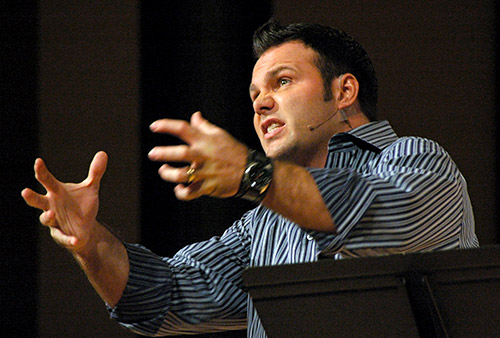
Charisma is an important element of leadership. In the contemporary Church there are a number of very charismatic leaders who are drawing numbers of people to faith in Jesus Christ. Many of these Christian leaders have published books, are interviewed by major news corporations, and have a strong social network presence. The fact that names such as Rob Bell, Joel Osteen, Rachel Held Evans, Rick Warren, Adam Hamilton, and Mark Driscoll (among others) are known in many homes across the American landscape says a lot about the growth of contemporary Christianity headlined by strong and charismatic leadership.

Rob Bell

Rob Bell

Mark Driscoll

Mark Driscoll

Adam Hamilton

Adam Hamilton

Joel Osteen

Joel Osteen

I have read books by the above mentioned leaders, I have watched youtube videos of their sermons/lessons. They can be very persuasive in the way they present their understanding of the gospel. In many ways, they are doing a great service for the Church through their ability to maintain the relevancy of the Christian faith for the modern world.

However, there is a strong temptation with charismatic leaders to become more consumed by them, than by the one they are talking about. For example: I recently heard about a church that, instead of giving new Christians a bible, they gave them a copy of Rob Bell’s Velvet Elvis. Now, Velvet Elvis is an incredible commentary on the place of faith in the modern world, but it is not a substitute for God’s Word. Charismatic leaders achieve a great thing when they bring people to the faith, but it is God who grows us in our faith.

When Paul was confronted with the differing teachings of Apollos in the Christian community of Corinth, he rightly affirmed the capacity for Christian leaders to plant the seed of faith and provide the initial nourishment of water, but in the end it is always God who provides the growth.

tumblr_lbbposcwda1qcqn2ko1_500

We are not called to follow the Rob Bells and Mark Driscolls of Christianity, but instead we are called to follow Jesus Christ. As we all continue down our faith journeys, let us embrace the wonderful teaching of charismatic leaders remembering that their job is to always point, not at themselves, but toward Jesus Christ. Let us see the light of Christ shine through them and us so that we might grow in our faith according to God’s grace, love, and mercy.

Weekly Devotional – 2/3/14

Devotional:

Matthew 5.14:

“You are the light of the world. A city built on a hill cannot be hid.”

image

For years this verse has served to defend the example that Christians are to make for the world to follow. “You are the light of the world,” Jesus says, “a city built on a hill cannot be hid.” Which is to say, you are shining as a light for others to see the error of their ways. Just as a city on a hill can be seen by all, so will your discipleship shine gloriously in order to transform the world.

But what if we’ve been reading it wrong? Or at least, what if there is a different way to read that verse?

Christians are almost always under the proverbial magnifying glass within the local community and at large. Just turn on the news and you will hear of scandals in Catholic and Protestant churches. The smallest bit of controversial news can take on a completely different manner once it is revealed that a Christian is part of the spectacle. Whether we recognize it or not, the world has expectations of us regarding our behavior and commitment to the gospel; we are held to a standard of excellence by those within, and those outside of, the church.

bible-magnifying-glass

In many ways the verse from Matthew could be read as, “You must be like a city on a hill, like a lamp in full view.” The desire to appear perfect as an example for all others is worthy of consideration and application, however, we need to remember that we will continue to fall short of God’s glory; we are not perfect beings. We are under the microscope of the community because of our commitment to be God’s people for the world.

So, instead of self-righteously proclaiming that we are the perfect example for the world to follow, perhaps we should instead recognize how visible we are to the world. Our faithful discipleship should be driven by our love of God, rather than wanting to the world to see how great and wonderful we are. Let us all strive to be the light of the world, not for our own glory, but for the glory of God to shine through us.


Weekly Devotional – 1/27/14

Devotional:

Psalm 15.1-4

O Lord, who may abide in your tent? Who may dwell on your holy hill? Those who walk blamelessly, and do what is right, and speak the truth from their heart; who do not slander with their tongue, and do no evil to their friends, nor take up a reproach against their neighbors; in whose eyes the wicked are despised, but who honor those who fear the Lord; who stand by their oath even to their hurt.


“Being a Christian must be so easy,” a friend of mine once said, “You can do whatever you want, just so long as you confess right before you die, you’ll still go to heaven.”

Responding to those kind of comments has always been difficult for me. Yes, we do believe that God’s forgiveness will always come because nothing can ever separate us from the love of God in Jesus Christ. Yes,  you could live your whole life in ignorance of God’s love and mercy, only to discover it in your last days and God would still be there waiting to receive you. However, upon later reflection, I wish I could have responded to that particular comment in the way that Augustine did in the fourth century:

703“Some delude themselves because of God’s mercy. They say: “I still have a little time left to live how I like. Why shouldn’t I live how I like as much as I like and then turn to God later? After all, God has promised to pardon me.” I respond, “True, but he has not promised that you are going to be alive tomorrow.” – St. Augustine, Sermon 339

When Christianity is compartmentalized into “what happens to me after I die?” then all respect and concern for the present is lost. In Psalm 15 we learn about what it means to be welcomed to God’s holy hill, to abide in God’s tent; our faithfulness is far less concerned with our ability to accept God in our last days, than it is about living a life of service and holiness.

A professor of mine once said, “The question should not be, ‘If I die tonight, what will happen to me?’ but instead, ‘If I live for another day, what will I do with it? How will I love God and my neighbor?’”

So, let us all seek to live holy lives in the present. Let us not put off for tomorrow what we can, and should, do today. Let us look at our own lives and ask “am I walking blamelessly, doing what is right, and speaking the truth?”