Devotional – Matthew 18.15

Devotional:

Matthew 18.15

If another member of the church sins against you, go and point out the fault when the two of you are alone. If the member listens to you, you have regained that one.

Weekly Devotional Image

During our weekly lectionary discussion group, after reading Matthew 18, Leah Pack questioned the group in attendance about whether or not any of us has had an experience of someone from the church confronting us in order to point out our faults. After all, pointing out the faults of a fellow church member is something Jesus charged his disciples to do. While the group pondered particular moments from their church lives, I shared with them one of my experiences.
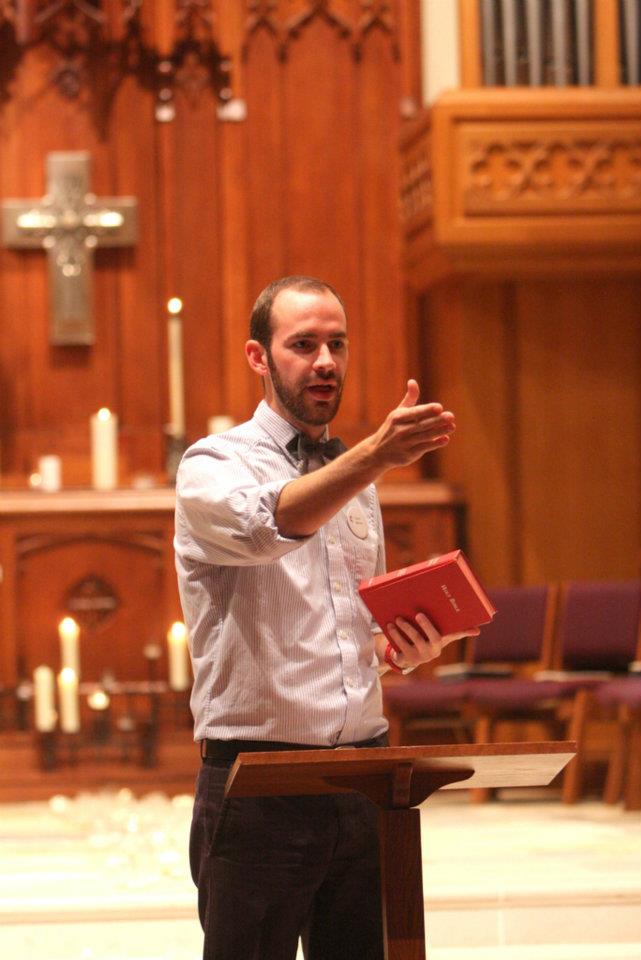
Preaching in Birmingham

Preaching in Birmingham

I had been helping serve at a church in Birmingham, Michigan for most of the summer. My responsibilities included visiting the hospitals, preaching, teaching, leading worship, and regular committee attendance. It was a particularly rewarding summer for me, and helped me identify my own strengths and weaknesses for ministry. Throughout my internship I met with the Seminary Committee who helped to provide the necessary information for my journey and offer advice and feedback regarding my work. On my last evening in Birmingham the committee shared their final evaluations for the summer and wished me well on my ministerial journey; the group was incredibly gracious and kind with their reflections.

As we prepared to leave the church that night one of the older gentlemen from the committee asked to speak with me privately before we left. “You are so full of it,” he began, “I watched you all summer long, and you might’ve fooled everyone else but you can’t fool me. You are one of the most arrogant and self-righteous young men I have ever met.” And with that he left me alone in the room; his words piercing deep in my soul.

I learned later that the man had a very difficult time watching a young person speak with such confidence from the pulpit on a regular basis and that, for him, was a sign of arrogance. Nevertheless, his words have stayed with me ever since that particular evening a few summers ago. Though I may not completely agree with him regarding his judgment of my faults, it was helpful (though painful) to hear him speak his mind. It has helped me to be mindful of the ways I come off as a pastor to others in ways than I could not previously imagine.

One of the highest callings of discipleship is a willingness to confront others when they are at fault. However it is important to remember that we are not called to judge them, but instead speak the truth in love about ways others have wronged us, and how we can reconcile broken relationships.

How have you confronted others who have faulted you? Has anyone pointed out your faults? Let us be truthful people who are kind with our words and courageous in our faith.

 

Devotional – Romans 12.9

Devotional:

Romans 12.9

Let love be genuine; hate what is evil, hold fast to what is good;

Weekly Devotional Image

By 1743 the “Methodist” movement within the Church of England was taking off and growing considerably. John Wesley was suddenly responsible for checking in with the numerous societies he had helped to establish in order to continually encourage them in their faith and love. On one such occasion (in February of 1743) Wesley traveled to Newcastle to check on a particular society and was dismayed to discover a lax of discipline within the group.

Though harsh by our modern standards, Wesley examined every member of the society and found it necessary to expel 64 people from the group for the following offenses: “2 for cursing and swearing, 2 for habitual Sabbath-breaking, 17 for drunkenness, 2 for retailing spirituous liquors, 3 for quarreling and brawling, 1 for beating his wife, 3 for habitual and willful lying, 4 for railing and evil speaking, 1 for idleness and laziness, and 29 for lightness and carelessness” (Heitzenrater, Wesley and the People Called Methodists, 138). The offenses were so grave that Wesley believed it was detrimental for the whole if these offenders remained.

Within the week Wesley wrote what we now know as the General Rules. The terms of membership were simple: “a desire to flee the wrath to come, and to be saved from their sins.” But in order to continue in the society, members were required to live out their faith by, “First, By doing no harm, … Second, By doing good, … Thirdly, By attending all the ordinances of God.” (ibid.) These General Rules became foundational for the Methodist movement that eventually led to the creation of the contemporary United Methodist Church.

6a00d8348e805369e2014e5f5f2a3c970c-500wi

Paul wrote to the church in Rome a similarly simple list about what it means to be in Christ: “let love be genuine; hate what is evil, hold fast to what is good.” These principles of Christian discipleship are like the compass of our faith, guiding us to new and continual life in Christ. Wesley truly believed in renewing the Church of England by creating a standard by which the Christians could dedicate their lives. Faith, for him, was serious and worth working hard for. Today we are responsible for renewing our faith through discipleship and our commitment to love God and neighbor.

How do you live out your faith? Has following Jesus become boiled down to showing up for church once a week? Do you follow any guidelines or responsibilities for discipled-living on a daily basis?

Perhaps today we are all being called to a life of dedicated and disciplined faithfulness by simply letting our love be genuine, hating what is evil, and holding fast to what is good.

Devotional – Romans 12.2

Devotional:

Romans 12.2

Do not be conformed to this world, but be transformed by the renewing of your minds, so that you may discern what is the will of God – what is good and acceptable and perfect.

Weekly Devotional Image

“Taylor,” he began, “I have been attending worship at United Methodists churches nearly every Sunday since I was a child and I have never heard anyone preach on the texts you chose this month.” We were sitting in the church social hall after worship yesterday afternoon when a member of our church made it known that he was still learning something new and church and growing in his discipleship. Georgeanna Driver, one of our members who passed away last week, made a similar comment two weeks ago about not knowing that story (Elisha and the she-bears) was even in the bible. It has been exciting and thrilling over the last three weeks to challenge peoples’ perspective on what the Word of the Lord can still speak into our lives today, even stories we might otherwise choose to ignore.

tumblr_mdhatd0Ybh1qhmhdfo1_500

When I was at Duke for seminary our Dean, Dr. Richard Hays, reminded us that the responsibility of the Christian is to be constantly transformed by the renewing of our minds. Etched in the marble archway leading into the chapel, Romans 12.2 is a relevant reminder for students of God’s Word but even more so for the people who have been called to follow Christ. In today’s world/society it is too easy to remain complacent with our understanding of faith and overreact when a new person/idea challenges our faith. In stark contrast Jesus was regularly pushing his disciples into new territory with understandings about the kingdom of God.

What we do as Christians is primarily about God, and only secondarily about us. We gather on Sunday’s to hear the Word of the Lord and then live it out in the world. Worship is that time that helps in the transformation and renewal of our minds so that we may discern God’s will for our lives, rather than be conformed to the ways of the world.

Outside of worship we can be transformed through the reading of scripture. Try opening your Bible to a book or a chapter you’ve never read (or haven’t read in a long time), read a set number of verses, and then pray over them. Ask yourself: what might God be saying to me through these words today?

The Word of God is alive and speaking anew everyday, we need only the faith to hear it and live it out.

Devotional – Psalm 133.1

Devotional:

Psalm 133.1

How very good and pleasant it is when kindred live together in unity!

Weekly Devotional Image

I prayed all week for the weather to cooperate. We had been planning the Community Cook-Out for weeks and the weather forecast kept pointing toward tremendous amounts of rain to fall during the scheduled event. As a church we had already procured a considerable amount of food, dedicated volunteers, and three bouncy houses. Yet, as the days passed and we came closer to the celebration, I became worried that it would not take place at all.

10556430_266797316847904_6460753775368326310_n

After many prayers, Saturday came and the weather wound up being perfect for the Cook-Out! The clouds provided a cool atmosphere for the children to play on the bouncy houses and allowed for us to celebrate on the lawn without having to worry about too much sunshine or rain. When people began to arrive for the event I prayed and thanked God for providing such a wonderful day for our community and was thrilled for our church to serve the folk of our neighborhood.

I spent most of the afternoon grilling more hamburgers and hot-dogs than I could possibly count. Every time I thought I could take a break, more people arrived and lined up for food! From my vantage point I was given a clear line of sight of everyone and all of the activities that were taking place: children (and adults) playing on the bouncy houses, families sitting at tables while enjoying food and fellowship, young people lining up to have their faces painted, frisbees and footballs being thrown through the air, and conversations taking place between people who had never met. While standing behind the grill I was overcome with a sense of wonder at how our church was living out its call to participate in God’s kingdom by being the body of Christ for the world.

10304431_10204425795911698_6731480664290185266_n

The psalmist wrote “how very good and pleasant it is when kindred live together in unity!” During our Cook-Out we had different people from all over the community present to join together in fellowship: parents and families from the pre-school, neighbors who attend different church, friends who do not attend church at all, and people from St. John’s. As we enjoyed the afternoon together I was given a glimpse of how wonderful and joyous it can be when a neighborhood lives in unity; I experienced Christ’s presence through the conversations and outpouring of love between strangers.

This week let us all seek opportunities to live together in unity. Let us look for those around us who are still strangers and do whatever we can to foster new friendships.

How can you live out Psalm 133 this week?

Devotional – Matthew 14.28-31

Devotional:

Matthew 14.28-31

Peter answered him, “Lord, if it is you, command me to come to you on the water.” He said, “Come.” So Peter got out of the boat, started walking on the water, and came toward Jesus. But when he noticed the strong wind, he became frightened, and beginning to sink, he cried out, “Lord, save me!” Jesus immediately reached out his hand and caught him, saying to him, “You of little faith, why did you doubt?”

Weekly Devotional Image

I love asking questions. Whether I’m sitting around the dining room table with family and friends or I am holding a ladder so that a middle-school student can paint a ceiling in West Virginia; asking questions is something that brings me joy. Of course there are the standard and typical “What’s your favorite movie?” and “What was the last good book that you read?” and even “If you could go on vacation anywhere, where would you go?” I love asking these types of questions because they afford an opportunity for everyone to respond and it often sparks a much longer and deeper conversation.

For as much as I love to ask questions, there is one in particular that I enjoy asking more than any other: “Who from the Bible do you most identify with?” I last asked this question of a handful of middle school students on our recent mission trip and it was so exciting to see them ponder over the question and eventually offer their response. However, when some of them were unable to answer the question I made it my mission to learn enough about each of them to tell them who I thought they reminded me of from the Bible by the end of the week.

walkingonwater9eh

In my life I identify most with the apostle Peter. I was not called out of a simple career to leave everything and follow Christ, I have not had a defining moment where I denied Christ three times, but when it comes to Peter’s personality I line up completely. Like Peter, I always have an answer to every question, I often volunteer for leadership positions, and I regularly speak on behalf of many others. Moreover I see the connections between myself and Peter most vibrantly in the story of Peter getting off the boat to walk with his Lord. When I feel that God is asking me to do something I usually do whatever it takes to jump right in, yet sometimes when I have already left the boat I notice the strong winds of life that make me doubt what I have done. I, like Peter, need to hear Jesus’ question over and over: “You of little faith, why did you doubt?

As we prepare to take steps into a new week I encourage you to reflect on who you identify with from the Bible. Do you feel like David, small but able to accomplish great things? Do you feel like Martha, always busy and working hard to take care of all the chores? Or do you feel like me, which is to say, do you feel like Peter, ready and willing to rush into anything for God? Who from the Bible do you most identify with?

Devotional – Isaiah 55.1-2

Devotional:

Isaiah 55.1-2

Ho, everyone who thirsts, come to the waters; and you that have no money, come, buy and eat! Come, buy wine and milk without money and without price. Why do you spend your money for that which is not bread, and your labor for that which does not satisfy? Listen carefully to me, and eat what is good, and delight yourselves in rich food. 

Weekly Devotional Image

I stood behind a table filled with enough food for a feast. We had completed our service and work in Beckley, West Virginia and now we were hosting a community meal for the many families that we had worked with during the week. The room was full of exhausted middle-schoolers sitting next to the children they had been reading with all week in addition to the parents and relatives that were invited as well. The meal was free for all in attendance and there was a steady line for 45 minutes as we served and ate together.

Offering food and drink without a cost is a remarkable gift that the church has to offer to our communities. In two weeks our church will be hosting a Community Cook-Out for the people in our neighborhood for free. Like the prophet Isaiah we are inviting everyone who thirsts to come to drink from our waters, to eat what is good, and delight themselves in rich food.

isaiah_55_1_by_sweetlysouthern-d5i6t2r

However, we recognize that (as Paul said) “food will not bring us close to God” (1 Corinthians 8.8). Without a willingness to build relationships with the people we serve and dine with, food will remain an ordinary element of life. When we served the food to the people in Beckley, West Virginia it would have remained a simple and nice gesture unless we were willing to sit side by side with our brothers and sisters and foster new relationships. Even with all the greatest and most delicious food it would have meant very little without our youth sitting down and laughing with their new friends. It is my hope and prayer that everyone in attendance that night will remember the joy of conversation rather than the food that we provided.

Offering food and drink is a wonderful thing to do as Christians. Hosting a meal at our homes for neighbors and friends reflects the goodness and abundance that God has provided in our lives. Yet, if we are not willing to offer our friendship with our food than we have neglected to take the necessary step to live out God’s Word in the world.

This week I challenge you to think about someone in your life who could benefit from receiving a free and delicious meal. Perhaps you have someone that you could take out to lunch, or invite over for dinner. But more than that I encourage you to think of how your willingness to love them and offer your sincere friendship will have a greater impact than any food or drink you could ever offer.

Devotional – Psalm 119.135

Devotional:

Psalm 119.135

Make your face shine upon your servant, and teach me your statutes. 

Weekly Devotional Image

St. Augustine once wrote, “There are three types of life: the contemplative, the active, and the contemplative-active. People can live the life of faith in any of these but everyone must make time both to seek the truth through contemplation and perform the actions that charity demands” (City of God, 19.19) I would slightly change Augustine’s language to say that there are three types of life for Christians: the prayerful, the server, and the prayerful-server. It is a tremendous element of our faith that we get to be in communion with God not only through our prayer, but also in our service of others.

St. Augustine

St. Augustine

Even with this threefold understanding of faithful living there is a temptation to elevate one over the other without seeking a balance of both. No one should be so totally committed to prayer that they neglect the needs of the community and no one should be so absorbed in serving others that he/she gives up praying to the Lord.

Both serving and prayer are intimately connected in the life of discipleship. Throughout my years of faith I have met delightful prayer-warriors that are committed to bring their joy and concerns to the Lord but as soon as they are asked to serve those in need they quickly receded into the shadows. Likewise I have had the pleasure of going on a number of mission trips with young and old Christians alike who worked tremendously hard for the kingdom but as soon as they were asked to pray about their experience they also quickly receded into the shadows.

It is a difficult challenge to keep both types of life together in such a way that we can be prayerful-servers. A balance of the two allows us to avoid burnout, on the one hand, and self-indulgence on the other. It is through the love and commitment of prayerful-servers that the kingdom of God becomes real and experiential for Christians.

When the psalmist calls for God to shine upon the servant and teach the statues they are calling for God to help them with their life of prayer (face shining) and service (teach me your statutes). It is a difficult challenge, but one worthy of our focus.

As the St. John’s mission team spends this week in Raleigh County, West Virginia it is my hope and prayer that we can balance both of these callings in all that we do. Moreover I hope that we can continue to keep both of these in tandem when we return back to Staunton.

As you embark on a new week I ask you to consider whether you are more attracted to a life of prayer, or a life of service. What could you to do to start living as a prayerful-server?

Devotional – Genesis 28.16-17

Devotional:

Genesis 28.16-17

Then Jacob woke from his sleep and said, “Surely the Lord is in this place – and I did not know it!” And he was afraid, and said, “How awesome is this place! This is none other than the house of God, and this is the gate of heaven.” 

Weekly Devotional Image

Next Sunday, after worship, a group from St. John’s will be leaving for Raleigh County, West Virginia for a week of mission work. Mission trips were foundational for my own faith development and I am excited to share a new experience with some of the youth from our church. Part of our time will be spent doing physical work for people in need, but a large portion of our trip will be dedicated to nurturing and fostering relationships with the children of the community. It is my hope and prayer that the youth will have their eyes opened to the ways we are called to serve our brothers and sisters.

One of the problems that faces many mission trips is the idea that, as the “missionaries,” we will be bringing Jesus to these people. I have seen it happen far too often when a group of privileged Christians make the false assumption that the people they are serving are devoid of God and it is their fundamental responsibility to bring God along as if God was something that they had packed in their suitcases.

genesis-28-16

The truth that we often fail to recognize is that God is already in that place! We are called not to bring God along with us, but instead to open our eyes to the way that God is already working in the world. When a mission trip has gone incredibly well, when the proper theology has been outlined for the participants, they come home with a different perspective about their faith; they come home having been helped by the people they served rather than the other way around. God is not something that we can compartmentalize, ship around, open at will, and exchange in a consumeristic program. If that is our idea of mission than we have failed the God we serve because we have wrongly believed that we get to decide where God goes and who gets to experience God’s majesty. God is already in that place! God has gone on ahead of us (just like Jesus went ahead of the disciples to Galilee) and will be made known to us as we serve others.

Jacob, after running away from his angry brother Esau, assumed that he had left everything behind. In a way, he believed that he could not only run away from his family and responsibilities, but that he could escape the God of his father and grandfather. How blessed was he to awake from his dream and discover the truth of God’s grace! “Surely the Lord is in this place – and I did not know it! How awesome is this place!”

As we prepare to take steps into a new week let us wake up from the dream that we get to control God and discover the truth, like Jacob did, that God is already in this place! God has been working through the family and friends around you for longer than you can imagine.

Wherever you go this week be assured that the Lord is with you.

Devotional – Isaiah 55.10-11

Isaiah 55.10-11

For as the rain and the snow come down from heaven, and do not return there until they have watered the earth, making it bring forth and sprout, giving seed to the sower and bread to the eater, so shall my word be that goes out from my mouth; it shall not return to me empty, but it shall accomplish that which I purpose, and succeed in the thing for which I sent it. 

Weekly Devotional Image

In church life we love to talk about “planting seeds of faith.” I have heard countless professors, theologians, pastors, and Christian leaders all convey something akin to “you never know how the seeds you plant might grow into beautiful lives of faith.” The point being that we must choose our words carefully because they contain enormous power; at times our words can help nurture someone in their faith, and at other times our words can destroy someone’s faith.

Dick Dickerson, a beloved man in our congregation, once told me a story about a particular Christmas Eve that he experienced while fighting in World War II. Dick had spent the previous days at the front lines frightened for his life and for the lives of his friends. Through the bitter cold they continued to push forward into enemy territory unsure of what they would discover. Without realizing it they serendipitously found themselves sleeping in the comfort of a church sanctuary on Christmas Eve enjoying a welcome reprieve from the fighting.

Dick describes that evening with vivid details: the wax from the candles spilling over onto the wooden pews, the hole in the roof letting in the tiniest snow flakes, and the huddled soldiers staying close to one another for warmth. Though he cannot explain what prompted him to speak up, he asked the young military men around him whether they would like to pray for anything. To him he seemed like the right thing to do on Christmas eve while gathered in a church sanctuary, regardless of the circumstances. One soldier prayed for his family and friends back home, another prayed for the weather to warm up, and another prayed for his fellow comrades in the fight against oppression.

The praying went on for sometime, but after a rather long pause one of the youngest soldiers spoke up: “I seem to remember Jesus saying something about praying for our enemies,” he began, “so tonight I would like to pray for the men we’re fighting against, I pray that God would be them as He is with us.” Upon hearing this man’s words Dick was worried that an argument or fight would break out between the men but he was surprised to discover that everyone was silent with their heads bowed down. With tears beginning to form in his eyes he joined his brothers and prayed for his enemies.

raining-on-yellow-daisies-natural-selection-craig-tuttle

God’s Word is mysterious, strange, and powerful. There are times when we hear or read something from scripture that will not become relevant or real for us until a later time. But like the prophet Isaiah said, “my word will not return to me empty, but it will accomplish that which I purpose.” The scriptures from both the Old and New Testaments are life-giving; they are like the blessed rain that fall from the sky in order to give new life from the earth.

Today let us all reflect on the ways that God’s Word has affected our lives.

Let us ask ourselves: What scriptures have transformed the way we see the world?

Devotional – Romans 7.15

Devotional:

Romans 7.15

I do not understand my own actions. For I do not do what I want, but I do the very thing that I hate. 

Weekly Devotional Image

While I was in seminary I became fascinated with the way particular theologians lived their lives. I would read the great treatises and reflections from the likes of Augustine, Aquinas, Calvin, Luther, Wesley, and Barth and have my mind opened to the great wonders of God’s interaction with creation. Their words became life-giving for me as I found myself persuaded by how they understood the world and their critiques of human behavior. However, for as much as I loved their writing I became frustrated with the ways they lived out their faith. With every wonderful theologian I discovered a dark and dangerous life of sin that appeared incompatible with what they were writing about.

Church Dogmatics

Church Dogmatics

For example: Karl Barth, my theological mentor, wrote the massive collection of Church Dogmatics which have slowly become earmarked and absorbed throughout my brief career in ministry. Barth engaged a new theological perspective focused on the paradoxical nature of divinity while at the same time opposing the rise of the Nazi party and Adolf Hitler in Germany. Barth’s thoughts have greatly shaped my understanding of God and church and I am thankful for his witness to the divine in the realm of theology. But like all Christians, Barth was both a saint and a sinner.

vonk

In 1924 Karl Barth met the young and gifted Charlotte von Kirschbaum after he had been married for 12 years. They quickly hit it off and became enamored with one another to the degree that she was invited to live with the Barths beginning in 1929; a relationship that would last for 35 years. They worked together on Barth’s work and were indispensable to one another while creating the Church Dogmatics. While Barth’s wife, Nelly, took care of the children, he and Charlotte would take semester break vacations together. The relationship caused incredible offense among many of Barth’s friends and colleagues and Barth’s children suffered from the stress of the relationship.

After I learned about Barth’s academic and perhaps physical affair, it was hard for me to respect his writings. The dialectic theology that had been so compelling quickly collected dust on my shelf. It took a long time for me to return to Barth’s work, only after I reflected about the sins in my own life.

Sin is unavoidable. Paul reflected on his journey of faith and the temptation of sin in his letter to the church in Rome: “I do not understand my own actions. For I do not do what I want, but I do the very thing that I hate.” What an incredible reflection on sin. We know, those of us who have been raised in the faith, what not to do. We have been taught how to recognize the sinful temptations in our lives. We want to be good and make the right choices. But sin is unavoidable. We choose they very thing we hate and sin continues to creep into our lives with disastrous consequences.

I wonder how often we reflect on our sinfulness. We might hear about what to avoid from the pulpit or from scripture but do we admit our sins to ourselves? I will freely admit that for me it is far easier to reflect on the good things of my life than to admit my short-comings. Perhaps today is the day that we should join Paul and begin to wrestle with our sins. We can begin by admitting the inner conflict within us and then recognize that, like with Barth, God has come in the form of Christ to redeem even our greatest sins so that we can live into a new life of faith and forgiveness.