Devotional – Psalm 85.8

Devotional:

Psalm 85.8

Let me hear what God the Lord will speak, for he will speak peace to his people, to his faithful, to those who turn to him in their hearts.

Weekly Devotional Image

In 1968 there was a man whose job was to record nature sounds for films and television. He would pack up his recording equipment, hike out into the wilderness, drop his gear, and then return later for the undisturbed natural sound. In order to achieve 1 hour of unaffected sound, no planes or sirens or human presence, it would take 15 hours of recording time.

Today, the same man continues to record and when he wants to get 1 hour of unaffected nature sounds, it takes 2000 hours of recording time.

We live in loud world.

noise

Most cars now come with separate audio systems for the front and back so that passengers can listen to different music. You can buy clothing with wires stitched into the fabric so that you can have music in your ears wherever you go. I even saw a commercial last week of a couple out in the wilderness camping and they were unable to sleep because it was too quiet and they then started playing “soothing city noises” of traffic and horns honking on their phones in order to fall asleep.

What does it say about us when we now have apps to help us sleep with the sounds of pedestrians and road rage?

What does it say about us when we need to have sound and music playing whenever we’re in the car, whenever we’re sitting in the backyard, or whenever we’re walking down the street?

What does it say about us when most of squirm and uncomfortably cough when we’re asked to pray silently in church on Sunday for all of 15 seconds?

Loud-Noises

Many of us want the same things as the psalmist; we want to hear what God the Lord will speak, for he will speak peace to his people. But how can we ever expect to hear God speak when our ears are filled with the sounds of life that bang and clash and hum over and over?

When was the last time you were intentionally quiet for ten minutes? What is it about silence that makes it so difficult? Why is it so much easier to be surrounded by noise than to stop and listen?

There are times when God will speak to us through loud and cacophonous means, but there are other times when God shows up in the silence, if we are willing to listen.

Devotional – Psalm 145.9

Devotional:

Psalm 145.9

The Lord is good to all, and his compassion is over all that he has made.

 Weekly Devotional Image

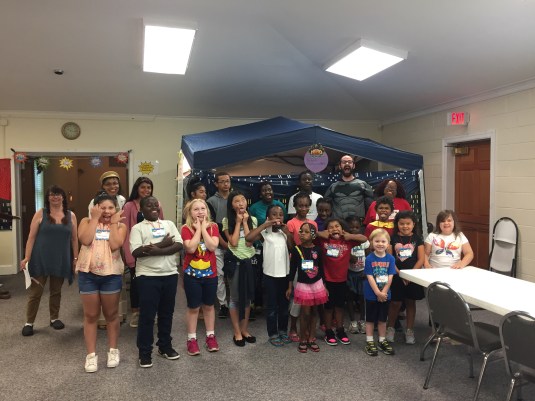
I arrived at church this morning mentally prepared for Vacation Bible School. I had read over the “Bible Story Teller” section, I knew where I needed to be and at what time, and I even had the perfect costume picked out: Batman.

However, I had assumed, foolishly, that the other adults would also arrive in some form of superhero costume. So, instead of blending in among a crowd of heroes, I stuck out like a sore thumb. However, when the children arrived (some from the church and some from the community) they were all shocked that the Caped Crusader was making his way around the building.

After our initial assembly time we broke out into age groups and then began making the rounds through the different centers. I made my way to the storyteller room and started teaching all of the children and youth about Samuel anointing a young David. The groups listened to my rendition and appropriately laughed at my silly jokes, they left with a sense that to be a hero in God’s kingdom one needs to have a compassionate heart, and they learned about how God is our true hero.

IMG_2824

Toward the end of the day, in my last bible story session, one of the youth was not as engaged in the others. I tried to include her as much as possible, but there was clearly something distracting her. When we finished, the rest of the youth walked out of the room, but she stayed behind as if to ask a question. Without prompting she lifted up her head and said, “Did you really mean that?” I said, “What do you mean?” She replied, “That God really loves everyone? Even me? You said that God’s love for David is the same as God’s love for eveyrone, and I want to know if that’s true.” And I said the only thing I could say, “Of course it’s true.”

I don’t know what’s going in her life to warrant her isolated behavior, or even her stark wonder at the fact that God could love her, but I am grateful for the opportunity to tell her the truth. As the psalmist says, “The Lord is good to all, and his compassion is over all that he has made.” God’s love and grace and mercy know no bounds. They are for ALL. And all means all!

From the youth who arrived for Vacation Bible School while wrestling with something beyond herself, to the man panhandling on the street corner, to the family sitting in the pews on Sunday morning, God’s love is for ALL.

Sometimes we lose sight of the tremendous extent of God’s love when we encounter people that we cannot love. When we disagree with them, or are angry with them, they feel outside the realm of God’s grace.

And sometimes we lose sight of the tremendous extent of God’s love when we feel like we know longer deserve it. When we really think about how we have sinned, or how we could be better, we feel outside the realm of God’s grace.

Then let us all hear the good news, the best news: The Lord is good to ALL, and his compassion is over ALL that he has made.

Devotional – Psalm 105.1

Devotional:

Psalm 105.1

O give thanks to the Lord, call on his name, make known his deeds among the peoples.

Weekly Devotional Image

I love Star Wars. When I was a boy I watched our VHS copies of A New Hope, The Empire Strikes Back, and Return of the Jedi so many times that they became unwatchable and we had to purchase new copies. I would read and reread the VHS cover so frequently that I began memorizing all of the inconsequential details. I still know almost every line in all three movies all from the time of my childhood.

I still love Star Wars as an adult. I’ve dressed up as characters from the universe for far too many Halloween celebrations, I definitely have too many Lego sets from the movies (that stay prominently displayed out of my son Elijah’s reach), and I even have a replica of Luke Skywalker’s green light saber from Episode VI.

Untitled

When new details about the upcoming films come out I become an evangelist for the films. I will turn just about any conversation in such a way that I can mention rumors about casting, or new hopes for screen writing, or even connections within the expanded universe. I become my nerdiest when I’m talking about Star Wars.

And I rarely talk about church the same way.

Don’t get me wrong: I love the church. I love the church’s liturgy, I love the call to preach, I love offering the sacraments, I love being with people in some of the most holy moments we can ever experience. But I rarely recommend the church to others in the same way that I recommend watching a Star Wars movie. And even with how much of my life has been blessed by Star Wars, God has done, and will continue to do, more than any film ever can.

The psalmist calls for the people of God to “make known [God’s] deeds among the peoples.” We tend to recommend things to people all the time like restaurants to try, books to read, and movies to watch, but when it comes to the church we often remain silent. Or, perhaps more importantly, when it comes to what God has done for us, we remain silent.

Part of this tendency is due to our belief that faith is a “personal and private” matter, which leads us to leave our faith to ourselves. Part of it also stems from the fact that we so often take our blessings for granted, or we don’t recognize where the blessings came from in the first place.

But God is the author of our salvation. God is the one working in and through our lives to bring about the kingdom on earth. God is the one who has transformed us.

How much better would it be then, to share with others what God has done for us?

Devotional – Psalm 139.4

Devotional:

Psalm 139.4

Even before a word is on my tongue, O Lord, you know it completely.

Weekly Devotional Image

I was shaking hands with people on their way out of worship when a young man, about my age, walked up. We exchanged the pleasantries due to one another in a place like church and then he asked if I would be willing to pray for him. I said something like, “Sure I’ll be happy to add you to my prayer list” and then prepared to shake the next person’s hand. But the young man kept standing there and said, “No. I need you to pray for me right now.”

He told me about the struggles in his life all while people standing in line waited patiently. He shared about his inability to find work, his complicated relationship with his father, and his general feeling of despair. And then he grabbed me by the hands, closed his eyes, and waited for me to pray. So I did.

I had casually known the young man for a couple years but I had no idea about his struggles. Week after week we were in the same church, singing the same songs, offering the same prayers, but I knew nothing about what was happening under the surface.

The psalmist proclaims, “Even before a word is on my tongue, O Lord, you know it completely.” And this is good and right and true. The Lord knows what we need and what we want even before we can articulate what we need and what we want. But just because God knows our words before we do, that doesn’t mean that everyone else does as well.

shutterstock_153536591

In today’s world many of us are uncomfortable with the thought of asking someone to pray for us, let alone having him or her do it right in the moment of our asking. Instead we fill the time of prayer concerns with the needs of other with whom we are familiar. And even then, the expectation is usually that a general prayer will be offered for individuals and groups removed from the immediate situation so that we can move on to something else.

The Lord knows what we need, but the people closest to us (our friends, family, church members) usually don’t. Instead, they are habituated by the masks we wear. They grow comfortable with what they experience and then assume that so long as everything on the surface appears normative then everything deeper must be the same.

What would it look like for you to ask someone in your life to pray for you this week? And not the “can you pray for me sometime” casual request we are used to hearing but the “I need you to pray for me right now.” It might be uncomfortable and even frightening, but it is at the heart of what it means to be in relationship with others in a way that is true, deep, and faithful.

Devotional – Zechariah 9.9

Devotional:

Zechariah 9.9

Rejoice greatly, O daughter Zion! Shout aloud, O daughter Jerusalem! Lo, your king comes to you; triumphant and victorious is he, humble and riding on a donkey, on a colt, the foal of a donkey.

Weekly Devotional Image

I just entered into my fifth year of ministry and one of the things that has sustained me the most throughout my vocation is the weekly reading of sermons that have nothing to do with the sermon I’m working on. I quickly learned that when you make the jump from receiving sermons to preaching sermons, you lose the important part of worship that is hearing the Word afresh and anew.

Some of my favorite preachers come from a variety of backgrounds and denominational affiliations, but perhaps my favorite preacher is Stanley Hauerwas. What makes Hauerwas’ sermons so powerful is the fact that he’s not a preacher. Though deeply involved in the work of ethics and theology, Hauerwas is still a lay-person and when he proclaims the Word from the pulpit it hits me more than from a lot of long time clergy.

Another reason I love Hauerwas’ preaching, perhaps the most important reason, is that he can get away with saying a lot more from the pulpit than most pastors precisely because he’s not a pastor. There’s a delicate balance the preacher has to find between saying what God wants to be said, and doing it in such a way that it doesn’t alienate everyone such that they won’t be back the next Sunday. But Hauerwas, as a layperson, can say just about whatever he wants.

His sermon on the Fourth of July is one that he stuck with me ever since the first time I read it, and particularly the last few paragraphs. Hauerwas again and again makes the claim that we are so entrenched in the worship of America that we can no longer recognize it for the idolatry that it is. He says that this is evident in the way that the political arena has overshadowed the reality of the church and in how we no longer question if the country has done anything wrong. Instead, we assume that if something is done in the name of America, it is for the greater good.

Bible-and-Flag

Try saying that from the pulpit in a church during the fourth of July weekend and you might not have a church to come back to the following Sunday.

But at the end of the sermon Hauerwas makes one final claim that is worthy of repetition. If the fireworks that burst in the sky and the red, white, and blue on our clothing are more captivating than the bread and wine at the table, then we are not the church. That’s not to say that we shouldn’t join together with neighbors to celebrate our country’s independence, or that we can’t sing patriotic songs or eat hot dogs or light off fireworks. But if all of those things are more important to us, if they speak a greater narrative in and to our lives, then we have to ask ourselves whom we really worship.

The prophet Zechariah proclaims that our King comes to us humble and riding on a donkey. As Christians, our King is not in the fireworks and the festivities and the food of the fourth of July. Our King is with the marginalized, the fearful, and the lonely.

Our King is not of this world. Our King rules the world.

Our King is not in a flag or in a pledge of allegiance. Our King is crucified and calls for our allegiance.

And so rejoice, Christians, sing aloud, for our King is triumphant and victorious. But he is not the same thing as our country.

Devotional – Psalm 86.10

Devotional:

Psalm 86.10

For you are great and do wondrous things; you alone are God.

Weekly Devotional Image

Yesterday, while the United Methodist Churches in the Virginia Conference gathered for worship, clergy and lay representatives were at the Hampton Convention Center to hear Bishop Sharma Lewis lead worship. In her sermon she brought together many of the ideas from the weekend of Annual Conference particularly regarding the fact that God is in the business of doing new things. And she concluded with our new ministry focus: “to be disciples of Jesus Christ who are lifelong learners, who influence others to serve.”

But there was another line from her sermon that has been playing over and over in my mind more than any other: “Laity, do not say to your Clergy who bring fresh ideas, ‘But we’ve never done it that way before.’”

I count myself blessed that over the last four years St. John’s has largely responded positively to new ideas. Working together with the leadership of the church has resulted in new ministries and ways to serve the community that have allowed us to accomplish God’s will. But just as we embarked into new territory during my time as the pastor, you (and I really mean you) need to continue to have open eyes and open hearts to the new ideas from your new pastor.

editors-rant

Just because we did something a certain way while I was here does not mean that’s the way you have to do it forever. Frankly, you should probably change almost everything because that would be a better way of allowing the Spirit to move in new and bold ways. And that is what is at the heart of what Bishop Lewis said and at the heart of churches that are currently fruitful; a recognition that new ideas should be embraced because they ultimately come from God.

The psalmist boldly proclaims that God is the one who is great and does wondrous things. Pastors can do good things for their churches, they can help to point to what God is doing in the world, but God is the one doing the things in the world! God is God alone and a church can only be fruitful when it knows and believes that God is the one from whom all blessings flow.

So when you hear about a new idea, whether it comes from your new pastor or even from yourself, know and believe that God is the source of the idea, and prepare yourselves to be surprised by the wondrous majesty of our God who is in the business of doing new things.

I will miss all of you and all of the remarkable things we’ve done together over the last four years, but I am grateful that God will continue to do even more for you in this new chapter of the church’s life.

Devotional – Matthew 28.16-17

Matthew 28.16-17

Now the eleven disciples went to Galilee, to the mountain to which Jesus had directed them. When they saw him, they worshipped him; but some doubted.

Weekly Devotional Image

Doubt has been with the church since the very beginning. Even after the resurrection while the disciples were worshipping Jesus on the mountain in Galilee there was doubt. This is a particularly interesting note in scripture considering the fact that doubt is so ridiculed and berated in parts of the church today.

In some so-called “prosperity gospel” churches if someone gets sick or loses a job the rest of the church blames the occurrence on the doubt of the individual. In other churches you might hear a sermon that makes it plainly obvious that doubting the Lord is a sign of weakness and it needs to be dismissed from the mind (or the heart). And still yet in some churches the “d” word is never mentioned because of it’s supposed negativity.

But doubt was with the disciples from the beginning! How else could a group of finite human beings respond to the infinite wonder and grace and mercy of God made manifest in the flesh?

doubt1

Doubt is not the opposite of faith. In fact, doubt is often the prerequisite and part of the cyclical nature of faith.

Two summers ago I took a group of people from the church on a mission trip to War, West Virginia and while we were there serving the needs of the community one of our members expressed doubt in God’s love and compassion when confronting the destitute poverty of the people in the community. One afternoon, while working on the floor of a house, he said, “It’s hard to believe in a God who could let something like this happen.” At that precise moment the homeowner walked around the corner laughing and said, “Honey, you are the proof that God is not done with us yet!”

Oftentimes when we are in the midst of doubt, whether a particular event has led us to begin questioning the Lord or it comes out of nowhere, it usually takes another person to show us back to The Way. In West Virginia is took a poverty-stricken homeowner to show my friend what the grace of God really looks like. When I begin questioning aspects of the kingdom or scripture or any number of things it usually takes a word or phrase from our hymnal to knock me back into the reality of God’s reign. For some people they need a friend or relative to reach out and ask to pray together. For others it takes something close to a miracle to show how God still rules this world and is the author of our salvation.

Regardless of what we doubt, or even if we doubt, the Good News is that God is not done with us yet!

Devotional – Acts 2.1

Devotional:

Acts 2.1

When the day of Pentecost had come, they were all together in one place.

 Weekly Devotional Image

When was the last time your entire family was together in one place? For some it probably occurred around a holiday like Christmas or Easter, for others it might have occurred at a funeral service or a wedding celebration, and for others the possibility of having everyone together might simply be an impossibility.

When an entire family is together in one place, magnificent things can take place. All the sudden you might overhear a distant cousin telling a story when you realize he or she sounds exactly like you, or you’ll notice that that you have the same color hair as an aunt, or you begin to see how really connected you are even without seeing the whole family very often.

However, being together with an entire family in one place can also bring about conflict. Old disagreements from the distant past can percolate to the surface, political differences can ruin an otherwise wonderful afternoon, or the swift judgments of family members about their family members can show the true colors of brokenness even within a group of people who share the same genes.

When was the last time the entire church was in one place? Across the country, at least in mainline Protestantism, most churches see the majority of their members only once a month. That is why there is such an abundance of churches with upwards of 400 members, but they see less than 100 on Sunday mornings. And, even if everyone showed up to be together in one place, you would get the good and the bad just like when an entire family gets together.

MIDEAST-JERUSALEM-RELIGION-CHRISTIAN-ORTHODOX-EASTER

But can you imagine what our churches would look like if we were all together in one place? And, if you can, think beyond the local church, what if The Church came together in one place? That, among many other wonderful blessings, is the miracle of Pentecost. When the Holy Spirit was poured out on the disciples in a new and transformative way, they were all together in one place even though they were not of one mind. The whole of Acts reads like a bad family reunion in that whenever they gathered together they were forever disagreeing about some tenet of theology, and it is why Paul’s letters were necessary and instructional for the Church to figure out what it meant to be the Church.

Pentecost, though we celebrate it once a year, is actually still taking place in all of our churches whenever we gather together (whether we have all our people or not). The journey and mystery of the church is a group of people striving to be together without agreeing together, it is a miracle made possible by the grace of the Spirit that binds us together particularly when we don’t want it, and it is nothing short of a miracle.

When was the last time you were together with everyone in church? This Sunday might be a great chance to encounter the story of Pentecost that is still being written whenever we gather together.

Devotional – John 14.18

Devotional:

John 14.18

I will not leave you orphaned; I am coming to you.

Weekly Devotional Image

I stood by the bell tower in my robe and I casually greeted everyone as they walked into the building for worship. Just inside the doors were greeters, ushers, and handful of other church members eagerly waiting to address those entering with greetings and salutations. I talked with individuals and families under the bell tower and when one particular woman stepped forward she was greeted by the small crowd with, “Happy Mother’s Day!” and she immediately grimaced; she is not a mother, and will never be one.

On Monday I spoke with a member of the church about a number of matters pertaining to the local community and right before we said goodbye she apologized for not being in church the day before. I asked if everything was okay, or if there was a specific reason she avoided church to which she responded, “I never come to church on Mother’s Day. It just hits too close to home.” She is not a mother, and will never be one.

mothers-day-church

Mother’s Day is a strange Sunday in the liturgical life of the church. There is nothing in scripture about the need to have a specific day focused on the glorification of those who are mothers, but in many churches that is exactly what it becomes. And it happens to such a degree that while trying to be grateful for mothers, we often ostracize a sizable community within our churches who can’t be, don’t want to be, or never will be, mothers.

To so emphasize and value the roles of the presumed normative domestic situation does a disservice to the truth of what the church is called to be: the new family.

Jesus, near the end of his earthly life, promised to not leave his friends orphaned. In a sense Jesus’ promise is a prediction of his own death and resurrection, but it also speaks to the future existence of the community of faith. Just as Jesus’ friends were not abandoned after the cross, so too have we not been abandoned in our communities of faith.

Through the sacraments of baptism and communion we are grafted into a community whereby the common identifiers and labels of mother and father are no longer limited by their biological connections. Instead we become brother and sister and mother and father to the entire community that gathers together to encounter the living God.

Being a mother is a remarkable responsibility and should be lauded on a regular basis, but it is not the most important identity that one can have. Following Jesus Christ as a disciple implies a willingness to be maternal toward all people regardless of whether or not we are biological mothers.

In the community of faith we are called to open our eyes to the realities of those around us so that, rather than discomforting someone on their way in or ostracizing someone to the point that they don’t even come, we remember that God will not leave us orphaned, not even in church.

Devotional – Psalm 31.5

Devotional:

Psalm 31.5

Into your hand I commit my spirit; you have redeemed me, O Lord, faithful God.

Weekly Devotional Image

It is such a blessing to work for a church with a preschool because I get to interact with children who are beginning to learn about God the Father, Son, and Holy Spirit. This takes place weekly during chapel time in the sanctuary as I help to share stories from the bible with the kids, and it also takes place on special occasions like when we celebrate communion together and when we talk about the waters of baptism. Our preschool represents a great diversity of families and religious convictions (including a few kids whose mother or father is the pastor of a different church) so I have to make sure that whenever we talk about scripture I’m not doing it in such a way that it will undermine what a child has been taught at his/her home church.

Over the last few years we’ve had two brothers attend the preschool whose mother is the pastor of another United Methodist Church in town. Pastor Sarah and I are very close and I’ve greatly enjoyed talking with her boys about the bible because they know it so well (though it has made chapel time sessions a challenge since they are forever answering the questions before the other kids get a chance). Her boys, Charlie and Jed, are what I hope my son, Elijah, will be like as he grows up.

Months ago I was having a conversation with Sarah at a clergy event when she shared with me that her boys were not baptized as infants and that they had recently decided to commit their lives to Jesus AND that they wanted me to participate in their baptisms. To be asked by another clergy person to take part in her children’s baptism is quite unlike anything I’ve ever been blessed to do in my life.

18274839_10101184948111357_2588130454250855285_n

And so yesterday afternoon, Sarah’s family and friends gathered together with her boys by a river just outside of Staunton for their baptism. I offered a little homily to reflect on how God has already moved in and through their lives and then it was time to go to the water. The river was moving at a good pace and was so cold that I was worried if the boys slowly walked out into the water they would have high-tailed it in the other direction, so one-by-one I carried Sarah’s sons over the water and together she and I baptized them in the name of the Father, the Son, and the Holy Spirit.

18342074_10101184948241097_8213855151748564830_n

For what it’s worth: the Spirit got a hold of them real quick and they were both screaming as they came out of the water!


Being there are the water’s edge, and then in the middle of the river for the baptism, was one of the holiest experiences I’ve had in a long time. And when I looked at Jed and Charlie, when I saw their utter dedication to what they were about to do (even with the water as cold as it was), and I was reminded of Psalm 31.5: “Into your hand I commit my spirit.” Jed and Charlie made a choice yesterday afternoon to offer their lives to Christ, something that most of us have done whether we made the choice or someone made it for us. And today I am grateful that I was there to participate because their faithfulness has challenged me to be more faithful like them.