Devotional – Jonah 3.1-2

Devotional:

Jonah 3.1-2

The word of the Lord came to Jonah a second time, saying, “Get up, go to Nineveh, that great city, and proclaim to it the message that I tell you.”

Weekly Devotional Image

Sometimes, we don’t want to say what God wants us to say. All of us have a little Jonah in us, and all of us have faced a Nineveh at some point and decided to run in the opposite direction.

However, there are times when God gives us the strength, courage, and wisdom to say what God commands us to say.

On Saturday morning 600 United Methodists from all over the Northern Virginia area gathered for a day of spiritual renewal and theological reflection. At the beginning of the event, the District Superintendent from the Alexandria District stood up and said, “By now you have all heard what our President said about the kinds of people he doesn’t want coming to our country. Well, last night I was driving home from church and I was listening to the radio when person after person denounced what the President said and the words he used. But there were three people in support of the President’s message: A member of the KKK, a member of the Neo-Nazi movement, and a pastor. Thank goodness it wasn’t a United Methodist Pastor, but most people outside the church do not differentiate between us.”

FUMCLogoWritten

The DS then went on to express his gratitude for our denomination, and in particular for our Council of Bishops, who publically condemned President Trump’s recent remarks against immigrants.

It’s not easy saying what God wants us to say. There are always people who will be angered by what the church has to say, and frustrated by the path of discipleship that calls for others to be better. But our Ninevehs are always waiting, and God has given us something to say.

Below is the statement from Bishop Bruce Ough, president of the Council of Bishops, on behalf of the whole council:

“We are appalled by the offensive, disgusting words attributed to President Donald Trump who is said to have referred to immigrants from African countries and Haiti, and the countries themselves, in an insulting and derogative manner.  According to various media accounts, President Trump made the remarks during a White House discussion with lawmakers on immigration.

As reported, President Trump’s words are not only offensive and harmful, they are racist.

We call upon all Christians, especially United Methodists, to condemn this characterization and further call for President Trump to apologize.

As United Methodists, we cherish our brothers and sisters from all parts of the world and we believe that God loves all creation regardless of where they live or where they come from.  As leaders of our global United Methodist Church, we are sickened by such uncouth language from the leader of a nation that was founded by immigrants and serves as a beacon to the world’s “huddled masses yearning to breathe free.”

Thousands of our clergy, laity and other highly skilled, productive citizens are from places President Trump has defamed with his comments.  The fact that he also insists the United States should consider more immigrants from Europe and Asia demonstrates the racist character of his comments.  This is a direct contradiction of God’s love for all people.  Further, these comments on the eve of celebrating Martin Luther King Day belies Dr. King’s witness and the United States’ ongoing battle against racism.

We just celebrated the birth of Jesus Christ, whose parents during his infancy, had to flee to Africa to escape from the wrath of King Herod.  Millions of immigrants across the globe are running away from such despicable and life-threatening events. Hence, we have the Christian duty to be supportive of them as they flee political, cultural and social dangers in their native homes.

We will not stand by and allow our brothers and sisters to be maligned in such a crude manner.  We call on all United Methodists, all people of faith, and the political leadership of the United States to speak up and speak against such demeaning and racist comments.

Christ reminds us that it is by love that they will know that we are Christians. Let’s demonstrate that love for all of God’s people by saying no to racism; no to discrimination and no to bigotry.”

Devotional – 1 Samuel 3.1

Devotional:

1 Samuel 3.1

Now the boy Samuel was ministering to the Lord under Eli. The word of the Lord was rare in those days; visions were not widespread.

Weekly Devotional Image

It’s mean, but one of my favorite games to play is called, “Is it in the bible, or not?” I could be in the middle of a mission trip with middle school students, or in a nursing home with residents, or in a preschool surrounded by 4 year olds, when I will start the game and relish in the responses.

I’ll usually start with something tame like, “Can anything good come out of Nazareth?” and the participants will nod their heads in affirmation. But then I’ll up my game a little bit with something like, “With your utensils you shall have a trowel; when you relieve yourself outside, you shall dig a hole with it and then cover up your excrement.” People will usually scratch their heads wondering why I brought out something so unpleasant, but it’s there in Deuteronomy 23. By the end of the game I usually drop something like, “God helps those who help themselves.” To which people often express their agreement when in fact it’s definitely not in the bible.

mar6

We no longer know the story of God like we once did. I don’t mean to sound overly harsh, but it’s true. During the time of Jesus, young men grew up having most (if not all) of the Psalms memorized. Today we’re lucky if we can get through the 23rd Psalm. John Wesley, the founder of the Methodist movement, was able to quote scripture left and right. Today we need bible apps and Google searches to find the right verse. Even preachers like me fail to love the Word of the Lord in a way that is comparable with the preachers of the past.

Perhaps our lack of love for scripture is due to the fact that we have other things to distract us constantly, or that we have tools that can give us scriptural answers whenever we need them, or that we no longer revere the text for what it is. It’s impossible to particularly pinpoint the reason for the bible’s fall from grace in our contemporary world, but it’s something we are called to combat.

Because, unlike the days of Samuel, the Word of God is not rare today.

We live on the other side of the resurrection, we have churches with more bibles than they know what to do with, and we can jump into the strange new world of the bible whenever we would like to.

If you want to hear the Word of the Lord, if you want to receive a vision about what is to come, if you want to encounter the living God, you need not look further than the bible.

Devotional – Psalm 29.2

Devotional:

Psalm 29.2

Ascribe to the Lord the glory of his name; worship the Lord in holy splendor.

Weekly Devotional Image

It is rare for me to face the altar during worship. Unlike lay people, I spend most of my Sunday mornings staring into the faces of a bunch of people rather than at just one person in a robe. Worship, therefore, becomes a time when I try to guide people along a path that leads all of us to discover more about what it means to love God and neighbor, though I do it from a slightly different vantage point than everyone else in the sanctuary.

However, on Christmas Eve, we all joined together for at least one moment as we held our candles and the words of “Silent Night” filled the sanctuary.

Because the moment only comes once a year, I do whatever I can to savor it. After lighting the ushers’ candles so that they can spread the light throughout the sanctuary, I quickly made my way over to my wife and son and we all sang together. At some point I stopped signing and just listened to the harmonies wash over me. At some point I glanced around the room to rest in the glow of candlelight reflecting off the faces of the young and old alike. Christmas Eve, and in particular when we sing silent night, is one of the moments where it really feels like we worship the Lord in holy splendor.

I think it feels so special because it is so different from everything else we do. Usually, we do whatever we can to avoid the darkness of life by surrounding ourselves with devices that shine brighter than any flame – we stream music all the time to the degree that it becomes difficult to appreciate a single song for what it can convey – we move so quickly through this world that we don’t enjoy the presence of strangers, nor do we appreciate the beautiful complexity of humanity all around us.

But on Christmas Eve, it’s a little different.

candlesHanded

I am grateful for the experience I had on Christmas Eve, but I also want to find ways to experience that same feeling of difference regardless of the holiday. I want to live and move in this world such that I can truly appreciate my God and my neighbor without taking them for granted. I want to ascribe to the Lord the glory of his name each and every day so that I can remember how blessed I really am.

God has been so good to us, and I hope all of us can appreciate what God has done more than once a year.

Think And Let Think’s Top 10 – 2017

I started Think And Let Think a few years ago as a way to compile my thoughts, sermons, and devotionals. After starting at my first church in 2013 it became an easy way for parishioners to access the sermons from Sunday if they were unable to attend. Over the years the scope of the blog has grown far beyond the people I serve in the local church, and 2017 saw a tremendous increase in readership. Below are the 10 most popular posts from 2017.

toptips10


  1. Open Hearts. Open Minds. Open Doors.

I preached exclusively from Romans during Lent. After reading through Barth’s Romans for the nth time, I felt like I needed to stay in the letter through a liturgical season and dragged my congregation along for the ride. This sermon was prompted by Paul’s reflections on Abraham’s righteousness and my contempt for the United Methodist Church’s slogan of open hearts, open minds, and open doors.

“We can have the perfect advertising campaign, with our slogan in big capital letters, but that does not redeem our sinful actions and behaviors. We might think we are righteous and that we are “color-blind” or “LGBTQ affirming” or “economically transparent” but we are nevertheless sinners in need of God’s grace and forgiveness. We can even leave the church doors unlocked all week long, but we will still be broken and in need of God’s redeeming love.”


  1. God Won’t Give You More Than You Can Handle

At the beginning of the year I preached through a series on Dumb Things Christians Say. One of the dumbest things Christians say on a regular basis is, “God Wont’ Give You More Than You Can Handle.” Oddly enough, it’s not true. This sermon works through the phrase and attempt to show that God doesn’t give us what we can handle, but that God helps us handle what we are given.

“Sometimes, we say things like “God won’t give you more than you can handle” because we don’t know what else to say. We encounter the shadow of suffering that is so suffocating we don’t know how to respond. So instead, we will that awful void with awful words. And we make God into a monster.”


  1. A Reminder For Those Attending Annual Conference

Annual Conference can be a time of great renewal and great cynicism. 2017 was no different. In the days leading up to the Virginia Annual Conference gathering I collected my thoughts in hopes that all of would remember that the church is primarily about God, and only secondarily about us.

“God is the one who first breathed life into John Wesley and sent him on a course that would forever reorient the fabric of the church. God is the one who breathed life into all of the churches of the Virginia Conference, who empowers the pastors to proclaim the Word from their respective pulpits, who shows up in the bread and in the cup at the table. God is the one who gathers us together for a time of holiness, who moves in the words we sing, who rests in the spaces between us when we worship, who calls us to serve the kingdom instead of serving ourselves.”


  1. The Mystery Of Marriage

I was privileged to preside over the wedding of one of my oldest friends this year and it prompted a wedding homily that gets at the heart of why getting married is such a strange act of faith.

“Love, the kind of love that will sustain your marriage, holy love, is Godly love. It is a love unlike anything else on this earth. It is beyond definition and explanation. It is deeper than the deepest ocean, and greater than the tallest mountain. It is sacrifice and resolution. It is compromise and dedication. The love that God has for you is the kind of love you are promising to one another and it is a mystery. It is only something you can figure out while you’re figuring it out.”


  1. The Church Doesn’t Exist To Make A Difference

It took five years of full time ministry before I received my first piece of anonymous hate mail. Because it was anonymous and therefore could not have a dialogue with the individual, I wrote a reflection about their complaint in hopes they would one day see it.

“Christians in America have played the political game for so long that we can almost no longer differentiate between America and God. Or, at the very least, we assume that if the church is not involved in the work of making the world a better place, than it’s not worth our time and attention. In scripture, Jesus calls this behavior idolatry.”


  1. Thoughts On The Cross Flag

In the days immediately following President Trump’s response to NFL players kneeling during the national anthem, the lectionary reading was Psalm 25.5: “Lead me in your truth, and teach me, for you are the God of my salvation; for you I wait all day long.” That week I found myself surrounded by conversations that had everything to do with politics, and nothing to do with God. And after reading the psalm, my thoughts on the Cross/Flag came flying out.

“It’s one thing for talking heads to ramble about the pros and cons of kneeling during the anthem but it’s another thing entirely when it comes to the realm of the church. These days the church seems to revolve around tweets from the White House more than the revealed Word of God. These days the church appears to spend more of it’s time debating the values of our country’s democracy than our Savior’s teachings and ethics. These days the church seems to believe that our salvation will come from Congress more than from Jesus Christ.”


  1. Ten Things I Learned From My First Week At A New Church

I moved from St. John’s UMC in Staunton, VA to Cokesbury UMC in Woodbridge, VA this year. It was my first pastoral reappointment and after finishing my first week at the new church, I put together a list of ten things I learned.

“Like being surprised, it’s important to remember that something will go wrong. On my first Sunday at St. John’s I completely forgot to give the offering plates to the ushers and they just stood by the altar patiently waiting until one of the choir members waved her hands to get my attention. For my first Sunday at Cokesbury we didn’t have anyone to play music. The long time organist retired the day before I arrived and the back up players were either out of town or don’t know how to read music. So instead of singing along to an organ or a piano or a guitar we did everything acapella and (thanks be to God) we made it through the service.”


  1. What Things?

After announcing to the church in Staunton that I was being appointed somewhere else, I discovered a tremendous freedom in my preaching (because like it or not, they were only stuck with me for a finite period of time). After reading the lectionary text for the week, Luke 24.13-19 (The Walk to Emmaus), I felt like the time had come to address a pertinent controversy in the community; naming the local High School after Robert E. Lee.

“We make so many assumptions of people without ever doing the good and difficult work of learning who they really are. We see a bumper sticker, or we hear an accent, or we observe a skin tone, or we read a Facebook post, and we let that dictate who they are to us. When truthfully, what we make of those limited observations says far more about us, than about the ones we see.”


  1. God Said It, I Believe It, That Settles It

Another sermon from the series about “Dumb Things Christians Say.” This one was based on “God Said It, I Believe It, That Settles It” with thoughts on church bathrooms, women speaking in church, and caring for refugees. (This one got me in some trouble)

“People have used this book, with understandings like “God said it, I believe it, that settles it,” to attack and belittle people for far too long. It has been used to justify the horrific practice of slavery. It has been used to subjugate and relegate women’s rights. It has been used to rationalize physical violence and aggression toward people of different religions. It has been used to incite fear and terror in those who do not believe. It has been used as a weapon again and again and again. And now we, the people of God, join together to say “no more!””


  1. On Not Looking Like A Pastor

I, apparently, don’t look, sound, or act like a pastor. And I think this is a good thing.

“We, Christians and Pastors alike, are more than how the world portrays us. We are broken people who are in need of grace. We are faithful people filled with the joy of the Spirit. We are hopeful people who believe the church is the better place God has made in the world. So I am grateful for not appearing like a pastor. I am grateful because I believe it will help me help others to see what the grace of God has done for me.”

Devotional – Psalm 126.3

Devotional:

Psalm 126.3

The Lord has done great things for us, and we rejoiced.

Weekly Devotional Image

I was in the midst of wrapping up my sermon yesterday when my 19-month-old son decided to clasp his hands together over and over and shout “Amen!” as loud as he could for everyone to hear. While some thought it was precious and perhaps even faithful for him to do so, he only really knows that we say “amen” at the end of things. Which is to say, he was trying to get me to stop preaching!

I couldn’t help but laugh when I finally got to my “amen” at the end of the sermon as I looked over and saw a huge grin across his face as he was standing straight up in the pew next to his mother. And in that fleeting moment, I realized how remarkably blessed I am.

In the ordinary moment of doing what I do every week, I took in the scene in a way that I had not done so before.

Does that ever happen to you? Do you experience moments where you contemplate how wonderful your life really is, but you realize it’s outside the frame of reference for what should be considered a blissful moment? Sure, when we graduate from school, or say “I will” to our spouse at the altar, or welcome a child into the world, we should count ourselves blessed. But those strange mysterious moments of ordinary divine gratitude are helpful reminders in between the big life events.

280808

In just a few days, scores of people will be gathering with family members from far and near to celebrate the birth of Jesus Christ, the Son of God. There will be moments where individuals look at the scene before them (children tearing open gifts, a full family at the dinner table, wood crackling in the fireplace) and think the great things God has done for them.

But why do we only think those thoughts at special times during the year?

I had a very typical moment from the pulpit yesterday, but it struck a profound chord within me. I am blessed each and every day in ways that I don’t deserve. I encounter people and experiences for which I should be extremely grateful. And to be honest, I don’t thank God nearly enough for all that God has done for me.

It is my hope and prayer that during the remaining days of Advent, each of us can look for those wonderful ordinary moments that remind us of all the great things God has done for us.

We can keep singing about how this is the most wonderful time of year, but with God every single day is a tremendous blessing, a blessing for which we should rejoice.

Devotional – Psalm 85.9

Devotional:

Psalm 85.9

Surely his salvation is at hand for those who fear him, that his glory may dwell in our land.

Weekly Devotional Image

I spent a lot of time last week considering how I might impress upon the congregation the need for darkness in order to appreciate the light. I weighed the options of telling stories from my life when I was particularly afraid of the dark and therefore grateful for the light when it arrived, I pondered the possibility of asking the congregation to announce their fears until someone said something about darkness, but I ultimately decided to shut off all the lights in the sanctuary for the majority of the service.

We therefore were guided by candlelight (which made singing from the hymnal particularly challenging!) but my hope was in the fact that we would all consider the darkness in our own lives in a new and different way. Additionally, while using Isaiah’s language about our righteous deeds being nothing more than a filthy cloth, I challenged the congregation to confront the truth of their sinfulness in a way often missing from the mainline church these days. And finally, I even talked about nuclear weapons to drive home to point about admitting our recklessness with the power we’ve been given and the need to repent.

After worship ended, I stood by the narthex doors shaking hands with everyone on their way out and someone said, “Pastor, I don’t know if I’ve ever been afraid in church before, but I was today. And I don’t know if that’s a good thing or a bad thing.”

The-Fear-of-the-Lord-is-the-beginning-of-all-wisdom

Fear, perhaps more than any other emotion, is the typical response and reaction from those who encounter God in scripture. Again and again we read the same words from the angels, or from God, “Do not be afraid.” But there are also many times in scripture when fearing the Lord is exactly what we are told to do.

Fearing God has less to do with being spooked when the sanctuary is dark and more to do with recognizing that God is God and we are not. When we perceive the great gulf between God and humanity, we are forced to consider our sinful souls and the need for God’s grace. Therefore fearing God might be just what we need this season.

Whereas the world worries about whether or not all the right gifts are under the tree, Christians worry about whether we’re living into the reality of God’s kingdom here on earth. While families hang lights on gutters, we wonder whether or not we have really clothed ourselves with Christ’s righteousness. And as individuals assume that the reason for the season is some plump red-dressed man, or remembering the names of all the reindeer, we know that God, whom we fear, has come near.

Devotional – 1 Corinthians 1.9

Devotional:

1 Corinthians 1.9

God is faithful; by him you were called into the fellowship of his Son, Jesus Christ our Lord.

Weekly Devotional Image

On any given day when I hear about faithfulness, it is often attributed to people. When a family is in church every Sunday for months in a row, I’ll overhear someone describe them as a truly “faithful” family. When a wife shares about her husband’s infidelity, she describes him having broken his “faithfulness.” When a family shares the story about Santa Claus with a questioning child they ask him/her to keep the “faith.”

Even from the pulpit, I am apt to use language about faithfulness primarily in regards to us. On any given Sunday I can wax lyrical about faithful giving, and faithful praying, and faithful yearning. I can quote the parables describing faith like a mustard seed, I can debate different uses of faith by Jesus across the gospels, and I can encourage people to have the type of faith that can move mountains.

But the faith I hear about the least, and sadly the faith I talk about the least, is the faith of God.

maxresdefault

Paul begins his first letter to the church in Corinth with a declaration not about who they are, but about who God is: “God is faithful; by him you were called into the fellowship of his Son, Jesus the Christ.” However, there are many moments in the realm of “doing Church” where we make it all about us and what we do. We say things like, “Let us now go and do likewise,” or “Accept Jesus Christ as your personal Lord and Savior,” and it’s like God isn’t even in the room.

But the bible, and what it means to be the church, is always primarily about God, and only secondarily about us.

At the heart of following Jesus is the recognition that God (in Christ) is faithful. God is faithful to the promises of scripture. God is faithful in receiving our prayers. God is faithful in delivering us out of captivity to sin and death. God calls us into fellowship with the Son. God reveals God’s self in the breaking of bread and the sharing of the cup. God destroys us and resurrects us to new life in baptism. God is faithful.

At the beginning of the liturgical year, it is good and right for us to remember that God is God and we are not, that God moves in and through us, and that God is faithful even when we are not.

Devotional – Deuteronomy 8.10

Devotional:

Deuteronomy 8.10

You shall eat your fill and bless the Lord your God for the good land that he has given you.

Weekly Devotional Image

When I was in college I lived in a house with a handful of other young men, though I was the only one who went to church. We had all, at some point, been involved with a church, but my roommates no longer felt the need to attend. However, as I was the one who usually made dinner for all of us, I insisted that we pray together before feasting together.

For the first few months of living together they begrudgingly participated and politely bowed their heads as I thanked God for all of our blessings. After time they started holding hands with one another while I prayed and even asked for me to included particular things in my prayers. And on one particular night, when I inexplicably forgot to pray, they were the ones who reminded me to pray on behalf of the table before we ate.

For years it was expected in many a Christian home that there would at least be a prayer before the common meal of dinner. Today, however, Thanksgiving has become one of the last refuges of prayer at a meal for many who follow Jesus.

We should pray before every meal recognizing that, as we read in Deuteronomy, the Lord has provided so much for us. But prayer is a habit that has to be cultivated; it is not something we can just institute overnight. However, we all have to start somewhere.

16549TCA150101_p19

There is a wonderful resource for developing a life of prayer titled Common Prayer: A Liturgy For Ordinary Radicals. And in it you can find the following prayer for before or after a meal:

“Lord God, Creator of all, in your wisdom, you have bound us together so that we must depend on others for the food we eat, the resources we use, the gifts of your creation that bring life, health, and joy. Creator God, we give thanks. Holy be the hands that sew our clothes so that we do not have to go naked; sacred be the hands that build our homes so that we do not have to be cold; blessed be the hands that work the land so that we do not have to go hungry. Creator God, we give thanks. Holy be the feet of all who labor so that we might have rest; sacred be the feet of all who run swiftly to stand with the oppressed; blessed be the feet of all whose bodies are too broken or weary to stand. Creator God, we give thanks. Holy be the sound of children laughing to take away our sorrow; sacred be the sound of water falling to take away our thirst; blessed be the sound of your people singing to heal our troubled hearts. Creator God, we give thanks. Holy be the bodies of those who know hunger; sacred be the bodies of those who are broken; blessed be the bodies of those who suffer. In your mercy and grace, soften our callous hearts and fill us with gratitude for all the gifts you have given us. In your love, break down the walls that separate us and guide us along your path of peace, that we might humbly worship you in Spirit and in truth. Amen.”

What would it look like to use this prayer before our Thanksgiving tables on Thursday? Or, perhaps more importantly, what would it look like to use this prayer every time we gather at the table to eat?

Devotional – Psalm 90.12

Devotional:

Psalm 90.12

So teach us to count our days that we may gain a wise heart.

Weekly Devotional Image

These are frightening words. We can read through the Psalms and discover just about every human emotion under the sun; we can dance with joy and weep with sorrow, we can raise our fists and anger and fall to our knees in gratitude. But confronting our mortality? That’s a challenge.

When I was in seminary one of my professors told me that the hardest thing about being a pastor is that I have to remind people that they are dying when everything and everyone else tries to claim the contrary. I have been given the unenviable tasks of proclaiming the deep truth of our mortality in hospital rooms, in church offices, and always at the grave.

Most of us are tempted to believe that we are invincible and that life will never catch up with us. We are tempted to believe that death isn’t real. Countless commercials and products are advertised with the sole purpose of prolonging our inevitable end. Even in church, we spend so much time talking about the joy and hope of God in the resurrection from the dead, that we fail to spend adequate time reminding ourselves of our own earthly finality.

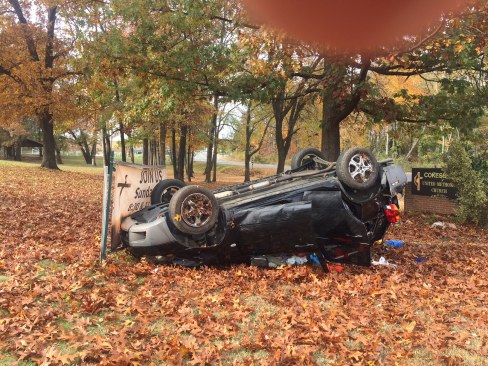
I received a phone call yesterday afternoon from our church secretary informing me that there had been an accident on the church property. A man was driving under the influence and lost control of his vehicle, smashed into our church sign, and eventually flipped over until it came to a stop. The man was quickly rushed to the hospital where he was treated for relatively minor injuries. And when I spoke with the police officers on the scene they kept saying the same thing over and over again, “He’s so lucky it wasn’t worse.”

IMG_1123

Death is a frightening thing. Contemplating our finitude is by far one of the strangest things we do as Christians. But in the end, we do it so that we may gain wiser hearts, so that God might sustain us in the midst of our sinful lives, and above all so that we can appreciate the sacrifice of Christ on the cross and take solace in the glory of the resurrection.

It is my prayer that the man who crashed his car into our church sign yesterday will count his days and gain a wiser heart. Through God’s grace I hope he see’s his life for the tremendous gift that it is, and he gives thanks for all that has been given to him; including one more day.

Devotional – Amos 5.23-24

Devotional:

Amos 5.23-24

Take away from me the noise of your songs; I will not listen to the melody of your harps. But let justice roll down like waters, and righteousness like an ever-flowing stream.

Weekly Devotional Image

Yesterday morning, while countless Christians were passing the peace, or humming the hymns, or celebrating communion all over the country, a man carried a Ruger assault-style rifle into a small Baptist church in southern Texas and murdered 26 people. Officials have reported that the associate pastor was walking up to the pulpit to preach when the gunfire began and that the victims ranged in age from 5 to 72.

Within a short period of time people all across the country flocked to social media and news outlets to share reflections, condolences, and prayers. Politicians tweeted their thoughts, parents held onto their children a little tighter, and pastors started thinking about how in the world they could address what happened in their own churches.

It was about a month ago that we were all reeling from the news that a gunman opened fire on a crowd of concertgoers in Las Vegas leaving 58 dead and 546 injured.

And within a short period of time people all across the country flocked to social media and news outlets to share reflections, condolences, and prayers. Politicians tweeted their thoughts, parents held onto their children a little tighter, and pastors started thinking about how in the world they could address what happened.

maxresdefault (6)

Is God tired of all our talking (and tweeting)? Are the prayers that we offer in the midst of a crisis, and then forget about until the next thing comes, being heard? Is God listening to all of this noise?

What would it look like to let justice roll down like waters in a world that lives in the shadow of the cross? When did we let the words we offer become more important than living lives of righteousness? Is the noise we produce so deafening that we can no longer hear what God has to say?

There’s no easy solution to the recent horrific shooting tragedies. We are clearly a people divided on just about everything these days, and in particular when in comes to gun rights and gun control. But when it comes to the realm of the church, when we think about what this all means for the kingdom of God, we have to ask ourselves if God has grown tired of all our talking.

This is not to say that we should cease to pray. In fact, we should pray without ceasing. But our prayers that we offer to God cannot be limited to words we toss around while our hands are clenched together. Sometimes the most faithful prayers are the ones we make with our actions.