Hoping Against Hope

strangely-warmed-spreaker-header

This week on the Strangely Warmed podcast I speak with Rev. Dr. Emily Hunter McGowin about the readings for the Second Sunday of Lent [Year B] (Genesis 17.1-7, 15-16, Psalm 22.23-31, Romans 4.13-25, Mark 8.31-38). Emily is a teacher and scholar of religious studies and a theologian in the Anglican tradition. She has a book on evangelical family practices titled “Quivering Families” coming out in May. Our conversation covers a range of topics including the recent school shooting in Florida, the covenant, name changes, mutual suffering, professional Christians, the difference between trust and witness, and the obsession with safety. If you would like to listen to the episode or subscribe to the podcast you can do so here: Hoping Against Hope

EM

The End Of The Rainbow

Genesis 9.8-17

Then God said to Noah and to his sons with him, “As for me, I am establishing my covenant with you and your descendants after you, and with every living creature that is with you, the birds, the domestic animals, and every animal of the earth with you, as many as came out of the ark. I establish my covenant with you, that never again shall there be a flood to destroy the earth.” God said, “This is the sign of the covenant that I make between me and you and every living creature that is with you, for all future generations: I have set my bow in the clouds, and it shall be a sign of the covenant between me and the earth. When I bring clouds over the earth and the bow is seen in the clouds, I will remember my covenant that is between me and you and every living creature of all flesh; and the waters shall never again become a flood to destroy all flesh. When the bow is in the clouds, I will see it and remember the everlasting covenant between God and every living creature of all flesh that is on the earth.” God said to Noah, “This is the sign of the covenant that I have established between me and all flesh that is on the earth.”

Lent is a season of repentance and introspection. However, that doesn’t mean the liturgical season encourages navel-gazing – in fact it compels us to look at our lives individually and corporately. Lent almost forces us to ask, “How have I failed, and how have we failed?”

It is not an easy season in the life of the church.

In preparing for this Lent I was struck by the theme of covenants – both biblical and otherwise, and what they have to do with our faithfulness. Almost everyone here is familiar with what a covenant is, we’ve borrowed money, or rented an apartment, or purchased a car, all under the auspices of a contract. They exist because of a fundamental distrust that we have for one another and institutions, we use them to protect ourselves should the other not hold up their end of the bargain.

Yet the truest and deepest relationships are those built on trust – when we lovingly yield ourselves to the other with vulnerability and fragility. And that is precisely what God has offered us in the covenant – the vulnerability required for true trust.


519_covking_657bull-02-02-1080x675

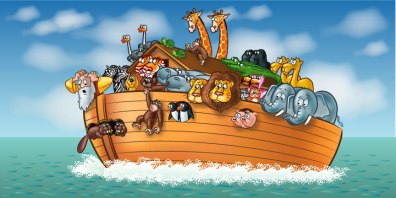
Things were looking good for the people of God, but just six chapters into the Good Book, humanity has become polluted beyond repair. The situation was so terrible that God sends a flood to start over. However, God calls upon Noah to build an Ark that will be the seed of new life, and he and his family, plus two of every animal are spared..

And then, after rocking gently on the waves for forty days and forty nights, the waters recede; the family and animals walk down the ramp, and up in the sky is a rainbow declaring God’s love toward all of creation.

This, of course, is the most beloved of all Sunday School stories for children. I have yet to encounter a church nursery or children’s Sunday school room in which the ark wasn’t painted on a wall, or a book describing the events couldn’t be found on a shelf, or plastic figurines of the animals and Noah weren’t tossed in a corner after years of repeated use and play.

At my last church I would take time every year to teach the children in our preschool about Noah and his Ark. We would put on little animal masks and line up two by two and march around the church property making animals sounds as loud as we possibly could while cars would slow down to watch a tall bearded man lead a group of children in flapping their wings, clomping their jaws, and shaking their tails.

And it would inevitably end in the playground where there was a large plastic boat that had enough space for everyone to climb aboard. We would pretend that the waves we shaking us back and forth, and then we’d look up in the sky for our make-believe rainbow.

            The end.

And we almost always tell the story that way; we jump straight to the rainbow. But in jumping ahead, we forget about the immense devastation the survivors would have witnessed. We forget that God sent the flood for a reason, and that death and carnage would have spread as far as the eye could see.

Have you seen what Houston looked like after the flood waters receded? Do you remember how long it took to sift through the entire city of New Orleans after Katrina? That’s what the flood must have been like, but worse.

            And we teach this story to our children.

Full_featured_double_rainbow_at_Savonlinna_1000px

The rainbow was in the sky as a sign and reminder of the covenant God made with God’s people, but it was also done in the presence of death and destruction. “Never again,” says the Lord, “Will I destroy the earth.”

On Wednesday afternoon, while countless Christians were walking around with ashes in the sign of a cross smeared across their foreheads, a young man pulled the fire-alarm at Marjory Stoneman Douglas High School in Florida, and waited for people to pour out in the hallways. And then he began shooting.

17 dead, another dozen injured.

In October, a man looked out from his room in Las Vegas at the crowds of people dancing at a music festival. While the pumping music was filling the air, he added to it with the sound of gunshots.

58 dead, 851 injured.

On December 14th, 2012, a young man walked into Sandy Hook Elementary School in Newtown, Connecticut and began shooting.

20 dead, the majority of whom were 6 or 7 years old.

Since the shooting at Sandy Hook, more than 400 people have been shot in over 200 school shootings. Those numbers don’t include what happened in Las Vegas, or a number of other shooting related events. But in the last five years, 400 people have been shot in over 200 school shootings.

Called to life out of chaos and nothingness by the breath of God, we humans seem at every turn bent on returning to that chaos. “The Lord saw that the wickedness of humankind was great in the earth, and that every inclination of the thoughts of their hearts was only evil continually.” And so God sent the flood.

Following the Flood, God placed the rainbow in the sky, and God promised to never drop such violence on us again, and for some reason, we’ve failed to hold up our end of the bargain.

God’s act over creation binds all of creation together, from the fish in the sea to the birds in the air, to the people in the pews next to you. And yet violence, anger, aggression, they rule the day. They captivate our attention, they fuel our inner thoughts, they drive our responses to frustration. We are a people near the end of the rainbow.

It’s like we’re so obsessed with the end of the story, we forget what got us here.

Since Wednesday afternoon I have been bombarded with messages from people both inside and outside of the church.

On one side there are people fighting for stricter gun control. They believe that sensible legislation could prevent events like those we’ve seen as of recent from ever happening again. They want to make it harder to purchase a firearm.

It’s important to note, that of the last 18 mass shootings, the majority of the firearms were purchased legally and with a federal background check.

On the other side, there are people fighting for greater access to weapons and freedom to use them. They believe that arming teachers and administrators will prevent events like those we’ve seen as of recent from ever happening again. They want to protect their freedom to defend themselves and others.

Violence, it seems, is inescapable. Regardless of the rainbows above our heads, this world of ours is captivated by one in which the power to end life reigns supreme.

But God has a knack for making a way out of no way.

We all know what chaos looks like, we don’t need the reminder from Genesis, we have the nightly news, and Facebook, and Twitter to show us what real chaos looks like. But it is in the midst of chaos, with the stories flooding in and the destruction around our ankles, that the rainbow arches across the sky demanding our attention.

And when we see that bow, when we hear about those teachers who sacrificed their lives to protect their students, when we witness the children standing in front of the school praying for their friends, we remember what God did for humanity and all of creation, we get a taste of the covenant, we discover redemption.
noahs-beaver-problem

Maybe that’s why we teach children the story of Noah and the Ark, and the rainbow in the sky, even if we’ve lost a connection to its deep and frightening truth – we want our children, in fact we want everyone, to know that God’s love and hope is present in the chaos, that even while the world is full of disturbing devastation, God has not forgotten us.

In the covenant made through the sign of the rainbow, God bound God’s own self to us in a new and different way. God became intimately connected with the creatures of his creation, preserving, sustaining, and encouraging them (us) toward redemption.

The rainbow, therefore, acts like a mirror, in which we see the truth of our reflection. We see who we really are, with our anger, and our propensity toward violence, and our fear. We see the truth, and we remember that God hung his bow in the sky.

So, perhaps the time has come to reclaim the strange, ugly, and beautiful truth of the rainbow. Maybe the time has come to put an end to the rainbow in nurseries and children’s bibles alone. Perhaps we need to seal our hearts with the rainbow that declares a new day has broken, that there is a better way, that there is room for all of the colors that make the covenant what it is.

That kind of rediscovery could completely reshape and shake up what we know of who we are. It won’t make us perfect, it won’t rid the world of evil, but it will stand as a reminder, just as it once did, that God has not abandoned us to our own devices, that God has made a new day and a new way.

This story from near the beginning, is the beginning of the covenants that lead to the kingdom. It is a promise established in Noah, and later with Abraham, David, and through our baptisms into Jesus’ death and resurrection.

            The covenant, at its core, is a witness to the fact that God is stuck with us, and that we are stuck with God.

In life, there are moments when we can feel the rage build within us. It usually happens in response to something we experience in another person, whether right in front of us, on television, or on the Internet.

And, to be clear, there are times when rage is appropriate. The Psalms are filled with these little vignettes into the anger of the people Israel amidst such terrible injustice. It is good and right for us to be angry when we see what happened in Florida this week, it is good and right for us to be angry about innocent children being murdered indiscriminately, it is good and right for us to voice our opinions about what can and needs to change.

            The challenge is in remembering that God is with us in the midst of our anger. That God saw the deplorable state of the world not only during the days of Noah, but in the days right before Jesus’ birth, and God sent us a new sign, in his Son, who came to show that love always trumps violence, that we are bound to one another even when we can’t stand each other, and that there is a better way.

The rainbow above Noah’s head, the experience of Jesus in our lives, they are a reminder that the world was broken, is still broken, and that God is in the business of reconciliation. It forces us to confront the brokenness of our own lives, and in the lives of others. It even makes us uncomfortable – for if God was willing to refrain from violence upon the world, if God was willing to hang up the bow, why haven’t we done the same? Amen.

The Word Made Verb

strangely-warmed-spreaker-header

This week on the Strangely Warmed podcast I speak with Johanna Hartelius and Jason Micheli about the readings for the First Sunday of Lent [Year B] (Genesis 9.8-17, Psalm 25.1-10, 1 Peter 3.18-22, Mark 1.9-15). Johanna is the host of the (Her)men•you•tics podcast where she unpacks theological terms without using stained glass language. Our conversation covers a range of topics including covenant reminders, God’s immutability, liturgical vision, Lent as Christianity’s January, and the connections between death and baptism. If you would like to listen to the episode or subscribe to the podcast you can do so here: The Word Made Verb

IMG_3586

Devotional – Ezekiel 27.1-2

Devotional:

Ezekiel 37.1-2

The hand of the Lord came upon me, and he brought me out by the spirit of the Lord and set me down in the middle of the valley; it was full of bones. He led me all around them; there were very many lying in the valley, and they were very dry.

Weekly Devotional Image

I love challenging couples to pick their own wedding scripture beyond the cliché of 1 Corinthians 13 (Love is patient, love is kind…). In between premarital counseling sessions, I ask them to dive deep into their bibles in order to final a passage or a verse that really speaks to them, and I have been deeply impressed with the scriptures they’ve picked. I’ve been blessed to bring couples together into holy marriage with the stories of David being anointed by Samuel, Paul’s description of what it means to be a Christian, a prayer to the church in Ephesus, and more.

The scripture passage a couple chooses for their wedding says a lot about what their relationship is like, and what their marriage will be like.

Years ago, two of my friends from Durham were married at a local Presbyterian church that was known for the preaching of the pastor. To start the wedding homily, the pastor described the sanctity of marriage and what it means for two individuals to make this covenant, but then he began shaking his head and said, “You know that these two standing before us are devoutly faithful, because when I asked them to choose their wedding scripture, they picked the valley of the dry bones from Ezekiel.”

1509747_10155231246960627_1383507341785953622_n

I can remember sitting with my back against the pew and wondering what in the world he was going to do with the text. The valley of the dry bones is a remarkably beautiful passage, but it doesn’t naturally lend itself to a wedding sermon.

So the pastor continued on with bits of wisdom and advice, he shared stories about successful marriages and what to emulate as well as terrible marriages and what to avoid. But for the better part of ten minutes, he completely avoided the Ezekiel passage. And then, out of nowhere, the Spirit start blowing and he said, “James and Jennifer, I think you two can have a good marriage, but if you think that you can do it without the help of your friends, family, and the Lord, it will never be more than a dry valley filled with old bones. Only your friends, family, and the Lord can breathe the Spirit back into those bones and give them life.”

It was a simple sermonic twist, but it’s one that I think everyone it attendance will never forget.

What does your life look like? Is it filled with vibrancy and energy? Do you feel the Spirit moving in your midst? Or is your life like a deep valley filled with dry bones?

Thanks be to God who calls us into relationship with the Spirit, with our friends, and with our families who can breathe life into the dry bones of our lives.

Baptism and Temptation

Mark 1.9-13

In those days Jesus came from Nazareth in Galilee and was baptized by John in the Jordan. And just as he was coming up out of the water, he saw the heavens torn apart and the Spirit descending like a dove on him. And a voice came from heaven, “You are my Son, the Beloved; with you I am well pleased.” And the Spirit immediately drove him out into the wilderness, and he was in the wilderness forty days, being tempted by Satan.

baptism (1)

This morning is the first Sunday in the season of Lent. Christians throughout the world will use this season to repent of past sins, and seek renewal in their commitment to follow Jesus Christ. Throughout this season we are going to explore and examine Jesus’ life from baptism to resurrection by walking in his footsteps on the way that leads to life. We are using Adam Hamilton’s book The Way to guide our weekly services, because it follows Jesus’ life in a way that is important for us to rediscover during Lent. We begin with Jesus’ baptism and temptation.


Before I became your pastor, I helped a number of churches with their ministries. One such church is nestled in the Great Smokey Mountains in the far reaches of western North Carolina. Bryson City United Methodist Church has a beautiful building right in the center of town. They have services every Sunday that are often interrupted by the sound of motorcycles during the summer. They have a dynamic choir that rivals choral groups from cathedrals. And it is within walking distance of one of my favorite restaurants: Bojangles.

I spent an entire summer doing everything I could for the church, but honestly they didn’t have many expectations – so long as I showed up on Sunday morning with something to say and checked in on people during the week, I was encouraged to spend my time exploring the local area by hiking and whitewater rafting. (It was a great summer).

I will never forget some of the characters that would show up on Sunday mornings. There was Ralph, the church organist and music minister, who had a ponytail and always wanted to talk more about fly fishing than the hymns we would use during a worship service. There was Mr. Outlaw who knew his bible better than the seminarian that had shown up for the summer. And there was Ben Bushyhead. I will never forget Ben Bushyhead, not just for his incredible last name, but because after I preached for the first time he walked right up to me and said (rather declaratively), “Son, you using too many of them big seminary words.”

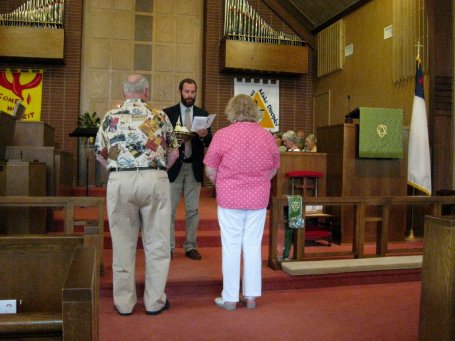
On one particular Sunday morning, toward the end of my time at the church, they were going to have their first baptism in a long time. A member of the church’s grandson was visiting and they all thought it was the right time and the right place to have him baptized. The excitement in the congregation that morning buzzed through the pews. This was what the church was all about: Welcoming visitors with signs of affection and love; returning to the great sacrament of baptism; and seeing young people standing near the altar.

The service built up toward the baptism at the end and the pastor invited the family to join him around the baptismal font. He spoke with conviction about how God had moved across the waters in creation to bring order out of chaos, he reminded us of the Israelites’ journey through the water on their way out of Egypt, and he even compared this sacrament to the baptism that John shared with his cousin Jesus at the Jordan River.

It was a holy moment seeing the congregation preparing for the baptism and a few of the older members were doing their best to cover up the tears that were slowly falling down their faces.

The pastor then motioned for the baby. He held the young boy with one hand, took of the top off the font with the other, and his eyes went wide. The beautifully and intricately carved baptismal font was empty; there was no water for the baptism.

The pastor looked up from the font and we locked eyes in the middle of the sanctuary. Without being told what needed to be done, I jumped up from my spot and ran to the kitchen. I frantically searched for any vessel that could hold water and settled on an old and chipped coffee mug. Using the sink, I filled the cup to the brim and then ran back to the sanctuary spilling a fair amount of water on the way.

While I stood in front of the congregation, I tried to make it look as liturgically appropriate as possible as I poured the water into the font, and the baptism went on as planned.

Bryson City UMC

Bryson City UMC

The beginning of the Good News of Jesus Christ. John was preaching and proclaiming in the wilderness when Jesus arrived to be baptized. This important and sacred event revealed the voice of the Lord identifying Jesus as the Beloved, while also setting in motion Jesus’ earthly ministry.

Jesus, as the Son of God, did not need to be baptized to be cleansed from his sins, but in going down to the water with the masses, he demonstrated his willingness to identify with sinful people. Jesus believed in doing ministry with others, rather than for others. In this scene we see God, in Christ, starting to bridge the great chasm between the earthly and the divine to inaugurate a new reality.

Yet, just as the baptismal scene comes to its conclusion, the Spirit of the Lord drives Jesus out to the wilderness where Satan tempted him for forty days.

During this time Jesus fasted from food and spent most of his time in prayer, though Satan was not inclined to leave him alone. He tempted Jesus with bread, with praise, and power. And Jesus remained steadfast; he resisted the temptations, and came out on the other side of the forty days strengthened and ready to begin his public ministry.

Again, in the temptations, we see Jesus’ willingness to identify with sinful people. All of us have moments where we wrestle with the devil.

We might feel helpless to resist the call of abundant and unhealthy foods. While countless people die of starvation everyday, few of us actively work to end hunger in the world.

We might feel helpless to the temptation of empty relationships and abusive power dynamics. We settle for the easy route so long as it benefits us completely, and few of us live selflessly instead of selfishly.

We might feel helpless to resist the urge to spend money on lottery tickets, or we cheat on our taxes, or we pretend to be something we’re not in order to further our quest for financial gain.

All of us are tempted one way or another. But chief among our temptations, is the temptation to forget what it means to be baptized.

In the small church in the Great Smokey Mountains, they had lost sight of the value of baptism; it had been so long since anyone was baptized that the font was empty and held no water! When we let the wells of baptism run dry in our churches and in our souls, we forget who we are and whose we are. When the identity we receive in baptism is forgotten, we quickly fall prey to the devil’s many temptations.

Baptism is a defining act. Through the sacrament of baptism God claims us, we are anointed with the Spirit, and we are set aside for God’s purposes. During baptisms in worship, the entire congregation makes a public commitment and covenant to raise the baptized person in the faith and become a new family. In baptism we receive the power of God’s Spirit to resist temptations through unending grace.

But when we forget who we are, when we forget how far God was willing to go for our sakes, our baptismal identity fades from our minds and is replaced with insatiable desires and temptations.

On Wednesday, many of us were reminded of our baptismal identities while ashes in the sign of the cross were marked on our foreheads. Wherever we went on Wednesday we were met with strange looks regarding the smudges on our skin, and whenever we glanced at our appearance in the mirror, we came face to face with our baptismal identities. But if you take a quick glance around the congregation, you will notice that all of the ashes have faded away.

Like empty baptismal fonts, and clear foreheads, we can fall to the temptation of forgetting who we really are.

In a few minutes all of us will be invited to remember our baptisms. We will use similar words just like the ones that have been used for centuries, we will pray over the water, and we will ask God to give us the strength to remember who we are each and every day. Whether we can vividly remember the moment we felt the water on our skin long ago, or it was done to us while we were babies, we will take time to give thanks for the people who surrounded us in those moments. We will give thanks for the congregations that promised to raise us in the faith, and do the same for others.

modern-artwork

But just in case this baptismal remembrance is not enough, we are going to take it one step further. After I take water and mark your forehead with the sign of the cross, you will receive a little plastic card with these words: “Lord, as I was my hands, I remember my baptism. Cleanse me by your grace. Fill me with your Spirit. Renew my soul. Amen.” Our challenge is to take these cards and place them near a sink in our homes. That way, whenever we go to wash our hands we can offer this prayer to God and remember who we are. That way, the baptismal font of our souls will never run dry. That way, we can resist the temptation to forget our baptisms.

Remember your baptism and resist temptation. Remember your baptism and receive strength. Remember your baptism and be thankful. Amen.

Devotional – Psalm 51.1

Devotional:

Psalm 51.1

Have mercy on me, O God, according to your steadfast love; according to your abundant mercy blot out my transgressions.

Weekly Devotional Image

When I am asked to preside over a wedding, I take full advantage of the opportunity to share the beauty of God’s love. During pre-marital counseling I encourage couples to find a bible verse that relates to their relationship, we discuss what it looks like to pray for our spouse, and we use God’s love as a lens by which we view the love we have for our partner. During the actual wedding ceremony I am unashamedly open about God’s love being at the center of this relationship, and that only with God’s power can all couples live in harmony and peace with one another.

This past Saturday I stood before a gathered community outside under the hot sun for a wedding. With sweat beading on my forehead I shared reflections on the joy of marriage and how God plays an integral role in all of our relationships. I used stories from the couple’s history in order to make the homily approachable, and I even included a number of lines from famous movies because the groom is a self-avowed movie buff. (For example: “Enjoy this time because life moves pretty fast, and if you don’t stop to look around once in a while, you could miss it” –Ferries Bueller’s Day Off)

11781683_10153086252896267_3300763643978016391_n

Following the ceremony I was mingling among the wedding guests when a young woman approached me and said, “I wish my pastor was like you.” Startled by the compliment, I asked her to explain and she described how her pastor “never connects the scripture with regular life” and that she leaves church feeling like she “listened to a lecture.” Our conversation continued for a few minutes, and before we went our separate ways she asked where I was a pastor and told me that she would be joining the church for worship sometime soon.

As I stood there taking in the complimentary conversation, feeling affirmed in my words, and hopeful about a new person coming to church, I was struck with the sensation that I had lost my focus. I let myself get puffed up by her kinds words and I recognized that I selfishly wanted her and her family to start attending the church I serve. I like the idea that she wanted to come to the church because of me. It only took a few words to stroke my ego to such a degree that I forgot my place in the kingdom.

So before she had a chance to walk away and disappear into the crowd I asked her to do me a favor and I said, “Before you come to St. John’s, I think you need to pray for the pastor you have. Maybe God wants you to help him grow and learn what it means to serve your church rather than leaving to just try something different.”

The psalmist calls for God to “blot out my transgressions.” In our daily prayers we thank God for our blessings, and we ask God to intervene in our lives and in the lives of others, but rarely do we pray for God to make us clean, to rid us of our selfishness and false pride. This week, let us take time to be honest about our sinfulness, pray for God to transform us, and begin taking steps into a new way of life.

Devotional – Mark 1.7

Devotional:

Mark 1.7

He proclaimed, “The one who is more powerful than I is coming after me; I am not worthy to stoop down and untie the thong of his sandals.”

Weekly Devotional Image

I was in the middle of a short homily when I started worrying about whether or not the water would be too cold for the baptism. You never can tell how a child will react to the living water; some laugh as if it is tickling them while it trickles down their hair, some scream in fear as the cold water seeps into their clothing, and others remain stupefied by a grown man wearing a long white dress pouring water onto their head. I stood in front of the local community hoping that this baptism would go smoothly, rather than be remembered for the blood curdling cries during the sacrament.

I had picked the beginning of Mark’s gospel for my baptismal homily; John baptizing Jesus in the Jordan. I love the text because it is concise and too the point while remaining profoundly theological. I shared with gathered body John’s ability to bring in the crowds for the repentance of their sins out in the wilderness when Sawyer began to squirm around in his mother’s arms. Without really thinking about what I was doing, I walked over to the family in their pews, reached for Sawyer, picked him up, and continued preaching. For a few moments I continued with whatever I was saying but it felt as if everyone had disappeared and Sawyer and I were the only ones remaining in the sanctuary. I was unsure why I had felt God push me to pick him up, but as I held him close I felt the words of John come alive for me: “I am not worthy to stoop down and untie the thong of his sandals.” Here I was holding a precious baby boy, who kept smiling as he stared at the hair growing on my face and I was struck by his preciousness. When I baptized him with the living water I felt unworthy to do what I was doing, and then became profoundly thankful for God’s presence in that beautiful moment.

10505419_827338247305732_338805337312225694_n

Through the waters of baptism Sawyer, and all of us, experienced a new beginning. Like the event of John baptizing Jesus in the Jordan, everything would be different from that moment forward. We covenanted to raise Sawyer in the faith, to pray fervently for him, and to be abundantly present for him in times of need. The church is at its best when we make good on the promises we make to the children we baptize, something I look forward to participating in during Sawyer’s life.

In this season of Advent we are reminded of the new beginning that took place in Bethlehem in a manger. Moreover, in our baptisms we had the privilege of being incorporated into God’s cosmic story to be God’s children. While we prepare for Christmas, I encourage all of you to be thankful for your baptisms, and remember that God came in the form of a baby, just like Sawyer, to dwell among us.


Divine Irony – Sermon on Exodus 2.1-10

Exodus 2.1-10

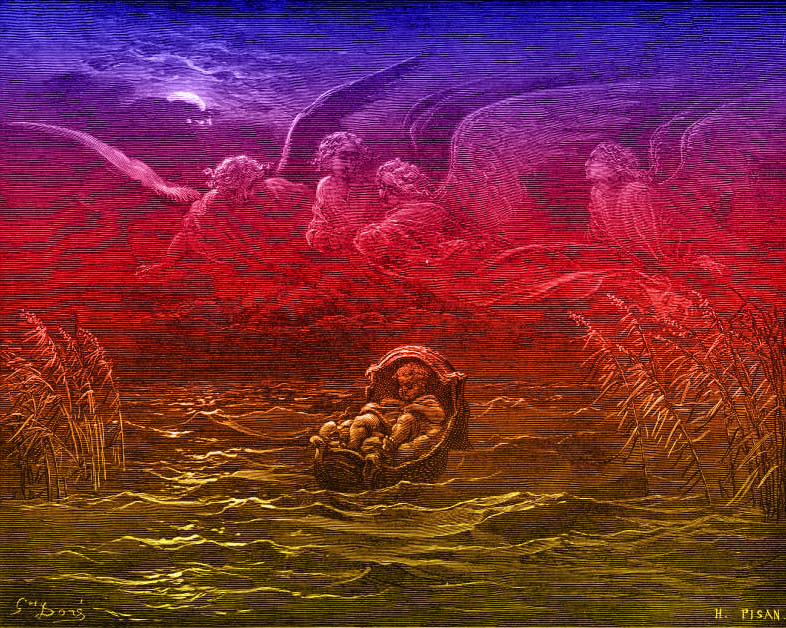
Now a man from the house of Levi went and married a Levite woman. The woman conceived and bore a son; and when she saw that he was a fine baby, she hid him three months. When she could hide him no longer she got a papyrus basket for him, and plastered it with bitumen and pitch; and she put the child in it and placed it among the reeds on the bank of the river. His sister stood at a distance, to see what would happened to him. The daughter of Pharaoh came down to bathe at the river, while her attendants walked beside the river. She saw the basket among the reeds and sent her maid to bring it. When she opened it, she saw the child. He was crying, and she took pity on him. “This must be one of the Hebrews’ children,” she said. Then his sister said to Pharaoh’s daughter, “Shall I go and get a nurse from the Hebrew women to nurse the child for you?” Pharaoh’s daughter said to her, “Yes.” So the girl went and called the child’s mother. Pharaoh’s daughter said to her, “Take this child and nurse it for me, and I will give you your wages.” So the woman took the child and nursed it. When the child grew up, she brought him to Pharaoh’s daughter, and she took him as her son. She named him Moses, “because,” she said, “I drew him out of the water.”

newjudaicia4

Can you imagine what was going through the mother’s mind when she placed her little son in the papyrus basket? Can you see her tears flowing down on to the boy who would change the course of history because she was forbidden to let him live?

Everything had changed in Egypt. Joseph had been sold into slavery but saved the Egyptian people by storing up food for the coming famine. He was widely respected and his people were held in safety because of his actions. But eventually a new king arose over Egypt and he did not know Joseph. He feared the Israelites, their power, and their numbers.

The Israelites quickly went from being a powerful force within another nation, to a group of subjugated slaves who feared for their lives. They were forced to work in hard service in every kind of field labor, they were oppressed and belittled, and their family lives were slowly brought into jeopardy. Pharaoh commanded the Hebrew midwives to kill all the males born to Hebrew women, but when they resisted, he changed the decree so that “every boy that is born to the Hebrews shall be thrown into the Nile, but every girl shall live.

Once a prosperous and faithful people, the Israelites had lost everything. Yet, even in the times of greatest distress, people continue to live and press forward… A Levite man married a Levite woman and she conceived and bore a son. When he was born and she saw that he was good, she kept him hidden for three months. But a time came when she could no longer hide the child and she found herself making a basket to send her baby boy into the Nile.

Kneeling on the banks of the river, she kissed her son goodbye, placed him in the crude basket, and released him to the unknown. The boy’s sister, who was allowed to live in this new regime, sat along the dunes and watched her baby brother float down the river toward where a group of women we beginning to gather.

Exodus-Chapter-2-The-Child-Moses-on-the-Nile

Pharaoh’s daughter saw the basket among the reeds, and when she opened it she saw the boy, and took pity on him. She recognized that he was one of the Hebrew boys but she was compelled to be compassionate toward him. The sister, with a stroke of genius, realized that she had the opportunity to save her brother and stepped forward from her hiding place to address the princess. “Shall I go and find a nurse from the Hebrew woman to nurse the child for you?” Pharaoh’s daughter said to the young slave, “Yes.” So the girl went and found her mother, the mother of the child she had just released into the Nile, and brought her to the princess. Pharaoh’s daughter charged her, “Take this child and nurse it for me, and I will give you your wages for doing so.” So the mother received back her own son and nursed him. However, when the child grew up, she brought him back to Pharaoh’s daughter, and she adopted him as her son, and she called him Moses because “I drew him out of the water.”

This story about the birth and the childhood of Moses is one of the most familiar texts from the Old Testament. It has just the right amount of suspense, intrigue, serendipity, divine irony, human compassion, intervention, and it concludes with a happy ending. Moses’ birth has captivated faithful people for millennia and offers hope even amidst the most hopeless situations.

One of the greatest pastors I have ever known serves a new congregation in Northern Virginia. Jason Micheli has inspired countless Christians to envision a new life of faithfulness previously undiscovered. He played a pivotal role in my call to ministry, we have traveled on countless mission trips together, he presided over Lindsey’s and my wedding, but above all he is my friend.

1934842_1140098793643_1336612_n

Jason and his wife Ali embody, for me, what a Christian relationship looks like. They support one another in their different ventures without overstepping their boundaries, they challenge each other to work for a better kingdom, and they believe in the Good News.

For a long time Jason and Ali knew that they wanted to adopt a child and they traveled to Guatemala when Gabriel was 15 months old to bring him home. As a young pastor and lawyer, Jason and Ali had busy schedules that were filled with numerous responsibilities that all dramatically changed the moment Gabriel entered their lives. They went from understanding and responding to the rhythms of one another to having a 15 month old living with them, a child who they were responsible for clothing, feeding, nurturing, and loving. I know that the first months must have been tough, but Ali and Jason are faithful people, they made mistakes and learned from them, they loved that precious child, and they continued to serve the needs of the community the entire time.

Jason and Gabriel

Jason and Gabriel

A year and a half later, just when the new patterns of life were finally becoming second nature, a lawyer who helped them find Gabriel contacted them. There was another family in the area who had adopted a 5 year old Guatemalan boy named Alexander, but they no longer wanted him. The lawyer recognized that Jason and Ali had recently adopted a child but wanted to find out if they would adopt another. However, the lawyer explained that this 5 year-old was supposedly very difficult, his adoptive family was ready to get rid of him, and he didn’t speak any English. Jason and Ali had a choice: lift this child out of the Nile, or let him continue to float down the river?

The story of Moses’ adoption by the Egyptian princess is filled with irony:

Pharaoh chose the Nile as the place where all Hebrew boys would be killed, and it became the means of salvation for the baby Moses.

The unnamed Levite mother saves her precious baby boy by doing precisely what Pharaoh commanded her to do.

The daughters of the Hebrews are allowed to live, and they are the one who subvert the plans of the mighty Pharaoh.

A member of the royal family, the Pharaoh’s daughter, ignores his policy, and saves the life of the one who will free the Hebrew people and destroy the Egyptian dynasty.

The Egyptian princess listens to the advice of the baby’s sister, a young slave girl.

The mother gets paid to do exactly what she wants to do most of all.

The princess gives the baby boy a name and in so doing says more than she could possibly know. Moses, the one who draws out, will draw God’s people out of slavery and lead them to the Promised Land.

Divine Irony! God loves to use the weak and the least to achieve greatness and change the world. God believes in using the low and despised to shame the strong and the powerful. God, in scripture and in life, works through people who have no obvious power and strengthens them with his grace.

How fitting that God’s plan for the future and the safety of the Hebrew children rests squarely on the shoulders of a helpless baby boy, a child placed in a basket, an infant released into the unknown. How fitting that God promised to make Abraham, a childless man with a barren wife, a father of more nations than stars in the sky? How fitting that God chose to deliver Noah from the flood on an ark, and young Moses from death in a basket floating on a river? God inverts the expectations of the world and brings about new life and new opportunities through the most unlikely of people and situations.

Jason and Ali prayed and prayed about the five-year old Guatemalan boy named Alexander. What would happen to them if they brought him into their lives? Everything was finally getting settled with Gabriel and they believed they had their lives figured out. They had planned everything perfectly, yet they we now being asked about bring a completely unknown, and perhaps devastating, element into their lives.

What would you have done? If you knew that there was a child, even with an unknown disposition, that was being abandoned by his adoptive family how would you react? Would you respond with open arms?

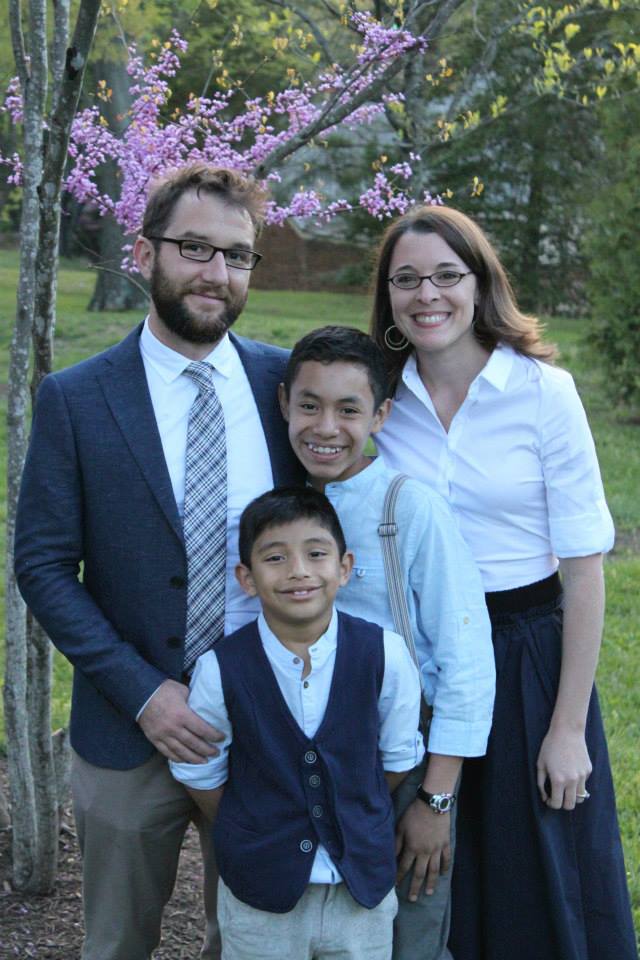
Alexander is now 11, soon to turn 12, and is without a doubt one of the most mature and incredible human beings I have ever met. After Jason and Ali met him for the first time they knew that God was calling them to bring him into their family, to love him with all that they had, and they responded like the faithful people they are, with open arms.

Jason, Ali, Alexander, and Gabriel

Jason, Ali, Alexander, and Gabriel

When Alexander arrived at Jason and Ali’s home, he came with the clothes on his back and nothing else. A five year old Guatemalan boy with little English was dropped off at their home; I can’t even imagine what it must have felt like for him. Yet, Jason and Ali brought him into their family and they never looked back. 

In the beginning, they had to sleep with him in his bed night after night, in attempts to comfort him and let him know that they were never going to leave him. That no matter what he did, no matter how far he fell, there was nothing that would ever separate their love for him. For a child that had been passed from person to family to family, Alexander had no roots, he had little comfort, and he had not experienced love.

Jason and Ali stepped into his life just as Alexander stepped into theirs. Perhaps filled with fear about what the future would hold for their little family Jason and Ali’s faithfulness shines brilliantly through the life of a young man named Alexander who I believe can, and will, change the world.

I imagine that for some time Jason and Ali believed that they, like Pharaoh’s daughter, had drawn Alexander out of the river of abandoned life. But I know that now when they look back, when they think about that fear of the unknown, they realize that Alexander was the one who drew them out of the water into new life. Divine Irony. 

In the story of Moses’ adoption out of the Nile, God is never mentioned. There are no divine moments when God appears on the clouds commanding his people to do something incredible, there are no decrees from a burning bush (not yet at least), and there are no examples of holy power coming from the heavens. Yet, God is the one working in and through the people to preserve Moses’ life and eventually the life of God’s people. God, like a divine conductor, orchestrates the music of life with changing movements and tempos that bring about transformation in the life of God’s people.

I believe that most of you, if not all of you, would take up a new and precious child into your lives. Whether you feel that you are too young, too old, too poor, too broken, you would accept that child into your family and raise it as your own. We are people of compassion, we are filled with such love that we can do incredible and beautiful things.

But it becomes that much harder when you look around and understand what we have become through baptism. Every child, youth, or adult, that it baptized into the body of Christ has been lifted out of the Nile of life into a new family. The people in the pews have truly become your brothers and sister in the faith through God’s powerful baptism. The Divine Irony is that we might feel we are called to save the people in church, when in fact they might be the ones called to save us. 

The story of Moses’ birth and childhood is beloved. It contains just enough power to elicit emotional responses from those of us lucky enough to know the narrative. It is a reminder of God’s grace and love through the powerful and the powerless. But above all it is a reminder that like a great and loving parent, Moses has been taken into the fold of God’s merciful love and grace. That we, through our baptisms and commitments to being disciples of Jesus Christ, have been brought out of the frightening waters of life into the adoptive love and care of God almighty. That we, though unsure of our future and plans, are known by the God of beginning and end.

Just as Jason and Ali held Alexander every evening, just as Pharaoh’s daughter cradled Moses in her arms, we have a God who loves us, who holds us close, and will never let us go. 

Amen.


Gabriel and Alexander in 2009

Gabriel and Alexander in 2009

Devotional – Psalm 18.1-2

Devotional:

Psalm 18.1-2

Protect me, O God, for in you I take refuge. I say to the Lord, “You are my Lord; I have no good apart from you.”

Weekly Devotional Image

5 days. In 5 days I will be waiting at the altar of my home church, watching a beautiful bride walk down the center aisle to stand next to me as we enter holy matrimony. It has been more than a year since I asked for her Father’s blessing and placed a ring on her finger; I cannot believe the wedding weekend is so close. Words do not do justice to the love and joy that Lindsey has blessed me with, and I am so excited for us to stand before God, our families, and our friends, as we covenant together.

741111_4136006929474_543179185_o

Our journey to the wedding has been filled with both wonder and trials. At first, Lindsey did not like me nearly as much as I liked her. My planned and executed dates were met with platonic affection. As I began to back away, she stepped forward and the tables had turned. Our relationship began out of a willingness to be honest with one another and find harmony in our time spent together.

We dated throughout our time in Durham, North Carolina surrounded by friends who helped to cultivate and nourish our relationship. We were spoiled rotten by our peers from work and school who went our of their way to include us and make us better than we were.

431201_673719668650_364622628_n

When we moved to Staunton we lost the familiarity of seminary/work in addition to our social network of friends. For months Lindsey and I had to live into a community that was very different than what we left. Lindsey had to find work, and I had to adjust to the work of St. John’s. Learning and appreciating the culture of our new home has been difficult, but with the wedding so close in sight I can say, without a doubt, that we are exactly where we are supposed to be.

1012326_10151692266377840_921328894_n

From the very beginning of our relationship we have tried to keep God at the center of our focus. Some of our first conversations were about how God has revealed himself in our lives and we have strived to keep that at the forefront of our minds. As I prepare to join Lindsey in wedded life I believe that I am only where I am because God is my Lord, and I recognize that the good in my life has come from Him.

This week I encourage each of you to take a look at your lives. When have you had your trials and tribulations? When has God been revealed to you? Do you take refuge in the Lord? Do you see the goodness of your life as a gift from God?

If we are an Easter people, a people of resurrection, then God can make all things new. No matter where you are, may God bless you as he has blessed us.