The Lord Is With You – Sermon on Luke 1.26-38

In the sixth month the angel Gabriel was sent by God to a town in Galilee called Nazareth, to a virgin engaged to a man whose name was Joseph, of the house of David. The virgin’s name was Mary. And he came to her and said, “Greetings, favored one! The Lord is with you.”But she was much perplexed by his words and pondered what sort of greeting this might be. The angel said to her, “Do not be afraid, Mary, for you have found favor with God. And now, you will conceive in your womb and bear a son, and you will name him Jesus. He will be great, and will be called the Son of the Most High, and the Lord God will give to him the throne of his ancestor David. He will reign over the house of Jacob forever, and of his kingdom there will be no end.” Mary said to the angel, “How can this be, since I am a virgin?” The angel said to her, “The Holy Spirit will come upon you, and the power of the Most High will overshadow you; therefore the child to be born will be holy; he will be called Son of God. And now, your relative Elizabeth in her old age has also conceived a son; and this is the sixth month for her who was said to be barren. For nothing will be impossible with God.” Then Mary said, “Here am I, the servant of the Lord; let it be with me according to your word.” Then the angel departed from her.
Luke-Chapter-1-The-Annunciation-to-Mary

Greetings, favored one! The Lord is with you.

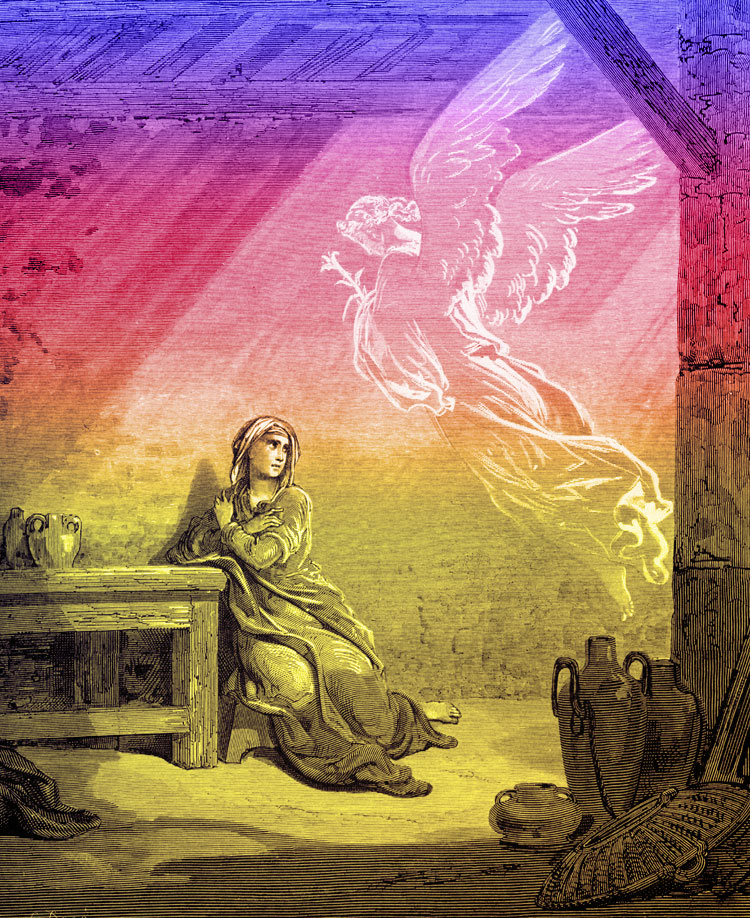
In the sixth month, that is to say in the sixth month of Elizabeth’s pregnancy (from the scripture last week), the angel Gabriel was sent to another Israelite. Just as he had come to bring good news to Zechariah, Gabriel was now on a mission to find a young woman. And so it came to pass that Gabriel was sent by God to a town in Galilee called Nazareth, to a virgin engaged to a man whose name was Joseph, of the house of David. The virgin’s name was Mary.

This is a new episode in the gospel of Christ according to Luke, yet it is very clear how closely this story parallels the story of Zechariah in the Temple. Both interactions with the divine messenger are stories of God’s grace and power. Grace in that what is soon to take place will illumine God’s favor toward the world, and power in that God can work through the unable — an old childless couple, and an unmarried virgin. Both Elizabeth and Mary will become mothers because God is able, and they will have sons for our sake because God is righteous and gracious.

Gabriel said to her, “Greetings, favored one! The Lord is with you.” But Mary was much perplexed by his words and pondered what sort of greeting this might be. And the angel continued, “Do not be afraid, Mary, for you have found favor with God.”

Do you remember the story from last week? Do you remember how Zechariah was struck with fear when confronted by the angel in the most obvious of places, the innermost holy place of the Temple? Do you remember how his unbelief regarding the good news from Gabriel resulted in his becoming mute until the birth of John the baptist?

archangel-gabriel-struck-zechariah-mute-1824

Instead of a priest, one who should have been most familiar with the ways of God in the world and the stories from the past, Gabriel appears to a young unmarried virgin named Mary who does not respond in the same way.

Zechariah was overwhelmed with doubt and fear whereas Mary responded with awe and perplexity. Zechariah wanted to see a sign, wanted proof of the tidings brought by the angel, wanted to have his unbelief changed. Mary responds with curiosity. The messages from God speak into one’s insufficiencies, and brings good news of heavenly grace that must be trusted before its ways are known. There is great power in this story between the way Zechariah reacted, and the way Mary responded.

“And now Mary, you will conceive in your womb and bear a son, and you will name him Jesus. He will be great, and will be called the Son of the Most High, and the Lord God will give to him the throne of his ancestor David. He will reign over the house of Jacob forever, and of his kingdom there will be no end.”

This is good news. This is the kind of message that everyone had been waiting for. A new gift from God was going to come into the world through a young woman to be called the Son of the Most High. A new gracious leader is coming to take back the throne of David. The kingdom that God had always wanted for us is coming! And nothing will be able to stop God in all his majesty because this new kingdom will have no end!

“How can this be, since I am still a virgin?” Mary wondered. There is a difference here between doubt and curiosity. She believes the words from Gabriel, she understands that she will be bringing a child into the world. She is already preparing herself for God’s will in her life, but her curiosity regarding the fundamentals of God’s purposes come forth.

“The Holy Spirit will come upon you, and the power from the Most High will overshadow you; therefore the child to be born will be holy; he will be called Son of God. And even now, your relative Elizabeth in her old age has also conceived a son; and this is the sixth month for her who was said to be barren. For nothing will be impossible with God!

9

After explaining the elements of her coming conception, Gabriel ends his description with a final word of assurance. Gabriel recalls for Mary, and all of us, the creed behind all creeds, the very words spoken to Abraham and Sarah when they doubted the word that they were going to have a child in their old age: For with God nothing will be impossible.

And with perfect clarity, with willing submissiveness to God’s plans in the world, and with hope and joy, Mary responds to the calling of God: Here am I, the servant of the Lord; let it be with me according to your word. And then Gabriel departed from her.

How many times have you heard this story? Even for the so-called “unchurched” most people have heard, even just a sampling, of this story. The amount of art, Christmas decorations, and portrayals of Mary’s meeting with Gabriel are far and wide. This story is the source of great hope, frightening church schisms, and definitive reality shifts. Just as the prophet Isaiah told the Israelites, “Behold a virgin shall conceive a son and he will be called Immanuel,” the virgin Mary was met in the middle of the night by an angel to discover that she was to be the vessel of the Lord.

However, like the story of Zechariah in the temple, Mary’s midnight meeting has been told so many times that it is often difficult to discover something new and fresh when we approach the story. This week as I made my way through the first chapters of Luke, engaged in numerous conversations, and pondered over the heart of Advent, I began to wonder: Why Mary?

Why Mary? If God wanted to come into the world in a big way, with pomp and circumstance; If God wanted to come in the form of flesh to dwell among us as a king with power, he certainly could’ve picked a better mother. Why on earth did he choose her?

I’ve always had a hard time understanding what it is about Mary that made her highly favored in the eyes of the Lord. Remember Gabriel’s first words: “Greetings, favored one!” Really? How could she possibly be favored? Immediately following this episode she would presently go on a long and difficult journey to small town, not because she wanted to, but because the foreign rulers of her homeland forced her to go. She would be ridiculed, and judged, and even threatened for carrying a child conceived outside of normal circumstances, particularly before being married. She would give birth to this “son of the Most High” in one of the lowliest places, a stable. And after Bethlehem? Long years of obscurity and poverty with the world continually churning with its disapproval of the Jews, with the power from on high weighing down the life of the people. Her baby from Bethlehem would go on to become one of the most hated men in all of Israel and his life would increase in danger until the very end. The humble, marginalized, poor, and weak loved him, while the powerful and wealthy regarded him with hatred. Mary’s baby boy would be murdered on a cross, betrayed by the very people he came to serve. She would come to cradle her lifeless son’s body in her arms just as she did that first night in the manger. That was the favor of God?

Why Mary? Why an unwed, impoverished, and teenage girl?

Throughout the gospels Mary is portrayed as thoughtful, obedient, believing, worshipful and devoted to Jewish law. To us, and to all who knew her, she is the ideal Christian. However, none of these qualities are offered as reasons for God choosing her, God’s reasoning is tucked away from our view. We can guess, and we can come to our own conclusions, but the truth of God’s choice is known only to God in his eternal plan.

If Mary had wanted a perfect life on unbroken happiness, ease and pleasure in all things, then she certainly didn’t get it. If she had tried to measure up the favor of the Lord by the expectations of the world, then it would seem that the promise and salutation of the angel was only an illusion.

But the truth, and I mean real truth, is always deeper than it appears on the surface. 

The world would tell us, that God’s favor is to be found in ease, pleasure, and prosperity. God’s favor can be seen in a Christmas tree covered in perfect ornamentation with a plethora or present piled underneath. How many televangelists and “christian” writers make their millions and claim that God’s favor is with them, that God wanted them to be wealthy and powerful? Their messages always contain some sort of theologically problematic promise: If only you pray more, if you only read your bible more, if you only put more money in the offering plate, then God will make you healthy, happy, holy, and wealthy.

That is not the gospel.

It is a terrifying paradox, but, it is the lives which have been given something great to do and to bear, even though they may have been bruised and battered in the process, which have truly known the favor of God.

If God had wanted our discipleship to be easy then he would not have come into the world through the difficult situation of an unwed virgin. If God had wanted our faith to be easy then we would have no need for church, repentance, and forgiveness.

With Mary, and frankly with every single one of us, it comes down to obedience. Purely and humbly Mary put herself into the hands of God. She sacrificed so that God’s will could be done in the world. “Let it be with me according to your word.”

As the story continues, Mary meets with her relative Elizabeth, and when John leapt in his mother’s womb while in the presence of Jesus in Mary’s, she responds by praising God. She praises God even though the child in her womb will certainly make her life more difficult. And when we read the Magnificat it seems like Mary is continuing to praise God for the wrong reasons. Rather than celebrating God’s gifts to the proud, the powerful, and the rich, she offers joy that God has turned such values upside down.

I believe that we, myself included, are so often caught up with what the world defines as greatness, what the world defines as favor, that we lose sight of God’s kingdom right in front of us. We would all do well to join in with Mary’s song and magnify the Lord who lifts up the lowly and vulnerable in love. We would do well to open our eyes and ears to what God is doing in the world, what God wants to do through us, and respond with a resonating, “Here I am, let it be with me according to your word.

So, how is it with your soul? Where have you felt God tugging you in your life? Is there a pull or a nudge that has happened, perhaps you don’t know why, but you know that something is there? Have you seen a place in your life that you want to change but you’re unsure of whether or not you really can? Is God calling you to do something in your life and you, like Mary, are perplexed at how it would even be possible?

My guess is, we all have something. Whether large or small, grand or simple, God is always calling us to something new. To fix a broken relationship, to reach out to those marginalized in our own community, to shine a great light when it feels like the darkness is taking over.

As we prepare to make our way to Christ’s table let us all remember that with God nothing is impossible. An old childless couple can be given new life, a virgin can bear a child who came to save us, we can all be forgiven for the wrongs we have committed, death can be defeated, life after life after death is available through the grace of God, lives can be transformed, love can be discovered, and faith can be rekindled. Nothing will be impossible with God.

Amen.
 

Weekly Devotional – 12/23/13

Devotional:

Psalm 96.1-4

O sing to the Lord a new song; sing to the Lord, all the earth. Sing to the Lord, bless his name; tell of his salvation from day to day. Declare his glory among the nations, his marvelous works among all the peoples. For great is the Lord, and greatly to be praised. he is to be revered above all gods.

1535751_10202812940587494_483312224_n

I love being a pastor. I love getting to spend time each week contemplating the Word of the Lord, reading from numerous texts, spending time in prayer, and working on a sermon for Sunday. I love getting to go out into the community to visit those who are sick, alone, afraid, or no longer able to attend church. I love representing St. John’s within Staunton through various organizations and events. I love the fact that people feel comfortable enough to spend time with me and share their stories. I love getting to participate in the life of this faith community as a pastor who serves the church and its people. But one of the things that I love most about being a pastor, is the fact that our church has a Preschool.

Every morning (while the school is in session) I make my way down to the classrooms and I try to greet every child and parent that comes in. I visit each room during the day and help the children with their letters, build giant block fortresses, and ask them questions about whatever I can think of. Most of the children “know” who I am, and they call me Pastor, but I believe they think thats my first name. Some of them are often confused by this adult who comes in to play with their toys regularly, and perhaps they see me as a giant kid (which I am).

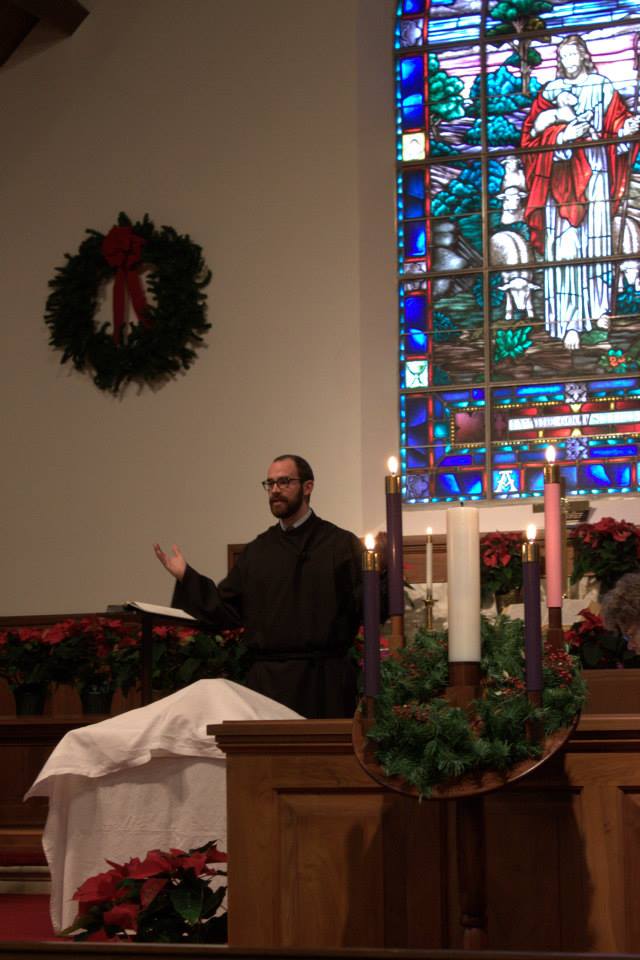
Last week the Preschool children put on a pageant for their parents and families in our sanctuary. I was blessed to be offered to the role of narrator and I dressed up as a shepherd for my role (the kids were in costume as the various animals from the manger scene). After they had remembered for us the Christmas story, and performed a number of Christmas themed songs, they went to the social hall in order to change out of costume and wait for the parents to join them for a reception. My job was to talk for 5-10 minutes to all the adults so the teachers would have enough time to get everything ready.

Now, bear in mind, that many of the people in attendance that night do not attend any church. Their children are affiliated with a Preschool from a United Methodist Church, but that night might be the only time of the year that they step forth into a sanctuary.

So, I gave a very brief sermon about the meaning of Christmas and the importance for everyone in the room to love their children; not just with presents, but with real and tangible love; caring about what they’re interested in, supporting them throughout their lives, and taking the time to show them they are loved. When it was clear that I had expended my theological and homiletical thoughts, I did what any good Methodist would do, and I picked up my hymnal.

I encouraged everyone to stand and join together with Hymn 246 “Joy to the World” and those people belted their hearts out! I couldn’t believe it. Here I was standing with a bunch of random adults, most of whom do not attend church, and they were singing Joy to the World in harmony and with gusto!

The psalmist writes, “Sing to the Lord a new song; sing to the Lord, all the earth.” For many of us, Christmas Eve is that one day where we get to sing some of our favorite hymns in church: Hark! the Herald Angels Sing, Angels We Have Heard on High, Silent Night, O Come All Ye Faithful, Joy to the World, etc.

Whether church attending or not, whether filled with faith or doubt, whether excited for Christmas or afraid, there is something about singing that allows the truth depth of our souls to break forth into the world. Wherever you are on your faith journey this year, I hope the words and the tunes of your favorite Christmas songs can help to reignite the flame of faith in all of our hearts.

“He rules the world with truth and grace, and makes the nations prove the glories of his righteousness, and wonders of his love, and wonders of his love, and wonders, wonders of his love!”

Merry Christmas!


0070=70

Greatness – Sermon on Luke 1.5-23

Luke 1.5-23

In the days of King Herod of Judea, there was a priest named Zechariah, who belonged to the priestly order off Abijah. His wife was a descendant of Aaron, and her name was Elizabeth. Both of them were righteous before God, living blamelessly according to all the commandments and regulations of the Lord. But they had no children, because Elizabeth was barren, and both were getting on in years. Once when he was serving as priest before God and his section was on duty, he was chosen by lot, according to the custom of the priesthood, to enter the sanctuary of the Lord and offer incense. Now at the time of the incense offering, the whole assembly of the people was praying outside. Then there appeared to him an angel of the Lord, standing at the right side of the altar of incense. When Zechariah saw him, he was terrified; and fear overwhelmed him. But the angel said to him, “Do not be afraid, Zechariah, for your prayer has been heard. Your wife Elizabeth will bear you a son, and you will name him John. You will have joy and gladness, and many will rejoice at his birth, for he will be great in the sight of the Lord. He must never drink wine or strong drink; even before his birth he will be filled with the Holy Spirit. He will turn many of the people of Israel to the Lord their God. With the spirit and power of Elijah he will go before him, to turn their hearts of parents to their children, and the disobedient to the wisdom of the righteous, to make ready a people prepared for the Lord.” Zechariah said to the angel, “How will I know that this is so? For I am an old man, and my wife is getting on in years.” The angel replied, “I am Gabriel. I stand in the presence of God, and I have been sent to speak to you and to bring you this good news. But now, because you did not believe my words, which will be fulfilled in their time, you will become mute, unable to speak, until the day these things occur.” Meanwhile the people were waiting for Zechariah, and wondered at his delay in the sanctuary. When he did come out, he could not speak to them, and they realized that he had seen a vision in the sanctuary. He kept motioning to them and remained unable to speak. When his time of service was ended, he went to his home.


“Do not be afraid, Zechariah, for you prayer has been heard.”

archangel-gabriel-struck-zechariah-mute-1824

And so it came to pass in the days when King Herod ruled Judea, that a priest named Zechariah had his life turned upside down. Now Herod was a terrible king, responsible for countless atrocities, murders, and high levels of corruption. A man with frightening power ruled over a land and a people with such chaos that he dominated the attention of the masses. During his rule, a nobody priest married to a woman named Elizabeth, made his way through life.

Zechariah belonged to the priestly order of Abijah and was regularly responsible for activities around the Temple in Jerusalem. Though Zechariah and Elizabeth lived righteous lives, they had no children and were getting on in years.

One day, a day like any other, Zechariah made his way to the temple in order to perform his regular duties. As was the custom, lots were cast to decide who would enter the sanctuary and offer incense to the Most High God. While countless people gathered outside the walls, Zechariah made his way in to perform a simple task that had been done for as long as he could remember.

This is where the story gets interesting.

1-blake-z-and-angel

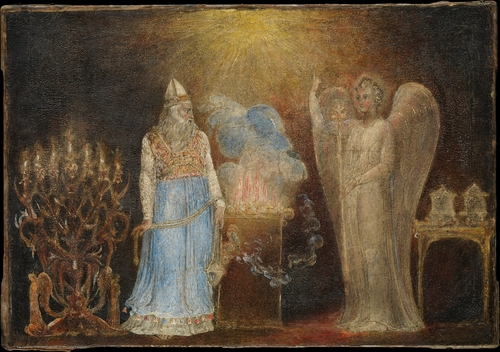
While standing within the closed room, an angel of the Lord appeared to Zechariah. We receive no description of this heavenly messenger in the biblical narrative, but the sight was enough to overwhelm and terrify Zechariah. Let your imaginations conjure up the confrontation with an angel to the degree that you would cower in fear and trembling.

Do not be afraid, Zechariah, for your prayers have been heard. Your wife Elizabeth will bear you a son, and you will name him John. You will be filled with joy and gladness and many will rejoice at his birth, for he will be great in the sight of the Lord. Take care to make sure that he never drinks wine or other strong substances, even before his birth he will be filled with the Holy Spirit. In time, he will turn the people of Israel back to the Lord their God. He will make ready a people prepared for the Lord.

And how does Zechariah react to this momentous declaration? How does he respond to the heavenly messenger carrying news of great joy?

“How will I know this is so? For I am an old man, and my wife is getting on in years.”

It’s moments like these in the scriptures that I wish I could jump into the story and smack some sense into the lives of the people experiencing the glory of God. How will you know this is so Zechariah? You fool! Don’t you know that with God all things are possible? Have you forgotten how he delivered your people from slavery and captivity in Egypt through the Red Sea to the Holy Land? Have you forgotten how the Lord provided a ram in the bushes for Abraham to sacrifice instead of his son? Have you forgotten how David was able to triumph over Goliath because the Lord was with him? Moreover, have you forgotten how many barren women the Lord has provided for? Sarah, Rebekah, Rachel, Hannah. Come on Zechariah, have a little faith. 

The angel responds to Zechariah: I am Gabriel and I stand in the presence of God. I was sent to bring you this good news, but now, because you did not believe my words, you will become mute and unable to speak until these things occur.

So Zechariah made his way out of the temple, stood before the crowds unable to speak, and eventually returned home.

Of course, thats not the end of the story, but we’ll save that for later.

What are we to make of this remarkable episode recorded at the beginning of the Gospel according to St. Luke?

God is at work here in ways familiar to us from the Old Testament: the story contains a casting of lots to make a decision, there is a vision in God’s holy Temple, a divine being appears to pass along a message, there is a promised sign, and a childless couple is given new life.

It is clear that God works in and through the normal avenues of life in the believing and faithful community. The community of faith can fall under the temptation to make God into whatever they desire for worship, but there is an important conviction present at the beginning of this New Testament: the stories of Israel are important, vital, and necessary for understanding how to be used for God’s purposes in the world.

Though this is a story from the past, doesn’t it sound familiar? Just as it is today, some horrible and frightening situation has gripped the people, a power reigns from above in order to control a community. Evil has taken root at the center of life and dominates the attention of the populace. This past week marked the one year anniversary of the shooting at Sandy Hook Elementary school and another shooting took place at a school in Colorado. You need only turn on the news or read a newspaper to be reminded how much fear and violence demands ALL of our attention.

However, in spite of all this fear and damage in the world, just as during the time of Herod, there is another sort of person, quiet, removed, and yet, more important than the powers that rule, men and women who are the core of society and give it the depth of its reality. Then and always there were and are the humble and brilliant men and women in whom the strength of the present and promise of the future lie.

Gabriel tells Zechariah that his son, John, will be great in the sight of the Lord. Sadly, according to the ways of the world, greatness has had its definition confused and reshaped. We have been told that greatness is measured in terms of selfishness rather than service, in terms of material rather than spiritual wealth, in terms of instant gratification rather than hard work and perseverance. But greatness as God sees it, the greatness that John will live into, is about being linked with the eternal purposes of redemption, about being an obedient instrument of God’s peace, and helping others to know and feel love in their lives.

But notice: the greater John will become for God, the more hostility he will arouse in those around him. Doing the will of the Lord, reaching out in love according to discipleship sends ripples through the fabric of what the world deems as “greatness.”

John is to be like the prophets from old: in light of their direct contact and experience of the divine, they drew the messages which burned within them like fire and would not rest until the decrees of God were delivered.

In every age we need the passion of people on fire for God to shout out in prophetic fervor. Our lives are so often filled with the dry wood of dull possibilities that desperately need to be rekindled by the divine spark that often comes through the words and actions of the prophets. We need to have our lives turned around and back to God in order to discover the passion that is waiting for us in our discipleship. The communion between God and the prophet allows for a divine condition to be present and the purposes of God can be realized in the world.

I love the juxtaposition of the story of Zechariah in the temple with Gabriel. It is precisely at the moment when John is being prepared to speak for God, Zechariah is struck mute for his unbelief. The typical, traditional, and tired voice of the priest, is being replaced by the fervent, fantastic, and faithful voice of the prophet.


Worship is at the center of the story. I’ve read it countless times, and heard it discussed and preached on during numerous advent services, but something fresh and new struck me this week about Zechariah’s encounter. I wondered: why was he so surprised and scared? Think about it for just a moment; Zechariah was a priest, well-versed in the stories from old about how God interacted with God’s people, a man who often found himself in the holiest of places performing the works of the Lord. What did he think would happen to him inside that holy space?

Being overwhelmed by the presence of an angel in the sanctuary of the temple is like going to McDonalds, ordering a Big Mac, and being surprised to discover beef between the bread… I mean this is how God works! God shows up, confronts us in the midst of a moment, and calls us to something. It does not need to be grand, and more often than not it occurs in the small silence in a moment we least suspect, but for Zechariah it came in a big way. He was in God’s holy temple confronted by an angelic messenger bringing the good news. So why was he so surprised? And more importantly, why did he doubt the validity of the message?

Our expectations about worship have major impacts on the way we live our lives.

What we believe shapes how we behave.

What to we think will happen to us when we gather in this space? Are we prepared to be confronted by the God who called John to greatness? Are we willing to let God dwell in our hearts and change the way we live in the world? Are we ready to take up our own crosses to follow Jesus. Are we prepared for God to show up in our lives in ways that we cannot expect or anticipate?

Unless we recognize the definitive need for real experiences and methods of discipleship which wake the whole depth of our experience, then what we do in worship will remain, as it did for Zechariah, thin and lacking. Until we prepare ourselves to be surprised by God’s desire to find us where we are, then this holy place will remain, as it did for Zechariah, boring and repetitive. Until we dare to step out into new forms of life and love, hearing the word of the Lord, and letting it become incarnate in the ways we live our lives, then faith will remain, as it did for Zechariah, dwindling and fruitless.

eucharist

What do we expect will happen when we gather together at Christ’s table? Are we repetitively entering the holy space to burn incense unaware that we are meeting God in all of his holiness? Or are we excited and nervous about the prospect of being welcomed to a table that we have no right to join? Are we so rooted in our habitual worship that we can no longer remember why we join at this table? Or are we prepared to be called forth toward greatness in the world through the redemptive and life-giving properties of God’s presence at his table?

Just as it happened with Zechariah, a heavenly voice might be trying to break out into the world. Perhaps God’s good news is striving to strike forth through the closed circle of our expectations of church, faith, and discipleship. Important for us this morning is to remember that God is always on the move, reaching out to find us and change our lives, that there is always a new message for those with ears to hear. The great need for us is to realize, as Zechariah eventually did, to not be caught up in the limited imagination of what God can do in the world which assumes that the present must always be governed by the past.

zech_eliz_john

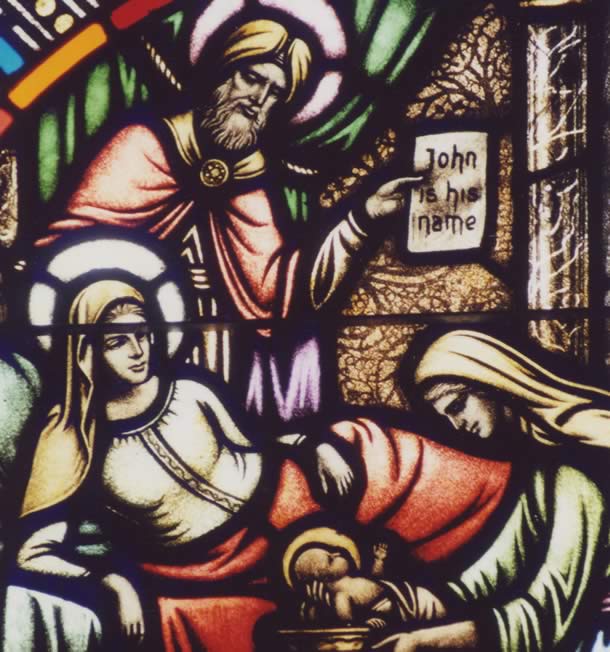
Nine months after Zechariah was struck mute in the temple by Gabriel, his wife Elizabeth gave birth to a baby boy. When it came time to name the child, the family wanted to name him Zechariah after his father, but Elizabeth insisted that it was to be John, and after Zechariah confirmed this with writing on a tablet his mouth was freed. The plague of his disbelief had been wiped away by the miracle of his son’s birth. Now filled with the Holy Spirit Zechariah spoke these great words to his infant son: And you, child, will be called the prophet of the Most High; for you will go before the Lord to prepare his way, to give knowledge of salvation to his people by the forgiveness of their sins. By the tender mercy of our God, the dawn from on high will break upon us, to give light to those who sit in darkness and the shadow of death, to guide our feet into the way of peace.

This is one of the many places that God confronts us in our lives. Through the bread and the wine let us all be moved to live lives worthy of the greatness that God is calling us toward.

Amen.


Weekly Devotional – 12/16/13

Devotional:

Psalm 80.19:

Restore us, O Lord God of hosts; let your face shine, that we may be saved. 


I used to love making fun of my pastors who complained about how much busier they became during advent. It’s not as if they had more on their plates than any other month during the year, but they nevertheless felt overwhelmed by this particular liturgical season.

I now regret making jokes at their expense.

I’m not sure how its possible, because we are not doing more than the ordinary during this time, but I am busier than I have been since I started working at St. John’s in June. I like to think that my newfound busyness stems from the different holiday concerts and Christmas pageants or the shifts for selling Christmas trees or the added time spent decorating the house… but I think it really comes from somewhere else.

country-church-christmas

This season carries with it tremendous joy but also remarkable sadness. Advent helps to prepare us for the coming of the Lord, but often times we fail to prepare ourselves for the onslaught of emotions and old memories that are triggered by this time of anticipation. In the last few weeks I have noticed more tears and tissues in the pews that are the result of the welling up of suppressed emotions that this season breaks forth. For as much as we can be excited about opening gifts together under the tree with a fire roaring in the fire place, for many of us Christmas embodies tremendous pain that is often difficult to ignore.

At the end of the 80th psalm, the psalmist writes, “Restore us, O Lord God of hosts; let your face shine, that we may be saved.” I believe that this psalm is one that we need during this season, perhaps more than any other. We need to feel restored in our lives during this time when old and difficult memories flood our perspective. We need to be reminded of God’s glory that outshines all of the darkness in our lives. We need to sing those familiar hymns, let the tears flow, and remember that God came in the form of our brokenness to dwell and walk with us.

So, as we all make it through this last week of advent, preparing for the great coming of our Lord on Christmas, let us all take the time to live into the brokenness in our lives. Do not ignore the pain that this season often brings. Let it be. But remember that it does not have the final word. God has triumphantly declared that He will make all things new, that we are not defined by our pasts, but instead by the love that God has for each and every single one of us.

Weekly Devotional – 12/9/13

Devotional:

Psalm 146.5-10

Happy are those whose help is the God of Jacob, whose hope is in the Lord their God, who made heaven and earth, the sea, and all that is in them; who keeps faith forever; who executes justice for the oppressed; who gives food to the hungry. The Lord sets the prisoners free; the Lord opens the eyes of the blind. The Lord lifts up those who are bowed down; the Lord loves the righteous. The Lord watches over the strangers; he upholds the orphan and the widow, but the way of the wicked he brings to ruin. The Lord will reign forever, your God, O Zion, for all generations. Praise the Lord!


I love to ask questions. For years I have always been “that guy” at dinner or at a party who can orchestrate the direction of the conversation just by asking a few well placed questions. Depending on the season, or company present, some of my favorite questions include: How did you two meet? What was your favorite halloween costume as a child? What was the last best book you read? All of these questions are geared toward opening up a conversation for all people to respond accordingly. It allows for everyone present to reflect on something and then share it with everyone present. My favorite question to ask during Advent has always been: What was the best Christmas present you ever received?

stxmco001christmas_tree_and_presents1

Its a perfect question. Everyone loves to take a few moments to go through the catalogue in their memory banks of all the presents they received as children, you can detect a positive change in the atmosphere because the memories elicit such joy, and the discussion will continue from that first question toward a full and fruitful conversation.

What was the best Christmas present you ever received? What memories do you have of gathering around the Christmas tree with your family preparing to rip apart the wrapping paper?

I love to ask that question, but recently I’ve begun to wonder whether I should be asking it at all. The celebration of Christmas (according to the ways of the world) has so trumped the theological convictions of Advent that Santa Claus has become frighteningly synonymous with Jesus Christ. Moreover, practices like “The Elf on the Shelf” have led children (and some adults) to grossly misunderstand the depth and breadth of God’s prevenient grace in the world.

When I read from the 146th Psalm I wonder if instead of asking everyone about their favorite present, I should instead ask: “When was the last time you gave food to the hungry?” Or “How are you keeping your faith?”

I know those questions are tougher to swallow, even for me, but I believe they really get at the heart of the Christmas message. How are we living out our faith, particularly during this season of giving? How are we reaching out to those in our community who need to feel the love of Christmas more than anyone else?

So, as we all gather in the shops to find the perfect present, and even as we sit around our perfectly lit and decorated Christmas trees, let us remember the true depth of Christmas. Let us recall that Christ came not to be served but to serve. Let us ask ourselves the difficult and life-changing questions in order that we might live fruitful lives in God’s kingdom.

Wake Up! – Sermon on Romans 13.11-14

Romans 13.11-14

Besides this, you know what time it is, how it is now the moment for you to wake from sleep. For salvation is nearer to us now than when we became believers; the night is far gone, the day is near. Let us then lay aside the works of darkness and put on the armor of light; let us live honorably as in the day, not in reveling and drunkenness, not in debauchery and licentiousness, not in quarreling and jealousy. Instead, put on the Lord Jesus Christ, and make no provision for the flesh, to gratify its desires.

00036884_h

On April 4th, 1742, Charles Wesley came up for appointment as university preacher in St. Mary’s in London. Charles preached from Ephesians 5.14 which reads, “Awake, thou that sleepest, and arise from the dead, and Christ shall give thee light.”

Now, just for context sake, Charles Wesley was the younger brother of John Wesley, the primary founder of the Methodist renewal movement that eventually led to the formation of the United Methodist Church. Both brothers believed that, at the time, the Church of England was losing a sense of purpose and needed to be renewed. They were strongly rooted within their church structure, but they considered their ministries to be caught up in spreading scriptural holiness throughout the land. While John was known for his organization and preaching, Charles was known for his ability to write hymns; some of his more celebrated hymns are sung on a regular basis in many churches: Christ the Lord is Risen Today, Come Thou Long Expected Jesus, Hark! the Herald Angels Sing, O for a Thousand Tongues to Sing, to name a few.

So, Charles found himself invited to preach in front of a university audience that he largely believed had lost sight of what it meant to be Christian in the world. Those in attendance that day were far more consumed with the “academic pursuits” of Christianity rather than a deep and inward sense of what it meant to be forgiven and loved.

Like many young and naive pastors, Charles preached a sermon filled with a barrage of frightening assumptions and left many in attendance frustrated, angry, and ignorant.

ArtMuseum-Awake-thou-that-sleepest

Here are a few of his lines, adapted for our contemporary period: Wake up! Everyone of you, wake up out of your dreams of worldly happiness. What is the state of your soul? If God required you to die right now while I am preaching, are you ready to meet death and judgement? Have you fought the good fight and kept the faith? Have you secured the one thing needful? Have you recovered the image of God, even righteousness and true holiness? Are you clothed in Christ? Do you know that God dwells in you by his Spirit that he has given to you? Have you received the Holy Spirit? Or do you even know if there is a Holy Spirit at all? If any of these questions offend you, be assured that you are not a Christian nor do you desire to be one. Indeed, your very prayers have been turned into sin; and you have definitively mocked God this very day by praying for the inspiration of his Holy Spirit when you did not even believe that such a thing existed!

Needless to say, this was Charles’ first, and very last, occasion for preaching there.

Though Charles chose to preach from Paul’s letter to the church in Ephesus, Paul also wrote in a similar vein to the church in Rome: “Besides this, you know what time it is, how it is now the moment for you to wake from sleep!” What is the “this” that he is talking about? Love is the fulfillment of the Law. So, besides knowing that love is the fulfillment of the law, it is now time for us to wake up! For salvation is nearer to us now than when we became believers; the night is far gone, the day is near. Let us then lay aside the works of darkness and put on the armor of light; let us live honorably as in the day, not in reveling and drunkenness, not in debauchery and licentiousness, not in quarreling and jealousy. Instead, put on the Lord Jesus Christ, and make no provision for the flesh, to gratify its desires.

A-Thanksgiving-meal-has-at-least-3000-calories

Coming off of a major holiday weekend where we have all gratified our desires with mountains of mashed potatoes, rivers of gravy, quarries of cranberries, and seas of stuffing, where many of us were filled with debauchery and quarreling as we competed for the best holiday shopping prices on Black Friday, where we are now more focused on Santa Claus than Jesus Christ… it is very difficult for a young foolish pastor like myself to preach this text without ruffling some feathers. I used to laugh when I read Charles Wesley’s sermon “Awake, thou that sleepest” but now I’m beginning to understand how important it was for him to preach those words.

ap_black_friday_21_dm_121123_wg

Today is the first Sunday of Advent, the beginning of the Christian year. Just as we came to a conclusion with Christ the King Sunday last week, today we begin by looking forward, with expectation, to the birth and arrival of our King. But here’s the great paradox, even though we are looking forward to Christmas, it feels like we’re stuck looking to the past. In many areas of church life this is a plague that has permeated throughout a multitude of ministries, relationships, and conversations. We talk about where we are as a church, what we want to do, but far too many of our imaginations are trapped by the past. 

If, as Paul argues, love is the fulfillment of the law in he past, then love is most assuredly also the appropriate mode of action in the present.

Being Christian is all about love in action; not just a reflection on the past, but also a waking up to the present and the future. 

For disciples of Jesus Christ, one of the hardest things to wrap our heads around is “time.” We are a people who regularly remember the past, in order to live into the present, while also looking forward to God’s promises. We are a people rooted in time, removed from time, and unaware of God’s time. Our past is constantly invading the present, and the future has already met with the present in the presence of the Holy Spirit within the faithful community.

If your head is spinning, don’t worry. It should be.

God-in-time

God’s future casts a light into the present and provides the illumination of the reality by which we are all called to live. Because God has promised to come again and make all things new, a new heaven and a new earth where death will be no more, death will die, then we are called to live into God’s future reality in the present. We are called to love in order to fulfill the Law.

What makes us unique as a people is precisely the fact that God has invaded our present with the Spirit, with his Son who walked among us, with his Word, with his sacraments, that we are a distinctive people with expectations of how the world needs to be.

For us, the time is now! Wake up! 

As Christians we are not to be content with passively accepting injustices and evils in the world. Our faith demands that we reach out in love to combat the sinfulness of the world. How often do we think about our obligations to love outside of our families and our church community? What could this world look like if we seriously considered loving all, and all means ALL, of God’s creatures?

We are creatures of the present, though we are so consumed with our pasts. Our text today encourages us to look to the future in order to know how to act. As Paul wrote elsewhere in Romans, do not be conformed to this world, but be transformed by the renewing of your minds. Discover newness in your lives which the future will bring.

Wake up! We are no longer burdened by living for ourselves, but we are privileged to live for God, we are a people who obey his will for our lives. That is what Paul means when he says we are to clothe ourselves in the Lord Jesus Christ. Its what he means by putting off the darkness and putting on the armor of light!

Because of Christ’s redemptive act on a cross in a place called The Skull we have all been liberated from the burdens of a sinful past. We strive forth with confident steps into a future that is always bringing us closer and closer to the fulfillment of God’s redemptive plan for the entirety of creation. We are here as a people of anticipation, here the first Sunday of advent, remembering while anticipating Christ’s in breaking in the world in order to bring about God’s kingdom on Earth.

Wake up! This moment is the eternal moment – the now – when the past and the future stand still, when the past ceases its going, and the future its coming. This moment is not a time that comes and goes, it is God’s eternal moment, a spot of clarity amidst the ridiculous chaos of our lives.

This passage from Paul, read for us this first Sunday of Advent, deepens our understanding of the future whose coming we celebrate both in the birth and in the return of Jesus Christ.

So, how can we wake up from the sleep that we are caught up in? How can we love in such a degree so as to fulfill the law?

Love is always the essentially revolutionary action.

We love the way that Christ loved, and still loves us…

We can reach out to the lonely in our community, those who do not have a family to share this holiday season with. We can gather together in the front of the church selling Christmas trees while demonstrating Christ’s love in the world through the way we reach out to those who stop by. We can participate in quilt for a cause, letting our fingers and needles and thread create a tangible sense of love for individuals in our community. We can donate money for the Children from Social Services who we have adopted for Christmas presents this year, reminding them that nothing will ever separate them from the love of God in Jesus Christ.

We can open our eyes to the injustices within our local community, and abroad, and be willing to speak out against the disparity present. We can love the unlovable, reconcile with friends and family from whom we have been separated, and we can provide a little warmth this coldest time of the year.

Our love for others, creation, and God is never just a concrete act, something that once began and continues on a course. Our love is the Beginning, the Miracle, the Creation in every moment of time, it sets our hearts aflame for Christ Jesus and allows us to be his body for the world.

And so, though paradoxical, what we are doing, the ways that we embody love, can be no more than point to the victory which has occurred, does occur, and will occur in Jesus Christ. Love directs us to the one whose very birth we now await and anticipate. Love awaits the ends of darkness which is the Beginning of the light of the world.

Wake up! You all know what time it is, and it is time for us to wake from our sleep. This is the beginning, another chance to start again. Whatever baggage you are carrying, whatever sin you believe is too harsh to be forgiven, whatever frustration you are dealing with in your life, today is a new beginning. We have gathered together as a community to rid ourselves of the darkness in our lives. We are here to care for one another. You are not alone. You are part of a community of faith that loves you because God loves us. Put on the armor of light. Prepare yourselves to be surprised by God’s grace in the world.

Wake up! Put on the Lord Jesus Christ. Do not be consumed by your past, but with excited expectation live in the present and anticipate God’s future for you.

This table is our Beginning. For it is here that we gather to confess our faults, receive forgiveness, reconcile with our community, and feast at Christ’s table. This place is where past, present, and future all wind themselves together. Christ’s table is the matrix of time; it is where we remember God’s mighty acts, anticipate his birth and coming again, and live into the new reality of love, mercy and forgiveness.

Wake up! God is waiting for you.

Amen.

00036884_h

Weekly Devotional – 12/2/13

Devotional:

Psalm 72.1-7

Give the king your justice, O God, and your righteousness to a king’s son. May he judge your people with righteousness, and your poor with justice. May the mountains yield prosperity for the people, and the hills, in righteousness. May he defend the cause of the poor of the people, give deliverance to the needy, and crush the oppressor. May he live while the sun endures, and as long as the moon, throughout all generations. May he be like rain that falls on the mown grass, like showers that water the earth. In his days may righteousness flourish and peace abound, until the moon is no more.

Youth Band at a Fat Tuesday Celebration

Youth Band at a Fat Tuesday Celebration

When I was in High School I was fortunate to help form a youth band at my home church. A number of us would gather on a weekly basis in the sanctuary playing contemporary Christian music with guitars, bass, drums, and singers. We always had an adult present in order to fulfill the Childcare Protection Policy, but we largely did everything on our own; we picked the music, practiced accordingly, and planned performances throughout the year.

Though I had been attending church my entire life, it was during this period that I began to have a serious appreciation for worship, scripture, and prayer. We would talk about the lyrics of the songs regarding their connection with biblical verses, we debated about how songs should be played in order to indicate the mood of a service, and we began and ended every practice with prayer.

169_1010929764498_9857_n

One of my best friends growing up was a regular for leading prayer at the end of practice. He was often filled with joy (and by the Spirit) and would wave his arms back in forth while we stood hand in hand in a circle. His way of prayer was unlike anything else I had experienced. Whereas many would pray in some sort of elevated way (“Oh Great and Holy Majestic God who knows no bounds, commit thyself to mercy” etc) Will always sounded as if he was talking to another one of his friends. God, for Will, was a constant companion, a trusted friend, and a exciting partner on this journey of life. Will’s prayers were life-giving for all of there because he made God so much more approachable for all of us. Moreover, the prayers were never limited to our specific needs as teenagers, or even as a band, but they flowed over every element of life. Will would pray for the weather (every week), the other people of our church and school, our futures, and justice in the world. He might not know it, but Will taught all of us how to be in relationship with God, and with one another.

The psalmist writes regarding the coming Messiah, “May he be like rain that falls on the mown grass, like showers that water the earth. In his days may righteousness flourish and peace abound, until the moon is no more.” Our relationship with God through Jesus Christ is one that meets us at every moment of our lives, the glorious and the mundane. God confronts us in magnitude and in simplicity. As we continue to shape ourselves into disciples of Jesus Christ, our prayers should always be for the one who falls like rain on the mown grass of our lives.

And so, in this holiday season filled with reunion and sacrifice, remember that Christ is a living presence in your life. When you go to God in prayer, let the words of Psalm 72 help to anticipate God’s coming reign, and our responsibility to live into God’s kingdom of justice on earth here and now. Let us all pray like Will, pray for God to reign abundantly in our hearts so that we might all come within his warm and peaceful embrace.


Jesus Said What? – A Thanksgiving Sermon on John 6.25-35

(preached at Cherryvale UMC in Staunton, VA on 11/27/13)

John 6.25-35

When they found him on the other side of the sea, they said to him, “Rabbi, when did you come here?” Jesus answered them, “Very truly, I tell you, you are looking for me, not because you saw signs, but because you are your fill of the loaves. Do not work for the food that perishes, but for the food that endures for eternal life, which the Son of Man will give you. For it is on him that God the Father has set his seal.” Then they said to him, “What must we do to perform the works of God? Jesus answered them, “This is the work of God, that you believe in him whom he has sent” So they said to him, “What sign are you going to give us then, so that we might see it and believe you? What work are you performing? Our ancestors ate the manna in the wilderness; as it is written, ‘He gave them bread from heaven to eat.’” Then Jesus said to them, “Very truly, I tell you, it was not Moses who gave you the bread from heaven, but it is my Father who gives you the true bread from heaven. For the bread of God is that which comes down from heaven and gives life to the world.” They said to him, “Sir, give us this bread always.” Jesus said to them, “I am the bread of life. Whoever comes to me will never be hungry, and whoever believes in me will never be thirsty.”

Jesus said to them, “I am the bread of life. Whoever comes to me will never be hungry, and whoever believes in me will never be thirsty.”

00029400_h

After miraculously feeding 5,000 people, the crowd stayed on the other side of the sea. Though they had been properly fed by the Word, the loaves, and the fishes, when they discovered that this miracle man was nowhere to be found, they got into the boats and went to Capernaum looking for Jesus.

When they finally caught up with him on the other side, they called out, “Teacher, where did you come from?!?” Jesus responded, “Very truly, I tell you, you are looking for me for the wrong reasons, you came here not looking for signs, but because I gave you enough to eat yesterday. Do not work for the food that spoils, but instead for the food that endures for eternal life, which the Son of Man will give you. For it is on him that God the Father has set his seal.”

“Okay, okay, so what do we have to do in order to perform the works of God?

Jesus answered simply, “This is the work of God, that you believe in him whom he has sent.”

“Well, who do you think you are Jesus of Nazareth? What sort of sign are you going to perform? Why should we listen to you? How can you prove what you are saying to us? Sure, yesterday you fed all of us, made something out of nothing, but so did Moses in the wilderness. Why should we turn away from him, to you?”

“Very truly, I tell you, it wasn’t Moses who gave you the bread from heaven, the manna, but it is my Father who gives you the true bread from heaven. For the bread of God is that which comes down from heaven and gives life to the world.”

“Now Jesus that sounds pretty good to us, we would like some of that bread!”

jeswelcom

“No, you don’t get it. I AM THE BREAD OF LIFE. Whoever comes to me will never be hungry, and whoever believes in me will never be thirsty.”

One of the great paradoxes of what it means to be Christian, is that we already know the end of the story while we’re stuck in the middle of it. Because we read from God’s word in order to remember the mighty acts of God in the world, we are all well versed on what happens in conclusion. Therefore it becomes nearly impossible for us to imagine the depth and meaning of these narratives in and of themselves.

Try with me, if you can, to imagine that you are there among the crowd. Yesterday you were blown away by this nothing of a man who made something out of nothing. As you stood in line with your stomach rumbling, you were given more fish and bread than you had ever seen in your life. Now, you were so hungry that you ate until your stomach was about to explode, (just like many of us will do tomorrow…) and the next day, the miracle man was gone. As your hunger started to creep back up, you agreed with those around you to go looking for this Jesus.

So here you are, gathered together to hear him speak once again. Some of the people in the front challenged him about Moses’ miracle in the wilderness, something about Manna, but you just want him to provide some more food. So as Jesus begins to describe this true bread from heaven that gives life to the world, your mouth begins to water. You imagine a glowing loaf cooked perfectly, warm and moist on the inside, with just enough crust on the outside. You join the chorus around you, “Give us some of that bread Jesus! We want that always!” And Jesus responds, “I am the bread of life.”

For us, the temptation to jump to the end of the story is great. We hear “bread of life” and we think about Holy Communion, we think about the last supper that Jesus shared with his disciples, we think about the crucifixion and the resurrection. And though it is important to know the end of the story, we’re not there yet.

I imagine that many who had gathered together that day were very confused. “What did he say? He’s the bread of life? What in the world could that mean?”

They don’t get it. The crowds that had witnessed Jesus’ miracle the day before knew exactly what they wanted, but thats not what Jesus is offering.

Today too many of us give the impression that numbers and popularity and packed pews are all important and sufficient in themselves. Many churches seem willing to accept people on any terms, if only they will come at all. How interesting is it then, that Christ would only accept the crowds on his terms, and would not want them upon any others. It hurt and frustrated him that they were merely interested in his ability to provide an easing of material difficulties or an increase in their comforts. “You came to me only for the chance of loaves and fish.”

8105338460_5b6fa706bf_z

Similarly, in our contemporary culture people are hugely interested in the by-products of Christianity, but hardly at all in Christianity itself. Crowds of folk are constantly looking for whatever they can get out of church and worship. They are primarily interested in the kind of faith that will give them bread and fish, bigger homes, shorter hours, better health, happier families. Today Christ looks into the depth of our hearts and triumphantly declares, “there are far better and more satisfying things within your reach than you have realized.”

The whole exchange begins with an accusation by Jesus regarding the crowds’ overwhelming desire and interest in full stomachs, instead of the power of theologically oriented signs. Jesus proposes to give them enduring food and not the kind they consumed the day before. The exchange then elicits a question from the crowd about the “works of God” which Jesus reduces to one, namely belief; belief “in him whom he has sent.”

What is belief? What does belief mean for each of you? Are we called to believe in God, in Jesus Christ, in the Holy Spirit? Is belief about accepting the bible as truth? Can we boil down our belief to something like the Apostles’ Creed?

Often times belief in Christian living is compartmentalized into believing that God simply exists.

The kind of belief that Jesus talks about with the crowds in John 6 is a different kind of belief. Belief is more than mental affirmation, belief is a world view, belief is a paradigm shift, belief is about a redefinition of reality.

What we believe, shapes how we behave.

Everything about what we do begins with belief; we believe in Jesus Christ and the things for which he stands, the way and the truth and the life he teaches us, the God whom he reveals to us, the grace and faith he came to offer us, the victory over death which he makes possible even for the least likely of us, the kingdom of God that he inaugurates for us. 

Okay Jesus, you want us to believe, to drop everything, to change our lives, to pick up our own crosses, to follow you. But why? Moses fed us with the manna in the wilderness, what can your belief offer us?

Moses was Moses, a mighty servant and steward of the Lord. Yet what Moses gave to the wandering Israelites was not the bread from heaven; it is God the Father who gives you the bread from heaven, and that is being offered to you this day. What Moses provided, rather what God provided through Moses, was merely food. What Jesus offers the crowd is the almighty God.

Tomorrow, millions will gather together with friends and family to celebrate the wonderful holiday of Thanksgiving. Crowds will develop in all of the airports, the roads will be filled with traffic, and kitchens will be teaming with individuals trying to concoct the perfect mashed potato – turkey – gravy – cranberry – stuffing combination of all time. After exchanging pleasant and cliche reflections on what we are most thankful for this year, most of us will partake to ridiculous degrees on the food set before us. Mountains of mashed potatoes will be eroded with rivers of gravy. Quarries of cranberry salad will rival seas of stuffing.

A-Thanksgiving-meal-has-at-least-3000-calories

Perhaps most frightening is the fact that within 24 hours, we can go from thanking God for all the blessing in our lives, to fighting one another at Best Buy in order to purchase something to fill our insatiable appetite.

ap_black_friday_21_dm_121123_wg

We know what we want, but thats not what Jesus is offering.

I like to think that, as the church, we have matured from our fragile days of discipleship in the first century. I like to believe that because we know the end of the story, we are better prepared to heed Jesus’ call to a life in the kingdom. I like to imagine that, as moderns, we are ready to take up our crosses in brilliant fashion and follow Jesus into glory.

But the truth is, we are still standing in that crowd asking Jesus for the bread.

We struggle so desperately to find meaning in our lives through failed relationships, the accumulation of material possessions, and vocational discernment. We hear the word of the Lord in scripture, and then quickly fall back away into the shadow of our lives. We thank God for our families and then bicker and fight as if they were not precious gifts in our lives.

Just as He did that day in the crowd, Christ looks out to all of us this thanksgiving season and offers us something more fulfilling than anything else. “I am the bread of life, whoever comes to me will never be hungry, and whoever believes in me will never be thirsty.”

“I am the bread of life”; search throughout the scriptures, I challenge you to find something equally simple and profound in summarizing the Good News. This the gospel of Jesus Christ at its very finest! How ample in its sweep, how generous in its description, how impossible to evade. This is a passage to which we can all cling in the darkest moments in our lives. With this one sentence we discover an everlasting hope that will endure all things.

“I am the bread of life”; Jesus Christ is as important to us as the very food we eat. Indeed, Christ is more important to us than food. No amount of food or drink or any material thing will ever fill us the way that Christ does. Through the bread of life that Christ offers we receive strength to live out our faith, we are sustained and nurtured and loved in all things.

“I am the bread of life”; The triune God is an end to all the craving and discontent in our lives. The bread of life roots our identities in the one from whom all blessings flow, the maker in whom we live and move and have our being.

lord__s_supper_by_bclary-d37hhzp

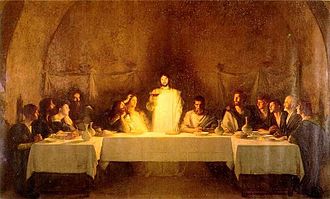
In a few moments all of you will be invited to Christ’s table to partake of him through the bread and the wine. Just as Jesus stood before the crowd to proclaim his identity as the bread of life, Jesus once gathered with his disciples to remember the stories of God in the world and share one final meal.

What are you thankful for this year? How have you been trying to fill the voids in your life? If you want to be filled, if you want to find a sustenance in your life, if you desire to have your life transformed, if you need to be made whole, if you want to discover purpose and faithfulness in your life, if you desire to know God, if you hope to find peace in your lives, then come. Come to Christ’s table. Feast on the true bread from heaven, believe in Jesus Christ, and be filled by the Spirit.

Amen.

00029400_h

Cross and Crown – Sermon on Jeremiah 23.1-6 and Luke 23.32-43

Jeremiah 23.1-6

Woe to the shepherds who destroy and scatter the sheep of my pasture! Says the Lord. Therefore thus says the Lord, the God of Israel, concerning the shepherds who shepherd my people: It is you who have scattered my flock, and have driven them away, and you have not attended to them. So I will attend to you for your evil doings, says the Lord. Then I myself will gather the remnant of my flock out of all the lands where I have driven them, and I will bring them back to their fold, and they shall be fruitful and multiply. I will raise up shepherds over them who will shepherd them, and they shall fear nor longer, or be dismayed, nor shall any be missing, says the Lord. The days are surely coming, says the Lord, when I will raise up for David a righteous Branch, and he shall reign as king and deal wisely, and shall execute justice and righteousness in the land. In his days Judah will be saved and Israel will live in safety. And this is the name by which he will be called: “The Lord is our righteousness.”


Luke 23.32-43

Two others also, who were criminals, were led away to be put to death with him. When they came to the place that is called The Skull, they crucified Jesus there with the criminals, one on his right and one on his left. Then Jesus said, “Father forgive them, for they do not know what they are doing.” And they cast lots to divide his clothing. And the people stood by, watching; but the leaders scoffed at him, saying, “He saved others; let him save himself if he is the Messiah of God, his chosen one!” The soldiers also mocked him, coming up and offering him sour wine, and saying, “If you are the King of the Jews, save yourself!” There was also an inscription over him, “This is the King of the Jews.” One of the criminals who were hanged there kept deriding him and saying, “Are you not the Messiah? Save yourself and us!” But the other rebuked him, saying “Do you not fear God, since you are under the same sentence for condemnation? And we indeed have been condemned justly, for we are getting what we deserve for our deeds, but this man has done nothing wrong. Then he said, “Jesus, remember me when you come into your kingdom.” He replied, “Truly I tell you, today you will be with me in Paradise.”


If you are the King of the Jews, save yourself! There was also an inscription over him, “This is the King of the Jews.

The first time I traveled to Guatemala I had no idea what to expect. Sure I had been on previous mission trips to different parts of the United States, but I had yet to serve the church in a truly different environment. Everywhere we traveled there was a sense of excitement in the air because everything was so remarkably fresh. The abundance of colors in the differing marketplaces, the worn and wrinkled faces of the elderly mayans carrying heavy loads, and the mountains scratching across the horizon.

285_1026151305027_4642_n

I had been looking forward to the trip for sometime and when we finally arrived, everything was meeting my expectations. I believed that we were truly serving God’s kingdom by serving our Guatemalan neighbors by building stoves in the indigenous highland areas. I believed that we had something to share with them, not to convert them, but to live out the gospel of Jesus Christ and demonstrate the love of God in the world.

On one of the early days of the trip, our team arrived in the town of Chichicastenango, known for its traditional K’iche’ Mayan culture. It was a pit stop for us on the way to the higher regions, and we were there for lunch and to explore the vast and dense market. Everywhere you turned you were overwhelmed by the sense of time and tradition, as if this place had remained unchanged for the last few centuries. I wandered through the winding streets, peeked in some of the different booths, but really I was just trying to soak up the culture.

6493_1147085688311_6475115_n

At some point, I became lost. I could not see anyone from my group and continued to travel aimlessly throughout the town. I tried to keep it together, not panic, and decided to find a high vantage point in order to get a bearing on my surroundings. I walked until the stones under my feet started to slant upwards and eventually found myself in front of a very old church. The stone steps were covered with Mayans, sitting and sprawling over every space, and I had to weave my way back and forth in order to reach the entrance of the church. Though I should have immediately turned around to look out at the town, something drew me inside.

6493_1147085808314_3679425_n

The church was damp, dark, and devoid of anyone else. The ground felt alive under my feet as it gave way to my weight, the walls were covered with black soot from centuries of fires, and the paintings and decorations had nearly all disappeared from view. The smell of melted wax filled my nostrils as I began to creep closer and closer toward what I imagined was the altar. It was the least church-like church I had ever entered. Without the help of lighting, I stumbled over rickety wooded seats until I finally found myself standing in the front of the church. There poised in front of me was perhaps one of the most pristine sculptures of Christ that I had ever seen. In complete contrast with the rest of the space, this Christ was unblemished, beautiful, and brilliant. Jesus stood elegantly with his robes draped over his shoulders with one hand outstretched with a remarkable golden crown resting on his forehead: Christ the King.


The celebration of Christ the King Sunday is a relatively recent addition to the Christian calendar. The greater church had celebrated the knowledge and image of Christ as king for centuries, but Pope Pius IX officially added to the Christian year in 1925. It took the church 1900 years to need this feast so bad in order to add it to the life of worship. When the first celebration of Christ the King occurred, Mussolini had been in charge of Italy for three years, the maniacal man named Hitler had been out of jail for a year and his Nazi party was growing in popularity, and the United States was preparing for the Great Depression. In such a time, when the world seemed out of control, the church asserted that, nevertheless, Jesus Christ is King of the universe.

This day, this celebration in the life of the church, became the church’s great nevertheless to the godlessness of the world. Despite the rise of dictators, wars, fear, and death, despite the widespread notion that religion was only a “private affair” for individuals, Christ the King asserted that Jesus Christ is the Lord, and he shall reign forever and ever. 

During the celebration of holy mass in the chapel of the Carmelite Monastery 6 members of the OCDS community made promises to the Order.  Dr. Jason Bourgeois and Judy Hawkins professed their temporary vows for 2 years and David Travers, Suzie Megown, Kath

On Christ the King Sunday the Lectionary provides for us scriptures that reflect the “kingliness” of Jesus. The Old Testament scripture from Jeremiah, contains a prophetic word about the coming Messiah: “The days are surely coming, says the Lord, when I will raise up for David a righteous Branch, and he shall reign as king and deal wisely, and shall execute justice and righteousness in the land. In his days Judah will be saved and Israel will live in safety. And this is the name by which he will be called: “The Lord is our righteousness.” Jeremiah reports the Word of the Lord to a people in a time of chaos: there are people who are unworthily leading and scattering God’s sheep. But nevertheless, God will bring about a righteous Branch, a king to rule all things, a king of righteousness.

What do we want out of a king? Someone who will execute justice and righteousness? Someone who has our best interests at heart? Someone who lowers our taxes? Someone who will lead us victoriously into battle?

The Israelites wanted a king like David. They so desired someone to come in the name of the Lord in order to overthrow the powers that be, and take a seat on their appointed throne. To be crowned with glorious gems and rubies, to bring about God’s kingdom on earth with power. What kind of a king do we want?


And he was led away to the place called The Skull with two others, who were criminals. There Jesus was crucified with the criminals, one on his right, the other on his left. With the blood still wet on his hands and feet, Jesus said, “Father, forgive them, for they do not know what they are doing.” those who had gathered to witness his death began to cast lots for his clothing, and people stood by watching, waiting. The leaders began to mock him, “He saved others; let him save himself if he is the Messiah of God, his chosen one!” The soldiers present also mocked him, coming up and offering him sour wine, “If you are the King of the Jews, save yourself!” And there was a sign hung over his head that read, “This is the King of the Jews.”

Crucifixion-PeterGertner

One of the criminals hung next to Christ kept deriding him and saying, “Are you not the Messiah? Save yourself AND us!” But the other criminal rebuked him, saying “Are you not afraid of God, since you are under the same punishment? And we were condemned justly, for we are getting what we deserve for our deeds, but this man has done nothing wrong.” Then he looked to the Christ, “Jesus, remember me when you come into your kingdom.” And Jesus replied, “Truly I tell you, today you will be with me in Paradise.”

That is our King.

When you really get down to it, when you hear Luke’s remembrance of the crucifixion, it is so simple and straightforward. This is in contrast with the flood of feeling-filled poetry, hymns, sermons, and images that have flowed ever since. Our King did not reign in glory according to the expectations of the world. Instead of a long flowing purple robe he was left nearly naked on the cross. Instead of a crown of rubies, diamonds, and gems, he wore a crown of thorns. Instead of a majestic throne inlaid with gold and comfort, Christ reigned from a cross.

The Romans were notorious for using crucifixion as a form of execution for common criminals because it not only warned the public about the crimes against Rome, but it also added shame, pain, and a slow death. Yet somehow, instead of being hung for shame, Jesus Christ was elevated to his throne on the cross.

In that simple moment of hanging for all to see, Christ the King reigned magnificently over God’s kingdom and demonstrated the depth of what it means to be our King. Jesus refused to test God and heed the call of his tormentors to save himself. Three separate times Jesus was mocked to “save himself,” with the one criminal adding, “and us.” In his final moments Jesus does save someone, and that the one he saved was a dying criminal fits perfectly with the greater message of God’s Good News of the world. In Jesus’ dying hour, he continued his ministry: For the Son of man came to seek and to save the lost. That is what it means to be King.


As I stood in that Guatemalan church, I was confronted for the very first time about what it really means to believe that Christ is the King. I was surrounded by decay, desolation, and disregard yet Christ stood before me as the King. In that moment I saw the paradox of the crucifixion, that the King of God’s glory was hung on a cross to die, that Christians in Guatemala can see the world slipping away from them, yet Christ is still King of the universe. I thought I was bringing something with me to Guatemala, that I was carrying God’s message. I believed I was looking for and seeking out God in my own life when God was the one looking for me; waiting to confront me in that dark and empty church.

How remarkable is it that we worship a God who loves us so much that he is continually looking for us, finding us in the differing moments of our lives to remind us who is really in charge? How beautiful is it that our God came in the form of flesh, to be the incarnate Word, and reign from a cross at the place called The Skull? How perfect is it that our King does not meet the expectations of the world, but instead turns the world upside down? How blessed are we that our King reigns not above us, but for us, beside us, and with us?

Today is the last Sunday of the Christian year, we have come to the conclusion of our liturgical calendar. We began with Christ’s birth made our way through his life death and resurrection. We have remembered the stories of the Old Testament where God made covenant with his people to be their God. We have witnessed the tragedies that have occurred in the world, we have lost loved ones, and suffered in our own lives.

Yet, nevertheless, Jesus Christ is King of all things.

christsinai

Jesus Christ, fully God and fully human, brought forth a new age in the life of humanity, ushered in a new kingdom by water and the Spirit, reigned triumphantly from the most unexpected of places. Jesus Christ, Son of Man, came not to be served but to serve and give his life as a ransom for many. Jesus Christ, Son of God, died on a cross for the world so that we might all be reunited and reconciled with God. Jesus Christ, the Holy One, taught us about how to live and love abundantly in God’s Kingdom. Jesus Christ, King of the universe, was resurrected from the grave to share life eternal with us.

Hallelujah! To God be the Glory forever and ever!

Amen.


Weekly Devotional – 11/25/13


Devotional:

Philippians 4.4-9

Rejoice in the Lord always; again I will say, Rejoice. Let your gentleness be known to everyone. The Lord is near. Do not worry about anything, but in everything by prayer and supplication with thanksgiving let your requests be made known to God. And the peace of God, which surpasses all understanding, will guard your hearts and your minds in Christ Jesus. Finally, beloved, whatever is true, whatever is honorable, whatever is just, whatever is pure, whatever is pleasing, whatever is commendable, if there is any excellence and if there is anything worthy of praise, think about these things. Keep on doing the things that you have learned and received and heard and seen in me, and the God of peace will be with you.


My family loves to celebrate different holidays. My maternal grandmother loves to go out of her way to develop new and fun games depending on the particular festivity. On Easter there is always an easter egg hunt in addition to counting all of the different easter bunnies throughout the house. On Christmas we are usually given a random assortment of objects with the challenge to create something that is indicative of the Advent season in addition to trivia quizzes about differing Christmas songs, scriptures, and traditions. I will wear my grandfather’s lederhosen while my sisters will wear some of my grandmother’s dirndls. Holidays are a big deal.

Mertins Family Christmas 2012

Christmas 2012

On Thanksgiving we always gather together as a family while also inviting friends to partake in this special holiday. The abundance of food and guests usually leaves us with having to put up temporary tables in different rooms in order to accommodate. There is usually some sort of Turkey quiz, or an acrostic poem for something like “M-A-S-H-E-D-P-O-T-A-T-O-E-S.” But the best thanksgiving tradition takes place immediately following the blessing of the food where everyone has to go around the table and share with the group what they are most thankful for. One of my uncles usually says something that makes the entire table laugh, one of my cousins leaves us with something deep to ponder, and my grandmother usually has us all in tears by the time she finishes. I love sharing what we are thankful for because it gives us a time and a space to reflect on the goodness in our lives with the people who embody God’s goodness for us.

Thanksgiving 2012

Thanksgiving 2012

In his letter to the Philippians, Paul writes about the Christian life as happy and holy. He encourages the budding Christian community to rejoice in the Lord, to think about the blessings in their lives, and to keep the faith.

As we gather together this week to celebrate Thanksgiving with our friends and family I encourage you to share the goodness of your lives. Reflect on how God has made your life happy and holy. Reflect on how you can be a blessing for others.

Remember that as you gather together around a communal table, Christ has invited you to partake of him at his table. That from Him all blessings flow. That we all have something to be thankful for: the gift of God’s son, Jesus Christ.