Strange Stories from Scripture: An Idiot And His Donkey – Sermon on Numbers 22.22-30

Numbers 22.22-30

God’s anger was kindled because he was going, and the angel of the Lord took his stand in the road as his adversary. Now he was riding on the donkey, and his two servants were with him. The donkey saw the angel of the Lord standing in the road, with a drawn sword in his hand; so the donkey turned off the road, and went into the field; and Balaam struck the donkey, to turn it back onto the road. Then the angel of the Lord stood in a narrow path between the vineyards, with a wall on either side. When the donkey saw the angel of the Lord, it scraped against the wall, and scraped Balaam’s foot against the wall; so he struck it again. Then the angel of the Lord went ahead, and stood in a narrow place, where there was no way to turn either to the right or to the left. When the donkey saw the angel of the Lord, it lay down under Balaam; and Balaam’s anger was kindled, and he struck the donkey with his staff. Then the Lord opened the mouth of the donkey, and it said to Balaam, “What have I done to you, that you have struck me these three times?” Balaam said to the donkey, “Because you have made a fool of me! I wish I had a sword in my hand! I would kill you right now.” But the donkey said to Balaam, “Am I not your donkey, which you have ridden all your life to this day? Have I been in the habit of treating you this way?” And he said, “No.”

This morning starts the beginning of our three-part sermon series on Strange Stories from Scripture. For the next three Sundays we will be looking at those wonderful moments from the bible that they never talked about in Sunday school. These are the passages that make us blush, raise our eyebrows, and leave us scratching our heads.

Many of us are familiar with the well-known stories of Moses leading the Israelites through the wilderness, we know all about King David and his kingdom, we can recall the miracles of Jesus, but the bible is also full of tales that are just begging to be used in worship and our daily lives. Our first story is from the book of Numbers regarding the prophet Balaam and his donkey.

Bible Stories 1

(Put on the prophet costume) My name is Balaam and have I got a story for you. All these preachers try to explain what happened and make sense of my life, but they never get it right. Even some of the writers from the bible got real nasty and used me as an example:

Peter said “They have left the straight road and gone astray, following the road of Balaam, who loved the wages of doing wrong, but was rebuked for his own transgression; a speechless donkey spoke with a human voice and restrained the prophet’s madness.” (2 Peter 2.15)

Jude wrote “Woe to the people who are wrong, for they go the way of Cain, and abandon themselves to Balaam’s error for the sake of gain.” (Jude 1:11)

And even the guy your church is named after had something to say: “But I have a few things against you: you have some there who hold to the teaching of Balaam and eat food sacrificed to idols and practice fornication.” (Revelation 2.14)

Harsh.

The truth is, I had a good gig, and I made the best out of it. I was a prophet of prophets, blessed with the powers of divination. I got lucky at the beginning, made a few good choices, used my words the right way, and stories about my powers began to spread.

Going through a dry-spell? For an affordable rate I would come out to your field and pray for the heavens to open up and the rain to pour forth: half due up front, and the other half on delivery.

Frustrated with your in-laws? With a reasonable down-payment I would travel to your relatives house and pray over their domicile for clear-heads and harmonious perspectives. Satisfaction NOT guaranteed.

Unsure of your future? With an easy set of monthly installments I would read your palms and tell you what was coming. I see an argument that remains unsettled… I predict days of joy and days of sorrow… You will be very cold in the winter and very warm in the summer… You will not get what you want for your birthday… Your wife will insist that you help with housework… Your husband will forget your anniversary…

I had a good gig and word spread quickly. Frankly, back in those days, people were willing to pay whatever I asked if they thought it could work. They were looking for cheap miracles at a high price, and I was the man to get the job done.

That’s when the King of Moab, a guy named Balak, entered my life. He had heard about this nation that had escaped Egypt, they called themselves the Israelites, and he wanted me to curse them. Now I wasn’t much for curses, but for the right price I would do anything.

We struck up a contract but before I signed the dotted line, the Lord appeared to me in a dream and told me not to curse God’s people, so I called the whole thing off.

But the king’s men came back and they offered me even more money, houses full of silver and gold. The Lord appeared again in a dream, telling me to go, but only to do and speak as he told me to.

When it came time to go, the money was speaking louder than the Lord so I set off on my trusted donkey, with dreams of swimming pools filled with gold and rooms covered in silver. Ready to say and do whatever it took to get my reward.

Time-out. (Remove prophet costume, and put on donkey costume)

1869218

What an idiot! Can you believe he called himself a prophet of prophets? More like a prophet of profit. I loved Balaam, I carried him everywhere he needed to go, but he was an idiot. Do you know how many times his false promises got us in trouble? I never knew anyone that could smile with such confidence knowing that he was selling hypocrisy. He was like all those televangelists wrapped up in one, and the people couldn’t get enough of it. It never made any sense to me.

What an idiot! The Lord finally gave him permission to go, but Balaam was far more concerned with what he wanted, than what the Lord wanted. (Remove donkey costume, and put on prophet costume).

With the donkey carrying me steadily along toward the king of Moab, I started preparing my plan of attack. For a curse of locusts and famine was a fixed rate, but I could throw in a flood for an extra 15%. I mean, when the king asks you to curse, he surely would have the means to pay for the big stuff.

But as I started tallying up the totals, the dumb donkey turned off the road and started walking into a field! So I picked up my switch and I let him have it.

Later on the journey, when I had finally got the curse prepared with all sorts of big and made-up words, the donkey scraped my foot against a wall! That fool really felt it when I hit him that time.

And finally, when we were close to our destination, the donkey laid down in the middle of the road and just sat there! I was furious, I was Balaam the prophet, so I picked up my switch and hit him for a third time. (Remove prophet costume, and put on donkey costume)

What an idiot. God was so angry with Balaam that he sent an angel of the Lord to kill him on the path, but he was so blinded by his love of money that he saw nothing. I knew that if I did not go into the field, or run us into the wall, or fall down in the path, that the angel of the Lord would surely kill my master.

But after Balaam hit me for the third time, something incredible happened. The Lord opened my mouth and I said to Balaam: “What have I done to you, that you have struck me three times? Am I not your donkey, which you have ridden your whole life to this day? Have I been in the habit of treating you this way?”

Then the Lord opened Balaam’s eyes, and he saw the angel of the Lord standing in the road, ready to kill him. Oh I wish you could’ve been there to see him fall straight to the ground, shaking and quaking in fear. That self-centered prophet of profit saw the error of his ways, and prayed for forgiveness from the Lord. (Remove donkey costume, and put on prophet costume.)

And would you believe it? The Lord told me to get up and say what he told me to say, and do what he told me to do. I met with King Balak, he showed me all the riches I was about to receive, and then he led me out to the Israelites. He told me to curse them, but when I went out to open my arms for the prayer, the Lord told me to bless them. So I did. (remove costume)

nm22_30

Balaam was supposed to be a prophet, someone who sees more than most, someone attuned to the will of God, and yet his donkey saw more than he did. Without that persistent reminder from the donkey carrying him on the road, Balaam would have been killed by his love of money and would have missed the opportunity for transformation.

I know a man who made a lot of money doing what he did, and spent more hours than most glued to his phone for work. One afternoon he came home and his son asked if they could play catch in the backyard. “No, no, no,” he said, “I’ve got too much work to do.” About a month later the son asked if his dad would pick him up from baseball practice to meet some of his friends, but the father had a business commitment so he said no. At the end of the season the son asked his father to come to his final baseball game to see him play, but a emergency happened at work, so the son played without his father in the stands.

Sometime later the family was getting ready to go on vacation and the father was fretting about whether or not his business would be alright without him and he spent the evening frantically packing whatever he could grab. When he turned around from the closet he saw his son stand in the door way holding an envelope. The young boy walked up to his father, and with the slightest quiver in his lip he handed him the envelope and said, “Dad, I’ve saved all my allowance from the last few months all the money I got for my birthday and I want to give it to you.” The father stood there in stunned silence as the boy finished: “but only if you promise to leave your phone at home when we leave for vacation.

There are many donkeys in our lives, hoping to redirect our attention to the path in front of us. Be it a son vying for our attention, a sermon that strikes at our hearts, or a simple remark from a friend, the donkeys are there.

The good news is the fact that we get these little reminders at all! That rather than leaving us to our own devices, the Lord is active and alive in our midst. In our prayers we remember the world is much bigger than just ourselves. In the words of scripture we see faint reflections of ourselves and we are transformed by God’s grace. And in the bread and wine at this table we experience the one who gave his life for us, so that we might give our lives for others. Amen.

Devotional – Psalm 51.1

Devotional:

Psalm 51.1

Have mercy on me, O God, according to your steadfast love; according to your abundant mercy blot out my transgressions.

Weekly Devotional Image

When I am asked to preside over a wedding, I take full advantage of the opportunity to share the beauty of God’s love. During pre-marital counseling I encourage couples to find a bible verse that relates to their relationship, we discuss what it looks like to pray for our spouse, and we use God’s love as a lens by which we view the love we have for our partner. During the actual wedding ceremony I am unashamedly open about God’s love being at the center of this relationship, and that only with God’s power can all couples live in harmony and peace with one another.

This past Saturday I stood before a gathered community outside under the hot sun for a wedding. With sweat beading on my forehead I shared reflections on the joy of marriage and how God plays an integral role in all of our relationships. I used stories from the couple’s history in order to make the homily approachable, and I even included a number of lines from famous movies because the groom is a self-avowed movie buff. (For example: “Enjoy this time because life moves pretty fast, and if you don’t stop to look around once in a while, you could miss it” –Ferries Bueller’s Day Off)

11781683_10153086252896267_3300763643978016391_n

Following the ceremony I was mingling among the wedding guests when a young woman approached me and said, “I wish my pastor was like you.” Startled by the compliment, I asked her to explain and she described how her pastor “never connects the scripture with regular life” and that she leaves church feeling like she “listened to a lecture.” Our conversation continued for a few minutes, and before we went our separate ways she asked where I was a pastor and told me that she would be joining the church for worship sometime soon.

As I stood there taking in the complimentary conversation, feeling affirmed in my words, and hopeful about a new person coming to church, I was struck with the sensation that I had lost my focus. I let myself get puffed up by her kinds words and I recognized that I selfishly wanted her and her family to start attending the church I serve. I like the idea that she wanted to come to the church because of me. It only took a few words to stroke my ego to such a degree that I forgot my place in the kingdom.

So before she had a chance to walk away and disappear into the crowd I asked her to do me a favor and I said, “Before you come to St. John’s, I think you need to pray for the pastor you have. Maybe God wants you to help him grow and learn what it means to serve your church rather than leaving to just try something different.”

The psalmist calls for God to “blot out my transgressions.” In our daily prayers we thank God for our blessings, and we ask God to intervene in our lives and in the lives of others, but rarely do we pray for God to make us clean, to rid us of our selfishness and false pride. This week, let us take time to be honest about our sinfulness, pray for God to transform us, and begin taking steps into a new way of life.

God Is God And We Are Not – Sermon on Psalm 24

Psalm 24

The earth is the Lord’s and all that is in it, the world, and those who live in it; for he has founded it on the seas, and established it on the rivers. Who shall ascend the hill of the Lord? And who shall stand in his holy place? Those who have clean hands and pure hearts, who do not lift up their souls to what is false, and do not swear deceitfully. They will receive blessing from the Lord, and vindication from the God of their salvation. Such is the company of those who seek him, who seek the face of the God of Jacob. Lift up your heads, O gates! and be lifted up, O ancient doors! that the King of glory may come in. Who is the King of glory? The Lord, strong and mighty, the Lord, mighty in battle. Lift up your heads, O gates! and be lifted up, O ancient doors! that the King of glory may come in. Who is this King of glory? The Lord of hosts, he is the King of glory.

P-019-w_I_Am_Not_God.37205641_std

Be careful.” That’s what they kept saying when they found out I was invited to preach at a church in the heart of Detroit. I had been living in Birmingham, Michigan (a rather wealthy suburb north of Detroit) helping serve a church for the summer when I received the opportunity to fill in at another church one Sunday. And as soon as I was asked, all the warnings started coming in: “Be careful” “Park as close as possible to the church” “Keep your wallet in your front pocket.

I remember thinking these people were crippled by fear, how bad could it really be? We were talking about driving into Detroit on a Sunday morning to preach at a church…

When the morning arrived I was filled with excitement. I picked out the perfect bow tie to go with my blazer, hoping to assert my authority regardless of my young age, I had a prepared a theologically profound manuscript sermon, hoping that it would get people to shout “amen!” from the pews, and I spent the long drive down Woodward Avenue in silence, hoping to boost my holiness before the service began.

The closer I got to the church, the stranger I began to feel. I hadn’t noticed it at first, but the longer I drove, the less people I saw on the streets. The buildings went from inviting homes and businesses to abandoned shells of carpentry. The streets went from well maintained to pot holes that required a car to drive up on the sidewalk in order to avoid.

In a matter of minutes I had gone from “Pleasantville” to a post-apocalyptic movie set, and my excitement was quickly replaced by fear.

By the time I pulled in the parking lot, I realized that I hadn’t seen another human being for at least ten minutes. The streets had been largely deserted leading up to Cass UMC, and it was strangely silent when I stepped out of my car.

So here I was, standing in the heart of Detroit, in a bowtie and blazer, with a bible and sermon tucked under my arm, completely alone on a Sunday morning.

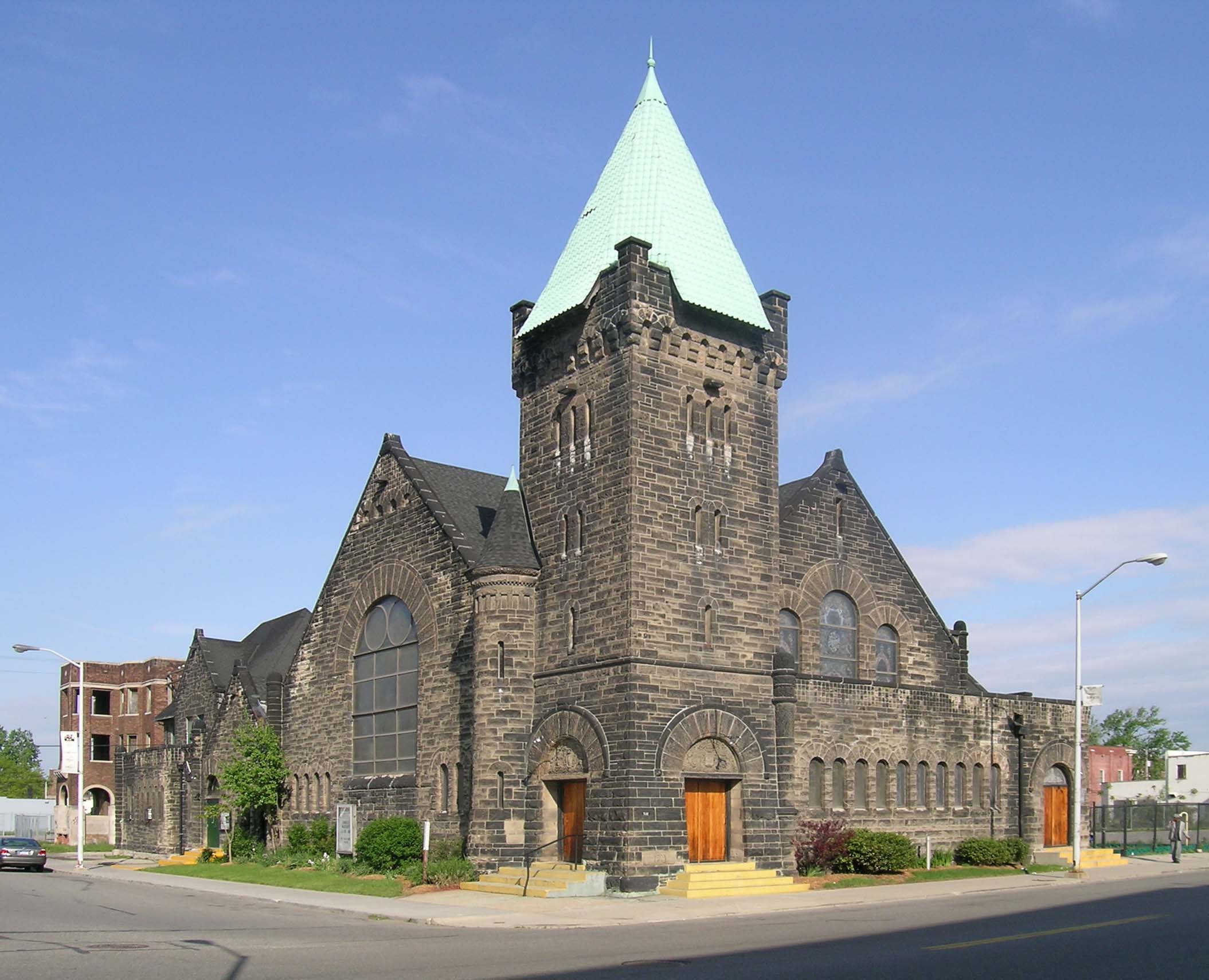
My footsteps across the concrete reverberated in echoes through the abandoned buildings flanking the church and even though it was a bright sunny day, I felt like I was walking down a dark alley in the middle of the night. The building itself was an architectural masterpiece having been built in 1883 with Tiffany’s stained glass windows, though I could tell from the street that bullet holes had cut through the once remarkable windows.

When I reached out my hand to open the doors, the height of my new fears were realized: It was locked.

Cass_Avenue_Methodist_Episcopal_Church_-_Detroit_Michigan

I knew no one from the church, I had no way to contact anyone, and all of the warnings started to really flow through my mind. But I did what any good pastor would do, I sat down on the front steps and waited for someone to open the door.

30 minutes later, a disheveled looking old man, the first person I had seen in a long time, peeked from around the corner, walked up the steps, and unlocked the front door without saying a word. I wandered around the building until I found the sanctuary, searched in vain for a worship bulletin, and resigned myself to sit down in a chair by the altar.

During the next hour, the most random assortment of people started flowing in through the sanctuary doors. The church, once renown in the heart of Detroit, was being filled with people who slept outside the night before, people who had no money to put in the offering plate, and people who were having conversations with themselves at a volume loud enough for everyone else to experience.

A group of 7 older black women arranged themselves on folding chairs near the front, and without really discussing it they all flipped their hymnals to the same page and started to sing. A man with wrinkled fingers was hunched over a piano in the corner struggling to keep up with the singing, and a young man had seated himself behind a drum-set hidden in the corner, and was wailing away to a song that only he could hear.

When the first hymn ended, the women huddled together to pick another hymn and began singing. At some point in the middle of their fourth hymn, with the pianist still planking away, and the drummer smashing the cymbals, a gentleman stood up in the middle of the sanctuary with his eyes trained on me. He walked down the main aisle slowly and deliberately until he was towering over me and then declared, “Son, if you don’t start talking, they ain’t liable to quit singing.

The earth is the Lord’s and all that is in it, from the sea to the mountains, from the rivers to the deserts, from the people to the animals; for the Lord has founded life upon the earth. Who then shall worship the Lord in holiness? And who shall stand with the Lord in the holiest of places? Only those who have clean hands, and pure hearts, those who do not lift up their souls to what is false, who do not break their promises. They will receive a blessing from the Lord, and vindication from the God of their salvation. Such is the company of those who seek the Lord.

I stood up after the end of the next hymn, and grabbed the hand held microphone to start participating in worship. I felt like a fool standing in my khakis and blazer, with my bowtie tilted just slightly to the side. I felt ridiculous with my over examined sermon under my arm, and bible in my hand. I felt like I didn’t deserve to stand before the congregation, but all of their eyes were on me. (just like all of yours are right now)

I took off the jacket and tie, rolled up my sleeves, ditched the sermon on my chair, and let the Holy Spirit go to work.

Let us pray” I began, and before I could start praying for our service, the people started shouting out their own prayers. “O Lord, help this boy to preach.” “Yes Lord, show us your mercy.”My God show me your glory!” “Remove our sins, give us your Spirit, clean our hearts!” “Your will be done!” “Have thine own way Lord!” “Help this boy preach, preach preach.

It was only after a few moments of silence that I finally said “amen” without having added any of my own prayers.

I preached on the apostle Paul’s second letter to the church in Corinth, about the new creation that comes in knowing Christ. I talked about moments that transform our lives. I said things like “there is a new life in Christ, but just because we find Christ it doesn’t mean our life will get better, but that we are called to make other lives better.” And instead of the typical, and silent, congregation I was used to, the people kept shouting at me while I preached. “Ain’t that the truth!” “Yes Lord!” “We know it, we know it” “Lord, give him strength to preach.” “Speak through him God.

When I got around to the close of the service, when I offered a benediction to the congregation, when the final amen was uttered, I heard them say in return, “Thank you Jesus.”

be-still-and-know-that-i-am-god-960x250

Lift up your heads, O gates! Open up you ancient doors! the King of glory is coming. Who is the King of glory? The Lord, strong and mighty, merciful and majestic, the Lord. Jesus Christ the author of salvation, the Good News, the Messiah. The Holy Spirit full of wisdom and truth, giver of life, and partner to our prayers. Lift up your heads, O gates! Open up you ancient doors! The King of glory is coming! Who is the King of glory? The Lord of hosts, he is the King of glory.

We can dress the part, we can read all the right books, we can memorize all the hymns and prayers, but unless we are looking for holiness in our lives, unless we are ready to bow down to the King of glory, then we are forgetting the truth: God is God and we are not.

Many of us are good Christians, we pray for our friends and family, we come to church, we put money in the plate, but there is a profound difference between believing we are holy, and wanting to be holy.

When I arrived at that church in Detroit years ago, I foolishly thought I was bringing something to them. With my well prepared outfit and sermon, I made the assumption that I was bringing God with me, nice and shiny, like a school project. I became my own main character in the story of worship, and it prevented me from seeing the King of glory.

When I stood up in the pulpit to proclaim the words, the people did not see a young man with a seminary education, they did not see some white fool trying his best to not pass out, they saw a vessel for the Lord. Their prayers were not to me, but for the Lord to work through me. The recognized the great division between God and me, and knew that Jesus was the bridge between the two.

They knew that God is God and we are not.

In our contemporary American culture, we tend to view ourselves as the center of the universe.

We assume that everything revolves around us, and that so long as our needs are being me, then everything else should be fine.

We believe that if we wear the right clothes, and get the right education, that holiness will follow accordingly.

We feel holy for giving up an hour every week to sit in a place like this and sing hymns, offer prayers, and listen to a sermon.

That church in Detroit had something that I never knew I needed: They believed that God was the center of the story, that God had the power to transform their lives, and that God really was the King of glory.

Too many of my friends have left the church because they “didn’t get anything out of it.” They might try different styles of worship and different denominations, but if they don’t get anything out of it, they will rarely return. However, church isn’t about what we get out of it, its about what God gets out of us.

Believing we are already holy limits God’s power to make us holy.

It is in the recognition of the great divide between humanity and the Lord that we can let Jesus get to work on our hearts and souls. It is in the great admission of Jesus as the King of glory we start to see ourselves, not as the center of the universe, but instruments for God’s love to be heard in the world. It is in the words of our worship that we recognize the Holy Spirit’s movement in our midst and our lives start to change.

If we remain in the assumption of our holiness, then our lives will stay the same.

But if we truly desire for the Lord to make us holy, then our lives will be transformed. Amen.

Devotional – Psalm 85.12

Devotional:

Psalm 85.12

The Lord will give what is good, and our land will yield its increase.

Weekly Devotional Image

When I was appointed to serve St. John’s UMC two years ago I asked a number of people about the goals of the church: What do we want to look like in five years? What ministries need greater attention? Where is the church heading? I asked and asked and was surprised to discover that our collective vision did not extend past next Sunday; so long as our doors stayed open, and we had people sitting in the pews, we would be content.

For two years this limited vision permeated everything we did as a church and we have been far more concerned with maintenance than mission. Yet at the same time our church has grown in numbers and faithfulness as we continue to discern the will of God for our lives and for the church. In light of this, I grew so accustomed to the status quo, and the consistent growth, that I neglected to start looking toward the future until I heard a sobering statistic at Annual Conference this year: The average person in a United Methodist Church invites someone to worship once every 38 years.

grow

In the wake of discovering this frightening statistic, I felt convicted by the Lord so start looking further than next Sunday and create goals for our church.

1) We grow in faithfulness by giving time every day to God in prayer.

2) We grow in attendance by inviting people to discover the love of God.

3) We grow in stability by offering our gifts and talents to the Lord.

If the mission of the church is to form disciples of Jesus Christ for the transformation of the world, then it is our responsibility to pray faithfully, invite lovingly, and give generously. We are called to be Christ’s body for the world and are equipped by the Lord to do so.

Our first goal is to grow through prayer so that we might be transformed into better disciples. By giving time to God every day in prayer we will start to see how true the psalmist really was: “The Lord will give what is good, and our land will yield its increase.” The Lord will grow our faithfulness, attendance, and stability so long as we are willing to play a part in this mission as well.

As we prepare to take steps into a new week, let us take time to reflect on the church that God has so graciously given to us. How can we be better stewards of this place? Where is God calling us to serve within the community? What goals do we have for the church?

Devotional – Ezekiel 2.3

Ezekiel 2.3

He said to me, Mortal, I am sending you to the people of Israel, to a nation of rebels who have rebelled against me; they and their ancestors have transgressed against me to this very day.

Weekly Devotional Image

God loves to send people where they least expect. Moses was shepherding when God spoke to him through the burning bush and told him to go back to Egypt in order to lead the people out of captivity. Jonah was minding his own business when the Lord told him to go to Nineveh. Paul was in the middle of his campaign against the early Christians when God told him to go see Ananias in Damascus.

In the United Methodist Church pastors are appointed (sent) to serve different churches. Rather than being interviewed and examined by every individual placement, a bishop (and cabinet) discern God’s will and send pastors accordingly. This style of appointments allows for churches to be challenged by their pastors (and pastors by their churches) because neither of them have a choice in the matter. Yet, I can’t help but imagine that some UM pastors feel like they are being sent to “a nation of rebels” whenever they are reappointed.

Yesterday marked the completion of my second year serving the needs of St. John’s UMC in Staunton, Virginia. I can still recall the first phone call I received detailing my appointment, and I will freely admit they I felt a little uncomfortable about where I was being sent. After all, I knew nothing about the town, the people, or the church.

I can also recall the feeling in the pit of my stomach two years ago when I approached the pulpit to preach for the first time (Between the nerves and the excitement we were lucky that I even made it through a sermon at all). I looked out from my vantage point and saw the people of God gathered together to hear the Word and respond accordingly. To this day I still thank God for blessing us with the Holy Spirit that morning who allowed us to listen, laugh, and love.

jesus-is-lord-graphic

In the beginning of my time at St. John’s I foolishly thought I was bringing something to the church that they previously lacked. I believed that I was the one who could turn the ship around. I expected that I would grow the church, have us start paying our apportionments (in full), and preach in the midst of the rebels. For a time I thought I could be the savior.

I quickly realized that my expectations were way off. Instead of being a prophet sent to the rebels, I myself was a rebel in the midst of rebels. To believe that I could save the church meant that I was putting faith in myself, rather than the Lord. To believe that I had the power to make the church start paying its apportionments meant that I did not trust God to provide. To believe that I could be the savior meant that I forgot that only Jesus is our savior.

If we have done anything to please the Lord over the last two years, it has only come because God gave us the power to do so, and only secondarily because of us (me).

We are all called to go and be Christ’s body for the world in different ways, but it is vitally important for us to remember that we have just as much to learn as we have to teach; that no matter where God’s sends us, we will be transformed just as much as we transform others; and that in the end Jesus is Lord, and we are not.

This week, let us reflect on the places the Lord has sent us to be Christ’s body, and on the people who have been sent to be Christ’s body for us.

Ready To Die – Sermon on 2 Samuel 1.17-27

2 Samuel 1.17-27

David intoned this lamentation over Saul and his son Jonathan. (He ordered that the Song of the Bow be taught to the people of Judah; it is written in the Book of Jashar.) He said: Your glory, O Israel, lies slain upon your high places! How the mighty have fallen! Tell it not in Gath, proclaim it not in the streets of Ashkelon; or the daughters of the Philistines will rejoice, the daughters of the uncircumcised will exult. You mountains of Gilboa, let there be no dew or rain upon you, nor bounteous fields! For there the shield of the mighty was defiled, the shield of Saul, anointed with oil no more. From the blood of the slain, from the fat of the mighty, the bow of Jonathan did not turn back, nor the sword of Saul return empty. Saul and Jonathan, beloved and lovely! In life and in death they were not divided; they were swifter than eagles, they were stronger than lions. O daughters of Israel, weep over Saul, who clothed you in crimson, in luxury, who put ornaments of gold on your apparel. How the mighty have fallen in the midst of battle! Jonathan lies slain upon you high places. I am distressed for you, my brother Jonathan; greatly beloved were you to me; your love to me was wonderful, passing the love of women. How the mighty have fallen, the weapons of war perished!

maassen_resurrection_sml

Funerals are strange, difficult, and at times, beautiful. I usually receive the phone call from someone in the family, or from a funeral home, that someone has died and they were hoping that I would preside over the service. No matter who the person is, I am immediately filled with sadness knowing that someone, anyone, is now gone. Regardless of my personal connection to the individual, there is a sense of loss that comes with death and not even I can avoid it.

But then I have to get to work. I have to take that grief and hold it for a moment while I help others properly grieve their loss. I have to balance the proper amount of mourning with hope, sadness with peace, and death with resurrection.

When I receive that first phone call I have to start taking care of the logistics: Where will the funeral take place and when? Do they want someone to play the organ? Are they hoping for a particular soloist? Does anyone from the family want to speak on behalf of the dead? And only after the plans are made can we begin talking about the person, making sure that I know everything I can in order to properly proclaim their life, death, and resurrection.

Most of the time funerals take place in the middle of the day in the middle of the week. Friends and family have to take time off from work, or take their children out of school, in order to attend the service. Yet, funerals are not meant for immediate friends and family alone. The entire community of faith is called to witness to the life of those who have died so that we can continue to live out their witness regardless of how well we knew them, or not.

So, this morning, as I mentioned before, we are doing something a little different. A few weeks ago one of our church members named Dick Dickerson passed away. He had only been coming for a few years, but he was a staple in worship. He always sat in the back of the church on the right side, he flirted with every female that crossed his path, and he was incredibly sweet.

When I found out that his family would be having a private service in Kentucky at a later date I knew that we still needed to do something here in order to say goodbye. I knew that we needed to praise God for putting Dick in our lives. And I knew that we were going to have our own little funeral for him on a Sunday morning.

Dick Dickerson

Dick Dickerson

Dick Dickerson called me “honey.” I know that this might’ve bothered other young pastors, but to me it was endearing and precious. I would walk over to visit Dick next door at Brightview/Baldwin Park and the moment I entered his room he would always say something like “Come on honey and sit down with me.” For months I cherished this identification, it made me feel special that Dick felt so connected to me. It was only later that I learned he called most of the people in his life “honey”!

My wife Lindsey would stop by to say hello before a church service started and he would hug her while calling her “honey,” Grace Daughtrey would smile and politely nod her head as he greeted her with a “good morning honey,” and even Marshall Kirby would start to blush when Dick would refer to his Sunday driver as “honey.”

Dick Dickerson was a man of profound love, who deeply appreciated all that God had given him from the very beginning till the very end.

Dick grew up in Kentucky with a family in the midst of financial struggles. Living through the depression was, as he put it, one of the hardest things to witness. But at some point there was a family in the community who saw Dick’s potential, and they brought him under their wing and helped to provide for his education. He always maintained a connection with his biological family, but in his quasi-adoptive family he saw the Christian commitment to loving others, something that would affect the rest of his life.

Dick was a man of stories, stories that shaped his life and the lives of others. When he served as a quartermaster in Patton’s army during World War II he used to offer whisky to his fellow soldiers so long as they affirmed the beliefs of the Republican party. He told me that at the beginning of the war most of his friends were Democrats, but by the time they got home (and enjoyed the whisky) they had become staunch conservatives!

He, unlike others who served in World War 2, was ready and willing to share reflections on his experiences precisely because he did not want anyone to have to experience what he did. He often told a story about an evening that took place in the middle of the war on Christmas Eve when he found himself resting for the night in a bombed out church building. He could remember the wax dripping from the candles, the hole in the roof letting in the tiniest of snowflakes, and all the soldiers huddling together for warmth.

He asked a question of the men that night that he only later attributed to the Holy Spirit. He asked if the men wanted to pray for anything. One soldier prayed for his family back home, another prayed for warmer weather, but one of the youngest said something that would stay with Dick the rest of his life: “I seem to remember Jesus saying something about praying for our enemies, so tonight I would like to pray for the men we’re fighting against. I pray that God would be with them as He is with us.” Dick said that while other men might have grown angry or dismissed the prayer, all of the men joined together in that tiny church on Christmas eve, and prayed for their enemies.

Prayer was at the heart of Dick Dickerson’ life. He spent most of his free time going through a list of people that he lifted up to the Lord and regularly invited me to join him in his prayers. He once told me that prayer was the only thing that got him through the war, and that prayer was the only thing that kept him together once he returned home.

Dick lived a wonderful and blessed life. He married his sweetheart Mildred, had two children, and eventually began working for Madison College in Harrisonburg. Dr. Dickerson, as he was known to his students, made himself available to everyone all all times because he saw the value in other people. Whether in the classroom or at home, you knew that he would make time for you no matter what.

I spent a lot of time with Dick over the last two years, we talked about a great number of things, but the one thing we talked about the most was death. In fact during our very first and our very last conversations he said the same thing to me: “Honey, I’m ready to die.

In the beginning of 2 Samuel we have a song that David wrote in memory of Saul and Jonathan. After giving their lives for the Lord and the people, David called the nation to weep for their loss: “O how the mighty have fallen.” In life David and Saul were seemingly opposed, but in the experience their death David wept and mourned.

ProgramPage_MightyFallen

Many of us take the people in our lives for granted. We grow so accustom to their presence and persistence, that we rarely think about what life would be like without them. It is only when someone is truly gone that we can really appreciate what they always meant to us. It happened to David after Saul died. It happened to the disciples during those three days before Jesus rose again. And it has happened to me with nearly every person that I have buried while I have served this church.

But friends, resurrection comes into its fullest meaning when we lose someone we love.

Can you imagine the exultation the disciples experienced when they saw their Lord again after he broke free from the chains of death? Can you picture the joy on their faces when they were able to sit again with their teacher and friend? Can you imagine how David would have felt if he knew that one day someone from his family tree would eventually hang in a tree for the sins of the world so that we could all rise again in the resurrection?

Dick Dickerson was ready to die because he trusted the Lord. His trust was evident in our many conversations, and in is interactions with others, but it was most present while he prayed at this altar.

Dick rarely missed a communion Sunday. Even while his bone cancer was spreading throughout his body, he would make the long and slow journey to the front of this sanctuary to pray on his knees to the Lord. After feasting on the body and the blood, Dick would lay all the worries of his life out for the Lord, he would pray for God’s forgiveness over his sins, and he would thank the Almighty for surrounding him at every moment throughout his blessed life.

Are we ready to die? Every death in this church community is a constant reminder that the bell will toll for us all, and that tomorrow is never guaranteed. Are we ready to die? What kind of faith would it take to be ready to give our lives over to the Lord?

Dick Dickerson certainly had that kind of faith, a faith born out of prayer, presence, and praise, a kind of faith shaped by World War 2, and a kind of faith made real through the witness of Christ’s church.

lord__s_supper_by_bclary-d37hhzp

As we prepare to take steps toward this altar, to feast at Christ’s table, we do well to remember all who have gone before us to eat and pray. We remember Dick Dickerson and his willingness to lift us up. We remember the saints before us, in our midst, and those who will come after and discover God’s grace in a moment like this. And we remember that Jesus came to die so that we would all live, so that death would be defeated, so that the resurrection would be offered to us all.

So, thanks be to God for the great gift at this table and for the life of Dick Dickerson, a man who lived by faith, prayed with every fiber of his being, and was ready to die. Amen.

Devotional – Psalm 130.1

Devotional:

Psalm 130.1

Out of the depths I cry to you, O Lord.

Weekly Devotional Image

When I heard about the shooting at Emanuel AME Church in Charleston, South Carolina I was shocked. The initial details conveyed a frightening scene: a lone gunman had attacked and killed 9 individuals who had gathered together for prayer. But perhaps the most frightening detail is the fact that he had participated in their prayer meeting for an hour before he began shooting. The attack at Emanuel AME is harsh reminder of the powers of evil that are manifest in our world.

The day following the shooting I knelt in the sanctuary at St. John’s and tried to pray but the words would not come. What good are words in the midst of such tragedy? How can we pray to our God when our emotions are so devastated by the events swirling around us? How can we be faithful and angry at the same time? So, when I was invited to a prayer vigil that evening at Allen Chapel AME in Staunton I knew I needed to go.

When the service began, the pastor invited all of his fellow clergy to surround him in the pulpit because “the only way we can get through this is in community.” While he prayed for the Good Lord to strike our hearts and calm our fears and frustrations, he was surround by pastors from a myriad of denominations, the sanctuary was filled with faithful disciples spanning the great mosaic of Christianity, and we all struggled to pray in the midst of such tragedy.

There was no order of worship. There was no list of scriptures to be read. There was no attendance pad being passed through the pews. Instead we called for the Holy Spirit to guide us, shape us, and nurture us throughout our vigil. As the Spirit led us we read words from the psalms and each pastor took a turn leading the congregation in corporate or silent prayer. Our responses ranged from lifting our fists in angry frustration to singing together “Thank You Lord.” At times we stood and held one another and at others we prayed on our hands and knees. We did as the Spirit commanded and we discovered the Lord in our midst.

hear_my_cry_o_lord_wide_t_nv

One of the most faithful prayers we can ever utter starts with the words from Psalm 130: “Out of the depths I cry to you, O Lord.” Prayer is not something that has to be precise and perfect, it does not need to be all lovey-dovey, and it does not have to be filled with theological and academic language. The truest prayers are the ones that come naturally and really affirm where we are while we pray. It was from the depths of human suffering that we all prayed to the Lord that night, and the Lord listened.

This week, as we pray for the people in South Carolina, let us all remember that it is good for us to pray from the depths of our souls, that it okay for us to be angry with God while venting our frustrations, and that the only way we can get through this is in community.

If you would like to know more about the prayer vigil that took place at Allen Chapel you can watch a video about it here: Staunton Prayer Vigil

Stranger In A Strange Land – Sermon on Ezekiel 17.22-24

Ezekiel 17.22-24

Thus says the Lord God: I myself will take a sprig from the lofty top of a cedar; I will set it out. I will break off a tender one from the topmost of its young twigs; I myself will plant it on a high and lofty mountain. On the mountain height of Israel I will plant it, in order that it may produce boughs and bear fruit, and become a noble cedar. Under it every kind of bird will live; in the shade of its branches will nest winged creatures of every kind. All the trees of the field shall know that I am the Lord. I bring low the high tree, I make high the low tree; I dry up the green tree and make the dry tree flourish. I the Lord have spoken; I will accomplish it.

stranger-in-a-strange-land

During my first year of college I felt like a stranger in a strange land. I grew up in a family that believed in sitting together for dinner every night. I was raised in a church that took the baptismal vows seriously and helped me pursue my vision of ministry. I had friends that supported my belief systems, and wanted me to be happy. I was strongly rooted in my home, and when I left I felt like I was wandering around without a map.

In the beginning, college was completely unlike home. Instead of eating with my family, I was lucky to eat a meal in the dining hall with anyone. Instead of a supportive church, I tried out a number of campus ministries that made it clear that if I wasn’t converting my heathen classmates I had no business being a part of their group. Instead of friends that loved me, I had surface level connections that were based on a system of consumerism more than genuine friendship.

The things I had grown to love (the comforts, the familiarity, and the rhythms) were gone and I felt like a stranger in a strange land.

Imagine, if you can, the prophet Ezekiel sitting by the river among the exiles. They had been taken from their homeland, uprooted, and planted in a new place. Families were separated, homes were lost, and they no longer knew how to worship their Lord. But the Lord continued to call prophets to proclaim the truth, even in the midst of the unknown.

Ezekiel, a prophet to the exiles, declared what the Lord had said. The Lord will take a branch from the full top of a cedar tree and will set it apart. Then the Lord will break off one of the most tender pieces of the young twigs and plant in on a high and grand mountain. The Lord will plant this piece so that it would produce boughs and bear fruit and become a noble tree unlike any other. Under it, in the protection of its shade, every kind of bird will live and find comfort.

All the rest of the trees will know what the Lord has done. Because the Lord brings low the high tree, and makes the low tree grow. The Lord dries up the green tree, and helps the dry tree flourish. The Lord has spoken, and he will do it.

The message is beautiful and hopeful. The poetic language of God’s creation helps us to imagine a mighty cedar giving life and shade to all who are in need. We can almost smell the scent of the cedar wafting through the air as we hear the words. We are reminded of God’s great power in upsetting normal expectations.

But when we remember who the words were for, when we remember the exiles in captivity, the passage becomes all the more powerful.

The remaining faithful had been carried off into captivity in Babylon. Their suffering was great and their questions were many. “Why has the Lord abandoned us?” “When will we return to the great city of Jerusalem?” “Where is the Lord in the midst of our suffering?”

The foundations of their religion were laid waste by a rampaging army. Those who survived would have witnessed the destruction of the temple, they would have smelled the burnt scrolls in the air, they would have heard the screams of fear and suffering.

The new home of Babylon brought subjection, and powerlessness. The people were small in number, weak in strength, and limited in faith.

They were strangers in a strange land.

Yet, in all of the great stories from scripture, a small people, of little account and worth, are the ones chosen by God to do something incredible. Though insignificant by the world’s standards, they were extraordinary in the eyes of God.

In the midst of the unknown, while their fear was real and palpable, Ezekiel shared this tender message from the Lord. I, the Lord your God, am the one who turns things upside down. I will have the final say about what it going on in your lives. You see the powers around you and you believe they have prevailed, but I will make things new, I will plant the seed that gives shade to the tired, strength to the weak, and life to the dead.

Today we are celebrating our graduates, those who have mastered their present set of educational expectations and are moving on to new horizons.

We have graduates from high school that will be entering the new area of the university. We have graduates with Bachelor’s and Master’s degrees that will be entering the new area of the so-called “working world.”

In a few minutes they will stand before the congregation and we will pray for God’s blessing on them in all that they do. But before we send them off, we need to help open their eyes to the truth.

Soon, and very soon, you will feel like strangers in a strange land. No matter how confident you feel taking the next steps in your life, there will be things that happen that shake the very foundation of what you know and believe. You will encounter new and strange ideas. You will miss your friends, and your family, and hopefully your church.

Moments will come that you will ask the same kinds of questions that the exiles did in Babylon: “Why has the Lord abandoned me?” “When will things get back to normal?” “Where is God in the midst of all this?

So, this message from the Lord through Ezekiel is meant for you as much as it was meant for them. God’s message of love and presence and growth is directed to you in a time of new beginnings and uncertainty. Whether you are about to start at a new school or a new job, let these words be comforting and full of life.

The Lord God almighty took a sprig, a tiny and powerless little thing, and planted him in a place called Bethlehem. He grew up as the son of a carpenter and was ignored by most people until he started to give shade to all the birds of the air, when he started inviting the multitudes into the kingdom of God. Through his words and actions Jesus Christ gave hope to the hopeless, strength to the weak, and life to the dead. Through him the people began to know and experience the love of God and the world was turned upside down.

Ezekiel17.24-660x371

Doesn’t all of this sound familiar? The Lord will plant a new tree… just like the sower who goes into the field… just like a tiny mustard seed become the greatest of all the plants. The Lord will make high the low tree and make low the high tree… just like the first shall be last and the last shall be first… just like the poor being welcomed into the kingdom of God and the religious elite were left scratching their heads.

This kind of inversion has been part of God’s great cosmic plan all along and we are still being swept up in it. The Lord calls on the strangers in a strange land to give hope for the world. The Lord uses the weak and least of these to show how the great tree of life in Jesus Christ gives shade and comfort to all of God’s children.

To those who are about to embark on something new: take heart and know that the Lord is with you. Even when you feel lost and alone, you are not. We, the gathered people, are praying for you and will continue to so long as we have life. But more importantly the Lord has faith in you to do incredible things, to help continually turn the world upside down.

To those who remain: look upon these graduates with hope. Because just as the Lord planted Jesus Christ to be a source of hope, the Lord is about to do the same thing with all of them. He will scatter them like seeds in the earth, he will nurture them through the power of his Spirit, and they will stretch out their arms to the world and will be a source of light in the darkness. Wherever they are planted, they will bear fruit for the world.

During my first year of college I felt like a stranger in a strange land. I wanted to cry out to the Lord like one of the lost exiles in Babylon. I felt abandoned, I felt alone, and I felt afraid. Weeks passed and nothing changed, my relationships started to suffer, and I started putting in the minimal amount of effort necessary in my classes. But it was also when I really learned how to pray.

I didn’t read about it in some book about faith, but I read about it in the book of faith. I looked for the times that Jesus prayed. It helped put things in perspective about what I was going through. It didn’t change my circumstances, but it changed me.

Because true prayer is not about asking God to fix something. True prayer is the gutsy willingness to let God be God in your life. So I gave it over, I prayed less like myself and more like Jesus, I prayed for God’s will to be done in my life instead of for my life to get better. But it did.

When we really pray, its not important what we say, but that we let God have time to speak. Prayer is far more about listening than it is about speaking. Prayer is not listing what we want, but a risk of being exposed to what God wants.

Prayer really changes things, and sometimes what prayer changes is us.

prayer-changes-me

So, whether we are about to embark on a new experience in a new place or we are still spreading our roots here in Staunton; whether we are confident in our faith, or filled to the brim with doubt; whether we feel surrounded by discipled witnesses, or feel completely alone. We are all strangers in a strange land.

As Christians we are called to see the world through the resurrection which means we will never feel comfortable where we are. We love our enemies and turn the other cheek. We offer a tenth of our income and pray for the weak. We listen for the Lord and lift up the meek. Being Christian is about living in the tension between what the world explains and what the Lord proclaims.

But with prayer, by taking time to be holy, we start to see the world turned upside down, we experience the beauty of God’s kingdom, and we find rest in the shade of God’s great cedar tree: Jesus Christ. So let us pray:

O Lord, let your will be done, nothing more, nothing less, nothing else.

O Lord, let your will be done, nothing more, nothing less, nothing else.

O Lord, let your will be done, nothing more, nothing less, nothing else.

Amen.

Confronting Conflict – Sermon on Isaiah 6.1-8

Isaiah 6.1-8

In the year that King Uzziah died, I saw the Lord sitting on a throne, high and lofty; and the hem of his robe filled the temple. Seraphs were in attendance above him; each had six wings: with two they covered their faces, and with two they covered their feet, and with two they flew. And one called to another and said: “Holy, holy, holy is the Lord of hosts; the whole earth is full of his glory.” The pivots on the thresholds shook at the voices of those who called, and the house filled with smoke. And I said: “Woe is me! I am lost, for I am a man of unclean lips, and I live among a people of unclean lips; yet my eyes have seen the King, the Lord of hosts!” Then one of the seraphs flew to me, holding a live coal that had been taken from the altar with a pair of tongs. Then seraph touched my mouth with it and said: “Now that this has touched your lips, your guilt has departed and your sin is blotted out.” Then I heard the voice of the Lord saying, “Whom shall I send, and who will go for us?” And I said, “Here am I; send me!”

6292687510_a9b81d37f4_z

Tell me about your last fight.” So began one of my recent premarital counseling sessions. The couple danced around the question for a few moments, claiming they couldn’t remember the last time they had a fight, but when I started to ask more specific questions the answers started pouring out. Their conflict could be boiled down to a lack of communication, and when I sat there with them I saw them begin to share things with one another for the very first time. Before we went on, I couldn’t help myself from asking, “Why haven’t you talked about this stuff before?”

The woman sat in my office with her head hung low. It took her a few minutes to muster the courage to begin telling her story, and when she started it came out like the floodgates were opening. She felt invisible to her husband, no matter what she did, he would brush it off and continue to focus on the task before him. She was afraid that she had done something wrong and didn’t know where else to turn so she came to me. We talked together about her situation, but I couldn’t help myself from wondering, “Why hasn’t she told her husband how he makes her feel?

We were sitting on the edge of a property in West Virginia after nearly a week on our mission trip. The young boy was from a different church, but I could tell something had sent him over the edge. His tears fell slowly and deliberately as he confided in me about his struggles. He could not longer stand being treated like an infant or a child. He had important ideas and things to share but everyone brushed him aside instead of treating him with worth. Rather than being supported in his discipled journey, he felt like he was all alone and he was worried. I listened, but I also knew that when the end of the trip arrived he would be going home to a different community and a different church so I asked, “Is there someone from home that you can share all of this with?” And he said, “I don’t know, I’m afraid.

In each of your bulletins you will find a piece of paper about the size of an index card and I would like you to hold it in your hand. We’re going to have some time for silence, and during that time I want everyone to write down the name of one person that you are currently in conflict with.

Maybe your mother-in-law has been driving you crazy with her relentless need to tell you how to raise your family. Perhaps your boss continues to heed your advice, but then takes all the credit when things go right. Maybe your son has made some poor choices and you can’t remember the last time you had a decent conversation about anything. Perhaps one of your best friends is letting their backwards political opinions isolate them from what it means to be a decent human being. Maybe your pastor has been preaching all sorts of sermons that you definitely do not agree with.

So take a moment, and write down a name. No one will see it but you. When you’ve finished, I want you to hold the card in your hand for the rest of the sermon.

In the year King Uzziah died, Isaiah saw the Lord sitting on a throne. God encountered the soon-to-be prophet in the midst of something important. Uzziah was an arrogant ruler, and his arrogance led to his death. Even though his reign brought economic prosperity, he neglected to respect the temple and the worship of God. It was at this particular time, in the wake of Uzziah’s death that Isaiah was called to speak.

The call is frightening. The Lord is high and lofty with the hem of his robe filling up the entirety of the temple. Seraphs, winged creatures, were flying above the Lord, each with six wings. One of them called out to another and declared, “Holy, holy, holy, is the Lord of hosts; the whole earth is full of his glory!

Everything around Isaiah began to shake and tremble and the room filled with smoke. Only then does Isaiah muster up the courage to say anything at all, “Woe is me! I am lost, for I am a man of unclean lips, and I live among a people of unclean lips; yet my eyes have seen the King, the Lord of hosts!

Isaiah was confronted with the utter and radical holiness of the Lord. With wind spinning, floors shaking, and voices trembling, Isaiah is struck with the realization of his own unworthiness and the unworthiness of his people. Have you ever felt unworthy when confronted by something greater than yourself?

When I saw my wife Lindsey walking down the aisle at my home church to meet me at the altar for the covenant of marriage, I felt completely unworthy. When I held Archer and Abram Pattie in my arms above the baptismal font and brought them into the fold of God’s kingdom, I felt completely unworthy. Every month when I serve communion here at the front of the church, I am met with eyes of Christians who have lived far more faithfully than I ever will, and I feel completely unworthy.

God’s majesty, whether through the beauty of creation, a call vision, or the people in our lives often leaves us feeling pretty feeble. When we discover the divine we can only feel that much more mortal. When we encounter the infinite, we are reminded of our finitude. When we meet the living God, we can’t help but wonder about the lives that he gave to us.

God’s call is frightening. God calls the young and old, men and women, to abandon their former and sinful ways to live fully in Christ. God called a young prophet to speak harsh truths to a community that had grown far too complacent. God continues to call all of his children to be prophetic with our words and our actions.

The call is frightening and scary enough. But when we respond, when we answer the call, the real trouble begins.

hereami2

Then one of the seraphs flying high above the Lord came down to Isaiah with a live coal that had been taken from the altar with a pair of tongs. The seraph touched his mouth with the burning coal and said, “Now that this has touched your lips, your guilt has departed and your sin is blotted out.” Then Isaiah heard the voice of the Lord saying, “Whom shall I send, and who will go for us?” and Isaiah said, “Here am I; send me!

Isaiah was dramatically changed through his encounter. The flaming coal not only cleansed him, but it also gave the him the power to speak on behalf of the Lord. In a matter of moments he went from crying out, “Woe is me! I am lost” to “Here am I; send me!

This whole story about Isaiah’s call is a lot like what we do in worship. We come together to praise the almighty God, we pray and confess our unworthiness, and then seek forgiveness. We pray for God to give us the grace and strength to hear the Word with faith so that we can respond accordingly.

How we worship matters because it shapes us into the disciples we are called to be. Every Sunday is like Isaiah’s call. We meet the Lord in the words from scriptures, prayers, hymns, and our brothers and sisters. Through that encounter we are called to live out our faith as soon as we depart in a way that will make God’s kingdom reign. All of these things that we do on a weekly basis, they are done to attune us to the voice of God who speaks into our lives.

Isaiah’s call, this dramatic and overpowering moment in the temple, reminds us that when we encounter the living God, there is not way to know God without being changed. Like a coal coming from the altar to our lips, we are tasked with speaking words like fire. Like a frightened prophet we are given the power to cry out “Here am I; send me!

The prophet was called to speak during a particular time, to sinners in the midst of sin. If we hear something from God’s Word today it should be a similar call. We should not be afraid to names the sins of our time, just as Isaiah did when he confronted the people’s political arrogance, spiritual pride, and economic injustice.

Abraham had to confront the Lord who promised to make his descendants more numerous than the stars. Jacob had to confront his twin brother Esau who sought to kill him for stealing his blessing. David had to confront King Saul who was jealous of the Lord’s favor. Isaiah had to confront a people who neglected to thank God for being the source of all their blessings. Jesus had to confront a religious elite who no longer practiced what they preached. Peter had to confront the gentiles and welcome them into the fold of the church. Paul had to confront his own sinfulness and call others to do the same.

Christians, for centuries, have been called by God to confront the conflict in their lives. To be faithful is to meet the outcasts where they are and show them love. To be a disciple means a willingness to forgive people when they have done something wrong. To follow Jesus means having the courage to ask for forgiveness when we have done something wrong.

What situation are you in right now that God is calling you to confront? I believe the holy Lord of hosts is personally addressing each and every one of us in the scripture today. Who do we need to call out? Where are the conflicts in our lives?

In each of our hands we have a name that represents a conflict in our life. Some of them can be confronted with a phone call or a conversation. Some of them can be confronted with our willingness to forgive a wrong that was done toward us. Some of them can be confronted with the simplest of gestures.

It might not go well. If we take the first step to confront one of our conflicts, it might blow up in our faces. But the longer we let these names stay on paper, the longer the conflict will keep us from fully living out our identities as disciples. The longer we let the conflict simmer, the longer we will be people of unclean lips living amidst unclean lips. The longer the conflicts remain, the harder it will be to hear the living God speaking into our lives.

The voice of the Lord is saying to all of us, “Whom shall we send, who will go for us to confront the conflict?” Our answer should be the same as Isaiah’s, “Here am I, send me!” Amen.

00021958_h

Devotional – Psalm 29.2

Devotional:

Psalm 29.2

Ascribe to the Lord the glory of his name; worship the Lord in holy splendor. 

Weekly Devotional Image

Every church is unique. Even if you had the same architect and the same builders and the same property size, churches are what they are because of people, and people are always different. Some churches value high liturgy and spend their Sunday services standing up, sitting down, kneeling, praying, singing, and listening. Others believe in the importance of contemporary music with big bands, projections screens, and coffee at the front door. Every church is unique.

Before I arrived at my current appointment I wondered about the uniqueness of this place. I pondered about their comfort with the hymnal, what expectations they had out of worship, and where they would be heading. Did they use the Lord’s Prayer? Did they affirm their faith with the Apostles’ Creed? etc. And I spent a good amount of time wondering how they dressed for church on Sundays.

hangars

I grew up in a church where ushers were required to wear ties on Sunday mornings. I have helped a church that expected men to wear full suits, and women to wear dresses for worship. And I have spent time at a church that if you weren’t wearing blue jeans, you were the odd one out. What people wear to church says a lot about what they expect from worship, and the kind of people they are hoping to attract.

I was therefore pleasantly surprised to discover that the people at St. John’s arrive on Sundays in a great plethora of fashion. We have suits, dresses, khakis, jeans, flip-flops, yoga pants, and everything in between. No one is judged for what they wear (so long as they are wearing something).

Yet, a few weeks ago, a child from our congregation asked why I wear my “black dress” (clergy robe) on Sunday mornings. I shared that, for me, it is important for Sundays to be different than the rest of the week. I expect to discover something I can’t normally find on my own Monday-Saturday, and when I dress differently, it allows me to act like the Christian I really am in the first place. The little boy thought about my answer for a few moments and then said, “Well then, I think I should wear my Iron Man costume next week.”

The psalmist call us to “worship the Lord in holy splendor.” Whether we wear our suits and dresses or our clergy robes and comic-book costumes, we do so in hopes that we can live into the reality of what it means to be a disciple in the world today.

This week, let us reflect on how we worship the Lord in holy splendor. Would changing our outfits for Sundays change the ways we worship? How can we better reflect what it means to follow Christ through our clothing, our words, and our actions?