This week on the Strangely Warmed podcast I speak with Teer Hardy about the readings for the Fifth Sunday of Easter [C] (Acts 11.1-18, Psalm 148, Revelation 21.1-6, John 13.31-35). Teer is one of the pastors of Mt. Olivet UMC in Arlington, VA. Our conversation covers a range of topics including love, books, ordination, dietary restrictions, the rule of threes, kingdom expansion, the praise of creation, funeral texts, tangible promises, commandments, Makoto Fujimura, and newness. If you would like to listen to the episode or subscribe to the podcast you can do so here: The New Newness
After this I looked, and there was a great multitude that no one could count, from every nation, from all tribes and peoples and languages, standing before the throne and before the Lamb, robed in white, with palm branches in their hands. They cried out in a loud voice, saying, “Salvation belongs to our God who is seated on the throne, and to the Lamb!” And all the angels stood around the throne and around the elders and the four living creatures, and they fell on their faces before the throne and worshiped God, singing, “Amen! Blessing and glory and wisdom and thanksgiving and honor and power and might be to our God forever and ever! Amen.” Then one of the elders addressed me, saying, “Who are these, robed in white, and where have they come from?” I said to him, “Sir, you are the one that knows.” Then he said to me, “These are they who have come out of the great ordeal; they have washed their robes and made them white in the blood of the Lamb. For this reason they are before the throne of God, and worship him day and night within his temple, and the one who is seated on the throne will shelter them. They will hunger no more, and thirst no more; the sun will not strike them, nor any scorching heat; for the Lamb at the center of the throne will be their shepherd, and he will guide them to springs of the water of life, and God will wipe away every tear from their eyes.”
“If Heaven exists, what would you like to hear God say when you arrive at the Pearly Gates?”
That’s how James Lipton ended every interview on Inside The Actor’s Studio. Famous actors would sit before a large audience, answering all sorts of questions about the art and craft of movie-making, and then, at the end, each of them would mull over that last lingering query and have to say something.
George Clooney: “Welcome, c’mon in. Rosemary’s singing, Nat Cole’s on the keys, Buddy Rich is behind the kit, and they’re playing Always.”
Halle Berry: “Your Dad will be so excited to see you.”
Robert Redford: “You’re too early.”
Robin Williams: “Hahahahahahahahahaha.”
And James Lipton, himself, once answered the question this way: “James, you were wrong. I do exist. But you may come in anyway.”
It’s a great equalizer, that question. Most of us spend most of our time doing everything we can to not think about the end. And then, these superstars get real for a moment, and they open up in a way that runs counter to their entire profession.
Well, a few years back, some friends and I started recording conversations with theologians and pastors and regular ‘ol Christians for the podcast called Crackers and Grape Juice. And, because nothing original ever happens in the church, we decided to end the episodes with Lipton’s ten questions from Inside The Actor’s Studio. Some of the other questions include, “What’s your favorite sound?” And “What profession would you not like to attempt?” And “What’s your favorite curse word?”
I love that last one. There’s nothing quite like listening to a somewhat famous Christian shift around back and forth deciding whether to tell the truth, or pick a word like “shucks!”
And, like with Lipton, we end with the infamous, “What would you like to hear God say at the Pearly Gates?”
Most, of course, answer with “Well done, good and faithful servant.”
It’s nice knowing Christians can quote the Bible, but that answer is so boring.
We’ve had only a handful of really striking answers to that question, but perhaps the best of all came from Bishop Will Willimon. Will and I went to church together when I lived in Durham, he was one of my professors when I was in seminary, I’ve got a bunch of his books on the shelves in my office.
Prior to having him on the pod, he had become quite vocal in his denouncements of modern politics in general and the Trump Administration in particular. He wrote op-eds, he rebuked the former President from the pulpit, on and on.
And then when we asked him the question, this is how he answered: “Welcome Will, it’s about time. We’re so happy to have you here. But before you get too settled, the Trump family is over here and they would like to have a word…”
In theological speak: that is a rather robust understanding of the Eschaton.
In church speak: we do well to remember that Heaven is populated entirely and only by forgiven sinners.
In normal speak: If grace really is as amazing as we sing it is, then we are going to be surprised by some of the people we discover in Heaven.
Imagine, if you can, a sermon that doesn’t start with some sort of punchy anecdote, though I do enjoy the one I just shared. Imagine you come to church, you sit down in these pews, and someone gets up here and says: “Blessed are those of you who are poor, who are hungry, who are unemployed, who are going through marital separation, who are afraid of what tomorrow will bring, who are failing in parenting, and who are going through any ordeals.”
You might wonder if the pastor lost his or her marbles.
How could any of those people be blessed?
If a pastor started a sermon in such a radical way, there’s no telling if anyone would still be listening by the end.
But here’s the rub: In the kingdom of the world, the kingdom we think pulls all the strings, if you are poor you are treated like a curse. If your marriage is falling apart, then you are cut off from your friends. If you’re failing in your parenting, then your children go off the rails and the birthday party invitations stop coming in. If you’re going through any type of ordeal, you’re largely left to your own devices.
There’s nothing blessed about going through an ordeal.
At least, not according to the world.
But sermons, and all of worship for that matter, they are not about the kingdom of the World. If they are about anything, they are about Jesus and his kingdom.
The kingdom of God.
And yet, we are so embedded in the world’s way of existence, that we live in constant kingdom confusion.
We can only act within a world, or a kingdom, we can see. What we do in church, through our singing and our praying and our listening and our responding, it’s all about painting a picture.
I know that, at times, church can feel like a program for betterness. That, all things considered, we’re a bunch of good people getting good-er all the time. A sermon can end with a call to social action, or the announcements can pull at our hearts strings in terms of being better paragons of virtue in the community.
But the truth is a harder pill to swallow. We are not a collection of nice people getting nicer, we’re actually a bunch of bad people who gather with other bad people so that we can cope with our inability to be good.
Therefore the church, properly considered, exists to open our eyes, that we might see, glimpses of truth, Thou hast for me.
The church is not the world and the world is not the church. The world will always tell us that the most important things are first, best, found, big, and alive. But the church stands as a stark contrast with the reminder that Jesus comes for the last, least, lost, little, and dead. Which, whether we like it or not, eventually includes each and everyone of us.
Jesus can say, in his sermon on the mount, blessed are the poor, and those who mourn, and those who thirst not because he is describing a program for what makes the world a better place. Instead, Jesus uses such striking language to push our vision to the limits so that we might see something so new, so different from everything else have ever seen, and begin to realize that we cannot rely on our older images of what is and what is not.
Put another way: The strange new world of the Bible doesn’t tell us what we’re supposed to do. Instead, it paints a picture of who God is.
After this I looked, and there was a great multitude that no one could count, from every nation, from all tribes and peoples and languages, standing before the throne and before the Lamb, robed in white, with palm branches in their hands. They cried out in a loud voice, saying, “Salvation belongs to our God who is seated on the throne, and to the Lamb!”
John the Revelator sees what we, more often than not, cannot.
The great multitude in the Eschaton, from every nation, tribe, people, and language. They sing and the worship together forever and ever. But, oddly, John does not know who they are. And the elder has to answer his question, and ours: they are those who have gone through the great ordeal.
John catches a glimpse of what Jesus’ promises. In the last days, it is by Jesus’ life, death, and resurrection that we shall rejoice at the Supper of the Lamb. No amount of suffering can stop God from getting what God wants. Each and every one of us will experience ordeals in this life because we live on this side of the end. But, in the same way, there is no amount of good works or repentance that can earn us anything in the resurrection of the dead. In the kingdom of heaven it is by the blood of the Lamb that the sins of the world are taken away.
Contrary to the often-used joke about St. Peter’s manning the gates to Heaven, there is no bouncer checking the IDs of our goodness before we are swept up into the party. Actually, there might be a bouncer. But if there is a bouncer, his name is Jesus, and he has torn town all the barriers that would ever prevent us from getting in.
Here’s the promise, the promise of God and the promise of scripture and the promise of faith – we will hunger no more, we will thirst no more, the sun will not strike us nor any scorching heat; for the Lamb will be our shepherd.
This is our comfort and our hope. And there is good reason for us to hear this promise today. It is good for us today because some of us are hungry right now. We hunger for literal food and we hunger for righteousness. Some of us are thirsty for clean water to drink just as others thirst for the waters of baptism that remind us who we are and whose we are.
On and on John speaks of his vision into our lives realities here and now.
But what does the vision mean? We can’t help ourselves from such a question, earthly creatures that we are. I long for the days when images and visions are enough on their own without us having to probe for every little meaning. But, perhaps today, we can at least answer the question with this:
John’s vision reminds us that not all is as it should be right now.
There’s a sentiment we sometimes share with one another, particularly when we don’t know what else to say: “There’s nothing to be afraid of.”
And, though its true, we often offer it as a denial of the truth of the world. There are plenty of things to frighten us. We know the depths of pain and the banality of evil. We sit in a sanctuary that is decorated with a cross!
We, therefore, tell the truth of what is happening among the powers and principalities in the world not as denial of their presence, but as a reminder that though they exist, they don’t get the final word.
God gets the first, and the last word. And that word is Jesus.
All of the multitudes gathered in John’s vision are there only because of the last word. We now see what John’s sees because it gives us the strength to live in a world such as ours.
Consider: The robes are made clean by the blood of the Lamb. We can’t make ourselves clean. We all do things we know we shouldn’t, and we all avoid doing things we know we should do.
As the old prayer book put it, we are miserableoffenders.
We can absolutely try to make the world less of a mess for ourselves and others, we can even come with ideas on how to make it more bearable. But any programs for progress or better strategies for better behavior will fail to do what we really need. It those things worked, we would’ve fixed all the worlds problems by now and no one would ever go through an ordeal.
What we really need is a Savior – we need someone to save us. And that’s exactly what God does for us in Christ Jesus.
Salvation is a gift offered by the only one who can give it: God in Christ. When we know that this gift is given, that it cannot be taken away, it starts to change everything else. Living in the light of grace compels us to be graceful toward ourselves and others.
John helps us to see that, in the end, when all is said and done, when the forces that sometimes cause us to suffer and weep and mourn are vanquished, the once crucified Lamb shall reign at the center of the throne. Every tear will be wiped away not because we have made it so, but because we worship God who reigns above and below.
There’s a lot of talk about acceptance/tolerance in the church today. We ask people to be more understanding of others, we create curricula of theological teachings that are so watered down so as to say not much of anything, and we assume that being Christians is the same thing as being nice.
But how would you like to be the one tolerated?
Tolerance is always a position for those who are in power. And the kind of power we have in the church is best exemplified in the One whose arms were outstretched on the hard wood of the cross. Put another way: We Christians do well to remember that we worship the crucified God.
Tolerance, therefore, is not something we should be in the business of. If the church is in the business of anything, it is the Jesus business.
And the Jesus business is run by forgiveness.
Hymn 560 in the United Methodist Hymnal is titled “Help Us Accept Each Other.” It is a catchy little tune of self-congratulation that is indicative of a church that no longer has anything left to say. If Jesus came so that we would merely accept each other, then there’s no good reason for him to die on a cross. You only kill someone when their very being in the world threatens to upend everything you think you know about the world.
Jesus died on a cross because his existence in the world called into question the powers and principalities that produce a vision of tolerance rather than an ethic of sacrificial love.
At the heart of Christianity is the proclamation that Jesus loves us even though Jesus shouldn’t love us. We all do things we shouldn’t do and we all avoid doing things we should do.
The “church of acceptance” leads to the fundamentally unchristian sentiment of “Love The Sinner, Hate The Sin.” We all know we’re supposed to love sinners, that’s what Jesus did. And yet, Jesus does not call us, his followers, to love sinners, but to love our neighbors.
The distinction is important. “Loving sinners” places us in the position of power in regard to others whereas “loving neighbors” reminds us that we, ourselves, are also sinners.
In the lexicon of the church this is made manifest whenever we gather at the table and hear: “Christ died for uswhile we were yet sinners, and that proves God’s love toward us. In the name of Jesus Christ, you are forgiven.”
While we were yet sinners. Not before and not after. But right smack dab in the midst of our sins, God in Christ loves us and forgives us.
That’s rather staggering. It’s staggering because we simply don’t deserve it.
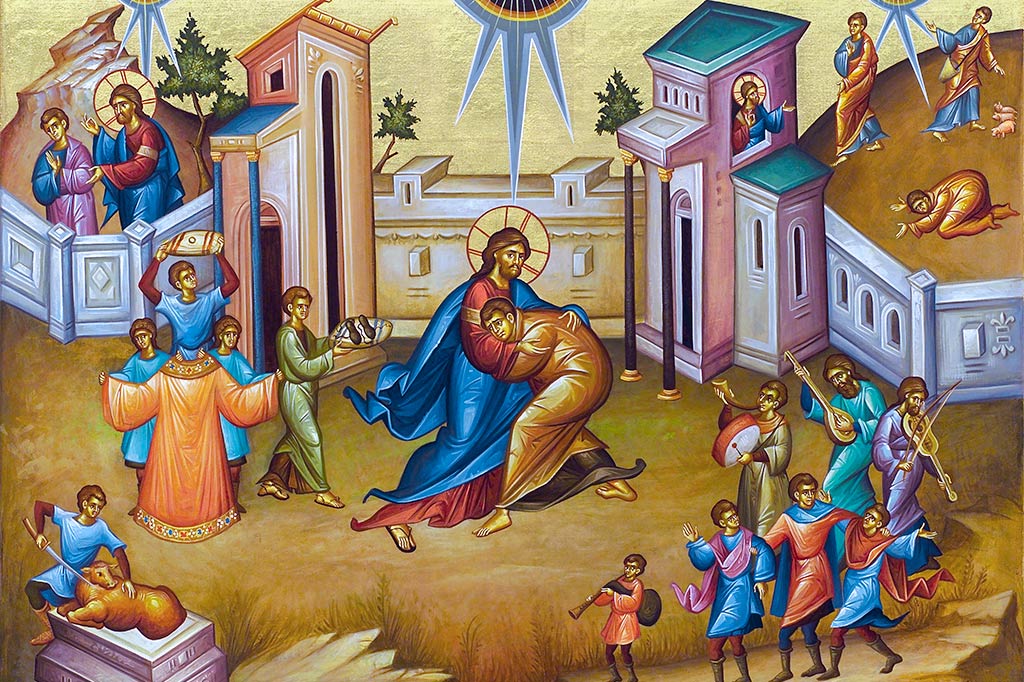
Consider the parables: More often than not they end with someone throwing our the ledger book, or offering mercy before an apology, or being invited to a banquet they have no business attending.
Or consider Jesus’ life: He pronounces forgiveness from the cross, reconciles with the abandoning disciples in the upper room, chooses the murderous Paul to be the CEO (chief evangelist officer) of the first century.
Jesus knows the prejudices we’re ashamed of (and the ones we’re proud of), Jesus knows the golden calves we worship instead of Him, Jesus knows our self-centeredness, and Jesus still says, “I forgive you.”
Jesus has seen all the emails we craft out of anger but are too afraid to send, Jesus witnesses the manifold ways we lie to our families and friends, Jesus is aware of our internet search histories, and Jesus still says, “I forgive you.”
Jesus is there with us in the comments we leave on Facebook, Jesus hears us when we scream in the car hoping no one else can hear us, Jesus knows about the biggest mistake we’ve ever made, and Jesus still says, “I forgive you.”
Perhaps, then, we should change the words to the aforementioned tepid tune in the church:
Help us forgive each other as Christ forgives us;
Teach us as sister, brother, each person to embrace.
Be present, Lord, among us, and bring us to believe
We are ourselves forgiven and meant to love and live.
Even though I walk through the darkest valley, I fear no evil; for you are with me; your rod and your staff – they comfort me.
In the 1990’s Jerry Falwell, bastion of theological conservatism, pleaded for funds for his “Save A Baby Homes.” The organization was designed to establish homes, all over the country, where a young woman who decides to continue in a difficult pregnancy could go and receive free, caring support all the way through pregnancy and birth.
And, rather notably, Falwell ended his plea by saying something to effect of, “If we do not give our resources, our money, to this venture, if Bible-believing Christians do not demonstrate through our gifts that we are willing to give to, and sacrifice for, and to support these women, then we have no right to tell them what they should, or shouldn’t, do with their bodies.”
It isn’t easy for ordinary people like us to do some of the extraordinary acts as Jesus commands. “Turning the other cheek” is a lot easier to preach than it is to practice. The same holds true for loving our neighbors as ourselves, particularly when it comes into contact with our theological understanding of reproductive rights.
On Monday evening a draft was leaked of a revision to the Roe v. Wade Supreme Court decision that focuses on reproductive rights in the United States. In response, those in favor and those opposed to the draft have been celebrating/protesting in various parts of the country.
Reproductive rights are often painted as a faith-based matter for a variety of reasons and there are a great myriad of theological positions with regard to the understanding of being bodily creatures. The United Methodist Church, in our Book of Resolutions, both affirms the sanctity of life for all persons born and unborn and, at the same time, we support those who choose the legal option of abortion under proper medical procedures by certified medical providers. We are committed to ministering with those who have had an abortion, providing support and encouragement. (You can read more here: Social Principles)
The only time I can remember hearing about abortion in church, prior to becoming a pastor, was in a small group setting as a teenager when one of my peers asked the pastor how we should think theologically about abortion. His response has stayed with me ever since.
He said something to the effect of: “If a woman in our church becomes pregnant and chooses to carry the baby to term, then we have a responsibility to support her in any way that we can – meals, rides, prayers, etc. But the same holds true for the other side of the spectrum. If a woman in our church becomes pregnant and chooses not to carry to term, then we have a responsibility to support her in any way that we can – meals, rides, prayers, etc.”
I remember thinking his answer was both deeply theological and faithful. I only realized, much later, that not every church feels and thinks that same way.
We do not talk of such things in the church today for a variety of reasons: we prioritize the privacy of the individual, we treat the church as a place to talk about churchy things and not worldly things, we are afraid of upsetting sensibilities, we don’t want to appear too political, etc.
And yet, we, in large part, have fallen into a fallacy of believing that the most important things in the world are political and can only be handled in a political manner. We therefore worry and lose more sleep over who sits behind the desk in the oval office (or behind the rail in the Supreme Court) than we do over who sits at the throne of the universe (and who comes to be the Judged Judge in our place).
The church is, and always will be, political but it is political on terms that run counter to the world. Put simply, the church does not exist to proclaim a list of do’s and dont’s, but rather to follow and point to the One who does for us what we cannot do for ourselves.
Therefore, the most interesting, creative, and faithful solutions we (that is: Christians) have to offer our weary world are not new laws, new politicians, or new social programs (though we certainly can support such efforts). The most important thing we have to offer the world is the church. We best serve the world by showing the world what it is not: a place where God is forming a family out of strangers.
We, the church, exist to be present for others not to judge them or to damn them, but to love them and support them to the end.
It isn’t easy – but nothing really important ever is.
This week on the Strangely Warmed podcast I speak with Bryant Manning about the readings for the Fourth Sunday of Easter [C] (Acts 9.1-6, Psalm 30, Revelation 5.11-14, John 21.1-19). Bryant is the director of the Wesley Foundation at FSU. Our conversation covers a range of topics including the Greek exegesis of Mark, chapel shadows, resurrection reminders, a hopeful ecclesiology, little deaths, goodness and mercy, church camp, resolution, the great ordeal, unbelief, and prayerful discernment. If you would like to listen to the episode or subscribe to the podcast you can do so here: Grace Like Rain
Then I looked, and I heard the voice of many angels surrounding the throne and the living creatures and the elders; they numbered myriads of myriads and thousands of thousands, singing with full voice, “Worthy is the Lamb that was slaughtered to receive power and wealth and wisdom and might and honor and glory and blessing!” Then I heard every living creature in heaven and on earth and under the earth and in the sea and all that is in them, singing, “To the one seated on the throne and to the Lamb be blessing and honor and glory and might forever and ever!” And the four living creatures said, “Amen!” And the elders fell down and worshiped.
“Were you crying during the first hymn?”
She asked me with a raised eyebrow out on the front lawn two weeks ago.
We worshiped the Lord with glory and splendor. The lilies surrounded the altar, the pews were packed, Easter! And then a stranger walked up and wanted to know whether or not I cried.
The truth? I did cry. In fact, I cried a lot. So much so I had to take my glasses off for fear that the tears would smudge my lenses and I wouldn’t be able to read the sermon.
But I couldn’t tell from her tone what she was trying to get at with her question. Had I been too emotional for her liking? Was she embarrassed to see such a handsome pastor blubbering up at the front?
I smiled and considered how I might respond. And then she interjected with a whisper, “It’s okay, I did too.”
John the Revelator sees a vision, and what a vision it is. Myriads of thousands, singing with a full voice, “Worthy is the Lamb!”
John shares his sights with a dispirited and anxiety ridden church. Easter has come and gone. The tomb is empty, the Lord is risen, but what happens next? The people called church run afoul of the powers and the principalities because they now know where real power can be found. They are persecuted, forsaken, punished.
And what does God have to say and show to the people called church?
A song.
A song that spreads wider and wider until the entirety of the cosmos sings praise to the One who is, who was, and who is to come.
Most of Revelation is music. As a book it is quoted among our hymnody and liturgy more than any other part of scripture. And for good reason. It is filled with such wild and wondrous images, it literally talks of music and singing over and over again.
And, if you spend enough time among the people called Methodist, you start to think in hymns/music.
Listen to this: My sin, oh the bliss, of this glorious thought. My sin, not in part but the whole, is nailed to the cross, and I bear it no more, praise the Lord, praise the Lord, O my soul.
That’s the faith we sing, in one verse.
And so it has been since the beginning. The earliest disciples devoted themselves to the breaking of bread, the singing of songs, and the sharing of scripture.
We are the songs we sing.
The Gospel lection for today, the one that is meant to be paired with our text from Revelation, finds Jesus broiling up some fish along the sea with Peter. The infamous tripartite questioning, “Do you love me?”
Peter is questioned three times, just as Peter denied Jesus three times. Do you love me?
In some sense, it doesn’t matter how Peter answers because Jesus loves Peter whether or not the love is returned. Its grace, all of it. Jesus will remain steadfast whether Peter does or not. Whether we do or not.
Love, in the Christian context, means to be possessed by something else. We love only in the sense that we are beckoned, compelled, drawn to the Lamb who was slaughtered and is therefore the one worthy to receiving power, wealth, wisdom, might, honor, glory, and blessing.
It is a strange love.
Like the cross, the love of God is both a reminder of what God does and what we do to God.
That is, the cross is our salvation and is also a proclamation of our complicity in the death of Christ.
Love, therefore, is our freedom, and also a declaration about our unworthiness of that very freedom.
And yet God loves us anyway.
To respond to God’s love means, oddly enough, doing exactly what we’re doing right now – gathering week after week with people we love, people who drive us crazy, and even people we hate because God in Christ calls us his friends.
To respond to God’s love means, oddly enough, even when we’ve sung these songs ten thousand times and feasted on the bread and cup ten thousand more, that we are still overwhelmed by the God who is love and loves us.
Revelation, and in particular this bit in chapter 5, is all about worship. We come to the altar of God to be met by the One who makes a way where there is no way. We worship the only way we know how – we sing, we read, we preach, we offer, we receive. This is worship and it is who we are.
We come to this place in this way with the conviction that we are in the presence of God. Every week there is an air of excitement, or at least there should be, in which we gather here thinking to ourselves, “I wonder what God is going to do next?”
And yet, to those outside, what we do here is indeed very strange.
They see people singing unpopular songs, someone who reads from an old dusty book, someone else making remarks about the book that may or may not interest those listening, and then everyone stands up to eat and drink really small portions of bread and juice.
Worship IS strange and worship changes things. And sometimes the thing that worship changes is us.
A prayer is offered that strikes us to the center of our hearts and we know that we can never be what we once were. A sermon is delivered and we receive it as if it was written for me and me alone. And still yet other times its less clear what it is that happens, but we leave not the same as we arrived.
And sometimes we are changed in spite of worship.
C.S. came up with the idea for his remarkable book The Screwtape Letters during what he described as “one very boring sermon.”
I myself learned of the beauty of the Bible because I grew disinterested in parts of worship when I was a child, and I reached for the old book attached to the pew ahead of me to pass the time.
More than a few of you have shared stories about sermons you heard that brought you not to the throne of God, but to the realization that you needed to join a different church!
At its best, and I mean at its very best, worship reminds us, and begs us to realize, that we, even us, we are included in the myriads of the thousands in John’s vision. Worship tells us over and over again that there is nothing we can do for good or ill that can stop God from getting what God wants.
Worship gives us Jesus.
There’s a story of an old seminary professor who used to interview candidates for the ministry, and in all the interviews he did over the years he would always as the same question, “Why should I join your church?”
Candidates would wax lyrical about the value of community, and the professor would say, “I’m in AA and I have all the community support I need.”
Then the candidates would mention something about outreach. And the professor would say, “I’m a member of Rotary and I already help the needy.”
And then the candidates would make a point to emphasize the beauty of the music at church. And the professor would say, “I have season tickets to the local symphony.”
For years and years he recruited for the seminary and not a single candidate ever mentioned anything specially about Jesus.
The church is not in the business of societal rearrangement, we are not paragons of community service, and we certainly don’t hoard all the musical prodigies. We may have some of those gifts, to be sure, but if we’re serious about really being the church then we only have one thing to offer at all: The Lamb of God who takes away the sins of the world.
We don’t have to have impeccable fellowship gatherings, or world transforming service opportunities, or even perfectly pitched singers because what we do here is already the difference that makes all the difference in the world. And that difference has a name: Jesus.
Here’s the shortest version of the longest story: Jesus the one whom we tried to push out of our world by hanging him on a cross, shall reign, and shall gather every living creature in, the last, least, lost, little, and dead, and even we ourselves will rejoice with the myriads. We will sup at the meal that goes on without end and we shall worship with song and voice.
Singing is who we are and what we do. And we’ve been doing it since the beginning. Moses, Miriam, Deborah, David, Mary, the Angels, Jesus, Paul, all of them sing in the strange new world of the Bible.
John Wesley was transfigured by the singing chorus of a group of Moravians. His brother Charles wrote the songs that we, and a whole bunch of other churches, sing all the time.
And that is why we sing even now. We sing when we are up and when we are down, when all is well and when all is hell. We sing.
The last word in worship is “Amen.” Every living creature in heaven and earth sings, “To the one seated on the throne and to the Lamb be blessing and honor and glory and might forever and ever!” And we all say, “Amen!”
Amen means “Yes.” It is our decisive declaration about who we are, what we are doing, and what is being done to us.
We respond to God’s great Amen with our own.
A few years ago I was in Raleigh, NC for a week-long mission trip with a group of youth from the church I was serving. We were tasked with helping out at the Hillcrest Nursing Center. Every morning we traveled to the facility in order to help in the activity center where residents could play bingo, exercise, and generally enjoy one another’s company. And yet, when we arrived, we discovered that the Activity Center was, perhaps, misnamed.
The residents sat in abject silence day after day.
We pulled out the bingo cards, but we didn’t get any takers. The youth put together a workout routine to a Michael Jackson song, that receive not even a toe tap. No matter what we did, it was as if we weren’t even there.
I remember one of the employees saying, “Don’t worry about it. The residents are always like this.”
And then, one morning, one of the girls found a dusty hymnal in the corner, she flipped to a familiar hymn, and started humming the melody.
It was Amazing Grace.
Without giving it much thought, all of our youth surrounded her and started singing together:
Amazing Grace! How sweet the sound that saved a wretch like me! I once was lost but now am found; was blind but now I see.
All the eyes in the room, previously locked onto the walls and the floor, turned toward the center where the youth stood surrounding the hymnal.
’Twas grace that taught my heart to fear, and grace my fears relieved; how precious did that grace appear the hour I first believed.
The residents started perking up in their wheel chairs, and some of them started mouthing the words.
Through many dangers, toils, and snares, I have already come; ’tis grace hath brought me safe thus far, and grace will lead me home.
Aides and employees started gathering in the doorways, witnessing this strange and wondrous sight, and more than a few of them joined in:
The Lord has promised good to me, his word my hope secures; he will my shield and portion be, as long as life endures.
Everyone in the room was now singing or humming along, even residents who were labeled as non-communicative were making a joyful noise:
Yea, when this flesh and heart shall fail, and mortal life shall cease, I shall possess, within the veil, a life of hope and peace.
With tears streaming and voices ringing, we all joined for the final verse:
When we’ve been there ten thousand years, bright singing as the sun, we’ve no less days to sing God’s praise, than when we’d first begun.
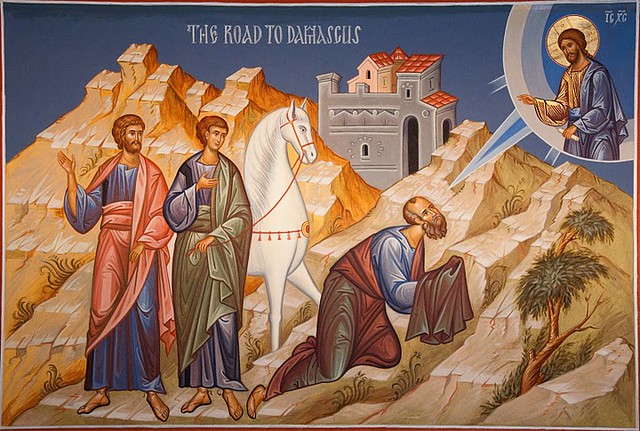
Meanwhile Saul, still breathing threats and murder against the disciples of the Lord, went to the high priest and asked him for letters to the synagogues at Damascus, so that if he found any who belonged to the Way, men or women, he might bring them bound to Jerusalem. Now as he was going along and approaching Damascus, suddenly a light from heaven flashed around him. He fell to the ground and heard a voice saying to him, “Saul, Saul, why do you persecute me?”
When I was in seminary I made myself available to friends who were serving churches if they ever needed someone to preach on a Sunday morning. I wish I could say the offer was purely altruistic, but it was mostly born out of a desire to get some experience before serving my own church one day. It was always exciting to arrive on a Sunday morning, to a church full of strangers, and stand up to preach the Word.
But it usually went poorly.
On one occasion I forgot to take up an offering and the congregation was more than happy to not pass around the plates. I preached at one church that had no bathrooms and I was encouraged to “use a tree out back” so I bounced back and forth behind the pulpit until the end of the service and quickly drove to the nearest gas station. And there was one particular Sunday when I got lost on my way to the church, and by the time I arrived they had already gone through two hymns and I was told they figured someone would show up to preach eventually.
But perhaps the most indelible memory took place one Sunday after worship during which a man in a handsome business suit approached me in the narthex and declared, “That Paul sure was in a heap of trouble. It’s a good thing Jesus was there to set him straight!”
The conversion of Saul, the so-called Damascus Road Experience, has penetrated the thoughts and imaginations of Christians for centuries. It’s one thing to question Jesus’ decision to enlist the help of a bunch of (not even very good) fishermen to spread the Good News, it’s another thing entirely to consider the Lord choosing Saul, the persecutor of the faith, to become the chief evangelist for the faith.
I cherish that narthex comment about Paul because, up to that point, I always thought of Paul being good and fine until Jesus showed up to complicate his life. Which, to be fair, isn’t necessarily wrong. He had power and prestige, he even had a calling in his life, and then everything got flipped-turned upside down. It’s also true in our lives that things seem to be well and good until the Lord encounters us and we cannot remain the same.
But, as that man so wonderfully put it, Paul was in a heap of trouble until the Lord changed him. Things might have felt and looked good in life, but what kind of life is it to spend all of your time persecuting others? Jesus said, “I have come to give life, and to give it abundantly.” Whatever Paul’s life was before Damascus, it could not compare at all to what it was after.
And so it is with us.
For some the Lord uses a bright wake up call to the life of faith. For others we know no other way because we’ve been part of the church for as long as we can remember. And for others it’s somewhere in between. But the Lord gets what the Lord wants. God is in the business of transformation. We, all of us, were in a heap of trouble until the Lord came to set us free. And now, like Paul, we live in the world turned upside down.
John to the seven churches that are in Asia: Grace to you and peace from him who is and who was and who is to come, and from the seven spirits who are before his throne, and from Jesus Christ, the faithful witness, the firstborn of the dead, the ruler of the kings of the earth. To him who loves us and freed us from our sins by his blood, and made us to be a kingdom, priests serving his God and Father, to him be glory and dominion forever and ever. Amen. Look! He is coming with the clouds; every eye will see him, even those who pierced him; and on his account all the tribes of the earth will wail. So it is to be. Amen. “I am the Alpha and the Omega,” says the Lord God, who is and who was and who is to come, the Almighty.
There’s a moment that happens every single Sunday without fail. It doesn’t matter what the context is, or what music is offered, or even what scripture is read.
It happens right before I stand right here.
There’s a silence.
An eerie silence.
Perhaps it sounds different to me than it does to all of you. Your experience of the strange silence might be born out of discomfort or awkwardness.
But as far as I can tell that moment happens every week and its special; there is true attention and silence. And in that silence there is hope.
People like you and me hope, even for but a moment, that this time we will hear an answer to the question: Is it true?
Sadly, more often than not, that hoped for question isn’t even addressed. And if it is, it is only done so indirectly. There’s an assumption that, just by being here, we all assume all of it to be true.
But that’s not right. I think we’re all here, the tall and the small, the first and the last, the believer, half-believers, and unbelievers, because we want to have our question answered.
Is it true?
Today is the second Sunday of the season we call Eastertide. It stretches all the way from Easter Sunday up to Pentecost Sunday, its the great 50 days. Every Sunday in this season is a little Easter in which we re-celebrate the most amazing thing ever to take place in the cosmos.
And let me tell you: you all are a special bunch. There is something remarkable about those in worship for the second Sunday of Easter. You’re here because you know that following the Lord is more than just being present for the big moments. You’re clued in to what takes place behind the curtain of the cosmos. You’ve experienced the Lord in such a way that you can’t imagine being anywhere else doing anything else.
But, we must confess, we of the second Sunday of Easter crowd, that the promises of Easter are not yet fully realized.
We need only turn on the television, or scroll through Twitter, to be reminded that not all is as it should be.
I, myself, riding the incredible wave of Palm Sunday worship was deeply grieved to receive a phonemail the Monday of Holy Week that my oldest friend in the world took his own life the night before.
We sang some good old gospel hymns down in Memorial Hall on Maundy Thursday, we shared the body and the blood of our Lord, and my family and I had to jump in the car to drive up to Alexandria so that I could speak at my friend’s service of death and resurrection the next day.
Not all is as it should be.
Easter Sunday, exactly one week ago, it was remarkable! First sunrise service in 100 years, the First Light Band had the whole sanctuary clapping, even our children shouted out the Good News in song and shakers.
All told we had more than 300 people in worship last Sunday! Truly remarkable.
And, I’m no mathematician, but I don’t see 300 today.
Why is that? Why are there those who only darken the doors of the church twice a year?
Much has been made of the so-called Chreasters, the C and E crowd. They come because of familial obligation, or guilt, or tradition. There’s a hope, even if people like me refuse to admit it, that one year they will actually all return the next Sunday.
But the longer I do this, the more I understand that the church swells at Christmas and Easter because those who don’t normally attend know they have a better than good chance of hearing nothing but Good News: “The hopes and fears of all the years are met in thee tonight,” and “Christ the Lord is risen today!”
Part of the challenge is that we always proclaim the joy of the resurrection, in song, sacrament, and sermon, to people who, admittedly, feel like those two on the road to Emmaus. We know something has happened, but life beckons us elsewhere.
It is true?
John the Revelator certainly seems to think so.
I don’t know what you know of John of Patmos and his epistle of Revelation. It is, perhaps, the most misunderstood book in the Bible and yet, at the same time, the most important. It, like the concluding chapter of any good book, ties everything together. But to drop in at the very end, without knowing the beginning or the middle is a recipe for disaster.
There are some wild bits to this book, some that we will encounter over the next few weeks, but, as GK Chesterton noted, “John saw many strange monsters in his vision, but he never saw a creature so wild as those who try to explain it all.”
John, whoever John was, wrote for a people living in a time in-between. They were stuck squarely between the already but the not yet, planted in the time before the end time.
You know, people just like us.
Easter people, while all is not as it should be.
Oddly enough, even with its bizarre images and confounding cassations, Revelation is an odyssey of encouragement. It tells us who we are, who God is, and what is the world is going on in the world.
To put it simply, it tells us the truth.
John begins, rather abruptly, with the decisive declaration that Jesus is Lord and King of the cosmos. He was, he is, and he will be.
Jesus Christ is the faithful witness, the one who remains steadfast even when we don’t, he points to the real things that matter in this life, and he is committed to doing so no matter what.
Jesus Christ is the firstborn of the dead, he is the one who, by death and resurrection, makes possible an impossibility, that in our deaths we are raised to new life.
Jesus Christ is the ruler of the kings of the earth, he is the one in charge.
I wonder though, if we actually believe that, or if we trust that to be true. I think, all things considered, it’s not difficult to affirm that Jesus is faithful, and that Jesus is risen. If it looks like Good News and it sounds like Good News. But Jesus being the ruler of the kings of the earth?
Its like a church meeting I remember attending long ago, certainly not something that would ever happen here, where we gathered for an important conversation, debate, decision making, and as we gathered voices were raised, accusations were made, and when finally came to the end of our appointed time, fists clenched, no wiser than we were when we stared, someone present had the audacity to ask if we might end our time in prayer.
I thought, “What for? We certainly didn’t behave like God was in the room, why invite the Lord in now?”
You see, when Jesus is in charge everything changes. And that doesn’t necessarily mean that it gets better. Have you read about the stuff he got up to the in the backwater towns of Galilee?
Are we sure we want Jesus to be in charge?
From the very beginning he predicted that those in power would reject him, and they did. I would say that’s strike one. Jesus has the gall to call all kinds of people who have no business being in the kingdom business. I mean, fishermen for disciples? Tax collectors for apostles? What’s next, bankers for Sunday school teachers? Lawyers on the mission committee?
Jesus is risky and foolish, spending all of his time among the last, least, lost, little, and dead. If we ever want to make the world a better place, we need a leader who’s going to spend time with the first, the best, the found, the big, and the lively.
What kind of leader forgives betrayers? What kind of ruler leaves ninety-nine behind to find the one who is lost? What kind of king hosts a banquet and invites everybody to attend?
Jesus.
John reminds us, across the centuries, through the power of words that Jesus is the one in charge, and in his infinite and confounding wisdom, he loves us, he has freed us from our very worst mistakes, and he has made us into a new people who will always feel like strangers in a stranger land.
And, to be clear, being in charge doesn’t mean being in control. If God in Christ is the author of every war, cancer diagnosis, and car crash then God isn’t worthy of our worship. But as the one in charge it means that God in Christ is the one we follow. He leads the way.
It is to Jesus, John says, that we owe our allegiance because he does for us what we cannot do for ourselves – he makes a way where there is no way. He, himself, is Easter for us.
The key according to the Revelator, the important truth that will be brought up again and again, is that it’s all up to Jesus. We can absolutely respond to what Jesus has done, we can even take up our crosses to follow, but he’s the one in charge, he gets all the good verbs. He, to put it plainly, is the Alpha and the Omega, the A and the Z.
Jesus came to raise the dead. He did not come to reward the rewardable, or improve the improvable, or correct the correctable; he came simply to be the resurrection and the life for people like you and me, the good and the bad and the ugly.
The message of Revelation, of the one who is, and was, and is to come, is that it isn’t over yet. Easter is still happening. Until we all feast at the Supper of the Lamb, we will live in the in-between – the place where we vacillate between mourning and dancing, crying and laughing.
Every Easter we make the same declaration – Christ is risen! But that’s a little deceptive. It is true, but we have more to say: Christ is risen, and he’s in charge. Amen.
This week on the Strangely Warmed podcast I speak with Bryant Manning about the readings for the Third Sunday of Easter [C] (Acts 9.1-6, Psalm 30, Revelation 5.11-14, John 21.1-19). Bryant is the director of the Wesley Foundation at FSU. Our conversation covers a range of topics including seminary salutations, campus ministries, silent retreats, the call of Saul, humbling humility, praying the psalms, divine anger, hand motions, nooma, the eschaton, choral singing, good worship, and texts for tweenagers. If you would like to listen to the episode or subscribe to the podcast you can do so here: Trading My Sorrows
This week on the Strangely Warmed podcast I speak with Drew Colby about the readings for the Second Sunday of Easter [C] (Acts 5.27-32, Psalm 118.14-29, Revelation 1.4-9, John 20.19-31). Drew is the lead pastor of Grace UMC in Manassas, VA. Our conversation covers a range of topics including strange intros, short sermons, eating in Eastertide, Raymond Brown, good trouble, Stanley Hauerwas, codas, timelessness, the firstborn of the dead, real peace, and the gift of faith. If you would like to listen to the episode or subscribe to the podcast you can do so here: It’s Better Than You Think It Is









 think and let think