Jesus Saves

Psalm 118.1-2, 19-29

O give thanks to the Lord, for he is good; his steadfast love endures forever! Let Israel say, “His steadfast love endures forever.” Open to me the gates of righteousness, that I may enter through them and give thanks to the Lord. This is the gate of the Lord; the righteous shall enter through it. I thank you that you have answered me and have become my salvation. The stone that the builders rejected has become the chief cornerstone. This is the Lord’s doing; it is marvelous in our eyes. This is the day that the Lord has made; let us rejoice and be glad in it. Save us, we beseech you, O Lord! O Lord, we beseech you, give us success! Blessed is the one who comes in the name of the Lord. We bless you from the house of the Lord. The Lord is God, and he has given us light. Bind the festal procession with branches, up to the horns of the altar. You are my God, and I will give thanks to you; you are my God, I will extol you. O give thanks to the Lord, for he is good, for his steadfast love endures forever. 

Every pastor has a favorite Palm Sunday story.

Like the year when the palm branches were delivered way too early and dried out so much that when the gathered congregation shook them over their heads in worship, palm branch particles went flying in every direction resulting in sneezing and coughing fits among the people of God.

Or the time when the pastor thought it would be a great idea to dress up like a donkey and preach the sermon from the perspective of the animal that carried Jesus into Jerusalem, to which the pastor received perhaps the greatest Sunday morning comment of all time: “You know, you’re not the first donkey we’ve had in that pulpit.”

Only they used a different word for donkey.

Or the time when the children of the church processed in waving their palm branches and lifting up their hosannas only to begin smacking one another in the face with their aforementioned palms until a nearby parent had to jump in to break up the melee and mutter, a little too loudly, “Lord, save me from these kids!”

And I think the reason preachers like me like to tell a cute or funny little story about Palm Sunday is because the actual story of Jesus’ triumphal entry into Jerusalem is rather confounding.

Put another way: Palm Sunday is perhaps the strangest Sunday of the year.

For, it begins in celebration and ends in catastrophe. It starts with “Hosanna” but it finishes with “Crucify.” It begins with life and it ends with death.

At they are approaching Jerusalem Jesus sends two of his disciples to procure a colt for his entry into the holy city. He rides in a cartoonish way, with his feet nearly dragging on the ground on either side of the animal, and the people of Jerusalem comes out in droves to see the would-be Messiah. They are overcome with reverence, so much so that they begin to take their own clothing, and spread it on on the road only to be trampled upon by the colt. They make a royal carpet as they worship the King of kings.

They take leafy branches from the fields and they wave them to and fro and they shout, “Hosanna! Blessed is the one who comes in the name of the Lord! Blessed is the coming kingdom of our ancestor David! Hosanna in the highest heaven!”

Hosanna. I’ve always loved that word. It’s such a churchy word. It makes me think of my own childhood and parading around the sanctuary. It makes me things of the musical masterpiece Jesus Christ Superstar and the crowds singing, “Hey sanna Hosanna, sanna sanna Hey, sanna ho sanna hey sanna.”

Hosanna is a wonderful word. And, every Palm Sunday, we reach into the vault of churchy words, we dust off this old familiar declaration, and we proudly put it on display. We shout it in our hymns, we put the word on the lips of our children, we hear it read in the scriptures. And then, at the conclusion of worship, we wrap it up and place it back into the church vault with our other special words only to come back one year from now.

We are familiar with this word. It conjures memories and songs. Churches everywhere will join us in our shouts of Hosanna today.

But do we know what it means?

Save us.

It is a declaratory pleading. It is an emphatic demand.

Save us. Now!

Saved?

That’s a word you don’t hear much in churches like ours. We’re Methodists. We sing and we eat and we sing some more. We try to love each other. Really, we do. 

Love, peace, grace, mercy, forgiveness. Those are our words.

But saved?

How many got saved on Sunday? We don’t talk like that. 

We might make fun of those other types of church that talk in such a way. 

I remember someone once asking me if I was saved, and I said something like, I suppose so, and he said he’d been saved no less than 9 times.

Hosanna! Save us!

Really? 

Well, perhaps we should go look in the Bible for this word, where else does it appear besides Jesus’ triumphal entry into the city that will kill him?

There’s a woman, suffering from a hemorrhage for 7 years. She’s among the crowd one day and she says to herself, “If I but touch the hem of his garment I will be saved.” 

Well, in our Bible’s it says, “made well.” 

But it’s the same word for saved. The same word the crowds cry out as Jesus’ enters Jerusalem. 

And she suffers from more than just her bleeding. She’s isolated, outcast, thrown away by the likes of her family and her friends. She is a nobody with no hope in the world. Until the hope of the world walks past one day and she reaches out. She’s got nothing until she gets saved.

Jesus saves.

There’s a blind beggar sitting by the roadside. Like the woman he is unseen by all because of his inability to see. Forgotten and abandoned. And when the Lord walks by he shouts out, “Son of David have mercy on me.” The disciples are quick to shut him up. The Lord has more important things to do than to waste his time on you.

But the Lord comes anyway and says, “What do you want me to do?” 

I want to see. 

And Jesus says, “You faith has saved you.”

He has nothing to show for anything. He’s desperate. And in a moments notice, he is in the parade of the faith. Dancing and shouting for joy. 

Jesus saves.

There’s a rich man, well to do, Mr. Z they call him behind his back. While his fellows get poorer and poorer he gets wealthier and wealthier. He’s a tax collector. One day he climbs a tree to see Jesus. And the Lord calls him down and says, “Got any plans for lunch?”

They go to Zacchaeus’ house and the crowds are incensed. How dare the Lord go to eat with that sinner! What do they talk about over lunch? We don’t know. We only know that as they leave the house the tax collector is changed. He says, “I will give back everything that I have taken with interest.” 

“Salvation” Jesus says, “has come to this house.”

Jesus saves.

It’s no wonder the crowds grew and grew and grew. It’s no wonder the strange new world of the Bible talks of people leaves their plows in the field and their bread in the oven when the Messiah shows up. 

Because the Messiah is the one who saves.

And there’s no such things as being a little bit saved, or partially saved. It means a total and complete salvation. 

So when they wave their palm branches, when they place their cloaks on the road, they scream for salvation from the only one who can bring it.

Hosanna! Save us Jesus!

Save us, from what?

Jerusalem is occupied, the Roman garrison enters the holy city on the other side. Pontius Pilate comes riding in on a war course while Jesus enters on a donkey. The people of God, therefore, are living as strangers in a strange land in the very land God had promised. Their way of life is fracturing, their faith is under scrutiny, they have no bright hope for tomorrow. 

And here comes the Messiah! The one who makes everything right! He’s saved others and now he’s going to save us. He’s going to give us our city back. He’s going to bring back our way of life. He’s the new king!

The crowds grow and grow, and the shouts of Hosanna echo through the city streets, until they see the cross.

It is strange and not so strange to know that those same people who shouted Hosanna at the beginning of the week were shouting crucify by the end.

It’s all too easy for us to cast Jesus into role of our own choosing.

It’s all too easy for us to put words, our words, into Jesus’ mouth.

We would still like to see him parade around into the madness of our circumstances to champion our hopes and dreams, to disrupt and frustrate the plans of our enemies.

But Jesus doesn’t come to bring us more of the same.

Jesus comes to save us.

He doesn’t enter the holy city to establish yet another political machine that result in one group lording it over everyone else.

He doesn’t pass out swords and shields to storm the temple walls.

He doesn’t even offer programs of personal morality that will make the world a better place.

One of the craziest parts of Palm Sunday is that, according to the strange new world of the Bible, Jesus doesn’t say anything.

He merely rides into the city that will kill him.

But it’s Palm Sunday. We don’t want to have to think about Friday yet. We like the images and the sounds of our children waving palm branches high in the air. But there is no jumping from today to Easter Sunday.

Put another way, we do well to remember there is no resurrection without crucifixion.

It’s in our hymns and in our creeds and even in our prayers, but we try to stay away from the crucifixion as much as possible. And for good reason – it is the sign of our total and utmost depravity. But it’s also the heart of God. 

God, the creator of the cosmos, lays aside almightiness to come and dwell among us in the muck and mire of life, to be one of us.

God becomes vulnerable for us.

And how do we return the favor?

Crucify, Crucify!

Why? Because we want salvation on our own terms. We want to take matters into our own hands. We want to save ourselves. 

We don’t want to be saved in our sins, we’d rather lord it over other sinners who are worse than us. The only problem with that is, according to the kingdom of God, none of us is righteous, no, not one. 

You see, we crucified Jesus not because he was God, but because he was God and then failed to come up to our standards in doing so. It’s not that we weren’t looking for the Messiah; it’s just that he wasn’t the one we were looking for.

We’re fine with being saved only so long as it fits neatly into our expectations of what it means to be saved. 

The crowds wave their branches and they shout their hosannas. Save us Jesus, save us! And, by the end of the week, that’s exactly what he does, whether we deserve it or not, whether we like it or not.

Jesus saves.

O give thanks to the Lord, for he is good, for his steadfast love endures forever.

Even on the cross.

Jesus saves. Amen. 

One Week

Luke 19.28

After he had said this, he went on ahead, going up to Jerusalem. 

Fleming Rutledge, patron saint of the Crackers & Grape Juice podcast, has often waxed lyrical about the need for preachers to proclaim the Word rather than explain the Word. Explanation often leads to exhortation; the Bible says this so we have to do that. But the Good News is an announcement that God has come into the world and we now live in the light of that in-breaking.

In other words, the gospel is a story – it is the story of God’s people Israel which culminates in the life, death, and resurrection of Jesus Christ. The gospel is not a program, or a set of beliefs, or a collection of rules, or an explanation of how to wind up in the right place when you die.

The gospel is a story, in fact it is the story. 

And preachers do well to tell the story, rather than explain it.

Therefore, here just a few days before Palm Sunday and Holy Week, here is one preacher’s attempt to tell the story of Jesus’ last days before the cross and resurrection…

It was early in the morning when Jesus sent two of his disciples to a village to find a suitable farm animal: a donkey. The time had come to enter the holy city of Jerusalem for Passover, a time when the city’s population would balloon up to 200,000 for the celebration. On a Sunday morning, the crowds gathered with palm branch and shouts of “Hosanna!” they placed their cloaks on the road as a sign of their devotion to the arriving king, and Jesus entered Jerusalem. 

At the same time, on the other side of the city, Pontius Pilate (the Roman Governor of Judea) entered with at least 1,000 soldiers demonstrating the power of the empire. 

One arrived on a donkey, the other arrived on a battle horse.

With the city coming into focus, Jesus began to cry. He looked over the temple and the people of God and he wept. 

And there was evening and there was morning, the first day.

On Monday Jesus made his way to the Temple with countless other Jews. With the triumphant and parodic entry the day before, all eyes were on this so-called Messiah. As his feet walked over holy ground, Jesus encountered the moneylenders and changers who set up shop in the temple courtyard. They were profiting off those who traveled great distances to make their ritual sacrifices and boosted their prices in anticipation of economic gain.

Jesus, who spent the better part of three years berating the elite for taking advantage of the last, least, lost, little, and dead, became incensed when he saw the poor being ripped off in the name of God. He therefore walked straight over to the tables, lifted them off the ground, and went into a full blown temple tantrum. He declared for all to hear: “This is my Father’s house and you’ve made it into a den of robbers!”

The elite and the powerful now had their eyes set on Jesus. It was one thing to have a crowd with palm branches welcoming a poor rabbi into the city, but it was another thing entirely when he disrupted the status quo particularly when it came to the economic practices of the Temple. The leaders started looking for a way to discredit him, or remove him completely. 

And there was evening and there was morning, the second day.

On Tuesday, Jesus once again entered the Temple and he began to teach. If people were excited to see him enter the city, they were now even more eager for a chance to hear and see the One who had been making waves in Galilee, the One who flipped the tables the day before.

While he was teaching the Pharisees and the religious leaders began interrupting and demanded to know from whom Jesus received such authority.

And Jesus, who used parables to teach his disciples and followers, responded to their accusations with head scratching stories about mustard seeds and prodigal sons and kingly banquets. Over and over he used examples to show how those in the places of authority had lost sight of their responsibility and he labeled them hypocrites, snakes, and broods of vines.

They tried to trap him in his words, but he continued to point to the in-breaking kingdom of God.

And there was evening and there was morning, the third day.

On Wednesday Jesus left the arena of the Temple and continued his teaching on the Mount of Olives. Some of his disciples made comments about the glory of the Temple and Jesus responded with talk of destruction. He revealed images of God’s cosmic plan for the world made manifest in himself, and he called for his disciples to stay vigilant.

He continued to speak his parabolic utterances and even offered a sermon describing the great inversion of all things. 

His presence and proclamations continued to threaten those in power and they grew afraid.

And there was evening and there was morning, the fourth day.

On Thursday Jesus continued his preaching and teaching until he retreated away with the twelve for their observance of Passover. While sitting at the table they remembered God’s mighty acts for the people Israel as they were delivered from slavery to sin and death into the Promised Land. But before the supper was finished, Jesus did something rather radical. He took a loaf of bread, gave thanks to God, broke it, and gave it to his friends while saying, “This is my body, I’m giving it for you.” Later, he took the cup, gave thanks to God, and gave it to his friends while saying, “This is my blood, and I’m pouring it out for you and the world.”

He knew one of his disciples at the table would shortly betray him to the authorities, and he offered him his body and blood anyway.

Later in the evening they went to the garden of Gethsemane, and Jesus urged his disciples to stay awake while he prayed. He knelt on the ground and ended his prayer by saying, “Lord, with you all things are possible; remove this cup from me; yet, not what I want, but what you want. Let your will be done.”

At the conclusion of the prayer, Judas arrived with soldiers. They grabbed and arrested Jesus while the disciples fled into the distance. 

And there was evening and there was morning, the fifth day.

On Friday Jesus was brought to the Roman leader Pontius Pilate. The religious authorities demanded Jesus’ execution by crucifixion, but Pilate could find no fault with Jesus. Pilate then gave the gathered crowds a choice: they could free a rabble rouser named Barabbas or the messianic Jesus of Nazareth.

They chose Barabbas.

Soldiers whipped and beat Jesus nearly to the point of death and then, to mock him, they placed a robe on his shoulder and a crown of thorns on his head. They forced Jesus to carry a cross, his own instrument of death, up to a place called The Skull.

The crowds berated him from either side of the road, “If you really are the Messiah, save yourself!” “Where are all your disciples now!” “Some King of the Jews you are!”

When he made it to the top of Golgotha, the soldiers nailed his hands and feet to the cross and they hung him high to die. With some of his final breaths Jesus offered a prayer that has haunted the world ever since, “Father, forgive them, for they do not know what they are doing.” 

With two thieves on either side hanging from their own cross, while some of his disciples watched from a distance, Jesus died.

And there was evening and there was morning, the final week.

And then, three days later, God gave him back to us. But that’s another story for another day. 

The Lord Needs It

Palm Sunday from the perspective of the donkey:

With palms beneath my feet, Jesus, there are so many things I wish I could tell you. Carrying you while the crowds scream on our sides, I wish I could share all the things I have seen and heard. This might be the only chance I’ll get, and it already feels too late.

I was there Jesus. I was there in the manger when you were born. Your parents had come into the tiny room and your mother looked like she was about to burst. I was but a young foal back then, but I remember. They were so afraid and alone when they cuddled together holding you close. While they were filled with fear, I was filled with joy. I knew from the moment I saw you that you were special, that you were the Son of God. The other animals could feel it too, and while your family fell into the familiar rhythm of sleep, we gathered around you to share our warmth. I watched you sleep all night and I could feel that our lives were connected, and I knew that I would see you again one day.

You left from Bethlehem but as the years passed I heard stories about your life. I would be in the marketplace, or moving about the village and rumors would fall upon my ears. 

When you were a child they said that you stood apart. Other children would spend their days running around and getting into mischief, but you would sit in the synagogue and teach the elders. Your command of the scriptures spread before you even started your ministry. I would watch the people while they talked about you and they were filled with such hope. Words like “messiah, lord, and savior” were used to describe you and I could tell that the Lord was among us.

Then it came to pass that you were baptized by your cousin John in the Jordan river. Witnesses said they saw the sky open up and they heard the voice of God. While others denied the claims, I knew it was true, I could feel that your ministry was about to begin and that everything would change.

You traveled throughout Galilee proclaiming the year of the Lord’s favor. You healed the sick, gave sight to the blind, and restored the outcasts to their families. Everywhere you went stories about your love and mercy traveled ahead and the crowds grew larger and larger. You fed the multitudes by the sea, you walked on water, and you brought Lazarus back from the dead. You spoke of mustard seeds, prodigal sons, and good samaritans. You ate with sinners, worked on the sabbath, and argued with the Pharisees. Some say that even just a few weeks ago you were on the mountaintop when Moses and Elijah appeared and you were transfigured

This morning I was tied up near the door when two of your disciples came close. One of them spoke to my owner and said, “The Lord needs him” and they brought me to you. I knew the time had come when we would be reunited, but the joy I expected to feel has been mixed with trepidation. 

Jesus, how I wish you could hear me, how I wish I could tell you all I have seen and heard. We departed early this morning and the crowds gathered around us. It feels as if the closer we get to Jerusalem the people grow louder and more eager to cry out. Do they know what they mean when they say, “Hosanna! Blessed is the one who comes in the name of the Lord! Blessed is the coming kingdom of our ancestor David! Hosanna in the highest heaven!”?

I’m beginning to worry Jesus. I don’t think they know who you really are. The people sound more like an angry mob waiting for you to overthrow the Romans than a faithful group waiting for the kingdom of God. They want another Moses to lead them out of physical bondage, they want another David who can lead them into battle, they want another Solomon to build a giant temple. 

These people have suffered but they believe in you. Did you see them take off their cloaks and place them in the road? I have been walking over garments for hours. Did you see them rush into the fields for palm branches to wave them in the air and create a royal pathway? The palms beneath my feet are a sign of how much these people believe in you.

What are you going to do Jesus? I can hear people murmuring about your coming mission, some are saying that you are going to the temple and you are going to overthrow the tables. Some are saying that you are going to lead the rebellion and kill the chief priests and scribes. Some are saying that you are going to destroy the temple and then build a new one. 

Jesus I’m afraid for your life! These people don’t know who you really are and what you’ve come to do. They shout “Hosanna, Hosanna!” but I fear their shouts will soon turn to “Crucify, Crucify!” They are only concerned about themselves. Even your disciples on either side of us, I can smell their fear. 

Jesus, I was there when you were born. I felt God’s presence in you and I knew you would save the world. But please Jesus, let me take you away from this place. Jerusalem can only bring about your death. We still have a chance to turn around and head home. 

Or is it too late? 

The crowds are starting to thin Jesus. The people are beginning to head home. We are stepping through the gate and the palms are no longer beneath my feet. I want to believe in you and what you are doing. I want to believe this is God’s will. But I’m so afraid. 

Jesus, I am an old donkey and I don’t know how much further I can carry you. 

It’s just us now and the sun is beginning to set. 

What will happen? What are you going to do?

If this is the last time I will see you, I wish I could talk to you. I wish I could warn you about what is to come. I wish I could stop you.

You swing your legs around and are standing right before me. Your eyes contain the same hope they did the day you were born in the humble manger. As you pet my old matted fur I can feel all the people you have already touched and healed. I can feel the sick children and parents, I can feel the blind and the lame, the last, least and lost.

What a privilege it was to carry you today my Lord. I knew that we would meet again, I only wish I could do something to warn you. 

You’re now leaning in close to whisper in my ear. Is this goodbye? Is this the end?

You said, “No my old friend. I know exactly what I am doing. And this is only the beginning.” Amen. 

Passionate Palms

This week on the Strangely Warmed podcast I speak with Alan Combs about the readings for Palm Sunday [C] (Psalm 118.1-2, 19-29, Luke 19.28-40). Alan is the lead pastor of First UMC in Salem, VA. Our conversation covers a range of topics including intergenerational trauma, the whole story, Holy Week, difficult hymns, The Wesley Bros comic, responsibility, the elected reject, singing stones, choices (or the lack thereof), and the not normed norm. If you would like to listen to the episode or subscribe to the podcast you can do so here: Passionate Palms

Beauty Will Not Save The World

John 12.1-8

Six days before the Passover Jesus came to Bethany, the home of Lazarus, whom he had raised from the dead. There they gave a dinner for him. Martha served, and Lazarus was one of those at the table with him. Mary took a pound of costly perfume made of pure nard, anointed Jesus’ feet, and wiped them with her hair. The house was filled with the fragrance of the perfume. But Judas Iscariot, one of his disciples (the one who was about to betray him), said, “Why was this perfume not sold for three hundred denarii and the money given to the poor?” (He said this not because he cared about the poor, but because he was a thief; he kept the common purse and used to steal what was put into it.) Jesus said, “Leave her alone. She bought it so that she might keep it for the day of my burial. You always have the poor with you, but you do not always have me.”

Lent is such a strange time in the life of the church. 

Yes, during Advent we re-await the baby born King in Bethlehem, which is bizarre in its own right. The author of the cosmos condescends to dwell among us through the least likely of people in the least likely of places.

But Lent? During Lent we hear about sin and shame – the need to lament and repent. We sing songs about death and crucifixion, we gaze inwardly at our wanton disregard for the good, the true, and the beautiful. 

But Lent, contrary to how we might convey it or even embody it, isn’t really about sin and it definitely isn’t about punishment. It is a time set a part to behold God, so that we might see ourselves and all in things in light of God’s devotion to us. 

In other words, Lent is a strange time of good news because in confronting the truth we are able to do away with falsehoods and trivialities. Looking at the cross, and our complicity in it, gives us the space to admit that nothing is as it should be. 

Just here in our local community we’ve seen, over the last week, an entire apartment complex being forced to vacate into a market where there are no available rentals, a student fired a gun inside a middle school bathroom, and a campsite for homeless people caught fire.

Each of these incidents, sadly, can be attributed to our own sinfulness and selfishness. When we care more about our wealth, our freedom, and our clean streets, than the wellbeing of others, we only further prove that we have behaved badly.

And it’s not even just the headlines that we can read in the paper. Lent, oddly, forces us to come to grips with the fact that even Beauty is not as it should be. 

Beauty cannot save the world, at least not in the ways we want it to be saved. 

Our cultural achievements, our aesthetic sophistications, our programs of spectacular morality cannot deliver us from the evil at work without or within us. 

It’s notable how often the strange new world of the Bible and the tradition of the church warns us about the dangers of beauty; beauty tricks us into believing that all is well when, in fact, all is hell.

Beauty is fleeting and finite, and no matter how hard we try and how much effort we put into things, they cannot save the world.

On Tuesday there was a benefit concert that featured the music of Ed Sheehan, Camila Cabello, and other artists that raised over 21 million dollars for Ukrainian refugees. It was a two-hour live streamed collection of performances during which the myriad array of musicians pleaded for an end to the war in Ukraine waged by Russia. 

21 million dollars is no small feat.

But you know what happened in Ukraine? Nothing.

The bombs kept falling. Cities continued to crumble. And families fled out of fear for their lives.

In Jesus’ prelude to his Passion, on the eve of Palm Sunday, he arrives in Bethany and goes to the home of Lazarus. Mary and Martha decide to throw a little dinner party for the Lord and while their kicking back over appetizers, Mary bends down to the floor with a pound of Chanel No.5, pours it out on Jesus feet, and then she wipes them with her hair.

Judas, of course, jumps up from his seat and puts her in her place, “Woman, what’s wrong with you? That perfume is worth $50,000, why didn’t you see it and give the proceeds to the poor?”

Jesus, ever calm, responds to his soon-to-be-betrayer, “Leave her alone. She bought it for my burial. There will always be poor people, but I won’t be here forever.”

Its Lent which means, hopefully, we’re all in a space to admit that we agree with Judas. We know we’re not supposed to identify with him, he is after all the one who gives up his Lord, but he has a point. It’s such a waste to pour out the perfume on Jesus feet when it could’ve been used to make the world a better place.

And Jesus’ words are downright offensive, “You will always have the poor with you, but you will not always have me.”

C’mon Jesus! Don’t you know being a Christian is about transforming the world? What a waste! Think about what we could’ve done with all that cash!

It’s embarrassing to hear the Lord speak in such a way.

And perhaps embarrassing isn’t the right word. It’s threatening to hear Jesus talk in such a way. His proclamation here to Judas threatens to upend everything we think we know. 

Our world is built on the assumption that whatever ails us can be fixed by us. And that’s not necessarily a bad thing. It is good and right for us to dig deep into our wallets and purses to help those in need. We do have an obligation to love our neighbors and our enemies as ourselves. We need to believe in a better world. We need hope.

But we aren’t the hope of the world. If we were then we would not longer need newspapers to tell us what’s wrong in the world because there wouldn’t be anything wrong in the world. 

Remember: some of the most horrific events in human history were done in the name of progress.

Transcendent hope, real hope for things not yet seen, can’t come from us, it has to be done to us. And that kind of hope has a name: Jesus.

The extravagant gift of the perfume poured out by Mary reveals to us that, unlike Judas, she knows that Jesus in the only hope in the world that we’ve got. She, therefore, can do something wild and reckless because she’s recognizes the wonder of the cosmos sitting at her table. She knows that true gifts, like the perfume and the incarnate One, cannot be controlled.

And, though we can’t help ourselves but agree with Judas, we also know (in some way, shape, or form) that Mary is right. We all encounter extravagant gifts that can disappear just as soon as they arrive.

A choir works for hours and hours only to stand up, sing for 4 minutes, and then it’s gone never to be heard again, at least not in that way.

A teacher does the same thing with every lesson just as a preacher does with every sermon.

Flowers are given in honor, love, memory, and respect only to die and wither shortly thereafter.

People like you and me put our money into offering plates week after week.

Even Jesus raises Lazarus from the dead, only for Lazarus to die again in the future.

Why?

Well, love is a strange thing. As is hope. But without them, we are nothing.

Judas rebukes Mary for her waste because she could’ve help the poor. And yet, Judas lacks the vision to see that Mary is helping the poor. She pours out the extravagant perfume on the poorest of all: God in the flesh who condescends to dwell among us. She gives value and worth to the very people that Judas is advocating for.

But Judas has his mind stuck on earthly things – he believes that the only real and important changes can come out of his own goodness and charity. 

Mary, however, has her mind on the divine, she perceives, somehow, that the One sitting at the table is the only One who can ever really make something of our nothing.

Does this mean that we are no bear responsibility for the last, least, lost, little, and dead? On the contrary, this dinner party disagreement is a profound declaration about the role of the church in the world. The world is an absolute mess and yet the church is a constant witness to the value and the worth of those the world throws away like trash. 

Lazarus was dead, wrapped up in a tomb. And Jesus brings him back.

The 5,000 have nothing to show for their faithfulness except the hunger in their bellies and Jesus feeds them.

The 12 disciples abandon, deny, and betray Jesus and he still breaks bread with them and returns to them on Easter.

Wherever the world sees failure and brokenness, Jesus sees value and beauty.

And beauty is a fickle thing. It is often fleeting and wasted. And it will not save the world. But it might make the world a little more bearable. 

Only the world that cannot save itself will be saved by God. And only the beauty that cannot save the world is worth saving at all.

Do you see? In God’s weird and wondrous way, Jesus himself is the nard purchased at a great price, to lavish upon the dying world. As Christ’s body in the world we are called to be symbols of broken beauty for a world that cannot and will not save itself.

We have hope because we know Jesus Christ and him crucified. Hope measures the distance between the now and the not yet. Hope is only intelligible amidst hopelessness. Were it up to us alone the world would never ever change. But it’s not up to us – Jesus is the hope of the world.

The anointing of Jesus’ feet is a reminder that, by the end of the week, those feet will be nailed to the cross. Jesus comes into a world that does not request him, nor even want him, because when push comes to shove we’d rather take matters into our own hands.

Or, put another way, when Jesus arrives with proclamations of grace and mercy and forgiveness, with announcements about a new age called the kingdom of God, we nail him to the cross. 

Things are not as they should be. 

No matter how hard we try there will always be more to do. But here’s the Good News: the one thing that needs to be done is already finished in the life, death, and resurrection of our Lord. Though we are unworthy, Christ makes us worthy. Though we have sinned, Christ offers pardon. Though we feel empty, Christ proclaims that we are enough.

We are freed from the burden of being God. We, like Mary, can do wild and reckless things because Christ is the hope of the world, not us. 

There is nothing beautiful about the cross. It is a sign of torture and death. And yet, for God, it is our salvation. Beauty will not save the world, but God does. Amen.

To The End

John 13.1

Now before the festival of the Passover, Jesus knew that his hour had come to depart from this world and go to the Father. Having loved his own who were in the world, he loved them to the end.

The synoptics (Matthew, Mark, and Luke) treat us to the scene of Jesus’ final evening with his friends as they sit around a table sharing bread and wine.

John, however, takes the scene a little bit further.

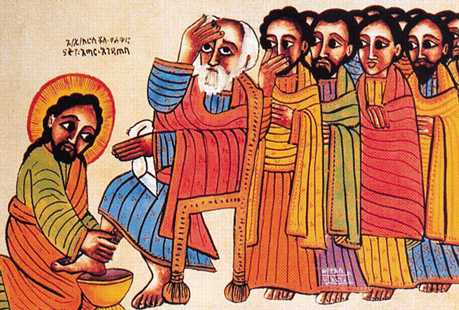
While eating at the table, Jesus gets up, takes off his outer robe, and ties a towel around himself. He begins washing all of the disciples’ feet and wipes them off with the towel around his waist.

Peter, of course, objects to the humble (read: humiliating) act of his Lord, but Jesus hits him hard with, “You do not know what I am doing, but later you will understand.”

Only after every disciple’s feet are washed does Jesus arise, and begins to teach:

“Listen, you call me Teacher and Lord which is good and fine because that is who I am. But check this out: If I, your Lord and Teacher, am willing to get down on the floor to wash your feet, you also ought to wash one another’s feet. This is what the Kingdom of God is all about – the first being last and the last being first. Things are getting flipped upside down right here and right now. And I do and say all of this knowing that one of you will betray me, it is to fulfill the scripture, ‘The one who ate my bread, has lifted his heel against me.’” Shortly thereafter, Judas leaves and sets in motion the world turned upside down. In mere hours the guards will arrive in the garden, Jesus will be arrested, put on trial, sentenced, beaten, and left to die on the cross.

The foot washing has always been a little strange and a little weird to the people called church. For one, as mentioned, the other Gospels don’t include it, and for another, it reveals the heart of God in a way that feels uncomfortable.

Not only does Jesus, God in the flesh, get down on his knees to wash the dirty feet of the disciples, one of whom will shortly betray him, another will deny him, and the rest will leave him hanging to die on a cross, but then Jesus has the gall to command us to do the same for one another.

And yet, in a way, more than being told what we are supposed to do, the whole message of this final moment is, again, about what Jesus does for us.

In the foot washing, Jesus repeats in himself the great lengths to which God was willing to go for a people undeserving – how far God was willing to go to wash us clean from our transgressions.

This moment, one that might make us cringe or, at the very least, furrow our brows, it reveals to the disciples and to us that the Lord, the Alpha and Omega, the Beginning and the End, is about to suffer and die just to rid us of the stench and dirt of sin and death that latches onto us.

And, notably, this is the final act of Jesus toward his disciples before Easter and, as John so wonderfully notes, Jesus loved his disciples to the end. Including Judas.

Do you see what this means? Even the worst stinker in the world, even the one who betrays his Lord to death, is someone for whom Christ died. While we were yet sinners, Christ died for us.

Jesus, bewilderingly, loves us to the end, loves us so much that he was willing to take our sin upon himself, mount the hard wood of the cross, and leave them there forever. Thanks be to God.