Someone Reigns!

Matthew 28.16-18

Now the eleven disciples went to Galilee, to the mountain to which Jesus had directed the,. When they saw him, they worshiped him; but some doubted. And Jesus came and said to them, “All authority in heaven and on earth has been given to me.”

On the evening of December 9th, 1968, Eduard Thurneysen had a telephone conversation with Karl Barth. Later that night, Barth died in his sleep. Thurneysen explained later that much of their conversation dealt with the world situation at the time, and that Barth’s final words were as follows:

“Indeed, the world is dark. Still, let us not lose heart! Never! There is still someone who reigns, not just in Moscow or in Washington or in Peking, but from above, from heaven. God is in command. That’s why I am not afraid. Let us stay confident even in the darkest moments! Let us not allow our hope to sink, hope for all human beings, for all the nations of the world! God does not let us fall, not a single one of us and not all of us together! Someone reigns!” (Barth In Conversation, Volume III). 

Karl Barth was never one to shrink away from speaking truth to power. He was removed from his teaching position in Germany for refusing to pledge allegiance to Hitler before the second World War, he ridiculed the United States for it’s criminal justice system in the 1960’s, and wrote about the childishness of the Vietnam War in his later years.

And it brings me great comfort that with some of his final breaths, he still remembered that, even in the darkest moments, the One who chose to come and dwell among us still reigns. That, as Christians, we know how the story ends which frees us for “joyful obedience” to a kingdom the world would never choose for itself. 

The Gospel is something that comes to us from outside of us. We are saved by God in Christ not because we deserve it (just turn on your TV for one minute these days and you’ll see how little we deserve to be saved), but because God choses to do so in God’s infinite freedom. That is what the Gospel is – it is our salvation granted to us by the only One who could – the judged Judge who comes to stand in our place – the shackles to sin and death have been vanquished forever.

Which is all to say, Christians, in light of the life, death, and resurrection of Jesus Christ see the world differently. We rebel against the insidious power of despair and seek out ministries that reflect the graceful work of Christ who came to raise the dead. 

Someone reigns – that someone is Jesus Christ.

He is the difference that makes all the difference. 
Lies We Wrap In Love

I’ve been thinking a lot about what it means to pray in the midst of a time like this. A time when all you have to do is get on Twitter or television and you’re bombarded with images and videos from our local community and across the nation of people in anguish and fear, and the ways others are responding to it.

This morning, I arrived at church and went to the sanctuary to pray as I always do and I was at a loss for what to share with the Lord. I felt like I had no words to offer in regard to everything being experienced.

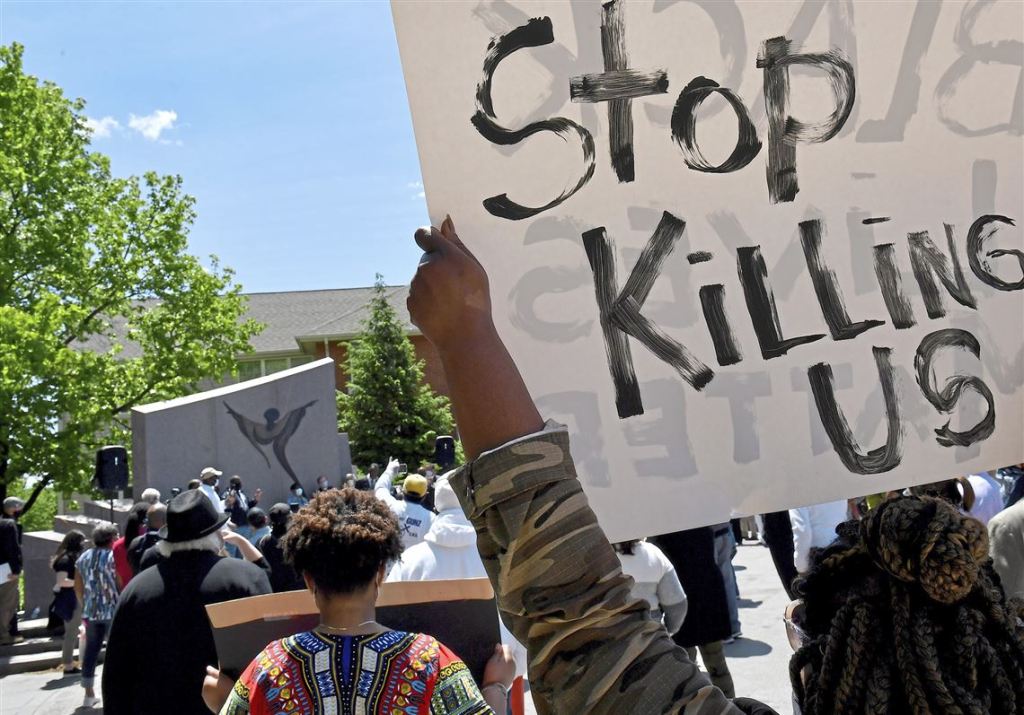
From protestors being hit by police cars, to the President tear-gassing a church so that he could have a photo opportunity with a Bible in his hands, to the countless images of violence being perpetrated against those who are demonstrating peacefully.

It’s difficult to know how to put into words how I’m feeling, how to communicate it to God, and how we should (perhaps) all be feeling about this. And I was reminded this morning, particularly as a pastor who feels like I always have to be coming up with new, fresh, and insightful things to say, that I can rely on the words of others.

And, in particular, I can rely on the prayers of others.

Karl Barth once said, “To clasp hands together in prayer is the beginning of an uprising against the disorder of the world.”

That’s how I try to think of prayer whenever I pray whether it’s individually or corporately.

Therefore, I would like to share a prayer from someone else, a prayer that has meant a lot to me, and feels even more important considering the condition of our current condition:

Lies We Wrap in Love – Stanley Hauerwas

Lord, we often ask you to invade our lives,

To plumb the secrets of our hearts unknown even to ourselves.

But in fact we do not desire that.

What we really want to scream,

If only to ourselves, 

Is “Do not reveal to us who we are!”

We think we are better people if you leave us to our illusions.

Yes, we know another word for a life of illusion is hell. 

But we are surrounded by many caught up in such a hell – 

People too deficient of soul even to be capable of lying, 

But only of self-deceit.

Dear God, we ask for your mercy on all those so caught,

Particularly if we are among them.

The loneliness of such a life is terrifying.

Remind us, compel us to be truthful, painful as that is.

For without the truth, without you, we die.

Save us from the pleasantness which too often is but a name for ambition.

Save us from the temptation to say to another what we think he/she wants to hear

Rather than what we both need to hear.

The regimen of living your truth is hard,

But help us remember that any love but truthful love is cursed.

The lie wrapped in love is just another word for violence.

For God’s sake, for the world’s sake, give us the courage to speak truthfully,

So that we might be at peace with one another and with you. Amen. 

So, whether it’s with your own prayers, or the prayers of those who came before, I pray that today you find a way to clasp your hands in prayer such that is a beginning of an uprising against the disorder of the world. 

Three Words

Genesis 1.1-3

In the beginning when God created the heavens and the earth, the earth was a formless void and darkness covered the face of the deep, while a wind from God swept over the face of the waters. Then God said, “Let there be light”; and there was light. 

God speaks creation into existence.

That might sound heady and overly theological, but it’s true. 

The witness of Genesis is not that God strung together sub-atomic particles to bring forth matter. Nor is it that God set up a tossed salad of building blocks in order to put the planetary bodies into place.

God spoke and it happened.

Much has been made about these words. Entire dissertations crowds the shelves at seminaries on these first verses in the Biblical record.

And yet, they are some that we avoid the most.

I can remember sitting in on a Bible Study with pastors from a small community in Western North Carolina when Genesis 1 was brought up. We politely alluded to the theological importance of particular verses, we showed off the little Hebrew we knew (if any), and pretty quickly the conversation came to a stand still. As the outsider, I felt it my responsibility to keep the study flowing so I asked, “Who was the last pastor to preach on Genesis 1, and what did you say about it?”

Crickets.

One by one the pastors sheepishly confessed that not a one of them had ever preached on Genesis 1.

Why? They didn’t know quite what to say about it.

As one now tasked with public proclamation on a regular basis, I empathize with the fear and trembling of my fellow pastors form the past. I know what it feels like to look at a text and scripture and feel as if there’s nothing I can say about it.

Which, after all, is kind of the whole point.

Preaching, at least faithful preaching, has little, if anything, to do with what a preacher has to say. Instead, it has everything to do with what God has to say through the preacher tasked with preaching.

Or, let me put it another way: Ellen Davis, noted Old Testament scholar, is known for saying that the best preachers are those who offer forgettable sermons. Their sermons are good precisely because they get out of the way to let the passage shine. At best, the hope should be that people don’t remember what was said from the pulpit, but the next time they come across the passage (whether reading at home or on another Sunday morning) they might hear something good, right, and true from the Lord.

So, here is my brief and hopefully forgettable thought about the beginning of scripture:

Words are far more powerful than we think they are. We might be taught that “sticks and stone may break my bones but names will never hurt me.” But that doesn’t mean it isn’t true! I have plenty of friends for whom a nickname from the past still haunts them even today. 

Words can build up and they can destroy. They can make us laugh, or cry, or rejoice, or lament.

Words can set us to action, or they can make us sit back and think.

Today there are three words that have set the nation on edge: Black Lives Matter. 

Those words matter because they are true. Or, at the very least, they should be true. But to most white folks, black lives don’t matter. They’re seen as inferior, or dispensable, or burdensome. 

We see images and videos of looting taking place across the nation and instead of joining together in a collective witness against the horrific racism that plagues this place, we offer trite words on social media about how this isn’t what Martin Luther King Jr. would’ve wanted.

But we’ve forgotten. 

We’ve forgotten that when asked about looting Dr. King said, “A riot is the language of the unheard.”

Words are important. Speaking words brings new things into existence. But for my fellow white brothers and sisters, perhaps now is the time not to add our words to the fray. Instead, let us listen to those whom we have oppressed since the beginning of time. And maybe, maybe we’ll hear the Lord speak through them to us, bringing a new creation into existence. 

A Pretty Good Party Trick

This week on the Strangely Warmed podcast I speak with Joshua Retterer about the readings for Trinity Sunday [A] (Genesis 1.1-2.4a, Psalm 8, 2 Corinthians 13.11-13, Matthew 28.16-20). Josh is a fried of the pod and a regular contributor at Mockingbird. Our conversation covers a range of topics including self-justification, reading between the lines, trinitarian thoughts, Carl Sagan’s COSMOS, sabbath rest, low anthropology and evangelicalism, muddling in the middle, guilt management, and theological homelessness. If you would like to listen to the episode or subscribe to the podcast you can do so here: A Pretty Good Party Trick