Isaiah 1.10-20
Hear the word of the Lord, you rulers of Sodom! Listen to the teaching of our God, you people of Gomorrah! What to me is the multitude of your sacrifices? says the Lord; I have had enough of burnt offerings of rams and the fat of fed beasts; I do not delight in the blood of bulls, or of lambs, or of goats. When you come to appear before me, who asked this from your hand? Trample my courts no more; bringing offerings is futile; incense is an abomination to me. New moon and Sabbath calling of convocation – I cannot endure solemn assemblies with iniquity. Your new moons and your appointed festivals my soul hates; they have become a burden to me, I am weary of bearing them. When you stretch out your hands, I will hide my eyes from you; even though you make many prayers, I will not listen; your hands are full of blood. Wash yourselves make yourselves clean; remove the evil of your doings from before my eyes; cease to do evil, learn to do good; seek justice, rescue the oppressed, defend the orphan, plead for the widow. Come now, let us argue it out, says the Lord: though your sins are like scarlet, they shall be like snow; though they are red like crimson, they shall become like wool. If you are willing and obedient, you shall eat the good of the land; but if you refuse and rebel, you shall be devoured by the sword; for the mouth of the Lord has spoken.

When I was in college I tried to attend as many different worship experiences as I could. At times I gathered with high church Presbyterians, Free Church Pentecostals, non-denominational evangelicals, and southern Baptists. After having already begun to wrestle with a call to ministry, and knowing that I was a Methodist through and through, I thought it would be helpful to experience many forms of Christian liturgical worship, and discover the individual strengths and weaknesses.
There was one campus Christian organization that met every a week in one of the lecture halls at JMU in order to have their worship service. Now this group was one of the most talked about throughout the university and people always raved about the spirit, vigor, and excitement of the services. A few of my friends from the Religion department regularly attended, so one week I decided to give it a shot.
Let me tell you: those people knew how to worship. If you can imagine a full band: drum kit, 3 guitarists, bass, keyboard, and multiple singers. They had stage lighting set up that would change dramatically during the songs, and even during the sermon. They had giant projectors that displayed lyrics, prayers, and even sermonic notes. When the band was playing, everyone had their hands in the air praising. When the preacher was praying, everyone had their heads bowed in submission. It was an experience. The energy in the room was so palpable that I felt on fire for Jesus when I left.
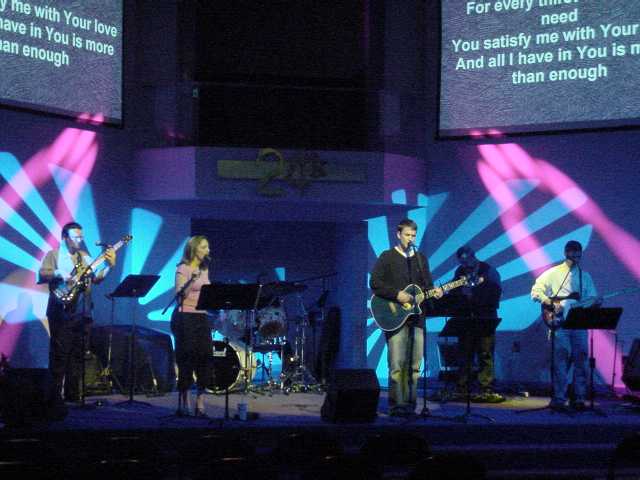
About a week later, after spending way too many hours in the library, I found myself walking back across the quad late at night toward my locked up bicycle. Across the perfectly mowed grass I saw a young man stumbling and trying desperately to maintain his balance. As our paths inevitably drove us closer and closer I recognized him from the worship service I had been in the week before, this young inebriated college student was the bass player for the worship band. It was obvious that he needed help, and remembering that I was a Christian and thinking that this would be a Christian thing to do, I offered him my arm and began to walk him back to his dorm.
“I loved your service the other night,” I said, “The music was particularly moving.” He met my statements with a suspicious eyebrow, so I awkwardly continued “It was really powerful for me.” “Look man,” he slurred, “I don’t believe in God. I just play in the band because they pay me to.”
Worship is important. As Christians we have gathered together for the last 20 centuries first in synagogues, then basements and homes, eventually we started to build churches, and then cathedrals. Worship is at the heart of what it means to be Christian because we participate in the kind of life that Jesus led with his disciples in the 1st century. You might not realize it, but the basic pattern of our worship service has its roots in the ancient practices of the Israelites, and have been handed down to Christians ever since.
First we gather together: we are brought into this place as a community, the body of Christ. We assemble together from the outside world preparing ourselves to be launched into the realm and praise of God almighty.
Second we proclaim the Word of God. We read from the scriptures of the Old and New Testaments. We remember the mighty acts of God in the world as recorded in the Bible and then a sermon is given in order to let the Word become incarnate in our hearing and living.
Third we respond to the proclaimed Word. After hearing about and remembering God’s actions in our lives and the lives of others we return to God with our own participation. Sometimes this response takes place in the form of Communion where we recommit ourselves and are welcomed to God’s table. Other weeks we respond with affirmations of our beliefs such as the Apostles’ Creed.
Finally, we conclude by being sent forth. We re-enter the world bringing with us the light of Christ. As a gathered community we recommit ourselves to life outside of the church being the body of Christ for the world.
Here’s the frightening part: All of that is meaningless unless our lives are transformed.
One of the things that we definitively learn from scripture, particularly the Old Testament is this: the children of God, the objects of divine grace, are not in any way worthy of it. Time and time again in the scriptures we learn about the people of Israel who, by way of their faithlessness, were transgressors of the commandments given to them by almighty God. Just think of some of the so-called “heroes” of the Old Testament: Noah – saved his family and all the animals in his ark and then got drunk and cursed one of his sons for all eternity. Abraham – entered into the holy covenant with God and then pretended to be his wife’s brother and nearly murdered his son. David– delivered the Israelites from the Philistines by killing Goliath, and then stole Bathsheba from her husband and tried to have him murdered. I could go on and on.
The normal sermonic response to these stories of failure and sin is that the children of God are corrupted children. However, in time, God came to dwell among his people and came in the form of a baby named Jesus, the one Israelite who took the place of the disobedient children, the faithless people, and their faithless priests and kings. The Word made flesh. It is only in the light of who Jesus is and was that we see how far humanity had fallen from the grace of God. What we miss though is the fact that this type of behavior, this faithlessness, does not only apply to the Israelites and the people of Isaiah’s critique, but in fact acts as a mirror for all of us.[1]
Its very easy to read this passage from Isaiah and assume that the Israelites were the one’s who got it wrong, but us enlightened folk in the 21st century, we United Methodists, we’ve got our worship lives together, we are appropriately liturgical. But the Word of God has a most perturbing way of disregarding dates and making truth contemporary.
Isaiah begins, “Hear the word of the Lord, you rulers of Sodom! Listen to the teaching of our God, you people of Gomorrah!” He continues by pointing out all of the failures of their worship: “What to me is the multitude of your sacrifices? I have had enough burnt offerings!” It’s as if God were looking at us today and saying: “I don’t care about your opening Hymn, I have heard enough of the scriptures read aloud.” All these elements of worship, the types of things we take for granted every week are relatively meaningless to God unless what we do in this place translates into the way we live our lives.
“Wash yourselves, make yourselves clean, remove the evil of your doings from before my eyes; cease to do evil, learn to do good, seek justice, rescue the oppressed, defend the orphan, plead for the widow.” These are the things that are important to God. The Hebrew prophets Isaiah, Amos, Micah, Hosea, and Jeremiah each denounce worship practices that have no influence on the way we handle our lives. The prophets try again and again to demonstrate that God is far more concerned with the relationships between people than with the details of public worship.
“Wash yourselves, make yourselves clean.” It is precisely at this moment that the voice of God, through the prophet Isaiah reaches us across the centuries and bids us to look into our own hearts before we come to God. Sometimes we don’t like to admit it, but there is a relationship between corporate worship and individual character. What we believe shapes how we behave.
When I ran into the young man on campus, the bass player for the worship service, I got a glimpse into what Isaiah is getting at in this passage. You can have the “perfect” worship service, we could get the lights going with the projectors and the band and the PowerPoint and the over the ear microphones. We could get people to wave their hands in the air and sing at the top of their lungs. But, worship ceases to be true worship unless our lives are changed when we re-enter the world. Worship becomes just a routine for us if we treat it like that bass player did: just a gig.
We here, good Christian United Methodists, we might not be guilty of the same hypocrisy in our worship, but we need to face the truth that to raise no voice against the evils and injustices of the world, to remain silent in the shadow of corruption and sin, is to leave a fatal gap between the type of Worship we offer to a righteous God, and the attitudes we have toward the wrongs of the world. Throughout history there has been a deep inconsistency between the faith we proclaim on Sunday mornings in the fatherhood, justice, and holiness of God and the type of ethics and moral decisions to which we consent in our lives and particularly in our dealings with other people.

We should ask ourselves: Is our worship changing the way we live our lives? Are we heeding the call to love the oppressed? Are we content to remain almost Christians, or are we fully embodying what it means to be disciples of Jesus Christ? Why do we gather together once a week?
All of this, gathering, proclaiming, responding, being sent forth, remains empty until we are transformed. They will continue to act only as a routine for us unless we enter the strange new world of the Bible and realize that our world has been turned upside down. We gather weekly to turn ourselves back toward God so that we can live lives that follow the teachings and practices of God in Jesus Christ. What we do in this place can function to help transform our lives if we continue to learn the grammar of discipleship and speak that new language when we go back into the world.
The only true worship worthy of God, the worship that God seeks from his people, is the time and space that reveals God’s character through justice, righteousness, unselfishness, and purity. What we are must ratify what we say. Or as one of my professors used to say: We can only live in a world we can see, and we can only see in a world we have been taught to speak. When we learn the stories of scripture, let the tunes and words of the hymns resonate deeply in our lives, we can then learn to be a new people for the world.
It is the responsibility of this church to make the love of God known and to comfort all people with the Good News of our Lord Jesus Christ. This cannot be done through worship alone, through singing hymns alone, through preaching alone, or by any other institutional method we can come up with, but only through living lives which reflect God’s loving spirit. When you walk out of church this morning I encourage you to remember that God has already transformed you through the life and death of Jesus Christ. As you interact with others remember that we have been called to love the oppressed, and seek justice in the world. I challenge you to do something this week that is truly worthy of God’s worship.
Worship in God’s church takes place right here in this space, but the results of our worship should be manifest in the way we live our lives here and in the world. Amen.
[1] Barth, Karl. Church Dogmatics V.1. (Peabody, Mass.: Hendrickson Publishing, 2004), 523.


 think and let think