Weekly Devotional – 1/13/14

Devotional:

John 11.27-28:

She said to him, “Yes, Lord, I believe that you are the Messiah, the Son of God, the one coming into the world. When she had said this, she went back and called her sister Mary, and told her privately, “The Teacher is here and is calling for you.”

bible

We sat around the room, uncomfortably crossing our legs occasionally while sitting in stiff chairs. The fellowship room at Asbury UMC in Harrisonburg, VA was welcoming but something was wrong with the thermostat; the heat was on full blast and the windows were open to help offset the sauna-like atmosphere. As is common in most Methodist gatherings, conversation percolated about the weather, parking in the immediate area, and church identities.

We were all there to talk about prayer. Lay and clergy alike, someone had invited each one of us to participate in this “Kindred Project” to focus on the importance of spiritual disciplines in the lives of our churches. We exchanged the typical pleasantries, identified our positions in local churches, and then entered a time of contemplative prayer.

Our leaders began to read from the 11th chapter of the gospel according to John, repeating the line: “The Teacher is here and is calling for you.” While sitting in the circle, we each looked to the person on our right and repeated the line to them, “The Teacher is here and is calling for you.” When the statement had finally made its way around the whole group, we entered a period of silence for 20 minutes.

Silence is difficult. Its hard to maintain focus without a myriad of thoughts beginning to sprout in the gray matter. I tried to keep focusing on that one sentence, but others ideas began to creep in: What am I going to preach about on Sunday? Who do I need to call this afternoon? etc. So, after a few moments of silence, unsuccessful in focusing on prayer, I removed myself from the circle, walked around the room for a minute and sat down on a rug in the corner. The silence weighed heavily on my heart as a tried to seek focus and contemplation. As I pushed my extra thoughts out of my mind the word teacher began to move through my head in a rhythmic fashion. Teacher, teacher, teacher.

When our twenty minutes were up, we shared our experiences and prayers with the rest of the group. This is what I said:

“I’ve been serving St. John’s for 6 months. I have embraced the role of teacher and preacher in a number of different ways and have thoroughly enjoyed my time so far. It often feels that I am supposed to be a master of the text (scripture) for the laity and provide for them concise and coherent reflections about how scripture continues to speak to us. However, during the last twenty minutes of silence, I realized that I’ve been looking at scripture and my calling to pastoral ministry a little backwards. I am not supposed to be a master of the text, but instead a servant of the Word. I am not called to be The Teacher, but must remember that I am still a student of God’s Word for me and my life.”

It never ceases to amaze me how God can use some of the most mundane moments to remind me what faith and discipleship is all about. For as much time as I spend in scripture to prepare sermons and bible studies, I must also remember my commitment to study the Word of the Lord in order to transform and shape my life as a Christian.

So, I encourage you to remember that “the Teacher is here and is calling for you.” It does not matter whether you have a degree in biblical theology, or you’ve never even opened a bible. Discipleship is about recognizing that we are forever students on the journey of faith. God’s Word is alive for you and me because whenever we approach it, it can speak a new word into our lives. So, if you have time this week, open your bibles to a passage of familiarity, read it aloud, read it silently, and dwell upon those words. How is God using them to speak into your life? What lesson is the great Teacher offering you right now?


Weekly Devotional – 12/2/13

Devotional:

Psalm 72.1-7

Give the king your justice, O God, and your righteousness to a king’s son. May he judge your people with righteousness, and your poor with justice. May the mountains yield prosperity for the people, and the hills, in righteousness. May he defend the cause of the poor of the people, give deliverance to the needy, and crush the oppressor. May he live while the sun endures, and as long as the moon, throughout all generations. May he be like rain that falls on the mown grass, like showers that water the earth. In his days may righteousness flourish and peace abound, until the moon is no more.

Youth Band at a Fat Tuesday Celebration

Youth Band at a Fat Tuesday Celebration

When I was in High School I was fortunate to help form a youth band at my home church. A number of us would gather on a weekly basis in the sanctuary playing contemporary Christian music with guitars, bass, drums, and singers. We always had an adult present in order to fulfill the Childcare Protection Policy, but we largely did everything on our own; we picked the music, practiced accordingly, and planned performances throughout the year.

Though I had been attending church my entire life, it was during this period that I began to have a serious appreciation for worship, scripture, and prayer. We would talk about the lyrics of the songs regarding their connection with biblical verses, we debated about how songs should be played in order to indicate the mood of a service, and we began and ended every practice with prayer.

169_1010929764498_9857_n

One of my best friends growing up was a regular for leading prayer at the end of practice. He was often filled with joy (and by the Spirit) and would wave his arms back in forth while we stood hand in hand in a circle. His way of prayer was unlike anything else I had experienced. Whereas many would pray in some sort of elevated way (“Oh Great and Holy Majestic God who knows no bounds, commit thyself to mercy” etc) Will always sounded as if he was talking to another one of his friends. God, for Will, was a constant companion, a trusted friend, and a exciting partner on this journey of life. Will’s prayers were life-giving for all of there because he made God so much more approachable for all of us. Moreover, the prayers were never limited to our specific needs as teenagers, or even as a band, but they flowed over every element of life. Will would pray for the weather (every week), the other people of our church and school, our futures, and justice in the world. He might not know it, but Will taught all of us how to be in relationship with God, and with one another.

The psalmist writes regarding the coming Messiah, “May he be like rain that falls on the mown grass, like showers that water the earth. In his days may righteousness flourish and peace abound, until the moon is no more.” Our relationship with God through Jesus Christ is one that meets us at every moment of our lives, the glorious and the mundane. God confronts us in magnitude and in simplicity. As we continue to shape ourselves into disciples of Jesus Christ, our prayers should always be for the one who falls like rain on the mown grass of our lives.

And so, in this holiday season filled with reunion and sacrifice, remember that Christ is a living presence in your life. When you go to God in prayer, let the words of Psalm 72 help to anticipate God’s coming reign, and our responsibility to live into God’s kingdom of justice on earth here and now. Let us all pray like Will, pray for God to reign abundantly in our hearts so that we might all come within his warm and peaceful embrace.


Weekly Devotional – 11/4/2013

Devotional:


Psalm 17.6-9

I call upon you, for you will answer me, O God; incline your ear to me, hear my words. Wondrously show your steadfast love, O savior of those who seek refuge from their adversaries at your right hand. Guard me as the apple of the eye; hide me in the shadow of your wings, from the wicked who despoil me, my deadly enemies who surround me.

psalm-17-8

In the midst of suffering and disappointment in our lives, faith can be very difficult to hold on to. When we hear someone say, “life just isn’t fair,” we want to cry out, “Well, it should be!” Life is full of ups and downs, valleys and mountain tops, trials and accomplishments. Psalm 17 is a prayer of deliverance from those moments in our lives where we feel that life is no longer fair. It is a prayer for freedom to live into God’s righteousness and for God to come and surround us with his wings of protection and grace. While life is not fair all the time, it is right at all times to pray for God to deliver us from the wrong doings in our lives and the suffering we endure.

Additionally, there is something else in this psalm that can help us in our daily lives:

Once, while reading through some of the psalms with a few peers, a friend of mine remarked that there is often a lot of language about enemies in the psalms and he was unsure what to make of it. What does the psalmist mean with “my deadly enemies who surround me?” And then he made a statement that I will never forget: “We often read the psalms as if they were written for us individually and we forget about others who need to pray these words. Maybe we need to remember that we might be the enemies that the psalm prays about for other people.”

So, the next time you find yourself in a valley of your life, come back to Psalm 17. Read the words and pray them aloud. Know that it is a good and wonderful thing to be able to call out to the God who loves you to help deliver you out of troubling circumstances. But, the next time you find yourself on a mountaintop, ask yourself if you have been living faithfully according to God’s holy word. Is there someone praying for deliverance from an enemy that may in fact be you?


Weekly Devotional – 10/21/2013

Devotional:

Luke 18.9-14

He also told this parable to some who trusted in themselves that they were righteous and regarded others with contempt: ‘Two men went up to the temple to pray, one a Pharisee and the other a tax-collector. The Pharisee, standing by himself, was praying thus, “God, I thank you that I am not like other people: thieves, rogues, adulterers, or even like this tax-collector. I fast twice a week; I give a tenth of all my income.” But the tax-collector, standing far off, would not even look up to heaven, but was beating his breast and saying, “God, be merciful to me, a sinner!” I tell you, this man went down to his home justified rather than the other; for all who exalt themselves will be humbled, but all who humble themselves will be exalted.’


There was a couple I knew growing up who had it all together, or at least it seemed like they did on the surface. They were in church every Sunday morning, sitting together holding hands, with children flanking them on either side sitting attentively. They attended the Wednesday night dinners, participated in bible studies, and volunteered for celebratory programs.

family of four on grass with hands up

However, on one particular Sunday morning I saw them out in the parking lot, before church, yelling at one another. I was shocked: not only were these two some of the best members of the church, but they were yelling so loud that many congregants were parking on the other side of the lot just to avoid them. Yet, 45 minutes later there they were standing in line with their palms outstretched ready to receive communion. They were surrounded by people who had seen them fighting in the parking lot, but they still came forward to receive the body and the blood.

I am often guilty of thinking I have to have it all together before I pray, before I read scripture, or before I arrive at church. Like the Pharisee in Jesus’ parable I tend to focus on all of the things I have done correctly. But, when I enter church thinking I’ve got it all worked out, I leave feeling empty, as if something is missing. Though I was perplexed by the juxtaposition of the fighting couple standing at the altar of God, I realized that we are all just like them, in different ways.

I think that this parable Jesus told is all about prayer and about the way we enter into a church on Sunday mornings (or any other day of the week). Jesus tells his disciples that there are two types of people who come to church – Pharisees and Tax collectors. Depending on the week, or the time of year, we are one or the other most of the time. There are times when we walk into the house of God, ready to worship as good bible-believing Christians, Pharisees of the 21st century. We are so pleased with ourselves for following all the rules and behaving appropriately all the time. And sometimes we go home after church with an emptiness because we were so full before we arrived. But there are other times when we enter the house of God as tax-collectors, needing everything, afraid, lost, full of doubt, and return home with more than we ever dared to ask in the first place.

So, the next time you prepare to worship, or to pray to God, know that sometimes we fail and sometimes we succeed. We all carry with us a lot of baggage and, occasionally, we are unaware of it. There will be sermons that you get nothing out of, a hymn that does not resonate deep in your heart, and a bible study that you already know all the answers to. But, there will come a time when you enter into prayer empty, afraid, and hopeless; a time when you do not have all the answers; a time when all you have left to say is “Lord, have mercy on me, a sinner!” And God will be there waiting.

Lord, Teach Us To Pray – Sermon on Luke 11.1-13

Luke 11.1-13

He was praying in a certain place, and after he had finished, one of his disciples said to him, “Lord, teach us to pray, as John taught his disciples.” He said to them, “When you pray, say: Father, hallowed be your name. Your kingdom come. Give us each day our daily bread. And forgive us our sins, for we ourselves forgive everyone indebted to us. And do not bring us to the time of trial.” And he said to them, “Suppose one of you has a friend, and you go to him at midnight and say to him, ‘Friend, lend me three loaves of bread; for a friend of mine has arrived and I have nothing to set before him.’ And he answers from within, ‘Do not bother me; the door has already been locked, and my children are with me in bed; I cannot get up and give you anything.’ I tell you, even though he will not get up and give him anything because he is his friend, at least because of his persistence he will get up and give him whatever he needs. So I say to you, Ask, and it will be given you; search, and you will find; knock, and the door will be opened for you. For everyone who asks receives, and everyone who searches finds, and for everyone who knocks the door will be opened. Is there anyone among you who, if your child asks for a fish, will give a snake instead of a fish? Or if the child asks for an egg, will give a scorpion? If you then, who are evil, know how to give good gifts to your children, how much more will the heavenly Father give the Holy Spirit to those who ask him!”

39347_1409537169434_1007347_n

A few years ago I was given the opportunity to lead an adult mission trip to Guatemala, (nearly identical to the one Lindsey went on 2 weeks ago). It would be my responsibility to help organize the trip, make sure we had all the proper preparations taken care of, and then lead the adults while in the country. I was 19 years old at the time, and all of the adults on the trip were closer in age to my parents. “Stressed” doesn’t even come close to describing the way I felt between organizing the trip and making sure we all arrived in the country. I mean this in the best possible way, but that trip was the first time I really experienced what its like to be a shepherd herding sheep.

We had been in Guatemala for 24 hours when it was time for us to make the long bus journey to the village where we would be working. I don’t know whether it was the restlessness that accompanies an impending workweek, or if I just had trouble sleeping, but I woke up before anyone else and I walked around the town of Panajachel on the banks of lake Atitlan. By the time I made it back to our little bungalows I thought I was still the only person awake, so I made my way back to my room before breakfast. Because I was leading the trip in tandem with my home pastor, we had been assigned to the same room, and I quietly crept in so as to not wake him up. When I finally pushed the door open I saw something that stopped me in the doorway.

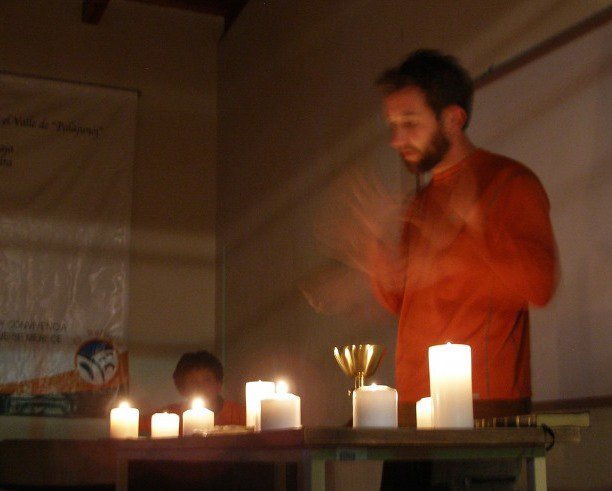
Jason was kneeling on the cold hard ground with his bible open on the bed praying out loud. I froze in the doorway because I had known Jason for 5 years and I had never seen him pray outside of Sunday worship. I could not hear everything he was saying, but it was one of the most beautiful things I had ever witnessed. And standing there in the doorway, watching my pastor pray on his knees, I felt convicted. In that moment I could not remember the last time I had talked to God.
38744_1412672047804_1769592_n

“Lord, teach us to pray.” On the lips of the unnamed disciple, this is one of the most revealing moments of the gospel according to Luke. From this one desire, this simple request regarding prayer, we get to take a step into the strange new world of the bible and hear Jesus speak from within the depth of his being: When you pray, say: Father, hallowed be your name. Your kingdom come. Give us each day our daily bread. And forgive us our sins, for we ourselves forgive everyone indebted to us. And do not bring us to the time of trial.”

How often have we wanted to ask Jesus the same exact thing? I can tell you, that as someone in the ministry, the only question I hear more often than “what will happen to me when I die?” is “how am I supposed to pray? Clearly this is something that gets at the heart of what it means to be a follower of Jesus Christ because even the original disciples wanted to know how to pray. In the same way that my pastor Jason’s prayer moved me to want to learn to pray, Jesus exemplified the importance of prayer for his disciples.

Throughout the gospel, Jesus is frequently in prayer and it carries an incredibly important image. At his baptism: “Now when all the people were baptized, and when Jesus also had been baptized and was praying, the heaven was opened (Lk. 3.21). As he made his way throughout Galilee “he went to the mountain to pray; and he spent the night in prayer to God. And when day came, he called his disciples and chose twelve of them, whom he also named apostles (Lk. 6.12-13). Before Peter’s confession of Jesus as the Christ, Jesus had been praying alone, with only the disciples near him (Lk. 9.18). Jesus, Peter, John, and James were heading up the mountain to pray when Jesus was magnificently transfigured in the midst of praying (Lk. 9.28-29). The importance of prayer in the life of Jesus Christ was significant enough that even his disciples, who were with him constantly, wanted to learn more about the role it played in his life. “Lord, teach us to pray.”

So our Lord looked out at his disciples and said, “When you pray, say: Father”

Father. Notice: Jesus does not pile adjectives on top of each other, its not O Great and mighty most wonderful eternal and almighty God. Instead he simply encourages his disciples to say, “Father.” This word alone helps to signify how this prayer can be both personal and communal. The disciples are to call God “Father” in an intimate and connected way while at the same time recognizing that they have one “Father” to which they can pray together. By beginning with “Father” Jesus is inviting his followers to share in his own prayer life, hoping that they will approach God in the same way that he does.

As the prayer develops it is continually a prayer of a community, “hallowed be your name. Your kingdom come. Give us each day our daily bread.” The plural language, mixed with the intimacy of the relationship with God, allows for this to be a prayer done in a communal gathering, or alone. It remarkably conveys the depth of mystery involved in a community of faith while affirming the desire for God’s kingdom on earth. Whether you pray alone every night before you fall asleep, or if the only time you pray is on Sunday mornings in church, you are connected to God, God’s people, and God’s creation

“And forgive us our sins, for we ourselves forgive everyone indebted to us. And do not bring us to the time of trial.” There is a subtle difference in the prayer at this point as compared to the one from the Gospel according to Matthew, which we say together every week. Instead of “forgive us our trespasses, as we forgive those who have trespassed against us,” Luke tells us that Jesus taught the disciples to seek God’s forgiveness of their sins as we forgive those who are indebted to us. Jesus is concerned with the way that we relate to God, one another, and to God’s creation. When we pray we are not isolated beings stratified from those around us, but we are personally connected with God through our brothers and sisters in Christ. According to Jesus, prayer is supposed to accomplish communal fellowship in such a way that we are not hindered when gathering as the body of Christ. This means that if we take seriously the words of prayer that Jesus taught us, we can’t ignore those sitting with us in worship, and everyone within the greater community.

Jesus concludes his prayer for the disciples by using a little parable to help explain true perseverance in prayer. Through the story of the friend asking for three loaves of bread in the middle of the night, we learn that prayer is to be continually asking, seeking, and knocking. “Ask, and it will be given to you; search, and you will find; knock, and the door will be opened for you.” Prayer is a learned experience, one that is continually cultivated. Prayer is not simply a release of feelings toward God, but a disciplined habit that influences the way we live our lives.

About a year ago, I was making regular visits to the shut-ins from a church in Durham, North Carolina. Every week I found myself sitting with all sorts of people learning about their pasts, and experiencing discipleship in new and exciting ways. Though most of my visits were often filled with excited dialogue there was one particular lady who never spoke. In fact, after meeting with her son, I discovered that she had not talked with anyone for some time. Whenever I saw her we would sit together, I would tell her about all the things happening at church, and I would eventually spend most of the time reading scripture. Her son was almost always with us in the room, and always politely thanked me for coming over but made it clear that there was nothing to be done. One afternoon, after reading from the Gospel according to Mark, I decided to try something new. I began to sing one of my favorite hymns: “Lord, I want to be a Christian in my heart, in my heart, Lord I want to be a Christian in my heart.” By the time I was halfway through the second verse I noticed that she started to move her head back and forth, and as I lowered my singing voice I noticed that she was humming along with me. I looked across the room to her son, and with tears in his eyes he started singing with us. This was the first time, in a long time, that he saw his mother communicating.

Before I left, the three of us held hands for prayer and when I started to say “Our Father, who art in heaven,” she joined us and said the words that Jesus taught his disciples.

It never ceases to amaze me how deeply profound our prayers can be. For that woman it was the hymns and the prayers of church life that stuck with her. They had helped to shape the life she led, and then helped to reunite her with her son that afternoon. When prayer becomes habitual in our lives, when communicating with God becomes part of who we are, our lives will be turned back to the one in whom we live, and move, and have our being.
Praying_Hands_-_Albrecht_Durer

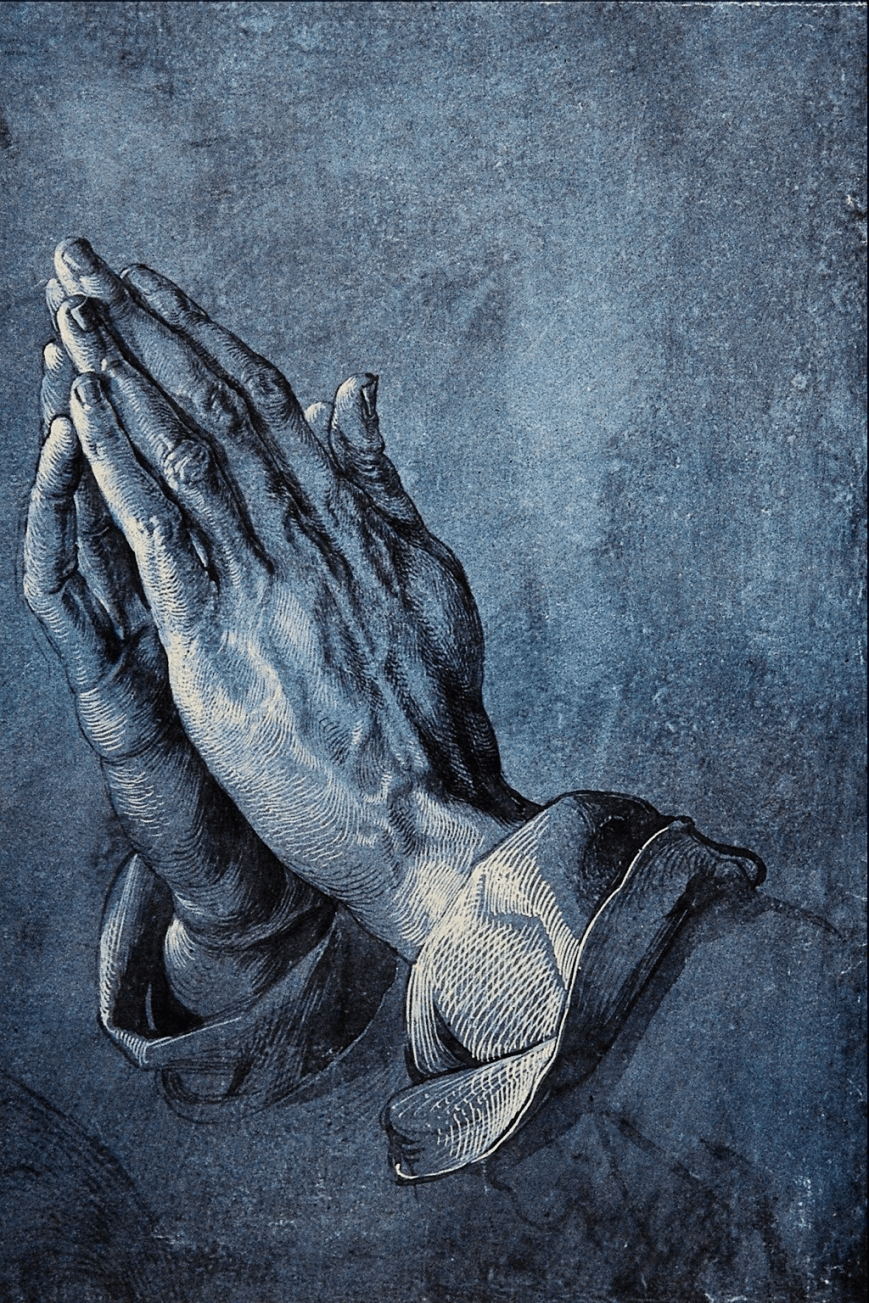
My Christian hero, the Swiss theologian Karl Barth once said: “To clasp the hands in prayer is the beginning of an uprising against the world.” When we follow Jesus and allow prayer to shape our lives like it shaped his, we will begin to stand against the ways of the world. Prayer refocuses our perspective on the ways of God so that the kingdom can remain manifest among us. Learning to pray is much more than just learning a prayer, and we cannot simply learn to pray by learning to say specific words, but the repetition of such words are part of the discipline of prayer. Sometimes we don’t realize it, but every time we read the words of scripture we are praying. Every time we sing the words from our hymnal we are praying. Every time we greet others around us in love we are praying. Living a life of prayer is not easy, but it is more fruitful than we can possibly imagine.

Jesus’ own prayer life was obviously important to the disciples, and should be important to us. We learn from Luke 11 that prayer is about bringing to God our deepest needs and most perplexing trials and tribulations. Prayer is about waiting there in the midst of unknowing for light, love, and strength from the God who made each one of us. Prayer is the recognition and presentation of our lives before him as a holy and living sacrifice. Prayer is the understanding that true Christian living depends not so much on what we do and say, but rather what we allow God to do in and through us. Lord, teach us to pray.

Amen.

The Lord Will Raise Them Up – Sermon on James 5.13-20

(Preached at Aldersgate UMC on 9/30/2012)

James 5.13-20: “Are any among you suffering? They should pray. Are any cheerful? They should sing songs of praise. Are any among you sick? They should call for the elders of the church and have them pray over them, anointing them with oil in the name of the Lord. The prayer of faith will save the sick, and the Lord will raise them up; and anyone who has committed sins will be forgiven. Therefore confess your sins to one another, and pray for one another, so that you may be healed. The prayer of the righteous is powerful and effective. Elijah was a human being like us, and he prayed fervently that it might not rain, and for three years and six months it did not rain on the earth. Then he prayed again, and the heaven gave rain and the earth yielded its harvest. My brothers and sisters, if anyone among you wanders from the truth and is brought back by another, you should know that whoever brings back a sinner from wandering will save the sinner’s soul from death and will cover a multitude of sins.”

James, the brother of Jesus wrote to the early Christians: Are any among you suffering? They should pray. Are any cheerful? They should sing songs of praise. Are any among you sick? They should call for the elders of the church and have them pray over them, anointing them with oil in the name of the Lord. The prayer of faith will save the sick, and the Lord will raise them up. Let us pray.

The man was dying. The sterile controlled atmosphere of the hospital room was almost beyond comprehension. Electronic devices were hung particularly from metallic arms, fluids were flowing, and the low buzz of the oxygen machine provided the only audible accompaniment. The man in the bed was dying and he knew it. His pale blue eyes rested upon mine as I sat across from him not knowing what to say. The sounds of the hospital filled the void of our conversation while his wife wept next to me and his 12 year old son sat stoically staring out the window. I was in the first week of my internship in Birmingham, Michigan and had naively volunteered to make the hospital visits that day. The Henry Ford Hospital was what the parishioners affectionately referred to as the “Cadillac of Hospitals” and it certainly felt that way. Upon entering through the magnificently large main entrance, you were greeted by an assortment of boutiques and small restaurants; there were more trees planted inside the opulent hospital than there were outside on the grounds. Everything about it screamed the opposite of hospital until you explored far enough in to find the patients in their rooms.

The man continued to stare at me from his bed; his eyes spoke more to me than anything conversation would have. I expected to see fear and anxiety in those pale blue eyes, but instead I saw peace, a peace that existed in stark contrast with the tears being spilled on the couch next to me. I had attempted to initiate small talk when I had entered the room, but it went nowhere. As I returned to the dying man’s gaze I was overwhelmed with a profound desire, one that was instigated beyond myself. I leaned forward from my chair toward his bed and though I was afraid of how he would respond, I asked, “May we pray together?”

Throughout the gospel narrative Jesus constantly finds himself in a setting where his saving touch is required. As he made his way throughout Galilee, droves of suffering human beings followed the humble rabbi and implored him to make them well. He was dragged into houses to cure fevers, followed by crawling lepers seeking his simple touch, compelled by friends of a paralytic to bring back restoration. He was confronted with people consumed by demons that were then cast out at the touch and sound of Jesus’ voice. A woman with a hemorrhage reached out just to touch the hem of his garment as he passed by. The blind and deaf were brought before him over and over again, requiring only the simplest touch from Jesus to be made well.

The God who became flesh in Jesus Christ was intimately involved in the healing business. The church, it seems then, should be decidedly emphasizing the healing power that Jesus presented in his earthly ministry. Important for us is that according to the New Testament Jesus also laid his hands on his disciples enabling them to perform similar miracles to those that he himself had accomplished. He sent out the twelve two by two in order to proclaim the Good News and “they cast out many demons, and anointed with oil many who were sick and cured them” (Mark 6.13) Even after Jesus’ death and resurrection, the early church continued in this tradition and was capable of healing the crippled, casting out demons, and even restoring the dead back to life (Acts 3.1-10; 5.12-16; 9.32-43).

Written at some point in the latter half of the first century, the epistle of James has been traditionally connected with James, the younger brother of Jesus. The letter is famous for being Martin Luther’s least favorite book of the bible. Part of the letter addresses the difficult problem of wrestling between faith and work, and what really accomplishes salvation. But this morning we find ourselves at the end of the letter, and James confronts us: Are any of you suffering? You should pray. Are any of you cheerful? You should sing songs of praise. Are any of you sick? You should call for the elders of the church and have them pray over you, anointing you with oil in the name of the Lord. The prayer of faith will save the sick, and the Lord will raise them up.

I wonder about what it really means to be healed. Its very clear in the Bible that when Jesus and the disciples pray or lay their hands on someone that they are physiologically healed from their suffering: the blind see, the deaf hear, and the lame walk. But is this the full intent of healing? What does the “prayer of faith” have to do with being made well? Do we gather every week in order to worship the God who fixes broken bones, or is there more to “healing?”

Beyond physical restoration, Jesus places significant emphasis on the power of being healed in the community. Because of the fear of weakness and sickness in the first century, many who suffered were ostracized from their families and were isolated outside of the community. The people of the New Testament were very logical: they needed to isolate the sick from those who were well. However, Jesus does not agree with the logic of the world. After most of the healing narratives, Jesus commands the newly restored to return to their family or town. Jesus inverts this prescription institutionalized on the suffering with his resounding command: “Go home to your friends.”

The letter of James falls completely in line with Jesus’ perspective of the way the church should stand in contrast to the world. James specifically addresses those within the community who are suffering and sick and admonishes them to call upon the elders to pray over them. James, in line with Jesus, places all of the power with the weak and the last rather than the strong and the first.

Though James’ letter is filled with many commands for Christian living, this scripture right at the very end of the letter is the first and only time that he addresses the ekklesia, the church. The church of the first century existed in sharp contradiction to the expectations of the world. Can you imagine what that community looked like, where the sick had the power to call on the elders to come visit them; a place where the weak and lonely were no longer isolated from their families and friends; an intentional way of living predicated on the practice of mutuality? Remember this: What we believe shapes how we behave.

When I asked the dying man if we could pray together, I did not know how he would respond. The tension in the room was palpable, but he held my gaze and nodded in approval. Before I reached out my hands, I asked if there were certain things I could pray for in that moment. Usually, when I’ve asked this question in hospital rooms the answer is same: “Pray for this to go away, pray for me to get better.” But that afternoon in Michigan, the dying man turned my world upside down: “I want you to pray for the church,” he said, “I want you to pray for the church so that it can take care of my wife, so that my son can have role-models to emulate. I want you to pray for the church so that my wife won’t remain lonely without me, so that my son has someone to throw a baseball with. I want you to pray for the church so that it can be a family for mine… I know I’m dying, but I’m not worried about that anymore because I have faith in our God”

That dying man’s faith is what grace is all about. He believed in something greater, more wonderful, and magnificently mysterious. He, in those simple words, spoke the truth of Gospel better than many preachers ever have. Living a life of faith is not about what you do but it’s about who you are. It’s not about signing up for every Sunday suppers or mission trips, but about believing in the goodness of God and the redemptive quality of Jesus’ death on the cross. It’s not about isolating the weak and the sick away from the healthy; it’s about making community. It’s about being the place where the dying man’s wife and son could be family. The life of faith is predicated on the grace poured out on us everyday of our lives, whether its the simple touch of a hand in a hospital room, or a young boy hugging his father when he finally comes home from work.

The dying man, James, and Jesus all show us how grace works. We are called to live in such a way that we can live up to the expectations of that dying man’s prayer. The church, this church, is the place where we can answer his prayer. We can come together in our suffering through praying and being present with one another. We can come together in our cheerfulness singing our songs of joy and praise. We can come together when we are sick and weak calling for everyone in the church to pray over one another.

How many of us our suffering? How easy it is to pretend like we’re okay when everything is falling apart around us? Have we told anyone about our suffering? Over the last month and a half I have been interning for a church in Durham, North Carolina. As the church’s congregational care intern, it is my responsibility to visit members from the church in the hospital or those who can no longer make it to church. Maybe it’s because they know I’m studying to be a pastor, but many of the people I have visited have shared with me the depth of their being: I have learned about cancers, divorces, unemployment. What I come to discover later is that I am the only one who knows about any of it. Many of these people have not shared their suffering with the best friends, or even their real pastors. Why are we so afraid to open up with on another? Have you told anyone about how you’re suffering? Listen to the command of Jesus through his brother James! We are the church James is speaking to! What would it mean for you to share your fears and failures with your brothers and sisters in Christ. How differently might we view each other when we know the depth of one another’s being?

James is showing us how we can be healed. Part of that responsibility rests on our shoulders: Are any of you sick? You should call for the church to pray over you! We are called to be a community committed to the welfare of the entire body of Christ, one where we know how we are doing, and what we can do for each other. That is our responsibility. What we believe shapes how we behave!

“The prayer of faith will save the sick, and the Lord will raise them up.”

Our belief is that through God’s grace that we find our truest wellness. The grace that he gave to us without any merit of our own, the grace that was poured upon us in the redemption of the world by our Lord Jesus Christ, the grace that knows no bounds! Through grace, the Lord will raise us up.

Amen.