God Said It, I Believe It, That Settles It

Deuteronomy 23.12-14

You shall have a designated area outside the camp to which you shall go. With your utensils you shall have a trowel; when you relieve yourself outside, you shall dig a hole with it and then cover up your excrement. Because the Lord your God travels along with your camp, to save you and to hand over your enemies to you, therefore your camp must be holy, so that he may not see anything indecent among you and turn away from you.

1 Corinthians 14.32-35

And the spirits of prophets are subject to the prophets, for God is a God not of disorder but of peace. As in all the churches of the saints, women should be silent in churches. For they are not permitted to speak, but should be subordinate, as the law also says. If there is anything they desire to know, let them ask their husbands at home. For it is shameful for a woman to speak in church.


We have a problem. I’m sorry that I have to use the pulpit to bring it up, but this is the best way to reach the highest number of people. We, as a church, have fundamentally broken one of God’s laws and we need to do something about it. We need to pray for forgiveness. We need to seek God’s mercy. And, we should get moving on this issue quickly in order to establish our faithfulness before the Lord.

We need to stop using the church bathrooms.

Now, some of you might be thinking: What in the world? Stop using the bathrooms? We’ve heard him say some strange stuff from the pulpit, but this has to be the strangest!

But scripture is pretty clear. We are supposed to have a designated area, outside the church, where we shall go when nature calls. We are supposed to keep a trowel with us at all times so that when we relieve ourselves outside, we can dig a hole and then cover up our excrement. We need to do this because the Lord is with us when we are in church, therefore this church must be holy and we can’t let the Lord see anything indecent among us.

So, after prayerful consideration, the trustees have voted to permanently close all the bathrooms in the church building, and we will construct some outhouses on the edge of the property for excrement disposal.

Just kidding.

lexica

Have you ever heard someone preach on Deuteronomy 23.12-14? I haven’t, nor have I even encountered it during a bible study. But in the 1880’s, churches and bathrooms were quite the topic of sermonic conversation. The advent of indoor plumbing had arrived and the question about whether or not to have bathrooms in churches started to pop up.

By the logic of the Old Testament, churches were seen just like the Israelite encampments and because of this the same rules about where people could relieve themselves were applied. Many preachers used this argument from their pulpit more than a century ago to fight the growing trend to build bathrooms in churches!

Today, when designing a new church, one of the first questions isn’t what the sanctuary should look like, or what kind of design will enhance the altar, or even how many people can fit in it, but how many bathrooms should there be, and where should they be put.

How do we understand the Word of God? Do we believe that all scriptures have been inspired by God and are useful for teaching? What does it even mean that God inspired the writing of scripture?

Years ago I was invited to participate in a bible study that met once a week. At the time we were going through the gospel of Matthew when one of the women in attendance interrupted with a dilemma for the group. Her son told her that he was thinking about getting a tattoo and she knew that God forbids this kind of behavior in the Old Testament. It was clear that she was looking for approval from the rest of us, but I opened my big mouth and said something like, “Well, I don’t think its that big of a deal” To which she replied, “If God says it in the bible, then the issue has been settled!”

I should have stopped right there, but I couldn’t help myself. “So, you don’t eat pork or shrimp? And you are going to rally the community together to stone your son to death for rebelling against you? And you didn’t mean to wear earrings today because you know the bible forbids them as well?”

This sort of extreme biblical literalism is problematic, and basically impossible. If we try to live by the Word with extreme rigidity, we would not be allowed to wear clothing with blended fabrics, we’d have to completely rethink our diets, working on the Sabbath would get us killed, and men would not be allowed to trim their beards. Ever.

            God said it, I believe it, that settles it.

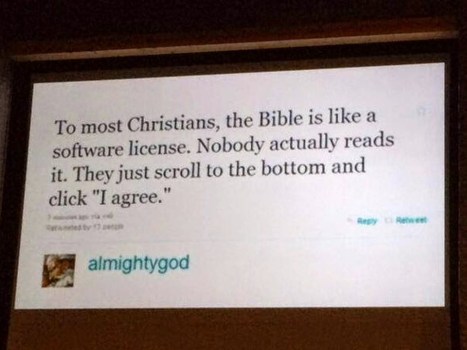
This is another one of the trite and cliché Christianisms that float around in conversation. When Christians get into an argument about a particular biblical precept, like prohibitions against tattoos or homosexuality, they will take a verse and use it like a weapon against the person they disagree with. God said it, I believe it, that settles it.

But, whether we admit it or not, rarely do we read the bible and think, “Okay, that settles it then.”

Today, no one worries about whether to build a church without a bathroom, we don’t hear preachers belabor biblical dietary restrictions, and we neglect a great number of scriptures while at the same time we use scripture to attack others.

There are all sorts of rules and regulations in scripture that, if we’re honest, we pick and choose to emphasize.
bible-and-its-interpretation

As we read earlier, Paul is clear in more than one letter that women should not speak in church. And yet, this church had a female pastor for a number of years, and our liturgist this morning just read out loud from the bible! Heaven forbid! A woman speaking in church! Can you believe it?

Of course, some churches still believe that the words about the subordination of women are the gospel truth. In those church, women are not allowed to serve in leadership positions, they are not allowed to teach Bible Studies where men are present, and they are not allowed to serve in any capacity that would require them to speak in front of the congregation.

I’ll tell you right now, this church would not be here if women kept their mouths shut. We are as faithful as we are because the women in our midst have been brave enough to speak what God has placed on their hearts, and because we have listened.

So what are we to do? We can’t just throw out the bible, but at the same time we can’t live by every single word within it.

Like the apostles and disciples before us, we read scripture and we hear God speaking through it. But we also ask questions of it. We consider context. We wonder if God really intended women to remain silent in church. We recognize that things like slavery are counter to God’s will, despite more than 200 verses that support it in the Bible. We don’t preach and teach that having bathrooms inside churches are offensive to God.

We follow Jesus’ example.

Jesus, Son of Man and Son of God, did not adhere to strict biblical literalism. He had different interpretations of the Sabbath restrictions, he had stronger opinions about divorce and adultery, and he regularly disobeyed the Law by eating with those deemed unclean.

Living as a Christian, reading the bible, it’s all about interpretation. And, to be clear, interpretation does not mean to change the text, or to ignore it, but to proclaim it for this time and for this place.

Even the Bibles in our pews are themselves a work of interpretation. Someone, and more often than not some people, made particular choices about how to translate particular words from Hebrew and Greek into English. This might not seem like a big deal, but if you take something like one of the most beloved of all scriptures: For God so loved the world that he gave his only begotten son that whosoever believe in him may not perish but have everlasting life. The word for “perish” in Greek is apollumi which can mean perish, but it can also mean to die, to be destroyed, to be lost, killed, or ruined. Each of these translations can change the meaning of the text slightly, and are therefore a product of interpretation.

So whenever we take up a bible, whenever we flip to a specific passage, the work of interpretation started long before our eyes flow over the English translation. But nevertheless, even the best translations leave us to continue the task of interpretation.

How do we do it? Well, we don’t do it in isolation. We don’t read our bibles in our living rooms never to speak about the words again, we don’t listen to a sermon only to have that be the only time we encounter the words.

We interpret God’s Word in community. We go to bible studies, we send emails to our friends and to our pastor, and we do what we need to do in order to comprehend that which is often incomprehensible.

And we let Jesus help us interpret. In the beginning was the Word and the Word was with God, and the Word was God. As the definitive Word, Jesus helps us to understand the words of scripture. We read from the Old and New Testament alike through the lens of Jesus and we begin to wrestle with how these words continue to live and breathe in our lives today.

But that requires a lot more work than “God said it, I believe it, that settles it.” It compels us to actually take up our bibles, read them, and talk about them. It challenges us to ask hard questions and produce new ideas. It requires us to believe that this book is in fact the living Word of God and that it continues to speak truth in new and exciting ways, perhaps in ways we cannot even imagine.

This last week has been filled with controversy from the Oval Office. In their first week, the new administration put forth a number of executive orders including a call to begin construction on a wall at our southern border, a gag order for the EPA, and the halting of refugee migration from a number of countries.

c3nffwbxaae5lbr

On the same day we celebrate the liberation of the concentration camps in Europe, our country said, “we don’t want them” to people fleeing persecution and destruction.

Now, no one has said that this has been done because of scripture, but the bible should have played a role in the decision if our politicians are going to keep claiming their Christian allegiance.

Moses was a refugee after fleeing from Egypt.

            Ruth was a refugee after her husband died and she followed her mother-in-law to a strange new land.

            The entire Israelite people were refugees in Babylon.

            Jesus, the one we worship here in church, was a refugee. Jesus, like people in the Middle East today, had to flee his home out of fear of violence, persecution, and even death.

And yet, we tout these certain stories from scripture and hold them over people’s heads about behavior and identity. But when we start actively preventing the oppressed from entering the country, we forget all about the story of our Lord and Savior.

People have used this book, with understandings like “God said it, I believe it, that settles it,” to attack and belittle people for far too long. It has been used to justify the horrific practice of slavery. It has been used to subjugate and relegate women’s rights. It has been used to rationalize physical violence and aggression toward people of different religions. It has been used to incite fear and terror in those who do not believe. It has been used as a weapon again and again and again.

And now we, the people of God, join together to say “no more!”

“No more!” to the use of scripture like a weapon to oppress the weak and the marginalized. “No more!” to the complacent Christianity that stands idly by as people are attacked for whom they are. “No more!” to the backwards ways of the past that lose sight of God’s grace here and now.

“No more!” to God said it, I believe it, that settles it.

Devotional – Psalm 27.4

Devotional:

Psalm 27.4

One thing I asked of the Lord, that will I seek after: to live in the house of the Lord all the days of my life, to behold the beauty of the Lord, and to inquire in his temple.

Weekly Devotional Image

Of all the questions I get asked, the one I hear the most is: “What’s heaven like?” I’ll be down in the preschool when one of the children will saunter over and randomly ask the question with their eyebrows askew. Or I’ll be sitting with a grieving family planning a funeral service when a new widow will ask the question as if she’s never really thought about it before. Or I’ll be working on a sermon in a coffee shop with my bible open on the table when a stranger will walk up to ask the question out of nowhere.

“What’s heaven like?”

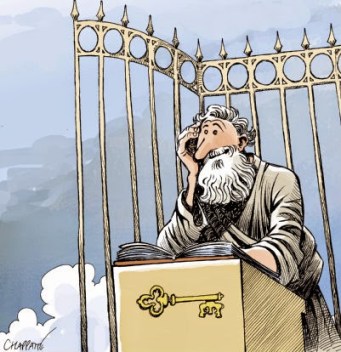
If Hallmark, the Lifetime channel, and uncles who tell bad jokes have anything to say about it, then heaven is a mysterious place in the clouds with fat little cherubic babies floating around playing harps, golden arches keeping certain people out, and Saint Peter sitting with a ledger.

st-peter-pearly-gates

If one of our preschool parents has something to say about it, then heaven (as she told her daughter) is a place filled to the brim with her favorite candy.

But if scripture has anything to say about it, then heaven is like a never-ending worship service. Which, to some people, sadly, sounds more like hell than heaven.

However, the bible is forever making connections between the worship of the Lord here and now, with the worship of the Lord in the New Kingdom. And not the announcements that always take to long to list at the beginning, and not the logistics of sitting down and then standing back up for hymns, but the beauty and wonder of encountering the beauty and wonder of the Lord.

The psalmist says the one thing worth seeking after is to live in the presence of the Lord each and every single day, to behold the beauty of the Lord, and to wonder and inquire in the house of God. In weekly worship, when we experience God’s faithful presence through a choice phrase in a prayer, or a melodic move in a hymn, or even a powerful sermon, we are catching a glimpse of heaven on earth. For when we gather in the house of the Lord, when we are confronted with God’s majesty, what could be better?

As Christians, we do well to seek out the presence of the Lord here and now as foretaste of the kingdom of heaven. We do it on Sundays when we gather together to proclaim and respond to God’s Word. We do it when we are invited to the table for communion. We do it when we sit with a friend and earnestly pray together. We do it when we hear God speak to us in the still small voice. And when we do, we receive an answer to the question, “What’s heaven like?”

God Helps Those Who Help Themselves

Psalm 121

I lift up my eyes to the hills – from where will my help come? My help comes from the Lord who made heaven and earth. He will not let your foot be moved; he who keeps you will not slumber. He who keeps Israel will neither slumber nor sleep. The Lord is your keeper; the Lord is your shade at your right hand. The sun shall not strike you by day, nor the moon by night. The Lord will keep you from all evil; he will keep your life. The Lord will keep your going out and your coming in from this time on and forevermore.

A guy was walking down a street when all of the sudden he fell into a deep hole. The walls were so steep that he couldn’t climb out and he began crying out for help. A doctor was passing by and looked down into the pit when the man yelled up, “Hey! Can you help me out?” The doctor thought about it for a moment, wrote a prescription, threw it down into the hole and kept walking.

Then a preacher came walking along and the guy shouted up, “Reverend, I’m stuck down here in this hole, can you help me up?” The pastor slowly put his hands together, said a prayer for the man, and kept walking.

Next, a sweet older woman from the local church came up and the man yelled, “Please help me. I’m stuck down here and I can’t get out.” The woman stared right into the man’s eyes and said, “Don’t you know that God helps those who help themselves?” And with that she went on her way.

Finally, a friend walked up and the man shouted, “Hey! It’s me down here! Can you help me out?” And the friend jumped right into the hole. The first guy said, “Are you stupid? Now we’re both stuck down here!” The friend said, “Yeah, but I’ve been down here before and I know the way out.”

A relatively recent poll found that better than eight in ten Americans think, “God helps those who help themselves” is in the Bible. In fact, more than half the people who responded to the poll were strongly convinced that it is one of the major messages of scripture.

Quote Typographical Background - vector design

Guess what? It’s not in the bible!

Do you know where it actually comes from? There are hints of the phrase in ancient Greek mythology, but it became popularized by Benjamin Franklin in Poor Richard’s Almanac published in 1736.

And yet, a majority of people in this country believe it is a major aspect of Christianity straight from the lips of Jesus.

Of course, there is some, very small, truth to the statement. After all, if we sit around our dinner tables praying for God to miraculously provide us with food, we’re going to be disappointed. We can eat because God has blessed creation with abundance and through things like employment we can afford to provide food for our tables. God helps us because we work to help ourselves.

Likewise, focusing in school, listening to our spouses, nurturing our children, these things result in our lives being better because we have worked for them to be better.

But that pales in comparison to how “God helps those who help themselves” has been used by Christians to avoid our obligation to help others.

Like the woman walking passed the man in the hole, it blinds us from our responsibility toward others and frees us from feeling guilty for how broken the world is outside of our respective bubbles.

The truth is: some people cannot help themselves. Societal discrimination, generational poverty, institutional racism, and a host of other problems prevent people from helping themselves. Some people, in fact many people, are in holes so deep, with walls so steep, that they can’t climb out without help.

About a year ago, some of the pastors in Staunton got together to talk about ways we could minister to the homeless population in our community. We asked ourselves how our respective churches could work together to help the people that cannot help themselves.

At first we debated the pros and cons of establishing something like a computer lab to help individuals apply for jobs. The thought being that if they found work, they could have an income, and no longer be homeless. We discussed offering weekly classes in reading, mathematics, and financial management at the Valley Mission to teach important skills necessary for breaking free from the cycle of homelessness. But in the end, only after we finally connected with homeless community members in Staunton, we discovered what they really needed were showers and a place to do their laundry.

What we failed to realize was that all the best training and teaching would be meaningless if the individuals arrived to a job interview wearing the same clothes they had been sleeping in for months.

We, the pastors, had walked passed the hole many times and decided how to fix the problem from our vantage point, rather than jumping into the hole in the first place.

The Church, and I mean big “C” Church, cannot shrug off the responsibility to help others with the use of another trite and cliché sentence because God, over and over again, commands his people to take special care of the poor, the widow, the orphan, and the needy.

A cursory scan through the prominent stories of the Old and New testaments leads us to the biblical truth that God helps those who cannot help themselves.

maxresdefault-1

In Leviticus, God commands the farmers to not harvest all the way to the edge of the fields. Certain amounts of the produce were supposed to be left for the poor and the immigrant. Instead of consuming it themselves, or selling it for a profit, a portion was to be left for those who were not able to make ends meet or for the strangers in the land.

In another part of the Old Testament, God says that compassion for others is itself a form of worship. There are times when the priest and the religious leaders heaped up sacrifice after sacrifice, they had the perfect worship services with all the right prayers and all the right songs, and God tells them their worship has become lifeless.

            What difference does it make if we show up at a place like this for an hour a week if we ignore the people God tells us to care about the rest of the week?

In the New Testament, Jesus is forever going from town to town and seeks out the last, the least, and the lost. And when he finds them, the sick and the needy, does he say, “God will help you if you help yourself?” When the crowds gathered to hear Jesus speak, did he command the disciples to tell the hungry 5,000 that God will give them food if they go collect it for themselves?

No. Jesus helps them. He connects with their brokenness and brings healing. He sends the abandoned back to the villages that disowned them, he feeds the hungry out of the abundant grace of God, and he helps people precisely because they cannot help themselves.

Have you ever felt like you’ve been the one down in the pit? Have you ever encountered a moment in your life that felt so suffocating and oppressive that you knew you couldn’t get out of it on your own? Have you lost a job, or a spouse, or a child? Have you received a frightening medical diagnosis, or a horrible tip for the stock market, or a habit that you couldn’t kick?

We can claw all we want, we can plead on our knees with our hands clasped in the air, but sometimes the only way out of the pit is if someone jumps in to help us find the way out.

From where will out help come? We lift our eyes to the edge of the pit and we see that our help comes from the Lord. The Lord who sends us a friend willing to jump down into the depths of our despair, the Lord who never abandons us even when we feel alone, the Lord who was willing to jump down into the pit of humanity and be born into this fractured world of ours.

That, my friends, is the whole point. We help others who cannot help themselves because God helps us when we cannot help ourselves. God came into the world as a baby in the deep pit of fear and suffering of a couple all alone in the world. God went to the margins of society in Jesus Christ to sink low into the stink of the world and offer hope. God went to the broken families and the battered spouses and the abandoned children and showed the way out. God went to the very depth of death just so that all of us could find the way to salvation.

Tomorrow, some of us who work will not have to because of Martin Luther King Jr. Day. It is a day set apart to remember the man who led this country through a particularly horrible period of racial injustice. His life, his teachings, his marches, and his protests all bear witness to his willingness to jump into the pit of his people’s suffering, in order to find a way out.

A father was with his four year old daughter last Christmas, and it was the first time she ever asked what the holiday meant. He explained that Christmas is all about the birth of Jesus, and the more they talked the more she wanted to know about Jesus so he bought a kid’s bible and read to her every night. She loved it.

They read the stories of his birth and his teachings, and the daughter would ask her father to explain some of the sayings from Jesus, like “Do unto others as you would have them do unto you.” And they would talk about how Jesus teaches us to treat people the way we want to be treated. They read and they read and at some point the daughter said, “Dad, I really like this Jesus.”

Right after Christmas they were driving around town and they passed by a Catholic Church with an enormous crucifix out on the front lawn. The giant cross was impossible to miss, as was the figure that was nailed to it. The daughter quickly pointed out the window and said, “Dad! Who’s that?”

He realized in that moment that he never told her the end of the story. So he began explaining how it was Jesus, and how he ran afoul of the Roman government because his message was so radical and unnerving that they thought the only way to stop his message was to kill him, and they did.

The daughter was silent.

A few weeks later, after going through the whole story of what Christmas meant, the Preschool his daughter attended had the day off in celebration of Martin Luther King Jr. The father decided to take the day off as well and treat his daughter to a day of play and they went out to lunch together. And while they were sitting at the table for lunch, they saw the local newspaper’s front-page story with a picture of Martin Luther King Jr. on it. The daughter pointed at the picture and said, “Dad! Who’s that?”

“Well,” he began, “that’s Martin Luther King Jr. and he’s the reason you’re not in school today. We’re celebrating his life. He was a preacher.”

And she said, “for Jesus?!”

The father said, “Yeah, for Jesus. But there was another thing he was famous for; he had his own message and said you should treat everyone the same no matter what they look like.”

She thought about it for a minute and said, “Dad, that sounds a lot like do unto others as you would have them do unto you.”

The dad said, “Yeah, I never thought about it like that but it’s just like what Jesus said.”

The young girl was silent again for a brief moment, and they she looked up at her dad and said, “Did they kill him too?”

If we are serious about following Jesus, it’s going to cost us. It might cause embarrassment, or ridicule, or shame. It might cost us money, or time, or status. But jumping into the pit comes with a cost. Thanks be to God.


dumb-things-christians-say-sermon-series-idea

Devotional – Isaiah 42.1

Devotional:

Isaiah 42.1

Here is my servant, whom I uphold, my chosen, in whom my soul delights; I have put my spirit upon him; he will bring forth justice to the nations.

Weekly Devotional Image

I need to apologize. At least, I need to apologize to the people of St. John’s who were present in worship on January 1, 2017. We started a new sermon series on “Dumb Things Christians Say” and I decided it would be good to start with “Everything Happens For A Reason.” It is one of those trite and cliché Christianisms that are forever being flung around without anyone thinking about the consequences of such a statement.

I began the sermon with a story and a quote from Franklin Graham, son of Billy Graham, who recently said that “It wasn’t Russia who intervened in the election of Donald Trump, it was God.” I then went on to theologically proclaim the strange tension Christians live in between and all-powerful God and a free humanity; God rules this world but gives us the freedom to act in the world.

The thrust of the end of the sermon went like this: “Sometimes there are reasons things happen, people feel tempted to go faster than they should and it means they run through red lights, they neglect to check their blind spots, or they run into icebergs. Sometimes people feel disaffected and forgotten by their government and they come out in droves and subvert the majority of polls and elect a political outsider to the most powerful position in our earthly world.

But that doesn’t mean that God made a car accident happen, or that God willed the sinking of the Titanic, or that God had a reason for making Donald Trump the next president of the United States.”

everything-happens-for-a-reason

Upon listening to the audio of the sermon, and rereading it before posting it online, I realized that I was very heavy-handed with my language about President-Elect Trump, and that I inadvertently compared his election with the suffering of innocent people in car accidents.

What I should have said was that even though Donald Trump was elected by the people of the United States of America, and not by some divine act of providence, God still uses people like Donald Trump to make God’s will incarnate on earth. The beautiful wonder of the Lord is that God works in and through individuals in ways that we can scarcely imagine; a chance conversation, a fleeting dream, a subtle nudge in the right direction. We can have hope in the Lord regardless of who sits behind the desk in the Oval Office because we know that God is the one who has the final Word. God came into the world in order to free us from the last vestige that had a hold on us, death. God broke the chains of death’s dark shadow in order to guide us into the light of resurrection.

Jesus is the servant who God upholds, the chosen one in whom the Lord delights. Jesus is the one who brings forth comfort to the afflicted and afflicts the comfortable. Therefore, as disciples of Jesus Christ, we are called to pray for our president in order that he may discern how to bring peace and justice to this world in a way that resonates with Jesus’ peace and justice.

Everything Happens For A Reason

Deuteronomy 30.19-20

I call heaven and earth to witness against you today that I have set before you life and death, blessings and curses. Choose life so that you and your descendants may live, loving the Lord your God, obeying him, and holding fast to him; for that means life to you and length of days, so that you may live in the land that the Lord swore to give to your ancestors, to Abraham, to Isaac, and to Jacob.


Since Thanksgiving, I have been at a lot of tables with a lot of people and talked about a lot of things. That’s what the holidays are often about, and frankly what we remember the most; we might forget the first present we opened, or who was the first person to arrive, but we can almost always recall those table side discussions.

A lot of things happened in 2016 that warranted conversation at those particular tables. The deaths of celebrities, cultural icons, and transformative leaders; the rise in popularity of strange things like Pokemon Go, the Netflix hit Stranger Things, and Bruno Mars’ 24K Magic; the never-ending saga of suffering in Syria, the increase in terrorist related events throughout the world, and the ever thinning ice like situation in the middle east; the incredible Rogue One, the magical Fantastic Beasts and Where To Find Them, and vibrant color palette of Trolls.

But do you know what was talked about more than anything else?

Politics.

Politics. Politics. Politics.

And then when you throw a pastor into the fray at the tables, you start mixing together the real forbidden topics of conversations.

So I have learned, over the years, to keep my mouth shut. Whether I agree with a political policy or not, I nod my head along with the speaker regardless of their position and then reign myself to sit in silence.

In the last few months I have been at tables where people bashed the political rhetoric of the Republican Party, I listened to people re-imagine a new Democratic platform with notes hastily written on cocktail napkins, I watched people force index fingers at others while berating the likes of Bashar al-Assad and Vladimir Putin, I’ve heard people place bets over how long it will take Donald Trump to build a fence at the border with Mexico, and I’ve seen people cry with tears of pain, and people cry with tears of joy, while talking about the political future of the United States of America.

But I heard something the other day that I can’t get out of my head, one theologically politicized statement that has rattled through my brain ever since.

It went like this:

“Did you hear what Franklin Graham said?”

            “You mean the son of Billy Graham?”

            “Yes, him.”

            “No, what did he say?”

            “He said that it wasn’t the Russians who intervened in the presidential election, it was God.”

Now, before we really get into this, I want to be clear. Donald Trump is going to be the president of the United States. That’s a fact. Even though we now live in the so-called time of “post-truth,” the truth is that Donald Trump will be president.

But how Donald Trump became the president elect is something we should talk about. Particularly when one of the leading Christian evangelists in this country can say something like “God made Donald Trump president.”

dumb-things-christians-say-sermon-series-idea

Everything happens for a reason. This is true, of course, in the sense that actions have consequences. If I step down from this pulpit and walk to the back and flip the switch in the breaker box, all of the lights in the sanctuary will turn off. If plants do not receive enough moisture and sunlight they will not grow. If I give my wife a mop for Christmas, I’m going to get in trouble.

In our scripture from Deuteronomy, Moses offers the Israelites a similar reflection: if you choose life and love the Lord you may live in the land the Lord promised. Actions have consequences. However, the problem with “everything happens for a reason” is that we almost always imply that God is the reason that everything happens.

So, to take the recent election as our example, if it was God who intervened to make sure that Donald Trump became president, why wasn’t the victory more lopsided? Or, does it mean that everyone who voted for Clinton is a sinner for doing so because they went against God’s will? Did God choose not to “show up” for the Obama elections in 2008 or 2012? If everything happens for a reason, then why did God choose to have Donald Trump elected as president while all sorts of other things (like the situation in Syria, Police shootings, etc.) are still happening?

And this logic can also be applied to a number of things: If everything happens for a reason, then why did one of my best friends die in a car accident when she was a teenager? What is the reason for men who beat their wives, or women who abuse their children, or children who assault their parents?

When we throw out a trite and cliché sentence like “everything happens for a reason” it removes all responsibility from us and puts it all on God. And yet, we do believe that God is in control, that God is the author of our salvation, and that God continues to move and act in this world of ours.

everything-happens-for-a-reason

This is fundamentally at the heart of the strange mystery of what it means to be a disciple. On one side we affirm that God rules, and on the other side we affirm that God has given us perfect freedom to live and act in this place that God rules.

God has given us the freedom to make choices, for better or worse. From the Garden of Eden to the sanctuary of St. John’s on this first day of 2017 we are free. When we do something right or wrong, we can’t blame it on God. It is our freedom to choose who we are to be, that allows this world to be as strangely beautiful as it is, but it makes it strangely broken and flawed as well.

We are not marionettes being strung along by a divine puppeteer. God gives each of us, his creatures, a brain, a heart, a soul, to make choices and act in this world. We use things like prayer and the reading of scripture to help us determine how our choices can coincide with God’s will, but the choices are fundamentally ours to make.

All of us know that terrible things happen that cannot be explained. They are a part of life. But we also know that those terrible things do not have the final word. We know that God is working through us, helping us to see and to know who we are to be in order to transform this world into his kingdom. And we know that God is the one who has the final Word, thats what Jesus’s birth and resurrection changed. God came into the world in order to free us from the last vestige that had a hold on us, death. God broke the chains of death’s dark shadow in order to guide us into the light of resurrection. We know that even though terrible things happen, and will continue to happen, God’s love in Jesus Christ is the final Word.

Living in this tension of God’s perfect sovereignty and our perfect freedom is one of the things that makes being a Christian so challenging. For when we encounter those terrible things that happen in the world we often vacillate between “everything happens for a reason” or “life is meaningless.” Whereas Christians, people like us, are called to live somewhere in the middle.

In the early hours of April 15th 1912, more than a hundred years ago, the infamous ship named the Titanic sank in the Northern Atlantic Ocean. 1,500 people were lost at sea when the ship ran into an iceberg and it is still one of the worst maritime disasters to have ever happened.

Much like other events that grab the attention of the world, many pastors felt called to speak about the disaster the following Sunday in order to make sense of the tragedy. In a small sleepy Swiss village was a young pastor named Karl Barth who regularly bored his congregation with long theologically dense sermons, but the Sunday after the sinking of the Titanic called for something a little more meaningful.

He used the beginning part of the sermon to outline the power of the almighty from creating the cosmos to bringing life to all creatures. He referenced heavily from the book of Genesis and went on and on. But at the end he said something that grabbed their attention.

It went like this: God most certainly put the iceberg in the water, but God did not make the captain feel pressured to beat the record time across the Atlantic and thereby neglect to pass slowly and safely through a region filled with large icebergs.

1101620420_400

Barth’s simple reflection is by no means perfect, but it points toward a better way of thinking about, “Everything happens for a reason.” Sometimes there are reasons things happen, people feel tempted to go faster than they should and it means they run through red lights, they neglect to check their blind spots, or they run into icebergs. Sometimes people feel disaffected and forgotten by their government and they come out in droves and subvert the majority of polls and elect a political outsider to the most powerful position in our earthly world.

But that doesn’t mean that God made a car accident happen, or that God willed the sinking of the Titanic, or that God had a reason for making Donald Trump the next president of the United States.

And sometimes things happen for no reason at all. Fathers in perfect health and in the prime of their lives die of sudden heart attacks. Natural disasters like tsunamis and hurricanes come out of nowhere and devastate entire communities. Marriages fall apart for no particular reason other than the build up of tiny disagreements that never get settled.

And still there is hope. There is hope because God can work through people like you and me to bring about the kingdom on earth. God still speaks through the ancient scriptures to remind us of the importance of ministering to the last, the least, and the lost. God places opportunities in our lives that we can choose to respond to, and in so doing, we can become the reason good things happen.

God has set before us life and death, blessings and curses. We have the choice to choose life so that our families and friends may live to love the Lord and obey what he has taught. If we choose the good we may all live in the peace that God promised to God’s people from Abraham, to Isaac, to Jacob, to David, to Isaiah, to Jesus, to Peter, to Paul.

So it is good and right for us to start this New Year in this place, where God makes all things new. At this table we receive the spiritual food necessary for the journey of life. We break bread knowing that strange things are afoot in this world, but that God moves in and through people like us to shine as a light in the darkness. We surround the cup together knowing that Jesus’ sacrifice opens up the glory of the resurrection and gives us the strength to do incredible things here and now.

Not everything happens for a reason. But sometimes God calls us to be the reason something good happens to someone else. Amen.


Let’s Talk About Doubt – Sermon on Isaiah 7.10-16

Isaiah 7.10-16

Again the Lord spoke to Ahaz, saying, Ask a sign of the Lord your God; let it be deep as Sheol or high as heaven. But Ahaz said, I will not ask, and I will not put the Lord to the test. Then Isaiah said: “Hear then, O house of David! Is it too little for you to weary mortals, that you weary my God also? Therefore the Lord himself will give you a sign. Look, the young woman is with child and shall bear a son, and shall name him Immanuel. He shall eat curds and honey by the time he knows how to refuse the evil and choose the good. For before the child knows how to refuse the evil and choose the good, the land before whose two kings you are in dread will be deserted.”


What a strange promise. The Lord will give you a sign. Look, the young woman is with child and shall bear a son, and shall name him Immanuel. The promise sounds nice and sweet, after all its part of a lot of the hymns we sign during this time of year. We read these verses and our minds immediately jump to the manger scene with Mary and Joseph carefully cradling the baby Jesus with the animals remaining perfectly quiet and still. But this promise is made to a particular person in a particular moment, and that’s what makes it strange.

At the time of Isaiah’s proclamation, forces were gathering and attempting to attack and invade Jerusalem. The King, Ahaz, is deeply afraid. And it is in the midst of his fear that God offers the King a sign, any sign that he wants, let it deep as hell or high as heaven. God offers Ahaz any sign he wants so that the king will remember to trust the Lord. Ahaz, appearing quite faithful, says he will not put the Lord to the test (the same thing Jesus says during the temptations in the wilderness), but the Lord ignores Ahaz and proclaims the coming sign nonetheless.

So it is while King Ahaz is shaking in his boots, while troops are gathering at the gates, that he receives a sign of God’s promised presence: A young woman will bear a son named Emmanuel.

Now, let’s be real for a moment: God’s promise of a baby is weird. And it’s rather ambiguous. God does not say, “I will destroy the invading forces with terrible violence” nor does the Lord promise that Ahaz will survive. Instead, God says that a baby is coming to save the world.

I don’t know about you, but Christmas, to me, always seems full of happy go lucky faith without any doubt or questions. Lights are hung up on all the houses, people tune their radios to the Christmas stations, and parents want their children to behave themselves in the Christmas pageants.

But doubts and questions are there, perhaps just barely below the surface of the façade we wear around during these weeks we call Advent.

doubt

Do we doubt? Are we allowed to? What happens to us if we do? More than a few of us will be sitting in the pews on Christmas Eve singing Joy to World and celebrating the Christ-child while we’re really wondering what it means to believe.

King Ahaz doubted. While surrounded by enemies, and offered a miracle by God, he insists on not putting God to the test. This might sound really faithful, but God offers something incredible and Ahaz turns it down. His pious response is more a dismissal of the Lord being able to actually help.

Moses doubted. When the Lord asked him to go and deliver the people from the tyranny of Egypt, Moses quickly listed off the excuses for why he shouldn’t be the one to go.

Jeremiah doubted. When the Lord called him to be a prophet to God’s people his response was quick, “I am only a boy! Surely I can’t speak on your behalf”

Jonah doubted. When the Lord commanded him to travel to Nineveh he traveled in the opposite direction in order to avoid what he had been asked to do.

Zechariah doubted. When the Lord spoke to him and told him that his wife was going to become pregnant he did not believe the Lord could perform such a miracle.

John Wesley doubted. You know, the guy in the stained glass window right there. He was asked to go travel to a strange place called Georgia and preach the Good News but he did not have faith. And when he told his superiors about it, they said, “Preach faith until you have it; and then, because you have it, you will preach faith.”

Even Jesus doubted, though only for a moment. When he found himself all alone and nailed to the hard wood of the cross, he cried out, “My God, my God, why have you forsaken me?”

Sometimes we feel like if we have doubts it is the complete opposite of having faith. In fact, many leave the church whenever that first doubt starts to creep in and they begin to wonder about the truth and promises of God’s Word.

I know more people than I can count who, at some point, were devout and faithful followers of Jesus Christ. And all it took was a little dose of the dirty word for their faithfulness to crumble. Was there really a virgin birth? Did Jesus really walk on water and feed the 5,000 and bring sight to the blind? Does God really care about our individual lives? Did God really raise Jesus from the dead?

Their entire discipleship hinged on the answer to one of those questions, and when they could not find an answer that was satisfying, they left.

I have friends from seminary who felt called to the ministry but have since left the church because a professor told them something like, “Moses didn’t write the first five books of the bible.” Or “Paul did not write the epistle to the Hebrews.” Or “Some of the psalms attributed to David were not written by David.”

            Doubt is such a dirty word. For a long time it has been shunned from the church and treated like a mortal sin. It has been seen as a weakness. But doubting is often a sign that our faith has a pulse, that it is alive and well and exploring and searching.

            Doubt and faith are not opposites.

            You can’t really have one without the other.

We’re now going to try something a little different, something a little strange, and frankly it might not work. But I’m going to leave this pulpit and come down to you and we’re going to talk about our doubts. Now the point of this is not for you to say something like, “I have trouble believing the virgin birth” and then have me completely remove your doubts with some sort of speech. No, the point of this is for us to be vulnerable and intentional with one another, for us to connect as a community of faith around the fact that we have doubts, but that God is big enough to handle our doubts.

So, what are your doubts?

This week, as I was scrolling through the seemingly endless cycle of news from around the world, I read about Russia’s apparent involvement in the democratic election cycle of the United States, and I read about Apple’s struggle to provide Bluetooth compatible headphones in time for Christmas consumers, and I read and read and read.

But then I saw a picture that still haunts me. In the image, a man and a woman are walking through the city Aleppo, Syria. The woman’s face is covered and her husband is cradling their baby in his arms, while holding up an IV bag that’s running down into the bundle of swaddling clothes.

            I’ll admit that what I should have been struck by most was the violence in the background and the terror in their posture, but what struck me the most was how much it reminded me of Mary, Joseph, and the baby Jesus.

A man carries a child with an IV drip as he flees deeper into the remaining rebel-held areas of Aleppo, Syria December 12, 2016. REUTERS/Abdalrhman Ismail

Over 250,000 people have died in Syria as a result of their civil war, most of them innocent civilians. And while we fret over the incoming president-elect and whether or not consumer goods will arrive on time, modern Marys and jaded Josephs are doing everything they can to protect their babies.

And it makes me doubt. I read the statistics, I see the photos, and I want to know where God is in the midst of all this. How can the God who knows us by name and has counted the hairs on our heads rest easy while innocent men, women, and children are dying at a rate we can barely fathom?

And while this is happening across the world, Christians in our country are worried about Muslims and are seriously considering instituting a registration of all Muslims. And do you know what’s happening in Aleppo? Christians and Muslims are serving shoulder to shoulder pulling children from rubble, consolidating food and resources to share with as many as possible, and are the remaining sources of light in a city under the shadow of death.

I doubt God’s presence in the midst of something as terrible as what’s happening in Aleppo, but then I have hope when I read about Christians and Muslims working together to bring joy to people who feel no joy.

And so I live in this tension between faith and doubt. We all do. We vacillate between the two like a frenetic sphere in a pinball machine. We doubt and we trust. We break down under the tyranny of violence and are built back up by the very nature of love. We weep for the world and its destructive desires, and are comforted by the God who came down to take on our flesh. We lift up our clenched fists in frustration to the sky, and we hear God speak in the still small voice: “Lo, I am with you always.”

Faith and doubt; you can’t have one without the over. Amen.


doubt

Devotional – Psalm 80.3

Devotional:

Psalm 80.3

Restore us, O God; let your face shine, that we may be saved.

Weekly Devotional Image

On Sunday mornings I drive to church hours before worship so that I can properly prepare. I always begin in the sanctuary by praying by the altar and then I pray over every single pew. After I feel like have spent enough time with the Lord I will make sure the doors are unlocked and the heat is working before I step up into the pulpit to preach my sermon to an empty sanctuary. I will go through the sermon line by line and make any changes necessary before printing off the final version.

Yesterday morning I was standing in the pulpit and preaching to an empty sanctuary when I heard a soft voice say, “Hello?” My first instinct was to look up in case God was telling me to make a change to the sermon, but it was actually someone who walked into the church through the main office door. When I went to shake his hand in the hallway it was clear that he had been outside for a long time because he had very red cheeks and he kept bringing his hands up to his mouth to blow on his fingers. He explained that he was homeless and was walking down the street when he felt the need to walk into the church. He told me about various life situations that led him to where he currently is and then I invited him in the sanctuary so that we could sit down and talk some more.

I motioned for him to join me in one of the front pews and asked him to continue. But he didn’t. Instead, his eyes rapidly filled with tears and he wept. I sat stunned and unsure if I had said something wrong, and then asked him if everything was okay. He said, “I can’t remember the last time I saw a Christmas tree.”

Colorful holiday lights background, defocused

What I had neglected to think about was the overwhelming sense of joy that was radiating through our seemingly countless poinsettias and our perfectly adorned and lit Christmas trees; a sense of joy that was in sharp dissonance with what the man has experienced recently.

We talked some more and I learned all about his life, and when it felt like the conversation was coming to an end I asked how I could help him, or how the church could help him. To which he responded, “Honestly, I was just cold and lonely. All I wanted was to warm up and have some company. Thank you.” After that, we prayed together, shook hands, and he left.

This strange season of Advent is one that often leaves us filled with joy, but it can also be a time of deep sorrow. Instead of fondly remembering presents under the tree, we might remember our parents fighting and yelling at one another. Instead of recalling the smells of a delicious Christmas dinner, we might feel suffocated by the sadness of another Christmas without someone we love. Instead of humming the familiar hymns with a twinkle in our eyes, we might not even remember the last time we saw a Christmas tree.

The psalmist cries out: “Restore us, O God; let your face shine, that we may be saved.” O that the Lord would make his face to shine upon all of us through the lights of a Christmas tree, and give us the hope and the joy and the peace we so desperately need this time of year.

Ridiculous Renewal – Sermon on Isaiah 35.1-10

Isaiah 35.1-10

The wilderness and the dry land shall be glad. The desert shall rejoice and blossom; like the crocus it shall blossom abundantly, and rejoice with joy and singing. The glory of Lebanon shall be given to it, the majesty of Carmel and Sharon. They shall see the glory of the Lord, the majesty of our God. Strengthen the weak hands, and make firm the feeble knees. Say to those who are of a fearful heart, “Be strong, do not fear! Here is your God. He will come with vengeance, with terrible recompense. He will come and save you.” Then the eyes of the blind shall be opened, and the ears of the deaf unstopped; then the lame shall leap like a dear, and the tongue of the speechless sing for joy. For waters shall break forth in the wilderness, and streams in the desert; the burning sand shall become a pool, and the thirsty ground springs of water; the haunts of jackals shall become a swamp, the grass shall become reeds and rushes. A highway shall be there, and it shall be called the Holy Way; the unclean shall not travel on it, but it shall be for God’s people; no traveler, not even fools, shall go astray. No lion shall be there, nor shall any ravenous beast come up on it; they shall not be found there, but the redeemed shall walk there. And the ransomed of the Lord shall return, and come to Zion with singing; everlasting joy shall be upon their heads; they shall obtain joy and gladness, and sorrow and sighing shall flee away.

advent_2015_screen


On Christ the King Sunday, the sermon was titled “Not My President.” And before we even started worshipping, more than a few of you made sure I knew your concerns about the impending proclamation. After all, Donald Trump had just procured the necessary electoral college votes to be labeled as president-elect, and people across the country were (and still are) protesting his election with signs saying, “Not My President.” If you were here on Christ the King Sunday, you know that the sermon had very little to do with Mr. Trump, and in fact was all about how grateful we should be that Jesus is not our President.

However, like the good Methodists we are, the sermon was not the pinnacle of our worship that Sunday. You might remember a few lines that I proclaimed from the pulpit, you might even remember one of the hymns we used, but if you sat in the front half of the congregation, I bet the thing you remember most from that service happened during communion.

As always I stood behind the table and I prepared to pray over the bread and the cup. Together we confessed our sins and asked for God to forgive us. We stood up from our pews and shared signs of Christ’s peace with one another. And then I asked God to pour out the Spirit on us gathered together and on the gifts of bread and the cup.

One by one each of you came forward to the front of this sanctuary with hands outstretched to receive the body and the blood of Jesus Christ. One by one I looked each of you in the eye as I tore off a piece of the bread and placed it into your hands. Some of you came up with tears in your eyes. Some of you came up with your eyes focused on the ground, perhaps out of reverence for the precious thing you were about to receive. And some of you came forward with eyebrows askew as if to say, “Who thinks of preaching a sermon about Jesus not being our president?”

The last family to come up for communion sat in the very last pew during worship, and they are connected to the church through our Preschool. Their son is here in the building every week learning about what it means to grow in knowledge, in wisdom, and in love of God. So when his father came up with his hands outstretched I asked if I could offer the bread to his son. The father smiled and said, “Of course.” With his blessing, I knelt down onto the floor and looked at my young friend in the eye and I said, “Owen, this is Jesus.”

To which he smiled, titled his head back slightly, opened his mouth, and waited for me to drop the bread right in.

Without really thinking about it, I took the piece and put it in his mouth, and in response he started chewing while smiling and trying to say, “Thank You Pastor Taylor.”

And I lost it. For whatever reason, I could not contain the laughter that was brewing inside me and I started cracking up. I laughed so hard that I actually snorted. Perhaps it was the seriousness of our service getting flipped upside down by a two year old receiving communion like a little bird from his mother, or maybe it was the smile he offered me while pieces of barely chewed bread were falling out onto the floor, or perhaps it was the little skip in his step while his cheeks were filled like a chipmunk preparing for winter, but I couldn’t stop laughing.

            In that simple and yet profound moment, the desert of our ritualistic liturgy was transformed with blossoms of laughter as other people laughed in response to my snort. In that brief and beautiful moment, God brought this church some much-needed joy.

You see, after spending the better part of two months confronting controversies facing the church and addressing the deep seeded political anger felt in this congregation and across the country, we needed to laugh.

man-jumps-for-joy

Isaiah says the wilderness and the dry land shall be glad. The desert shall rejoice and blossom. The prophet looks to the future and shares the ridiculousness of the renewal that is waiting for God’s people. Like a desert blooming in the middle of a drought, like old and worn out people finding strength in their knees, like tongues of the speechless being filled with words, so will the glory of the Lord transform the world.

In this vision everything is made new from the farthest reaches of creation, to the deepest aspects of our souls. The deserts shall rejoice and blossom, flowers will grow abundantly in the forgotten places, the blind will see, the deaf will hear, and waters will break forth in the wilderness.

God promises transformation and joy. Though not necessarily the transformations and joys we pray for, but ridiculous and redemptive reversals nonetheless. Isaiah sings of liberation, joyful homecomings, and the end of all sorrow and sighing.

Signs of this future of joy will be made manifest in the weak being strengthened, those with feeble knees will stand firm, the fearful will be strong. Those who have long been isolated to the powers of loneliness will be grafted in and never forgotten.

Isaiah sings about the Holy Highway cutting through the wilderness, a way for God’s travelers to move without threat or fear, a place where the people of God’s can sing on their way home.

It sounds a lot like the Garden of Eden, and it sounds a lot like heaven.

But just like last week, Isaiah’s song about the promises of God are not just things that will happen in the distant future; they are part of God’s wonderful and creative reality here and now.

Yet, there are things in this world that hold us back, accidents on the highway of God’s grace, that prevent us from traveling the way to God’s promised salvation. There are chains and bumps that derail us from the pathway to glory: economic fears, political disappointments, spiritual droughts, emotional baggage, relational frustration, and seasonal depression, to name a few. And yet over and over again, whether it’s through a child walking back to his pew with bits of saliva soaked bread falling out of his mouth, or a host of other means, God transforms this world and fills us with joy.

I love to tell stories. From the time we are young children we learn important lessons more through stories and less through object lessons. That’s why scripture is so powerful, and it’s why Jesus used parables to relate the immensity of God to his disciples. This week, in anticipation of this sermon, I emailed a number of you to ask for stories of how God has transformed your life. I wanted to hear about the times that God’s living water broke forth in the midst of an otherwise desert-like existence.

And you did not disappoint.

One of you came to church for years without it really meaning much. It was just the thing you were supposed to do. And on one particular occasion, you were sitting in these pews listening to the choir sing an anthem. There wasn’t anything particularly moving about the words or even the melody, but you found yourself watching the individuals as they were singing and you could tell they meant it. Though you had seen and heard the choir many times, God spoke to you through their faithfulness that fateful day, and since then you have known and experienced the power of God through the music of our church, and through those who provide it.

One of you expressed how narrow-minded and intolerant you used to be. Whether it had to do with politics, or religion, or social status, you judged others unfairly. And then a pastor came to this church named Zig Volskis and he changed everything for you. His spiritual presence and demeanor taught you the importance of asking the right questions, and the importance of being content with answers that pushed you into a new direction. Instead of treating you like a student who needed to be lectured, Zig encouraged you with amazing insights and discernment. And through God working in him, you began to see the Bible not as a book to be consumed, but a life-giving witness to the reality of God.

One of you wrote about recent event whereby you attended a funeral for a man out of guilt because you were afraid that very few people would be in attendance. And yet, when you arrived, there was a line out the door and across the street full of people trying to get into the chapel. You described the experience as a moment through which God made you aware of one of your many sins, your judgment of others based on accomplishments you deemed as worthy, and through it you were transformed to know and believe that everyone has worth, and everyone is sacred.

God transformed the world through the advent of Jesus Christ, and God continues to transform our lives in ways we cannot even anticipate or imagine. The devastated deserts of our souls will once again blossom through a crowded funeral, a faithful pastor, a passionate choir, or a child-receiving communion. God uses people in our lives to change our lives so that we might change other lives.

Isaiah’s song is all about the ridiculous renewal awaiting us, God’s people. That through God’s transformative work, joy will rain down from the skies, and all the scattered promises of the bible will be fulfilled like a dance – the earth will spring forth new life, bodies will be remade, freedoms will be conferred, the city will be reclaimed, joys will erupt from unexpected places, and sorrow and sighing will be banished from the earth.

Isaiah’s song ends with the happy and joyful homecoming of those who have been liberated from the bondage that keeps them from traveling on the Holy Highway. For there is a new way that cuts through desolate deserts and turns them into beautifully blooming fields. God’s people will travel on this path without threat or fear, they will sing with joyful hearts, because the Lord is doing a new thing.

God is not done.

            God is not done with creation and God is not done with us.

            God breaks the chains of our slavery to sin and death.

            God delivers us to places yet unknown.

            God transforms our hopes and dreams into real and tangible experiences.

            God fills the deserts of our souls with living water.

            God blossoms and brings forth new life and opportunities in ways we cannot even imagine.

            God offers unending joy to the redeemed.

            God makes a way where there is no way. Amen.


Kidnapping Santa Claus


Isaiah 11.1-10

A shoot shall come out of the stump of Jesse, and a branch shall grow out of his roots. The spirit of the Lord shall rest on him, the spirit of wisdom and understanding, the spirit of counsel and might, the spirit of knowledge and the fear of the Lord. His delight shall be in the fear of the Lord. He shall not judge by what his eyes see, or decide by what his ears hear; but with righteousness he shall judge the poor, and decide with equity for the meek of the earth; he shall strike the earth with the rod of his mouth, and with the breath of his lips he shall kill the wicked. Righteousness shall be the belt around his waist, and faithfulness the belt around his loins. The wolf shall live with the lamb, the leopard shall lie down with the kid, the calf and the lion and the fatling together, and a little child shall lead them. The cow and the bear shall graze, their young shall lie down together; and the lion shall eat straw like the ox. The nursing child shall play over the hole of the asp, and the weaned child shall put its hand on the adder’s den. They will not hurt or destroy on all my holy mountain; for the earth will be full of the knowledge of the Lord as the waters cover the sea. On that day the root of Jesse shall stand as a signal to the peoples; the nations shall inquire of him, and his dwelling shall be glorious.

advent_2015_screen


One Christmas, many years ago, there was one thing I wanted more than anything else: I wanted to kidnap Santa Claus.

I must’ve been 7 years old when I decided it was time to enter the world of criminal activity and I began plotting my plan. At the time, my bedroom was in the basement just down the hall from the living room and the fireplace where Santa usually entered the house. For months I eagerly anticipated that hallowed night when we would leave out the cookies and the milk, when we would deck ourselves out in matching pajamas, when we would struggle to sleep with the excitement of the morning presents so close at hand, but this time I was going to be ready.

In the days that led up to Christmas, the time we call Advent, I went through every drawer and found items that could be used for my trap. I took every tie and belt that I owned and tied them together in one long rope. It wasn’t quite enough so I started collecting random bits of string I found around the house and added them to my dress clothes accessories. I carefully laid out the entirety of it from my bed, through my room, down the hall, around the corner, and right up to the front of the fireplace.

The key to the whole operation was the last piece attached to the last tie, my plastic Fisher-Price stethoscope. You see, with the stethoscope at the very end, it would functionally wrap around Santa’s ankle so that I could pull from my end in my bedroom and bring ole Saint Nick down to the ground.

And so I practiced. I set up the elaborate trap and forced my little sister to stand by the fireplace while I ran back to my bedroom, got under the covers and pulled as hard as I could. Over and over again I yanked on the line perfecting the angles and the force necessary to bring my prey into captivity. It was perfect. Now of course, my mother was very concerned when she discovered that all of my nice belts and ties were wrapped together and when she asked what I was up to, I replied, “Don’t worry about it.”

On Christmas Eve, we went to church with everyone else and I didn’t listen to a word. All I wanted was to get back to the house and catch the red-dressed man.

Why? Well I’m not entirely sure, but why not? After all, this guy shows up in homes every year and brings overwhelming cheer to so many. I guess I just couldn’t stand all the mystery, I wanted to know what compelled him to do what he did, and I wanted to know what he would say.

And so, after setting out the milk and cookies, after being tucked into bed, I waited until my parents went back upstairs and I set the trap. For minutes, which seemed like hours, I laid in bed with my hand tightly gripping the last belt. My focus was pure and unwavering. I listened for any sound that would indicate the moment to pull, I sniffed the air for the delicious smells of peppermint that accompany those from the North Pole, I held on for the slightest vibrations in response to Santa’s boot falling perfectly into the stethoscope.

            And then I woke up.

Anticipation, expectation, patience, waiting: These are the words we can’t stand during this season we call Advent. Instead, we’d rather know what’s wrapped under the Christmas tree, we have lights hung up on the gutters before Thanksgiving, and we plan our holiday meals weeks in advance. We want to skip right to Christmas morning, and we can’t imagine it any other way.

And who can blame us? Christmas is all about the presents, and the songs, and the lights. The word “Christmas” conjures images of trees, and children ripping through wrapping paper, and squeals of delight. At least, that what Christmas means to the world.

Christmas is actually about Jesus. But with the advent of consumer driven commodities and the need for economic growth, Christmas has become the competition of corporations. Black Friday doesn’t even start on Friday anymore, but at 5pm on Thanksgiving Day. Americans will spend almost as much money on material goods from Thanksgiving to Christmas as we do the rest of the year combined. And we do all this to celebrate a homeless baby born in a stench-filled manger. Or, just take a drive around Staunton at night sometime this week, there used to be mangers and magi in yards, now you’re lucky it you can find a plastic baby Jesus behind Frosty the Snowman, Rudolf the Red-Nosed Reindeer, and giant inflatable renditions of Santa Claus.

Advent, this strange and beautiful season in the life of the church, is all about our re-participation in the season of anticipation, expectation, patience, and waiting.

It’s like planning to kidnap Santa Claus for weeks and dreaming about what might happen. Advent is a time where we are forced to wait, like the Israelites did so long ago, for so long, to find out what would happen. While the world fast-forwards to the next consumer driven holiday, while retailers are already putting out decorations for Valentine’s Day, while the world rushes on and on and on, we wait.

We wait and remember how long God’s people waited for what we have: Jesus the Christ.

A shoot shall come out of the stump of Jesse, and a branch shall grow out of his roots. Peace comes from a stump. Out of something that appears completely and utterly finished, an object that others would gloss over comes the sign of new life – a green sprig.

3f187ee188f77c511fdbb525f08307d2

This is how hope and peace begin – they emerge like a tiny tendril in unexpected places through the least likely of people. Like a child foregoing their Christmas presents so that other might rejoice in the celebration this year; hope and peace appear in this world in strange and beautiful ways.

From the line of David will come a child, and the Spirit of the Lord shall rest upon him, wisdom and understanding, counsel and might, knowledge and fear, will be his. He will not judge by what his eyes see or by what his ears hear, but with righteousness he will transform the world.

For centuries the Israelites waited for a child such as this. While new powers and principalities dominated their very existence, they prayed in anticipation of the Messiah who would come to turn the world upside-down, they proclaimed the faithfulness of the Lord in sending the shoot from the stump, and they dreamed about how reality would change.

In that day, the wolf shall live with the lamb, the leopard shall lie down with the kid, the calf and the lion and the fatling together, and a little child shall lead them.

This is not what the world looks like today. There are no predators and prey lying sweetly together in the fields. Republicans and Democrats are not skipping hand in hand down the main streets of our communities. Children are not content with Christmas trees without presents bursting from the bottom. The protestors at Standing Rock are not dancing around the fires with the leaders of the Dakota Access Pipeline while snow falls from the sky.

2016-09-16-1474044012-2676960-defend_the_sacred

Isaiah’s vision of a child leading the way to peace is strange because it is so different from what the Israelites experienced, and it is so different compared to the terror and brutality and greed that we experience.

We don’t know peace.

            We know fear and violence and pain.

We see the images of fires raging through communities and leveling places like Gatlinburg to the ground. We hear the screams of children in Aleppo on the news as they run from bombs falling out of the sky. We experience the terror of ever-shrinking bank accounts when we feel pressured to fill this particular season with as many material goods as possible.

We are a fearful people. Even today, we are just like the Israelites waiting for a better day, a day of hope, a day of peace.

I failed in my attempt to enter the criminal world by kidnapping Santa Claus because I fell asleep. I was exhausted by the insatiable desire to get precisely what I wanted. Instead of patiently waiting for the mystery, instead of living into the reality of things unseen, I fell asleep on Christmas Eve with a belt tied around my hand.

Peace and hope come from unexpected places. But when we are so consumed by our desires, when we want to skip right to Christmas morning, when our sin stands in the way of God making all things new, we become the ax resting by the roots of the stump. We become the stumbling blocks that prevent God’s peace and hope from reining in this world.

Our desire for an answer to every question propels us into a place where we no longer consider the consequences of our actions.

            Our desire for economic prosperity fuels our inability to remember those who suffer at the hand of our greed.

            Our desire for material fulfillment prevents us from ever being the people God is calling us to be.

In my attempted Christmas Eve kidnapping, I wanted to have control over the one bearing gifts. But God calls us to relinquish our control and seek the will of the Lord.

In life we want answers to all our questions, but God calls us to be the answers to our questions. If we want peace, then we have to become part of the solution, and not part of the problem.

Advent is the time for us to wait and remember. We wait for the Lord and remember our brokenness. We wait for the Lord to do a new thing, and we remember that we are called to be people of peace. We wait and remember that through God’s help, we can destroy the ax that is our sinfulness, and instead we can bear fruit in the kingdom of God.

Isaiah promises the people a future of peace, a time we cannot yet imagine, though it will be so new and strange and wonderful that it will be like predators and prey lying contently with one another. This is a vision of God’s infinite future of reconciliation when we are brought into unity with one another, with creation, and with the Lord.

But’s Isaiah’s vision of a future of peace is also a promise of peace here and now. Peace from a stump. Peace from a baby. Peace from something like a loaf of bread.

            For it is at this table, where bullies and the bullied sit together, where the weak and meek eat with the healthy and wealthy, that we catch a glimpse of the future of peace. This meal, the bread and the cup, are a foretaste of God’s heavenly banquet, this is the place where all divisions end.

God is doing a new thing whenever we feast together. It’s not just that we march up to the front and catch a glimpse of heaven only to return to our pews with thoughts of sugarplums dancing in our heads. No, we come to this table, we are consumed by that which we consume, and we are changed. The meal follows us when we leave, God works in us through the power of the Spirit and we necessarily become the people of peace that God promised so long ago.

Isaiah saw, with eyes wide open, a vision of the kingdom of God that we wait for every Advent. He had a vision of a baby being born into the world in order to transform the world. He saw the glorious dwelling of the Lord made manifest in the least likely of places.

And through this, he had hope. Hope for things yet unseen. Hope for old and backwards assumptions being lost to the sands of time. Hope for new vision and hearing to perceive the world through the power of the Spirit. Hope for peace. Amen.

Devotional – Jeremiah 23.1

Devotional:

Jeremiah 23.1

Woe to the shepherds who destroy and scatter the sheep of my pasture! says the Lord.

Weekly Devotional Image

The last week has been crazy. People on both sides of the political aisle are filled with anger, fear, and resentment. Those who voted for Donald Trump are being attacked for the political opinions and those who voted for Hillary Clinton are protesting the results of the election across the country. Many Republicans and Democrats are being led astray by false shepherds who seek to destroy and scatter the sheep of God’s pasture through calls for violence and manipulation.

However, there are some who are seeking to lead God’s sheep in ways that lead to life. One of those shepherds is a former youth, and now college student, from St. John’s named Danielle Hammer. While others were flocking to Facebook in order to shout their political joy or disappointment into the fray of social media, Danielle wrote a post that makes me proud to call her my friend and my sister in Christ. This is what she said:

“This election has caused so much uproar among our American communities. We have heard of the hate crimes and violence that has occurred. It is genuinely terrifying, and I think we need to take a moment and sit down with God and pray. Lend God your anxieties and concerns, because God is listening to your cries and God holds the future. How comforting it is to know that no matter what happens here on earth, our Lord God knows our destiny. And yet, we need to make peace in this world. Compliment someone, pay for someone’s meal, help someone carry their groceries, or any other act of kindness that will show someone that there is still kindness and love in this world. Volunteer in your community. Stand up for your beliefs. Be a listening ear for those who need it. These small but significant acts add up, and they brighten the day of people who might be upset. Showing God’s love is timeless, and no matter who is in office, we need to radiate God’s love to others. So keep on radiating kindness in your life, and pray for those who are living in hatred or fear.”

optimized-belight

Oh that we could reject the false shepherds who lead us astray, and instead remain steadfast in our willingness to follow the Good Shepherd! For the Good Shepherd is the one who goes before us on the way that leads to life. In our discipleship, in our following, we radiate God’s kindness toward all people. We look for the ways that we can speak up for the disenfranchised, the poor, and the marginalized. We seek the peace that allows all of us to dwell together in unity. We pray for the Lord to give us the courage to show God’s love toward all people.