Devotional – Luke 1.52

Devotional:

Luke 1.52

He has brought down the powerful from their thrones, and lifted up the lowly.

Weekly Devotional Image

Some sermons stick with us, while others fade away. I can remember interactive sermons from the church where I grew up that required congregational participation for the message to hit home. I can remember specific lines from the church I attended in college that continued to resonate in my relationships and activities. And I can definitely remember a preacher from seminary who connected the hymns in worship with the sermon better than anyone else.

After preaching steadily for the last few years, I have noticed how much I miss listening to sermons. I enjoy the art of crafting words to proclaim God’s Word in worship, but I also need to have words preached toward me as well. I will often listen to, or read, sermons online but they are no substitute for the depth of experiencing a sermon in worship.

Last advent, Clayton Payne, one of my clergy peers from Staunton, preached for a community advent service. I served as the liturgist for the service, welcoming the congregation, announcing the hymns, praying when necessary, and introducing the speaker. And then Clayton walked up in to the pulpit and brought the Word.

He preached from Mary’s Magnificat, Luke 1.46-55, a song of praise that she delivered after meeting with Elizabeth. The beginning of the sermon was striking because Clayton specifically confronted how joyful Christmas is for us, and how Mary’s song should really put us in our place. Mary proclaims that God will bring down the powerful from their thrones, and lift of the lowly. Clayton then made it very clear that most of us are not the lowly that God will be raising up. We who rest in comfort, we who have presents piled under the Christmas tree, we who always know that we will have another meal, are like the powerful that God needs to bring down from our thrones of privilege.

I remember thinking that Clayton was mighty brave for preaching such a convicting sermon, and then I realized how right he was. Christmas should be a time of great joy and celebration, but it should also be a time when we take a hard look in the mirror and recognize our place of privilege. The words of scripture around the first Christmas are filled with hope for the lowly, but they are also filled with terror for the powerful.

the-virgin-mary-cared-for-her-child-jesus-with-simplicity-and-joy-elizabeth-wang-

Some sermons stick with us, while others fade away. Though it still makes me uncomfortable, I am grateful for Clayton’s words that helped me to see another angle of the great story of God coming to change the world.

This week, as we prepare for Christmas, let us reflect on the sermons from the past that have stayed with us. Let us give thanks to the preachers who faithfully proclaimed God’s Word. And let us remember our place in the story.

Life After Christmas – Sermon on Matthew 2.13-23

Matthew 2.13-23

Now after they had left, an angel of the Lord appeared to Joseph in a dream and said, “Get up, take the child and his mother, and flee to Egypt, and remain there until I tell you; for Herod is about to search for the child to destroy him.” Then Joseph got up, took the child and his mother by night, and went to Egypt, and remained there until the death of Herod. This was to fulfill what had been spoken by the Lord though the prophet, “Out of Egypt I have called my son.” When Herod saw that he had been tricked by the wise men, he was infuriated, and he sent and killed all the children in and around Bethlehem who were two years old or under, according to the time that he had learned from the wise men. Then was fulfilled what had been spoken through the prophet Jeremiah: “A voice was heard in Ramah, wailing and loud lamentation, Rachel weeping for her children; she refused to be consoled, because they are no more.” When Herod died, an angel of the Lord suddenly appeared in a dream to Joseph in Egypt and said, “Get up, take the child and his mother, and go to the land of Israel, for those who were seeking the child’s life are dead.” Then Joseph got up, took the child and his mother, and went to the land of Israel. But when he heard that Archelaus was ruling over Judea in place of his father Herod, he was afraid to go there. And after being warned in a dream, he went away to the district of Galilee. There he made his home in a town called Nazareth, so that what had been spoken through the prophets might be fulfilled, “He will be called a Nazorean.”
22.86

A voice was heard in Ramah, wailing and loud lamentation, Rachel weeping for her children; she refused to be consoled, because they are no more.

After the magi had spent time with the baby Jesus, presenting him with gifts of gold, frankincense, and myrrh, they left. The new parents were now alone with their relatively unexplained child, forced to fend for themselves with this baby Messiah. Christmas had come and gone in that tiny village of Bethlehem and life after Christmas was starting to settle in.

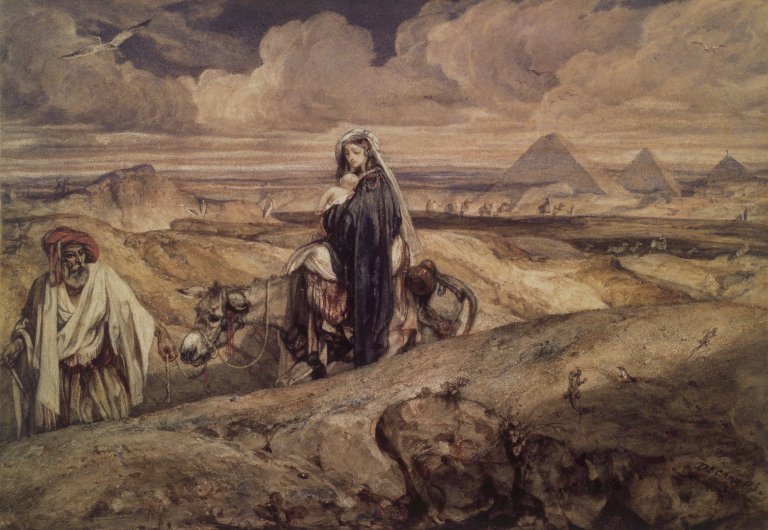
One night an angel of the Lord appeared to Joseph in a dream and called him to take Mary and Jesus and flee to Egypt, because Herod was after the child. And so, following the commands of the Lord yet again, Joseph took his family and went to the land that God had called him to travel to. There he waited until Herod died.

The wise men, on their way to meet and greet the baby Jesus had shared the news of this newborn king with Herod, who asked to learn of his location and identity after they found him. Because of a dream telling them not to return, they withheld the information regarding the baby Messiah to which Herod was infuriated. He gathered together hordes of soldiers and commanded them to travel to Bethlehem in order to kill any child under the age of two in and around the village.

Later, after the death of Herod, Joseph brought his family back to the land that had been promised to his ancestors, but traveled to the area of Galilee and settled in Nazareth, which would become the boyhood home of Jesus.

When I was 17 years old, I spent a lot of time at my home church. If I wasn’t practicing drums with the worship band, then I was at a boy scout meeting, or helping with youth group, or immersed in a bible study, or running the sound system for worship services, funerals, and weddings. Every Christmas Eve the church would hold multiple services and I would sign up for multiple shifts in order to have the sound system function properly for one of the highest attended services of the year. When I was 17 I was blessed, and I mean that ironically, to run the system for the 3pm and the 11pm services.

400x400_1266205978139-AldersgateAlter

The 3 o’clock service went as well as could have been expected. It was the family friendly service with a cacophony of children all running around and climbing over their pews while their parents attempted to listen to the sermon and not lose their place while singing the hymns. The sermon was spot on about the depth of Christmas and the graceful coming of God into the world in the form of a baby in a manger.

The 11 o’clock service was the complete opposite.

Instead of families with young children, the sanctuary was filled with older adults sitting scattered throughout the dozens of pews. Instead of children climbing over pews and dropping pencils everywhere, there was a profound silence within the worshipping body; a completely different sense of reverence. The sermon was the same, though it felt a little dull with the patterns of repetition throughout the afternoon and evening, however, you could feel a sense of wonder and awe flowing throughout the people that night, as they gathered together to celebrate God’s coming into the world.

By the time I was able to leave, it was already past midnight and I was exhausted. All I wanted to do was drive home, get in my bed, wake up, and open presents. As I drove back to my house I made my way down the George Washington Parkway with the Potomac River on my right thankful for the end of another Christmas Eve.

Right after I turned off the parkway to head up my street I saw flashing red and blue lights underneath the bridge that went over the road I had just drove on. I’m not sure why, (maybe it was the eagle scout in me) but I immediately pulled my car over and ran down to the road to see if I could help.

DSC08174

The details of what I saw there on the road that night will stay with me for the rest of my life, and there were things that I should never describe from the pulpit. Suffice it to say that, before I arrived, a terribly sad man had been standing on the edge of the bridge for sometime. The drop was nothing to speak of, maybe 13 feet, so he just kept standing there, waiting. He waited until he saw a large SUV coming toward the bridge, and when he felt that it was just the right moment, he jumped.

The SUV was carrying a family on their way home from an 11 o’clock mass from one of the Catholic churches in Old Town Alexandria, a family excited for the prospect of heading home after a wonderful service to get the milk and cookies ready for santa, a family ready to go to bed in order to wake up for Christmas morning, a family whose lives would be forever changed.

I don’t know how long I stood there, but one of the police officers made his way over to me, put his hand on my shoulder and said, “Go home, and try to forget ever seeing this.”

Life after Christmas can be one of the best, and one of the worst, times of the year. Its that strange time that often never meets our expectations. After weeks of preparation, hanging all the lights, decorating the house, wrapping all the presents, planning the meals, sending all the Christmas cards, Christmas comes and goes. We wake up and before we know it the holiday has arrived and departed. And for all the prep that we do, our expectations can almost never be met perfectly. We never receive all the gifts we want, we never have the perfect interaction with our family without fights and arguments, we never get to experience God and faith exactly the way we expect and hope for.

Life after Christmas can be a real shock if we’re not ready for it. We build up this wonderful holiday moment through the songs on the radio, through the worship services of Advent, and even with the sales promotions at all of our favorite stores.

Its no wonder therefore why there are more incidents of hospitalizations for depression, and attempts at suicide during the next few weeks, than any other time during the year. For all the joy that we muster together on Christmas Eve, life after Christmas can hit hard and low.

Life after Christmas for Jesus was filled with trial and tribulation as well. In the wake of his birth in one of the most inhospitable of places, Jesus, Mary, and Joseph had to flee to Egypt in order to avoid the wrath of Herod. It is curious that we receive little detail regarding Herod’s desire to kill all of the children in Bethlehem, only that he was infuriated by the deception of the wise men. It would seem that Herod feared for the loss of his position of power and control and he then decided to eradicate any remnant of this supposed “Messiah king” that could usurp his power.

If we only read this story on the surface, hearing about the new family’s retreat to Egypt, their patient waiting for Herod’s death, and their inevitable return, then we will be stuck with the devastating imagery of Rachel weeping for the children, the imagery of Herod killing innocents babies in Jerusalem, and a family’s terrifying experience of fear and isolation. But the story contains so much more.

In Matthew’s gospel, Jesus comes to be understood as the new Moses. He will deliver a sermon on the mount with his commands for the ways we are to live our lives, just as Moses stood on the mountaintop to deliver the ten commandments to the wandering Hebrews. It is important for Jesus to be understood through a Mosaic lens because he will also deliver the people out of slavery – not slavery in Egypt to foreign pharaohs, but out of slavery to sin and death.

Here, in this story, we get the beginnings of Jesus’ connections with Moses.

During the time of Moses’ birth, the Pharaoh in Egypt had all of the young males murdered in order to maintain the reigns over the Hebrew slaves. It was during this child massacre that Moses was saved by his mother. In a similar way, Jesus was saved from Herod’s massacre of the children because of the warning from God. Just as Moses would come to lead the Hebrew slaves out of Egypt toward the Promised Land, Jesus would eventually return to Galilee from Egypt in order to begin his ministry.

I wonder what it must have felt like for Mary and Joseph to raise that baby under such circumstances; to be told to leave all that was familiar, to enter a foreign land, because a ruler wanted to see your baby murdered. I wonder what could’ve sustained them through the days, weeks, months, and years of unknowing, the periods of fear and isolation.

I wonder what it must still feel like for that family that hit the man on their way home from church. What kind of emotional roller coaster does Christmas bring for them each year? What sustains them through that time of year when joy is so intertwined with fear?

Christmas, for us, is the reflection of that great event where God came to be with us. That time of year where we attempt to set aside all of our disappointments from the past, and look forward to that new beginning that we can hopefully emulate in our own lives.

Why is life after Christmas less ecstatic than the weeks leading up to it? Why do we let ourselves fall into states of sadness and the blues when we were just singing Joy to the World, and Angels We Have Heard On High? What is it about this time that makes it so much harder to get out of bed every morning, and get back into the routines of life?

opt-the-day-after-christmas from Life Magazine Jamie Wyeth

Life after Christmas is almost never easy; not for us now, not for that family driving home, and it certainly wasn’t easy for Jesus, Mary, and Joseph. As we continue to step forward into this uncertain time let us not hold fast to the decorations, and the pomp and circumstance, and the presents, and the meals, and all the other elements that make Christmas what it appears to be, but instead let us hold fast to the hymns we sang together as a church, let us hold fast to the fact that Christ is the light of the world that shines in the darkness, let us hold fast to the faith that we have in Jesus Christ as the Lord of all.

When you really get down to it, Christmas isn’t just a day, or even a time of year that we celebrate. As a faithful community, Christmas happens every single time we gather together. Every worship service, every bible study, every quilt for a cause, every Men’s club meeting, every UMW gathering, every youth activity, every thing we do reimagines the Christmas message for us. To be the church, to be the body of Christ for the world, means that we are continuously celebrating the fact that the greatest thing that ever came to be, came to be with us.

The fact that God humbled himself to be like us, for us, and with us, surmounts everything else in the world. For all the disappointments that we might face, for all of the ways we have fallen short of God’s glory, nothing will ever compare to the love of God in Jesus Christ manifested in a man’s life who changed the world.

It is okay to feel hurt and sad during life after Christmas. It is okay to feel the emotional tide that comes and goes while we rest in the awkward time after celebration. But we must never forget that though death, and suffering, and fear are real, they do not have the final word. God’s glory and grace surpasses all things. God’s love for you is eternal, it extends beyond all things, and is present in the ways that we love one another. Jesus, our Moses, came to deliver us from the bonds of the world, to help transform the way we live, and to share with us life eternal.

And so, If we take seriously the faith that we confess in Christ, then life after Christmas should really be the most wonderful time of the year.

Amen.


In Those Days… – Christmas Eve Sermon on Luke 2.1-20

Luke 2.1-20

In those days a decree went out from Emperor Augustus that all the world should be registered. This was the first registration and was taken while Quirinius was governor of Syria. All went to their own towns to be registered. Joseph also went from the town of Nazareth in Galilee to Judea, to the city of David called Bethlehem, because he was descended from the house and family of David. He went to be registered with Mary, to whom he was engaged and who was expecting a child. And she gave birth to her firstborn son and wrapped him in bands of cloth, and laid him in the manger, because there was no place from them in the inn. In that region there were shepherds living in the fields, keeping watch over their flock by night. Then an angel of the Lord stood before them, and the glory of the Lord stood before them, and they were terrified. But the angel said to them, “Do not be afraid; for see – I am bringing you good news of great joy for all the people: to you is born this day in the city of David a Savior, who is the Messiah, the Lord. This will be a sign for you: you will find a child wrapped in bands of cloth and lying in a manger.” And suddenly there was with the angel a multitude of the heavenly host, praising God and saying, “Glory to God in the highest heaven, and on earth peace among those whom he favors!” When the angels had left them and gone into heaven, the shepherds said to one another, “Let us go now to Bethlehem and see this thing that has taken place, which the Lord has made known to us.” So they went with haste and found Mary and Joseph, and the child lying in the manger. When they saw this, they made known what had been told them about this child; and all who heard it were amazed at what the shepherds told them. But Mary treasured all these words and pondered them in her heart. The shepherds returned, glorifying and praising God for all they had heard and seen, as it had been told them.


Do not be afraid; for see — I am bringing you good news of great joy for all the people: to you is born this day in the city of David a Savior, who is the Messiah, the Lord.

lord-jesus-christ

In those days Augustus ruled over everything. The emperor of the powerful Roman empire had true and frightening power. His authority was known from the British Isles to Asia and into Africa. His very name meant wealth, rule, and power. His face and title was printed on currency, his decrees spread throughout the lands, and he was known by all. So, in those days, in the days of Augustus, our story begins.

And then one night in a tiny and seemingly obsolete town, part of Rome’s conquest, a baby was born. It was a tucked away village of little consequence to which the mother and her soon-to-be husband were traveling, not by choice, but because Augustus wanted the world to be registered. Both of them were poor, and when they arrived in the town no one took notice of their coming, no one offered to help them find a place to stay, no one even spoke to them. They went looking for space at the Inn, but there was no room, so the only place they could find to stay was a stable; that was where their child was born, a child named Jesus.

We learn then that within the region there were shepherds living in the fields who were confronted by an angel of the Lord. The angel brought great tidings of this new child’s birth, calling him a Savior, the Messiah, the Lord. And so these unnamed shepherds traveled into the city of Bethlehem to meet this child face to face, coming into contact with the incarnate God almighty. They shared their story with anyone who would listen and continuously glorified and praised God for all they had seen.

In those days, when everyone knew and feared the power of Augustus, a baby was born. And somehow, that tiny child born in the most unlikely of places and circumstances transformed the world forever. Augustus is only remembered in history books and lecture halls, whereas that baby grew into the man that embodied hope for the world from the day he was born to this very night. Augustus had all the power and money and influence to do whatever he wanted, yet Rome still fell. But of God’s kingdom there will be no end. Why? Because the power of Christ lives on, his light and love reaches into our very hearts and changes us into something new, different, and wonderful.

This story has been told for millennia. Gatherings of the faithful have taken place over and over again to remember this particular story, this radical moment that changed the fate of the world forever. It has been dramatized in countless films, books, songs, and plays. We, whether we come to church or not, hear this story as children and again and again as we grow older.

When you think of the manger, what do you see? Do you picture the animals lying silently with adoring eyes at the baby comfortably resting in the hay? Do you envision the wise men bringing their gifts of gold, frankincense, and myrrh? Do you imagine the warmth and the glow from the angelic presence as the incarnate God was brought into the world?

I know this might not be the Christmas message you want to hear, but Luke would have us imagine a very different scene.

Nativity

The story, as was read for us, is remarkably simple. Besides the appearance of the angels in the fields there is no great miracle or display of God’s power. The manger scene is quite stark, empty, and even frightening. Mary and Joseph were completely alone after traveling to Bethlehem while Mary was pregnant. They had to retreat to a stable at the back of, or underneath, the house (perhaps even in a small cave). When Jesus was finally born he was placed inside of a feeding trough, not the comfortable and clean version we often seen depicted on the mantle. There is a bare and frightening emptiness at Jesus’ birth, while two adults crouched in a cave feeling more alone than ever before.

Luke keeps the story clean of any decorations that would remove it from the lowly, the poor, and the marginalized — the people just like Mary and Joseph.

Sadly, in many Christmas celebrations we have not resisted the temptation to run to Matthew’s gospel where the royal visitors arrived with their gifts, or imagine a soft glow coming from the manger straw, and with the air filled with cherubs and angels. Luke has a glow in the story, but it is shining somewhere else.

angelandshepherdsloop

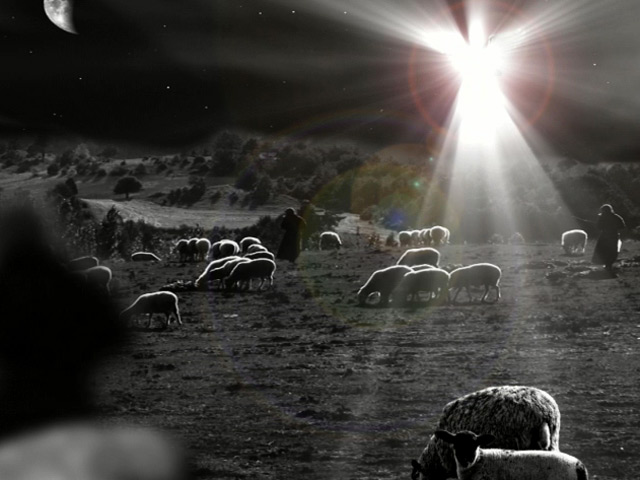
So where does the story move? To shepherds who are living in the fields in order to watch over their flock at night. Shepherding was a despised occupation during the time of Jesus’ life. They were a homeless group of ragtag sheep watchers, worse off than even Mary and Joseph in their difficult manger. And for whatever reason the angel of the Lord appears to them in the wilderness — Not Augustus in his palace in Rome, not the chief scribes and the temple priest in Jerusalem, but the lowly shepherds in a field.

“Do not be afraid,” The angel bellowed. “for see – I am bringing you good news of great joy for all the people: to you is born this day in the city of David a Savior, who is the Messiah, the Lord. This will be a sign for you: you will find a child wrapped in bands of cloth and lying in the manger.” And without warning a multitude of the heavenly host appeared praising God and singing, “Glory to God in the highest heaven, and on earth peace among those whom he favors!”

And so the homeless shepherds traveled to Bethlehem to see this Savior, Messiah, and Lord waiting for them in a feeding trough born to an unwed couple.

So you see, Mary and Joseph were left alone that night — it was from the shepherds that they learned of the angel and the heavenly host. The two new parents, busy with the chores of childbirth in the most inhospitable of places under the most difficult of circumstances, did not get to experience heaven’s visit but instead heard about it from a group of homeless and wandering sheep watchers.

This is an unusual story, but it is precisely because of its strangeness, that it has made all the difference.

“I am bringing good news of great joy for all the people: for you is born this day in the city of David a Savior, who is the Messiah, the Lord.”

For whom is the child born? Not Augustus with all of his power, not the priests and the scribes who ruled the religious practices, not the super elite and fabulously powerful, but for those shepherds in the field, for all of you. For YOU this child has been born.

In that tiny dark manger God was born of the flesh in the baby Jesus. God became incarnate, took on our humanness. Jesus was both human and divine. Born into two worlds, from above and below, Jesus came as a new being in order to reconcile the world back to God. Though he carried the glories of God with him everywhere that he would eventually travel, he never ceased to care for our most basic needs: food, water, relationships. Wherever he went he ate with his friends and the marginalized, all of the shepherd types within the community, nurtured relationships so that all would come to know more about the love of God.

He knew that we could not truly live by earthly things alone… Do you have a Christmas tree at home filled with presents underneath but you cannot find pure joy in your life? Have you raised the perfect family with 2.5 children, a dog, a cat, and a white picket fence, but you feel like something is missing in your life? Do you find yourself searching for meaning, and even when you fill your life with all of the things that the world tells us we need, you never feel completely satisfied? Christ knows our emptiness, God came in the form of flesh to bear our emptiness, so that he could help fill us in a way that we never could on our own.

Haven’t we all had a Bethlehem moment in our lives? A time where it felt that no one knew us, no one understood what we were going through, no one reached out to help us? A period where we carried the weight of the world on our shoulders unable to share the burden with anyone else. A moment where it felt as if the darkness was too powerful for any light to shine forth. In many different ways, we have all traveled to our own Bethlehem.

How perfect is it then, that Bethlehem means “town of bread”? From a tiny manger, from an unwed couple, from the town of bread comes the incarnate God who is the bread of life. It is in this meal he came to bring us the bread of life that can and will sustain us in all things.

00029400_h

Because at this table, at Christ’s holy banquet, we are all invited into that tiny unlit manger, into the darkness and loneliness that Mary and Joseph must have felt. We are incorporated into this story because Jesus has welcomed us in. We are there, but more importantly Jesus is with us here. Christ is with us in all of our brokenness, in all the failed attempts to live perfect lives, in our fears and our frustrations, he is here because God came to be like us to help transform us.

That is Christmas! That is hope! That is grace!

That is the story worth telling over and over again, because the greatest thing to ever be, came to be with us.

Amen.


The Lord Is With You – Sermon on Luke 1.26-38

In the sixth month the angel Gabriel was sent by God to a town in Galilee called Nazareth, to a virgin engaged to a man whose name was Joseph, of the house of David. The virgin’s name was Mary. And he came to her and said, “Greetings, favored one! The Lord is with you.”But she was much perplexed by his words and pondered what sort of greeting this might be. The angel said to her, “Do not be afraid, Mary, for you have found favor with God. And now, you will conceive in your womb and bear a son, and you will name him Jesus. He will be great, and will be called the Son of the Most High, and the Lord God will give to him the throne of his ancestor David. He will reign over the house of Jacob forever, and of his kingdom there will be no end.” Mary said to the angel, “How can this be, since I am a virgin?” The angel said to her, “The Holy Spirit will come upon you, and the power of the Most High will overshadow you; therefore the child to be born will be holy; he will be called Son of God. And now, your relative Elizabeth in her old age has also conceived a son; and this is the sixth month for her who was said to be barren. For nothing will be impossible with God.” Then Mary said, “Here am I, the servant of the Lord; let it be with me according to your word.” Then the angel departed from her.

Luke-Chapter-1-The-Annunciation-to-Mary

Greetings, favored one! The Lord is with you.

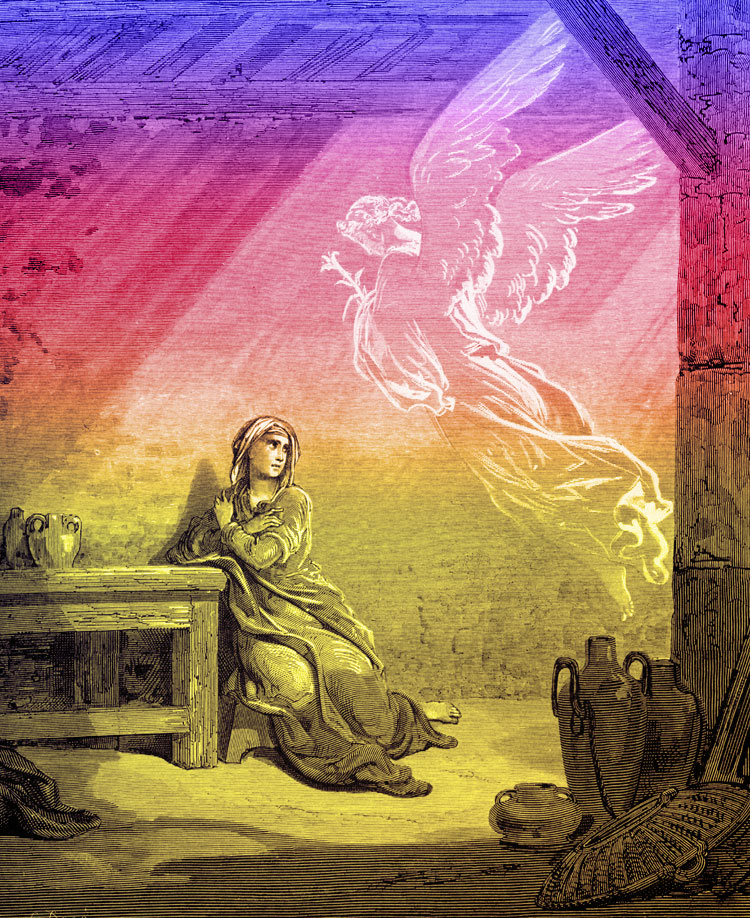
In the sixth month, that is to say in the sixth month of Elizabeth’s pregnancy (from the scripture last week), the angel Gabriel was sent to another Israelite. Just as he had come to bring good news to Zechariah, Gabriel was now on a mission to find a young woman. And so it came to pass that Gabriel was sent by God to a town in Galilee called Nazareth, to a virgin engaged to a man whose name was Joseph, of the house of David. The virgin’s name was Mary.

This is a new episode in the gospel of Christ according to Luke, yet it is very clear how closely this story parallels the story of Zechariah in the Temple. Both interactions with the divine messenger are stories of God’s grace and power. Grace in that what is soon to take place will illumine God’s favor toward the world, and power in that God can work through the unable — an old childless couple, and an unmarried virgin. Both Elizabeth and Mary will become mothers because God is able, and they will have sons for our sake because God is righteous and gracious.

Gabriel said to her, “Greetings, favored one! The Lord is with you.” But Mary was much perplexed by his words and pondered what sort of greeting this might be. And the angel continued, “Do not be afraid, Mary, for you have found favor with God.”

Do you remember the story from last week? Do you remember how Zechariah was struck with fear when confronted by the angel in the most obvious of places, the innermost holy place of the Temple? Do you remember how his unbelief regarding the good news from Gabriel resulted in his becoming mute until the birth of John the baptist?

archangel-gabriel-struck-zechariah-mute-1824

Instead of a priest, one who should have been most familiar with the ways of God in the world and the stories from the past, Gabriel appears to a young unmarried virgin named Mary who does not respond in the same way.

Zechariah was overwhelmed with doubt and fear whereas Mary responded with awe and perplexity. Zechariah wanted to see a sign, wanted proof of the tidings brought by the angel, wanted to have his unbelief changed. Mary responds with curiosity. The messages from God speak into one’s insufficiencies, and brings good news of heavenly grace that must be trusted before its ways are known. There is great power in this story between the way Zechariah reacted, and the way Mary responded.

“And now Mary, you will conceive in your womb and bear a son, and you will name him Jesus. He will be great, and will be called the Son of the Most High, and the Lord God will give to him the throne of his ancestor David. He will reign over the house of Jacob forever, and of his kingdom there will be no end.”

This is good news. This is the kind of message that everyone had been waiting for. A new gift from God was going to come into the world through a young woman to be called the Son of the Most High. A new gracious leader is coming to take back the throne of David. The kingdom that God had always wanted for us is coming! And nothing will be able to stop God in all his majesty because this new kingdom will have no end!

“How can this be, since I am still a virgin?” Mary wondered. There is a difference here between doubt and curiosity. She believes the words from Gabriel, she understands that she will be bringing a child into the world. She is already preparing herself for God’s will in her life, but her curiosity regarding the fundamentals of God’s purposes come forth.

“The Holy Spirit will come upon you, and the power from the Most High will overshadow you; therefore the child to be born will be holy; he will be called Son of God. And even now, your relative Elizabeth in her old age has also conceived a son; and this is the sixth month for her who was said to be barren. For nothing will be impossible with God!

9

After explaining the elements of her coming conception, Gabriel ends his description with a final word of assurance. Gabriel recalls for Mary, and all of us, the creed behind all creeds, the very words spoken to Abraham and Sarah when they doubted the word that they were going to have a child in their old age: For with God nothing will be impossible.

And with perfect clarity, with willing submissiveness to God’s plans in the world, and with hope and joy, Mary responds to the calling of God: Here am I, the servant of the Lord; let it be with me according to your word. And then Gabriel departed from her.

How many times have you heard this story? Even for the so-called “unchurched” most people have heard, even just a sampling, of this story. The amount of art, Christmas decorations, and portrayals of Mary’s meeting with Gabriel are far and wide. This story is the source of great hope, frightening church schisms, and definitive reality shifts. Just as the prophet Isaiah told the Israelites, “Behold a virgin shall conceive a son and he will be called Immanuel,” the virgin Mary was met in the middle of the night by an angel to discover that she was to be the vessel of the Lord.

However, like the story of Zechariah in the temple, Mary’s midnight meeting has been told so many times that it is often difficult to discover something new and fresh when we approach the story. This week as I made my way through the first chapters of Luke, engaged in numerous conversations, and pondered over the heart of Advent, I began to wonder: Why Mary?

Why Mary? If God wanted to come into the world in a big way, with pomp and circumstance; If God wanted to come in the form of flesh to dwell among us as a king with power, he certainly could’ve picked a better mother. Why on earth did he choose her?

I’ve always had a hard time understanding what it is about Mary that made her highly favored in the eyes of the Lord. Remember Gabriel’s first words: “Greetings, favored one!” Really? How could she possibly be favored? Immediately following this episode she would presently go on a long and difficult journey to small town, not because she wanted to, but because the foreign rulers of her homeland forced her to go. She would be ridiculed, and judged, and even threatened for carrying a child conceived outside of normal circumstances, particularly before being married. She would give birth to this “son of the Most High” in one of the lowliest places, a stable. And after Bethlehem? Long years of obscurity and poverty with the world continually churning with its disapproval of the Jews, with the power from on high weighing down the life of the people. Her baby from Bethlehem would go on to become one of the most hated men in all of Israel and his life would increase in danger until the very end. The humble, marginalized, poor, and weak loved him, while the powerful and wealthy regarded him with hatred. Mary’s baby boy would be murdered on a cross, betrayed by the very people he came to serve. She would come to cradle her lifeless son’s body in her arms just as she did that first night in the manger. That was the favor of God?

Why Mary? Why an unwed, impoverished, and teenage girl?

Throughout the gospels Mary is portrayed as thoughtful, obedient, believing, worshipful and devoted to Jewish law. To us, and to all who knew her, she is the ideal Christian. However, none of these qualities are offered as reasons for God choosing her, God’s reasoning is tucked away from our view. We can guess, and we can come to our own conclusions, but the truth of God’s choice is known only to God in his eternal plan.

If Mary had wanted a perfect life on unbroken happiness, ease and pleasure in all things, then she certainly didn’t get it. If she had tried to measure up the favor of the Lord by the expectations of the world, then it would seem that the promise and salutation of the angel was only an illusion.

But the truth, and I mean real truth, is always deeper than it appears on the surface. 

The world would tell us, that God’s favor is to be found in ease, pleasure, and prosperity. God’s favor can be seen in a Christmas tree covered in perfect ornamentation with a plethora or present piled underneath. How many televangelists and “christian” writers make their millions and claim that God’s favor is with them, that God wanted them to be wealthy and powerful? Their messages always contain some sort of theologically problematic promise: If only you pray more, if you only read your bible more, if you only put more money in the offering plate, then God will make you healthy, happy, holy, and wealthy.

That is not the gospel.

It is a terrifying paradox, but, it is the lives which have been given something great to do and to bear, even though they may have been bruised and battered in the process, which have truly known the favor of God.

If God had wanted our discipleship to be easy then he would not have come into the world through the difficult situation of an unwed virgin. If God had wanted our faith to be easy then we would have no need for church, repentance, and forgiveness.

With Mary, and frankly with every single one of us, it comes down to obedience. Purely and humbly Mary put herself into the hands of God. She sacrificed so that God’s will could be done in the world. “Let it be with me according to your word.”

As the story continues, Mary meets with her relative Elizabeth, and when John leapt in his mother’s womb while in the presence of Jesus in Mary’s, she responds by praising God. She praises God even though the child in her womb will certainly make her life more difficult. And when we read the Magnificat it seems like Mary is continuing to praise God for the wrong reasons. Rather than celebrating God’s gifts to the proud, the powerful, and the rich, she offers joy that God has turned such values upside down.

I believe that we, myself included, are so often caught up with what the world defines as greatness, what the world defines as favor, that we lose sight of God’s kingdom right in front of us. We would all do well to join in with Mary’s song and magnify the Lord who lifts up the lowly and vulnerable in love. We would do well to open our eyes and ears to what God is doing in the world, what God wants to do through us, and respond with a resonating, “Here I am, let it be with me according to your word.

So, how is it with your soul? Where have you felt God tugging you in your life? Is there a pull or a nudge that has happened, perhaps you don’t know why, but you know that something is there? Have you seen a place in your life that you want to change but you’re unsure of whether or not you really can? Is God calling you to do something in your life and you, like Mary, are perplexed at how it would even be possible?

My guess is, we all have something. Whether large or small, grand or simple, God is always calling us to something new. To fix a broken relationship, to reach out to those marginalized in our own community, to shine a great light when it feels like the darkness is taking over.

As we prepare to make our way to Christ’s table let us all remember that with God nothing is impossible. An old childless couple can be given new life, a virgin can bear a child who came to save us, we can all be forgiven for the wrongs we have committed, death can be defeated, life after life after death is available through the grace of God, lives can be transformed, love can be discovered, and faith can be rekindled. Nothing will be impossible with God.

Amen.