The Gifts of God – Truth

Psalm 25.1-10

To you, O Lord, I lift up my soul. O my God, in you I trust; do not let me be put to shame; do not let my enemies exult over me. Do not let those who wait for you be put to shame; let them be ashamed who are wantonly treacherous. Make me to know your ways, O Lord; teach me your paths. Lead me in your truth, and teach me, for you are the God of my salvation; for you I wait all day long. Be mindful of your mercy, O Lord, and of your steadfast love, for they have been from of old. Do not remember the sins of my soul or my transgressions; according to your steadfast love remember me, for your goodness’ sake, O Lord! Good and upright is the Lord; therefore he instructs sinners in the way. He leads the humble in what is right, and teaches the humble his way. All the paths of the Lord are steadfast love and faithfulness, for those who keep his covenant and his decrees.

Christmas 1

Happy New Year! As I mentioned last week, today is the beginning of our year as Christians. We have reset the calendar to rediscover the love of God in our lives and in this place. From now until Christmas Eve, we will have a sermon series on the gifts of God. This is particularly fitting considering the fact that Advent is usually a time when we fret about what we will be purchasing for everyone else. However, this Advent, we will be reflecting on what God has given us. Today we begin the sermon series with God’s gift of truth.

Make me to know you ways, O Lord; teach me your paths. Lead me in your truth, and teach me, for you are the God of my salvation; for you I wait all day long.


One of God’s greatest gifts to us is truth. God provides for us a way and a path for Christian living and they all point to the truth. The psalmist confesses the beauty of this truth and pleads for God to maintain the truth in all times and in all places.

Advent is a wonderful and strange time for us Christians. In four short weeks we, as a church, are expected to make time and space to prepare our lives for God’s indwelling. All the while, many of us want to quickly break out the carols to accompany the dizzying whirl of parties and purchasing the usually precede Christmas. We want Christmas morning to be here so badly, that we forget about the anticipation of Advent.

True confession: My Christmas lights were up three weeks ago. We had a particularly balmy day and I decided that I might as well get outside and string up the lights, even if I was wearing shorts and a tee shirt. I have almost purchased all of my Christmas presents. I keep a notebook with me throughout the year and whenever Lindsey makes mention of something she likes, I make a note of it so that I will be prepared for Christmas. And even this morning, while I was praying in our sanctuary and on the front lawn, I caught sight of a particularly beautiful Christmas tree that I will probably bring home this afternoon.

I am impatient. I get so excited about a particular time and event that I often lose sight of the time leading up to it, precious time to be savored and enjoyed. But here’s a truth that God provides for us impatient people: the anticipation is just as important as the thing itself.

If couples went from engagement immediately to the wedding they would not have the important time of really learning what their in-laws are like.

            If young people were given a driver’s license without having a learner’s permit for nine months there would be a tremendous amount of fender benders in Robert E. Lee’s parking lot.

            If we jumped straight from Thanksgiving to Christmas morning then we would believe Christmas is more about gifts under the tree than God’s gift of Jesus for you and me.

The anticipation is just as important as the thing itself.

The psalm describes a profound trust in the Lord, a trust in the Lord’s paths, ways, and truths. God reminds us of these truths through different people and events, and when we confront them we can’t help but admit how true they really are.

The psalm also proclaims an important truth that we all need to hear right now: God is the God of our salvation.

In our contemporary culture, people often use the language of salvation when referring to politicians. President Roosevelt was considered by many to be a savior as was Kennedy and Reagan. Today we still look at our politicians with a messianic lens.

I was walking down Beverley street a few weeks ago when I overheard a couple in front of me discussing Donald Trump’s political astuteness. One of them said, “If only he was president, he would fix all the problems that the democrats started!” I couldn’t help but laugh when I heard what they had to say and I kept on walking. But then when I got in the car and started to drive back to church I heard someone call into NPR to claim that Hillary Clinton has the power to unite all people and will bring us, as in Americans, to the Promised Land. And then I got an email from someone who asked me to use the pulpit as a means by which to convey to all of you that Ben Carson was handpicked by God to bring about infinite prosperity and a return to Christendom here in the United States. And then someone sent me a picture that said, “We should elect Bernie Sanders as a socialist Jew, because we worship another socialist Jew every Sunday in church.”

political_saviors

In a matter of hours, I heard about how four different political candidates would bring about a peace and wholeness in America that sounds impossible. Politicians cannot save us. They can advocate for us, they can institute law that can help us, but they cannot save us. Donald Trump cannot save us. Hillary Clinton cannot save us. Ben Carson cannot save us. Bernie Sanders cannot save us. Only Jesus saves.

This is one of God’s truths: only God can save. Yet, we all fall to the temptation of believing that political leaders are like messiahs who should be the ultimate objects of our trust and allegiance. Just drive around Staunton for an hour and look at all the political bumper stickers and yard signs covered in red white and blue. Countless Americans will contribute untold sums of money to political campaigns, they will use their precious free time to attend rallies and knock on doors, and they will jump at the first chance to get into an argument with someone who has a difference in political opinion.

Can you imagine what our community would be like if we actually worshipped Jesus like we worship our politicians? Can you picture what Staunton would look like if we put crosses on our cars (letting everyone know what we are supposed to act like) instead of political bumper stickers? Can you imagine what it would be like if we put up mangers in our front yards letting everyone know we worship the kings of kings instead of political banners?

We need politicians for our country. But we only need God for salvation.

That’s what God’s truths are like. On some fundamental level we know them to be true, but life tries to convince us otherwise. Getting excited about Christmas isn’t a bad thing; it’s only when we let the material become more important than the spiritual that God needs to remind us of the truth. Wanting politicians to make substantial and important changes isn’t a bag thing; it’s only when we start worshipping politicians like we are supposed to worship Jesus that God needs to remind us of the truth.

On Thursday evening I was sitting around the table at my parents house in Alexandria, VA for Thanksgiving. Family members had worked all day to get the food exactly the way we wanted, decorations had been set up across the house, and we were finally about to go around the table and share what we were thankful for this year. One of my cousins got the waterworks flowing as he shared that he was thankful for the new life that Lindsey and I will be bringing into the family in April. Both of my sisters expressed thankfulness for our family that has supported them throughout their lives. But then my grandmother started to share.

She told us about a family that lives across the street who has been through the ringer over the last few years: Divorce, unruly children, uncertain employment, etc. The mother of the family has grown close with my grandmother and they were out in the street talking a few weeks ago. The woman asked my grandmother what she would be doing for Thanksgiving and she described the very feast and fellowship that we were currently enjoying. The woman listened patiently to all the things my grandmother described and then said, “Do you know how blessed you are?

My grandmother began to cry and she exclaimed how she takes so many of her blessings for granted: Good health, a family that loves one another, food on the table, her faithfulness. The joy and exuberance of the day quickly transformed into a brief time of silence as we all pondered about the blessings that we take for granted.

Want to know one of God’s truths that we miss the most? We are blessed. Amidst spinning truths and impending threats we have a God who loves us more than we can possibly imagine. Amidst all of our fears and frustrations we have a savior who was willing to die on a cross to save us. Amidst all of the uncertainties and hypocrisies we have a Spirit that breathes new life into us each and every day. We are blessed.

blessed-main-image

Good and upright is our God. He patiently instructs us through his Word in the way that leads to salvation. God leads the humble in what is right and teaches each of us the path to follow. All of the Lord’s ways are steadfast love and faithfulness so long as we remember the truth.

In a moment I’m going to invite us to encounter and confront one of these truths. Some of us will still wish it was Christmas day today, some of us will still worship politicians like we should worship Jesus Christ, but one of the things all of us can do is be thankful for the blessings in our lives. I would like each of us to pair up with someone in the church, someone that we don’t normally spend time with, and I want us to just have a conversation about how God has blessed us this year. Take a few moments to share, perhaps like you did on Thanksgiving, what you are thankful for right now.

One of the gifts of God this advent is the truth. The truth of God’s love made manifest in a baby born in a manger, a baby that embodied the Good News, a baby that carries the promise of transformation of life from sin to salvation, from slavery to freedom, from injustice to peace, and from death to resurrection. We are blessed. Amen.

Devotional – Psalm 146.1

Psalm 146.1

Praise the Lord! Praise the Lord, O my soul!

Weekly Devotional Image

On Thursday afternoon I made my way over to the parking lot at Gypsy Hill Park to prepare for the UMC Trunk or Treat. The pastors and lay leaders from the Staunton area United Methodist churches had been planning the event for a number of months and it was my responsibility to set up the parking lot and organize the first wave of volunteers. For months we had collected candy and advertised in the local community and I was anxious to see how it would turn out.

In our earliest conversations we thought we would be lucky to receive a few hundred children and their parents for our Trunk or Treat. We continued to organize, plan, and pray for the event and when it was time to start trunk or treating a long line had already started to form; All of our hard work was about to come to fruition.

Over the next two hours the line of people never dwindled. Volunteers were running around in order to maintain the safety of the young children while also replenishing the candy supplies that had run low in some of the trunks. Children were dressed in some of the wittiest and most delightful costumes as they came forward with grateful hands to receive a peace of candy. And every trunk was attended by a faithful Christian eager and willing to share God’s love through the tiniest of gifts.

At about 7pm I left Lindsey with the candy at our trunk and made my way to the top of a hill for a better vantage point; I wanted to see how well the line was moving and if people were still enjoying themselves. I resisted the temptation to turn and look until I got to the very top and when I did I was stunned. From where I stood I could see no end to the numbers of children and families that had gathered in the park. I tried taking a picture and I could not even come close to capturing everyone in it. By the time the Trunk or Treat came to a conclusion over 3,500 people had come through.

12182395_10204873871677559_710633466728393275_o

When I stood on top of the hill and looked out at what the United Methodist Church could do in connection I wanted to praise God. Only an almighty and powerful God could call us to work in community with one another instead of in competition. Only a faithful and loving God could stir our hearts to give generously to this wonderful community. Only a redemptive and sustaining God could accomplish something in us as powerful as our Trunk or Treat.

We truly serve an almighty God who is worthy of our praise!


Devotional – Job 38.4

Devotional:

Job 38.4

“Where were you when I laid the foundation of the earth? Tell me, if you have understanding.”
Weekly Devotional Image

The grains of sand fell through my hand while I was sitting on the beach. My Boy Scout troop had set up camp the night before and a few of us had woken up to catch the sunrise. We could hear our fellow scouts still rustling in the warmth of their sleeping bags, but we were content to sit in the sand and listen to the water.

The boy next to me was absent-mindedly running his fingers through the sand when he looked up and said to no one in particular: “How many grains of sand are in my hand? And in this little spot where I’m sitting, how many grains of sand could there possibly be? Do we even have a number to count that high? And what about all the beaches in the world… and all the sand under the oceans… all those grains of sand… And yet, there are more stars in the sky at night than there are grains of sand on the whole earth…”

4e5e532e25bc1DSC01828_large_medium (1)

The rest of us sat there in amazement at such a simple and profound reflection and immediately felt tiny and insignificant in the grand scheme of the cosmos. If we felt like the world revolved around us, we were all changed by our friends’ comment, and I have never forgotten the way it made me feel.

After Job has been through all his trials and tribulations, after Job challenges the Lord, God finally answers Job by saying: “Where were you when I laid the foundation of the earth? Tell me, if you have understanding.” As if Job had heard our discussion about the grains of sand, he was immediately put in his place in relation to God. Instead of believing that he was the center of the universe, Job was humbled by God’s declaration.

Sometimes it is good for us to be humbled. After a particular season of life where we believe that people should worship the ground we walk on, we do well to be knocked down a peg or two. It can be incredibly life giving to realize that we are no greater than anyone else. And it can do wonders to remember what we are in the grand scheme of things: a grain of sand. Because when we remember our place, our eyes can be opened to the people around us instead of only focusing on ourselves.

This week let us remember to not think too highly of ourselves. If we catch ourselves deep in the clutches of vanity and vainglory let us remember the story of the grains of sand, let us remember God’s declaration to Job, and let us remember to be humble.


Devotional – Amos 5.14

Devotional:

Amos 5.14

Seek good and not evil, that you may live; and so the Lord, the God of hosts, will be with you, just as you have said.

Weekly Devotional Image

A few weeks ago I found myself sitting in a sanctuary filled with pastors and lay people for a class on spiritual disciplines. Our teacher led us through a lecture about the means of grace and the many ways that we can find communion with God through spiritual disciplines. We heard about the value of reading scripture, praying for God’s intercession, and listening to the silence. All in all it was a very informative class, and I believe that many of us left with a renewed spirit and dedication to living prayerful lives. However, in addition to all the wonderful comments during the class, I overheard the instructor talking with someone on the way out and what he said stopped me in my tracks.

A woman stood with the instructor and asked for his advice regarding the fact that God’s love was absent from her life. She claimed to have committed herself to the spiritual discipline of Morning Prayer, but God’s presence was still lacking. The instructor stood there with a serious look on his face and simply asked, “Are you doing all the good you can in your life?”

That question is one that cuts straight to the heart. Though I was unable to pick up on the rest of the conversation, I can imagine that the instructor was trying to make the point that, as we read in Amos 5, if we seek the good, God will be with us. We can pray and commit ourselves to spiritual disciplines, but unless those disciplines are bearing fruit in our lives then they might need to be reconsidered.

telling-your-story-to-motivate-donors-and-advocates-for-your-cause-32-638

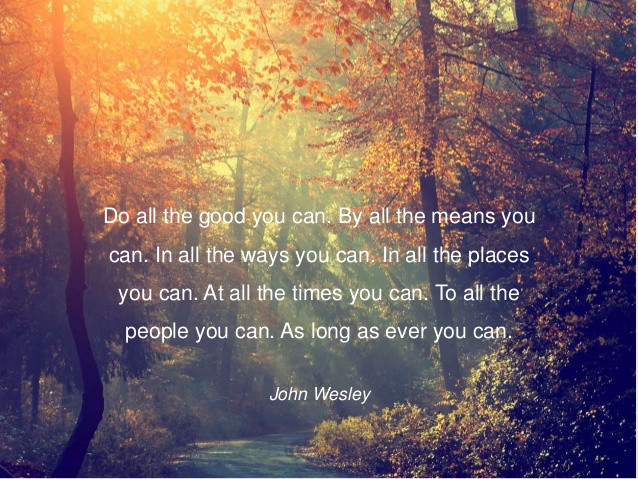
During the time of John Wesley, many Christians were consumed by a faith of the mind. They relied heavily on reason and experience to determine their understanding of God and were content to let God be something they pondered rather than someone to whom they could give their life. Frustrated with the way the church was moving, Wesley pushed for holiness of heart and life whereby spiritual practices and thoughts would become manifest in daily life by doing the good. A wonderful quote often attributed to Wesley shows his commitment to the good: “Do all the good you can. By all the means you can. In all the ways you can. In all the places you can. At all the times you can. To all the people you can. As long as ever you can.”

In our lives, how often do we strive for the good? If God’s presence feels absent, if we want to experience God’s love here and now, then one of the best things we can do is seek the good and discover God’s presence along the way.

Devotional – Mark 9.47

Devotional:

Mark 9.47

And if your eye cause you to stumble, tear it out; it is better for you to enter the kingdom of God with one eye than to have two eyes and be thrown into hell.
Weekly Devotional Image

I was sitting in a classroom at James Madison University when one of my peers raised her hand to ask a question. The lecture had been focused on the reliability of the New Testament writers/witnesses and a debate had erupted over whether or not to take the bible literally. I sat patiently near the front of the class watching the comments fling back and forth like a ping pong match between the students and our professor when the girl finally raised her hand.

She said, “I just want everyone to know that I take the bible literally because Jesus is my savior.” The rest of us stared at her and then slowly turned to watch our professor’s rebuttal. “Really? You take the entire bible literally all the time?” he asked rhetorically. The silence was palpable. He continued, “Well then, let me ask you this: Are you a sinner?”

With an obvious look on her face, she said, “Of course I am, but Jesus died on the cross to save me from my sins.” The professor responded, “Yes yes, but do you sin, even though Jesus died for the world?” “Duh,” she said, “everyone sins, and that why we need to let Jesus into our hearts.”

The professor then sighed and brought the point home, “So you say you’re a sinner, but I notice that you have two hands, two legs, and two eyes… Jesus told his disciples that if their hands or feet cause them to sin, they should cut one of them off, and if their eyes cause them to sin they should pluck one out. So you see, I’m having a hard time understanding how you take the bible literally, affirm that you’re a sinner, and still have both your hands, both your feet, and both your eyes all at the same time.”

I don’t remember the girl’s name, but I will never forget the way she looked as she slumped back down into her chair thinking about what our professor had said.

Image processed by CodeCarvings Piczard ### FREE Community Edition ### on 2015-05-18 22:39:16Z | http://piczard.com | http://codecarvings.com &

The bible is full of different literary forms that give it life. There are epic poems that retell the great story of the past in order to teach a lesson to the present. There are long genealogies that connect different characters throughout the centuries. There are parables of everyday situations that are meant to leave us scratching our heads in wonder. There are metaphors used (just like we do) to convey meaning in a way that is memorable and effective. There are proverbs, psalms, and poems that contain wisdom beyond their literal words.

The bible is not a historical narrative to be analyzed and redacted like a modern textbook. It is not a perfect collection of rules to live life. The bible is not a text to be read literally all the time in every situation; otherwise we would all be stumbling around with missing appendages.

The great beauty of scripture is that it opens up the strange new world of what it means to be in relationship with God and with our fellow human beings. The greatest moments in our lives cannot be conveyed in simple words to be taken literally, but are in fact so profound that we must use differing literary forms to even begin conveying what our experience was like. The bible is full of wonder and that’s why we keep coming back to it every day and every week to learn more about who we are, and whose we are.

This week, let us open up our bibles to discover the strange new world of God’s kingdom, and start letting it become incarnate in the way we live.

O To Be Wise – Sermon on Proverbs 1.20-33

Proverbs 1.20-33

Wisdom cries out in the street; in the squares she raises her voice. At the busiest corner she cries out; at the entrance of the city gates she speaks: “How long, O simple ones, will you love being simple? How long will scoffers delight in their scoffing and fools hate knowledge? Give heed to my reproof; I will pour out my thoughts to you; I will make my words known to you. Because I have called and you refused, have stretched out my hand and no one heeded, and because you have ignored all my counsel and would have none of my reproof, I also will laugh at your calamity; I will mock when panic strikes you, when panic strikes you like a storm, and your calamity come like a whirlwind, when distress and anger come upon you. Then they will call upon me, but I will not answer; they will seek me diligently, but will not find me. Because they hated knowledge and did not choose the fear of the Lord, would have none of my counsel, and despised all my reproof, there they shall eat the fruit of their way and be sated with their own devices. For waywardness kills the simple, and the complacency of fools destroys them; but those who listen to me will be secure and will live at ease, without dread of disaster.”

seek-wisdom

Wisdom is standing on the street corner shouting at anyone within distance. In all the town squares she is that preacher standing on a box yelling at the crowds to repent from their ways. At the entrance of the largest cities she is the one holding up the signs about our idiocy and the power of God’s wrath. She is all the preachers, prophets, and teachers that weep in sadness that their words are no longer heeded. Wisdom is frightening and demanding.

How long, all you simple minded people in this congregation, how long will you love to remain being so simple in your thoughts and reflections? How long will you enjoy scoffing at the events in your life and hate the knowledge that is given to you in scripture and in church?

Listen to Wisdom right now, because she is pouring out all her thoughts to you and making all of her words known in this place.

Yet, she has called and called, she has screamed and screamed, and none of us have listened. We ignored her words and demands, and now she laughs at our suffering and at us. She will relish in the calamities that come like a whirlwind, she will delight in our frustration and anger. She knows that when we are at the end of our ropes, when we have nowhere else to turn, that we will turn back to her, but it will be too late.

Because we have so consistently hated knowledge and did not fear the Lord, we will eat the fruit of our way, and be sated with our own devices.

Wisdom cries out from the streets, yells at us in our cars and in our pews: “Waywardness kills the simple, and our complacency as fools will be our undoing. But whoever listens to Wisdom will be secure and will live at ease, without dread of disaster.”

Are you feeling uncomfortable yet? When you heard me rambling up here about Wisdom’s disposition, did you squirm in your pews? This is one tough scripture precisely because Wisdom does not mince her words and comes with a clear and stern warning. We can continue in our stupidity that leads to suffering, or we can listen to Wisdom and live in peace.

For a long time, the book of Proverbs has been marginalized and forgotten in contemporary American Christianity. Similarly the church might confess that our wisdom has suffered a similar fate in culture. Many of us no longer read our bibles, we no longer know what it means to pray, and we live in fear rather than in hope.

But are we really at fault? The church has not done the best job of equipping Christians for the work of discipleship, and the world is full of other options for Wisdom. We are constantly overwhelmed with choices and advice. For instance: The front of our church right now is filled with most of the books that I was assigned to read in seminary. You can read about what it means to do church, you can read books about preaching and teaching, you can read about suffering and temptation, but none of those books taught me the true wisdom of what it means to be a pastor.

Any of us can read about the importance of praying for our enemies in scripture, but the words cannot possibly prepare us for the moment when someone grabs us by the hands and actually asks us to pray for them.

Any of us can turn on the news, or search online to hear about the refugee/migrant crisis happening in Europe right now, but all we hear and learn means very little unless we ourselves are forced to flee our home in hopes that someone else will welcome us in.

So it’s not so much that we have not been given the chance to learn and become wise, but because there are so many options out there, we run the risk of feeling like we just walked into at an all-you-can-eat-buffet prepared for people who ate before they arrived.

wisdom-large-3

Books and television shows and lecture halls can point us in the right direction, but lady Wisdom will more often show up in the places where we live our lives. She shows up in the busy streets, in the public squares, and at the bustling intersections. Wisdom appears in our simple experiences, in the blink-and-you’ll-miss-it advice from an acquaintance, and in the quick responses of our children.

On Wednesday night St. John’s hosted the first meeting of “The Circle.” It was designed as a space where the youth of the church can feel comfortable sharing reflections on their own discipleship and partake in communion with one another. Our first meeting went pretty well, the conversation flowed naturally, and I was incredibly impressed by the youth’s ability to convey how Jesus is real for them.

But toward the end of the meeting, I saw the youth really come alive. We were sitting around the table with our bibles opened to Proverbs 1.20-33. We read together about Wisdom yelling out from the streets and then I asked them to share pieces of advice they wished they could tell their parents without fear of getting in trouble.

Up to that point I thought all the youth were really enjoying The Circle, but with one question about advice for their parents, they all became animated and had more advice than I could possibly write down. We went back and forth for at least fifteen minutes before we were able to agree on a solid list that everyone agreed on and, in the true spirit of Wisdom, I am now going to share the list with all of you.

Disclaimer: Parents, your children were vulnerably honest about their responses and they knew I would be sharing them in church. I will not tell you who said what, but listen carefully, because the advice might be for you…

I wish my parents knew that nobody is perfect.

            I wish my parents knew that is not worth it to takes things so seriously all the time.

            I wish my parents knew that they could trust me; after all, I trust them.

           I wish my parents knew how much it hurts when they interrupt me.

            I wish my parents knew that patience is still a virtue, even when you’re old.

            I wish my parents knew that I am smarter than they think I am.

            I wish my parents knew that if they tell me “not to have an attitude,” I am DEFINITELY going to have an attitude.

            I wish my parents knew that I love them, but sometimes I don’t love their cooking.

Wisdom is a tough pill to swallow. But even as difficult as it is to hear Wisdom speak to us this way, whether it be the dreadful warnings in scripture or the advice from our children, it is difficult to argue with her warnings. The advice the youth offered was so profound that it not only applies to parents but to all people. We could read about how we are supposed to behave as rational human beings, but having a youth tells us that patience is a virtue, and to remember that nobody is perfect actually affects us in all the right ways.

It shocks us to hear something so right from someone we least expect. It bewilders us to hear Wisdom crying out in the streets when we would otherwise like to ignore her.

To walk in the way of Wisdom is incredibly demanding. We cannot claim to be wise by reading a lot of books and watching a lot of television, true wisdom requires us to act and move in the world.

gods-wisdom-02

When Wisdom cries out, when we hear about what our children wish they could say to us, it hurts (or at least cuts deep), but it makes sense. When we forget about who we are and whose we are, when we forget about the ways of God built on love, we often get ourselves in terrible predicaments. We say things without thinking, we act without conscience, and we believe we are smarter than the people around us.

I regularly discover wisdom in the people from this church who listen for the still small voice of God while the world is screaming and spinning. I will be in my office after a difficult phone call, or standing outside shaking hands following worship, or walking through the grocery store, when one of you will come up to me and say something that just reorients my entire being. Something like: “Remember God loves you too

Wisdom is all around us, particularly in the people in the pews next to us, calling to us to start behaving like God wants us to. Because Wisdom is finally approachable and possible as we participate in the practices of God, who is Wisdom. We start to see and hear the Wisdom around us as we search for ways to love like God, listen like God, and even laugh like God, in the complicated and ordinary places of life.

I experienced the depth of Wisdom this week when our youth spoke far beyond their ages and dropped some important knowledge on me. In them I experienced a power greater than my own, and realized that if I gave up my false assumption that I was greater than, or wiser than, those youth, I would start to recognize the true wisdom around me and actually listen.

Where do you hear Wisdom? Do you hear her in the scriptures you read? Do you find her in the worship services at St. John’s? Have you seen her shouting through a parent or a spouse or a child? Does she make you uncomfortable when she shows up?

Wisdom speaks to us all the time; we only need the patience to hear her, and the strength to respond. Amen.

Devotional – Proverbs 22.2

Devotional:

Proverbs 22.2

The rich and the poor have this in common: the Lord is the maker of them all.

Weekly Devotional Image

The way a community responds to a particular event demonstrates where they place their priorities. In the wake of the shooting at Emmanuel AME Church in Charleston, South Carolina, a group of Christians gathered in Staunton to pray and mourn for the lives lost. After a fire that broke out in an apartment complex on the other side of town, the community rallied together and raised money for the families that had been displaced. When a community, regardless of theological differences, can join together in harmony it is a reminder of the power of God’s kingdom here on earth.

However, many of us are often quick to respond to certain events with: “What does it have to do with me?”

I remember hearing a wonderful sermon from a peer of mine about our overwhelmingly insatiability during the holiday season, in sharp contrast with Mary and Joseph making their way toward Bethlehem. Yet, while people were departing from the sanctuary, I listened to numerous Christians making quick comments about all the Christmas presents they had already purchased, or were looking forward to receiving.

Scripture constantly reminds us, and implores us, to look at one another the way God sees us. Yet, more often than not, those of us with stable economic futures look down upon people of lower socio-economic statuses. We do things like avoid the particular streets corners with people begging for money, or we are quick to assume that if they only worked harder, they would be able to pull themselves our of their current situation.

The writer of Proverbs has a good reminder for all of us: “The rich and the poor have this in common: the Lord is the maker of them all.” We, whether we like it or not, are caught up in this great mystery called “life” together. As human beings we are part of God’s great community regardless of socio-economic situations, races, genders, sexual orientations, and any other identifier that we use to divide, rather than celebrate.

nq5fzaff

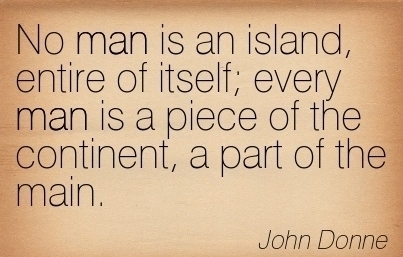
John Donne, the famous English poet, puts it this way: “No person is an island, entire of itself, every person is a piece of the continent, a part of the main… any death diminishes me, because I am part of humankind…”

This week, let us remember that God has created us in God’s image, that we are all connected in the body of Christ, and when something happens in the world, it has everything to do with you and me.

Devotional – Deuteronomy 4.9

Devotional:

Deuteronomy 4.9

But take care and watch yourselves closely, so as neither to forget the things that your eyes have seen nor to let them slip from your mind all the days of your life; make them known to your children and you children’s children.

Weekly Devotional Image

Rev. Tom Berlin stood in front of a room filled with pastors in the midst of the ordination process and asked us to consider this important question: “How is your church transforming the world?” He asked us to briefly write down the stories of transformation that we had heard since we started at our appointments, and whether or not we had shared them with the congregation. When we felt like we had enough time to answer the question, we broke up into small groups and debated how the stories could be used to help grow the churches we serve.

Rev. Berlin then told us his favorite story from Florris UMC. Long before he arrived as the pastor, on a typical Sunday morning, a new couple from the community decided to try out the church. The husband sheepishly stood in the middle of the congregation during worship, but when the hymns began he could not contain his operatic and beautiful singing voice. When worship ended a couple from the choir beelined over to the new couple to introduce themselves and invited the man to join the choir. A few days later they called him on the phone and reminded him about choir practice. In the weeks that followed they made sure to check in with the couple in church and ask about their lives in the community. And after the new man had practiced with the choir for a few weeks, the couple baked a pie and brought it over to the new couple’s house to show them how valued they were.

“I know it sounds like such a simple story,” Rev. Berlin said, “and I’m sure each of you have a story just like that one from the church you serve. The point is to keep telling that story over and over until new people start living into it as well. The people of Florris are probably sick of that story, but it has truly shaped the ways we reach out to people even today.”

pass-it-on

We read in scripture about the importance of remembering who we are and whose we are. We learn about the value of taking hold of the moments that have shaped our lives and share them with our children and our children’s children. When we remember what shaped us into the disciples we are today, we are caught up in God’s great story that will continue to unfold into the future.

This week, let us each take time to reflect on the ways the church has shaped our lives: How have you been transformed by your church? What important stories are you telling to you children and your children’s children?

Devotional – 1 Kings 3.5

Devotional:

1 Kings 3.5

At Gibeon the Lord appeared to Solomon in a dream by night; and God said, “Ask what I should give you.”

Weekly Devotional Image

When I go on mission trips, I love asking youth a familiar set of questions. For instance: After a few days of cold-cut sandwiches for lunch at our work sites, I always ask them to share what would be their ideal meal. In a matter on minutes, strangers become best friends over their intense bonds with the likes of Gummi Bears, Big Macs, Snickers Ice Cream Bars, etc.

Occasionally I will ask them to share their favorite movie or book, and I always wind up asking about their favorite story from the bible. The questions are a mechanism by which conversations will begin to flow, but it also helps to create friendships over shared interests with people that never imagined they could be friends.

A few weeks ago while I was serving with a mission team in McDowell County, WV I asked the group one of my go-to questions: “If a Genie offered to grant you one wish, what would you wish for?” Some of the answers were hysterical: “I would ask for a swimming pool full of chocolate syrup” “Definitely a basketball court as my bedroom” and “french fries; lots and lots of french fries.” The question got the conversation flowing and we all began to debate the merits of our particular wishes compared with the wishes of our peers.

genie

Later on that afternoon, while we were cleaning up our tools before heading back to our main site, one of the younger boys from my crew approached me with a strange look on his face. He stood next to me for what felt like a long time before he finally spoke. “I’ve been thinking about your question, you know the one about the Genie, and I finally got my answer: I would wish to be more patient.” In all the quick responses to the initial Genie question, I neglected to ask this young man what he would wish for, and when he finally shared his answer, it hit me deep in my soul.

After his father David died, Solomon was approached by the Lord and was offered anything he wanted. Solomon, though given the opportunity to request anything in the world, asked for wisdom. That young boy on the mission trip, rather than being led by selfish desires for wealth and power, told me that what he really wanted was patience.

When we go to God in prayer, what do we ask for? Are we treating God like a Genie who will give us our greatest wishes? Or are we seeking the Lord’s power to help shape us into the disciples God knows we can be?

Strange Stories From Scripture: A Week In The Word – Sermon on Judges 3.12-23

Judges 3.12-23

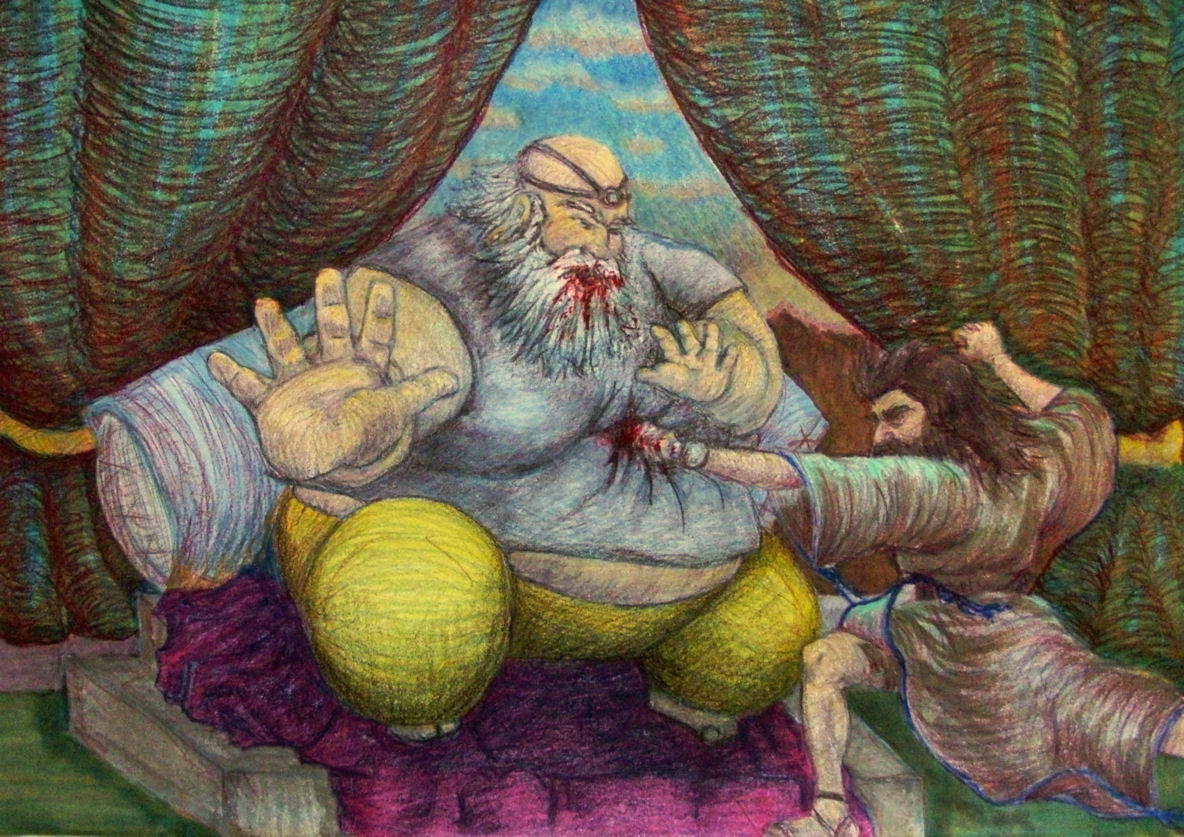
The Israelites again did what was evil in the sight of the Lord; and the Lord strengthened King Eglon of Moab against Israel, because they had done what was evil in the sight of the Lord. In alliance with the Ammonites and the Amalekites, he went and defeated Israel; and they took possession of the city of palms. So the Israelites served King Eglon of Moab eighteen years. But when the Israelites cried out to the Lord, the Lord raised up for them a deliverer, Ehud son of Gera, the Benjaminite, a left-handed man. The Israelites sent tribute by him to King Eglon of Moab. Ehud made for himself a sword with two edges, a cubit in length; and he fastened it on his right thigh under his clothes. Then he presented the tribute to King Eglon of Moab. Now Eglon was a very fat man. When Ehud had finished presenting the tribute, he sent the people who carried the tribute on their way. But he himself turned back at the sculptured stones near Gilgal, and said, “I have a secret message for you, O king.” So the king said, “Silence!” and all his attendants went out from his presence. Ehud came to him, while he was sitting alone in his cool roof chamber, and said, “I have a message from God for you.” So he rose from his seat. Then Ehud reached with his left hand, took the sword from his right thigh, and thrust it into Eglon’s belly; the hilt also went in after the blade, and the fat closed over the blade, for he did not draw the sword out of his belly; and the dirt came out. Then Ehud went out into the vestibule, and closed the doors of the roof chamber on him, and locked them.

Today marks the second part of our series on Strange Stories from Scripture. As a church we are taking time to look at those wonderful moments from the bible that they never talked about during Sunday school. These are the stories that make us blush, raise our eyebrows, and leave us scratching our heads.

Many of us are familiar with the well-known stories of Moses leading the Israelites through the wilderness, we know all about King David and his kingdom, we can even recall the miracles of Jesus, but the bible is also full of tales that are just begging to be used in worship and our daily lives.

Our first story was from the book of Numbers regarding the foolish prophet Balaam and his talking donkey. We explored how the donkey attempted to steer Balaam in the right direction, and pondered about the donkeys in our lives.

Today we are talking about Ehud and King Eglon from the book of Judges.

Ehud-and-Eglon (1)

Monday.

I’m sitting in my office, going over the emails from the weekend when I pull out the list of all the scriptures from now until Christmas Eve. I reread the plan for the sermon series on Strange Stories from Scripture, I wonder if people felt convicted by the sermon on Balaam and his donkey yesterday. I check the email once again to see if anyone took the time to send me a complaint about the sermon. The only one I receive makes a comment about seeing such a “smart… donkey” in the pulpit, but I file it away for later.

The A.C. is pumping out cold air, and I open up my bible to Judges 3 to read the scripture for Sunday. The story of Ehud and Eglon. As the words flow past my eyes, I can’t help myself from giggling in the office: Ehud stabs him in the belly, and Eglon was so fat that the blade disappeared and the dirt came out. I quickly scan through a number of other translations to see what they do with the vague “dirt” description. Some call it dirt, most call it dung, but at least one calls it poop.

When I see the word poop in the bible, it just makes me laugh.

I wonder if people will let me get away with saying poop from the pulpit on Sunday morning. I quickly make a note to pray about it during the week, before deciding whether or not to put “poop” in the sermon.

This has got to be one of the funniest and strangest stories in the bible, but before I dive into sermon writing, I decide to leave the word document open on my computer, and get to some of my other daily tasks before returning.

Tuesday.

The screen stares back at me empty. So I decide to get the mental juices flowing and rewrite the story in my own words:

The Israelites messed up again. Whether they were grumbling for more food, or worshipping false idols, they messed up, and the Lord decided to raise up King Eglon of Moab against God’s people, because they were continually messing up. King Eglon, with the help of God, went and defeated Israel and ruled over God’s people for 18 years.

But then, of course, the Israelites started to cry out to the Lord for delivery, perhaps they had seen the error of their ways, so God decided to provide their savior, Ehud, a left-handed man.

The Israelites, at the time, were in the habit of sending their taxes to King Eglon, and Ehud used this delivery to make his attack. He fashioned himself a double-edged sword, and attached it to his thigh under his clothes.

King Eglon was a very fat man.

ehud2

When Ehud finished delivering the money, he sent his compatriots away, and teased the King with the promise of a secret message from God. Eglon sent away all of the people from his inner court and invited Ehud to share this secret. But as Ehud leaned in to deliver the precious secret, he removed the hidden dagger and thrust it into Eglon’s belly.

Strangely enough, the further Ehud pushed, more of Eglon fat rolled over the blade until it disappeared from view, and Eglon’s poop came out. Then Ehud snuck out of the chamber and locked the doors behind him.

I rewrite the story, looking for sermonic inspiration that would drop down from heaven like manna in the wilderness, but I just sit in my office wondering what in the world God is trying to say through the text. Throughout the day the phone and doorbell continue to ring at church, and I welcome the distractions.

Wednesday.

I pull out some commentaries on the text, and decide to see what other people think God was saying. A few of them go into remarkable detail about the significance of Ehud being left-handed, while others address how detailed the descriptions were, and a few even propose a sexually metaphorical interpretation.

The more I read, the less the story makes me laugh. Instead of looking at the story like a cartoon with poop on the floor, I see human beings driven by enough anger and fear to conquer a nation, and murder a king.

Reluctantly, I start searching online for other sermons about Ehud and Eglon. Do people preach about this? What in the world do they say?

One of the sermons is titled, “Lefty vs. Hefty” and it is all about the differences between the two central characters. The writer emphasizes Ehud’s cunning against Eglon’s girth.

One of the sermons is titled, “Salvation” and it goes into profound detail regarding how, supposedly, God ordains the killing of people even today who get what they deserve. The preacher calls for the people to commit themselves to a radical system of justice, where they take matters into their own hands, just like Ehud did.

One of the sermons is titled, “The Power of Praise” and it focuses on how Ehud was able to trick Eglon into giving him the opportunity to strike. It ends with a reminder for the listeners to be careful about the promises they hear and the compliments offered their way, because a dagger might be lurking in the corner.

The more I read from God’s Word and from other sermons the more I regret picking the scripture for the series:

Eglon, the fat king, is now less a caricature, and more like the punishment God ordained for the people for messing up.

Ehud, the people’s deliverer, is now less a righteous judge, and more like a murderer.

Months ago I thought it would be perfect and hilarious to use this text during a series on Strange Stories, but now I worry about what I will actually say about it when the time comes.

Thursday.

Sitting in a coffee shop in attempts to begin crafting a sermon, I continue to stare at a blank screen. I have started at least three different sermons but before I am able to start really crafting a deep response to the Word, I highlight the text and pressed “delete.” Nothing feels good enough, all of the attempts feel flat.

How is this story speaking anything into our world today? What does the death of Eglon at the hand of Ehud have anything to do with the life of St. John’s and the community of disciples?

I close the computer and grab a nearby newspaper in hopes to distract myself from the seemingly endless flicker of the cursor on my computer. The top article says “US drops Atomic Bomb on Japan 70 years ago today.

1945-08-07-New-York-Times-headline

Before I realize it, I am sucked into the article, and the sermon floats away from the forefront of my mind. The writer has reproduced the original texts used the Associated Press the day the Atomic Bomb was first reported:

“An atomic bomb, hailed as the most terrible destructive force in history and as the greatest achievement of organized science, has been loosed upon Japan… The atomic bomb destroyed more than 60 percent – 4.1 square miles – of Hiroshima, city of 343,000 and radio Tokyo reported “practically every living thing” there was annihilated… Secretary of War Henry Stimson said, “If they do not now accept our terms, they may expect a rain of ruin from the air the like of which has never been seen on this earth.” (From the original AP article http://bigstory.ap.org/urn:publicid:ap.org:3fd267ba7b3c40479382189c99172d61)

I read the article and tears begin to form and fall down my face. Normally I would hide my face from the other patrons, but I am so struck by the words that I forget where I am and what I’m doing. 70 years ago we dropped the most powerful weapon we had ever created on a nation and virtually wiped out an entire city in a matter of seconds.

I start to remember where I am, and the sermon that needs to be written. The connections between the article and the scripture start to form:

Did Ehud leave the sword in Eglon because he wanted the effects to be devastating? Did he want to leave his mark in such a way that death was not the only consequence? Was the Atomic Bomb our sword that we had hidden under our clothes? Did we attack Japan in such a way that death was only the beginning of what we wanted to accomplish?

I wonder what people will think if I try to draw a connection between the anniversary of the Atomic Bomb with the death of Eglon at the hand of Ehud. Did Ehud do the right thing? Did we do the right thing? I have no idea where the sermon is heading.

Friday

I sigh deeply in front of my computer. Picking the Ehud and Eglon story was a bad idea. I explore an idea about dressing up like Ehud with a sword in church but it feels trite, impractical, and vaguely irreligious. I start writing a poem about how the Lord calls people to do extraordinary things during extraordinary times, but then it feels like I’m telling people its okay to murder and steal.

I sit in silence with my hands outstretched praying for the Lord’s will to be done, and for the sermon to be written. And I wait.

Saturday

The Community Cook-Out is going well; children are running around, adults are being fed, and conversations are flowing all over the place. I am thankful for the distraction the cook-out has provided, though I’m also worried about tomorrow morning. What will I say when the time comes? What is God’s Word speaking into our lives right now?

I watch the community in action. Not just the church, but all the people who make Staunton what it is and I think about Jesus. I remember the call to live radically transformed lives based on love and forgiveness, not on fear and retribution. I see people breaking bread for the first time, and I see Jesus in the midst of the people providing hope, the Holy Spirit giving life to our words and relationships, and God making new and lasting connections.

I think about Jesus and the new life he invites his disciples to experience. I think about the lengths God was willing to go to to respond to the cries of God’s people, raising up prophets and judges. I think about God finally offering the most precious gift he ever could, his Son, to die for all the people out on the front lawn of the church, and for the world.

I wonder if the story of Ehud and Eglon isn’t so much about how we react when the world pushes us into a corner, but about the trajectory of God’s gifts to the world. That at one time God would raise up a judge to save Israel, but that now God raised up his Son to save us from ourselves and from death.

Sunday

I stand in the sanctuary before disciples hungry for the Word of God and I say: I offer this to you in the name of the Father, and the Son, and the Holy Spirit. Amen.