Shaped By The Word – Sermon on Psalm 25.1-10

(preached at St. John’s UMC on 7/14/2013)

Psalm 25.1-10

To you, O Lord, I lift up my soul. O my God, in you I trust; do not let me be put to shame; do not let my enemies exult over me. Do not let those who wait for you be put to shame; let them be ashamed who are wantonly treacherous. Make me to know your ways, O Lord; teach me your paths. Lead me in your truth, and teach me, for you are the God of my salvation; for you I wait all day long. Be mindful of your mercy, O Lord, and of your steadfast love, for they have been from of old. Do not remember the sins of my youth or my transgressions; according to your steadfast love remember me, for your goodness’ sake, O Lord! Good and upright is the Lord; therefore he instructs sinners in the way. He leads the humble in what is right, and teaches the humble his way. All the paths of the Lord are steadfast love and faithfulness, for those who keep his covenant and decrees.

wordle-psalm-251-9-advent-1-29nov09-11152009-101459-pm


I remember being really cold. I had walked out of my house in a hurry with books in one hand and my lunch box in the other. I jogged down the hill to the bus stop hoping that I would make it in time. As my feet swept over the damp and life-less leaves on the path I struggled to maintain my balance, hurrying to the sign at the bottom. After reaching my destination, and seeing my breach hanging in the air, I reached into my pocket in order to check the time on my iPhone, but my pocket was empty. In the rush out of my house that morning, I had forgotten to unplug my phone from the wall and place it in my pocket.

So there I stood, all alone at the bus stop, waiting for my transportation to arrive, with nothing to do. Every other normal day I would pull out my phone, check some emails, send a few texts messages, play some games, listen to music, examine the news; But not that day. I stood there shivering and bored. After what seemed like an hour, but was probably only a few minutes, the bus arrived and I hopped on. As I made my way to a seat, I found myself even more frustrated that I had left my phone at home, and I would have to wait a whole 7 minutes on the bus with nothing to do. So I looked around hoping to strike up a conversation with someone on the bus in order to pass the time. My eyes scanned from back to front, side to side, and literally every single person on the bus was starring at their cell phone, or had headphones in. And that’s when I noticed the silence; no one was talking to anyone else. Admittedly I remember again wishing that I had not forgotten my phone, so that, ironically, I wouldn’t have to feel so lonely on the bus.

We are increasingly moving away from a relational society, toward a functional one. We are so caught up in what we need and want that we put up blinders to those around us and we seek to serve ourselves rather than others. The advents of technological developments have benefited our society greatly, but at the same time I fear that they are actually driving us farther and farther apart. I no longer see families praying together at restaurants, but I do see families who are all on their cell phones at the same time.

modern-family-tech-use

In a similar way we no longer know how to read anymore. We become so caught up with the quantity of texts rather than the quality. Young people are no longer taught handwriting in school, but instead are given computers that can spell-check their words faster than you could say them. Our culture is moving rapidly toward an increasing fast-paced existence and the church is barely holding on. Our culture has begun to reshape what the church looks like, what is says, and what it hopes to accomplish. I took a class at school during my final year of seminary where we were actively encouraged to tweet during a few class periods, which only resulted in me no longer remembering what we covered during those days.

Now I’m not saying that any of these technological developments, or cultural shifts, are necessarily bad things, but what they say about us and how they affect us makes all the difference. When we approach something like the Bible today, it is nearly impossible to take it up in a way that rejects the pressures of our surrounding culture. We are not called to read the bible like everything else. We are called to be servants of the Word, rather than masters of the text.

What we discover in the Bible, what we read, informs what we believe. And what we believe shapes how we behave.

If we wanted to talk about Psalm 25 in the way that our culture would dictate I could deliver to you short and concise facts, so that you could become masters of the texts: Psalm 25, in its original Hebrew is an acrostic individual lament psalm. It can be attributed to the post-exilic period because of its acrostic form and its combination of hymnic and wisdom motifs. It contains three subsections: a prayer of faith, a description of the uprightness of God, and what to do when lonely or in trouble.

But, if we wanted to talk about Psalm 25 in a way that we could be shaped by the Word, we have to slow down, we have to let it rest on our souls, and we have to listen for what the text is saying to us, rather than what we can dig out of it.

To you, O Lord, I lift up my soul. O my God, in you I trust;

The psalmist did not compose these words on his own behalf, but instead constructed a form of prayer that can be used by anyone who seeks help from God during a time of fear and frustration. Above all there is a confession of trust in the midst of a plea for help. This is not done because of religious constancy of blind faith, but because the psalmist knows of God’s unchangeable character. Our stories, our past with God, confirms our trust and hope in God. In the deepest and darkest moments of our lives there has always been a shimmer of God’s light ready to break through, we have never been abandoned to our own devices, but God has always resided with us in everything that we have done. O my God, in you I trust.

Do not let me be put to shame; do not let my enemies exult over me. Do not let those who wait for you be put to shame, let them be ashamed who are wantonly treacherous.

These enemies don’t have to be just physical beings; our enemies can be spiritual as well. How helpful might it be for us to personify the impersonal, and to imagine spiritual enemies worthy to be combatted? God do not put me to shame, do not let my addictions, do not let my doubts, do not let my fears exult over me.

Some of us are terribly tempted, but all of us know what it is like to succumb to simple temptations. We make them more formidable by dwelling on them and continue to tempt ourselves. As the psalmist cries out, we should be ashamed of those easily avoided temptations. Like putting off calling your son or daughter who has been bothering you, like neglecting to reach out to those around you that truly need help, like pretending everything in your life is peachy when its really not. Do not let my enemies exult over me.

Make me to know your ways, O Lord; teach me your paths. Lead me in your truth, and teach me, for you are the God of my salvation; for you I wait all day long.

This is perhaps one of the greatest and simplest lines throughout the psalms. If there was ever an ancient prayer that should be on our lips constantly it is this: “make me to know your ways, O Lord.” If we can learn to pray this sincerely, then we first need to be willing to be taught and to be changed. With open hearts, minds, and souls we can give everything we have to give in order to answer the demands that Christ places on our lives. There are times when the darkness will seem to overshadow and encompass all things, but we can trust that the Lord our God is with us. Make me to know your ways, O Lord.

Be mindful of your mercy, O Lord, and of your steadfast love, for they have been told from old. Do not remember the sins of my youth or my transgressions; according to your steadfast love remember me, for your goodness’ sake, O Lord!

Do not remember my sins God! How bold are we to ask this of the almighty, and how blessed are we that he hears this prayer? But just because God forgets our sin, that we can be forgiven for our wrongs and nothing divides us from the love of God in Jesus Christ, the consequences from our sins can continue to affect out lives. We can be courageous enough to call God to forget our sins because we are not defined by how, and how often we fall. There is also the spark of God within each and every single one of us and while there is life – that breath of life breathed into us by God – there is hope.

Good and upright is the Lord; therefore he instructs sinners in the way. He leads the humble in what is right, and teaches the humble his way. All the paths of the Lord are steadfast love and faithfulness, for those who keep his covenant and his decrees.

It is certainly not always true that if we are good we shall necessarily be happy and prosperous. Bad things happen to good people. So how do we wrestle with this final verse: those who keep God’s testimonies remain unshaken in their confidence of the outcome for humanity as a whole, and for themselves as a part of that whole. Those who trust in the goodness of God, those who are shaped by the Word can be confident in what God will do through us and for us. The paths of the Lord are steadfast love and faithfulness so long as we remember that they come from the God who loves us.

The first ten verses of Psalm 25 open up for us the depth of God’s being and give us a glimpse of what God has done, and will continue to do for us: Psalm 25 is a prayer that we can keep close to our hearts and lips because it conveys the spectrum of feelings that we experience within the world. The words are meant to be pondered over again and again, not something merely to be read quickly for understanding, but to resonate within our own lives and bear fruit.

Being shaped by the Word allows us to enter into a state of being harmoniously in relationship with God. It gives us the capacity for praise and lament, slowing down our ways of life to remember that God is in control. It means that we cannot treat the Bible like an app on our smart phones, a website to be skimmed over, or even a 30 minute television show. If we can remember that the bible is the living Word of God then we will be thankfully open and receptive to the shaping purpose of God in all the circumstances of life, humbly yielded to being the word God speaks us forth to be for others.

If we allow our lives to reverberate the Word of God, then we can begin to experience increasing levels of wholeness in our being because to be fully human, as the psalmist conveys, is to have a profound, unshakable, elemental trust in Yahweh as reliable, present, and strong. To be fully human means acting on the basis of that confidence in God even when He is not visible and everything attests to the contrary.

I encourage you to come back to this psalm in times of distress or uncertainty. Read the words and let them sink into every fiber of your being because this psalm reminds us what it means to be shaped by the Word: to have everlasting hope, faith, and trust in God. We are called to be a people of hope, not in the sense of foolish optimism, but in the conviction that our destinies are powerfully presided over by the One who has greater plans for us than we can possibly imagine.

Amen.
Daniel’s Nightmare – Sermon on Daniel 7.1-18

(Preached at Bullocks UMC and Stem UMC on November 18th 2012)

Youtube videos of the sermon at Stem UMC:  

Daniel 7.1-18: In the first year of King Belshazzar of Babylon, Daniel had a dream and visions of his head as he lay in bed. Then he wrote down the dream: (2) I, Daniel, saw in my vision by night the four
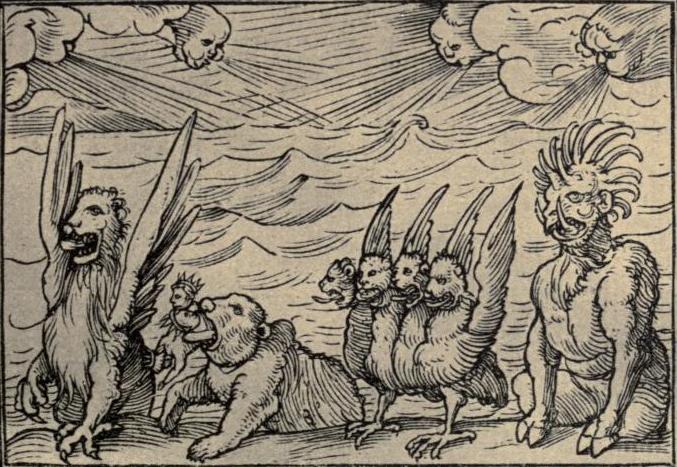
winds of heaven stirring up the great sea, (3) and four great beasts came up out of the sea, different from one another. (4) The first was like a lion and had eagles’ wings. Then, as I watched, its wings were plucked off, and it was lifted up from the ground and made to stand on two feet like a human being; and a human mind was given to it. (5) Another beast appeared, a second one, that looked like a bear. It was raised up on one side, had three tusks in its mouth among its teeth and was told, “Arise, devour many bodies!” (6) After this, as I watched, another appeared, like a leopard. The beast had four wings of a bird on its back and four heads; and dominion was given to it. (7) After this I saw in the visions by night a fourth beast, terrifying and dreadful and exceedingly strong. It had great iron teeth and was devouring, breaking in pieces, and stamping what was left with its feet. It was different from all the beasts that preceded it, and it had ten horns. (8) I was considering the horns, when another horn appeared, a little one coming up among them; to make room for it, three of the earlier horns were plucked up by the roots. There were eyes like human eyes in this horn, and a mouth speaking arrogantly. (9) As I watched, thrones were set it place, and an Ancient One took his throne, his clothing was white as snow, and the hair of his head like pure wool; his throne was fiery flames, and its wheels were burning fire. (10) A stream of fire issued and flowed out from his presence. A thousand thousands served him, and ten thousand times ten thousand stood attending him. The court sat in judgment, and the books were opened. (11) I watched then because of the noise of the arrogant words that the horn was speaking. And as I watched, the beast was put to death, and its body destroyed and given over to be burned with fire. (12) As for the rest of the beasts, their dominion was taken away, but their lives were prolonged for a season and a time. (13) As I watched in the night visions, I saw one like a human being coming with the clouds of heaven. And he came to the Ancient One and was presented before him. (14) To him was given dominion and glory and kingship, that all peoples, nations, and languages should serve him. His dominion is an everlasting dominion that shall not pass away, and his kingship is one that shall never be destroyed. (15) As for me, Daniel, my spirit was troubled within me, and the visions of my head terrified me. (16) I approached one of the attendants to ask him the truth concerning all this. So he said that he would disclose to me the interpretation of the matter: (17) “As for these four great beasts, four kings shall arise out of the earth. (18) But the holy ones of the Most High shall receive the kingdom and possess the kingdom forever – forever and ever.”

Dreams are beginnings. It is through our dreams that we discover images of what could be, what may be, and perhaps most exciting, what will be. The dream in Daniel 7 presents for us the fullness of a vision where God’s glory is revealed. I imagine that, rather than a just a simple dream, Daniel was having a nightmare. He tossed and turned under the warm cover of his bedding as he began to shake and sweat. While the images and sounds poured vividly through his mind, things slowly came into focus; this was no ordinary dream. While sleeping, Daniel saw before him the four winds of heaven stirring up the great sea. The fury of the wind shook Daniel to his core and he could feel that he was witnessing something on a divine scale. From the sea four great beasts emerged, each different from one another. The vividness of the beasts was unlike any dream Daniel had ever had:

The first beast was like a lion and had eagles’ wings. As Daniel’s eyes followed the feathers attached to the beast they were plucked off and it stood on its two hind legs like a human being. Before he had time to contemplate what had happened, a second beast emerged from the deep. This one looked like a bear. It was raised up on one side and had three tusks coming from its mouth. Suddenly a voice cried out to the second beast, “Arise, devour many bodies!” Immediately a third beast arose, this one like a leopard with four heads and four wings of a bird on its back. Finally, a fourth beast appeared in Daniel’s dream, this one too terrible to describe and unlike any natural animal on earth. The fourth beast had iron teeth and was devouring everything in its sight while crushing anything it could under its feet. Daniel saw its ten horns jolting off in every direction, and a little horn suddenly appeared requiring three of the original horns to be plucked up by their roots. The terror of these four beasts gripped Daniel’s soul, as he stood transfixed before them. But before he could even move thrones were set in place in the sky and an Ancient One took his throne. The Ancient One’s clothing dazzled whiter than anything Daniel had ever seen and the throne burned with fiery flames yet remained unconsumed. Surrounding the Ancient One Daniel witnessed a thousand thousands serving him as the great book was opened. Immediately the fourth beast was put to death and its body destroyed. And then one like a Son of Man came with the clouds of heaven. The Ancient One gave him dominion, glory, and kingship, an everlasting dominion where all people, nations, and languages would serve him. As Daniel stood witnessing this cosmic battle he was greatly troubled and frightened. Before he awoke he approached one of the attendants, an angel, near the throne of the Ancient One and questioned him about the truth of the vision: “As for the four great beasts, four kings shall arise out of the earth. But the holy ones of the Most High shall receive the kingdom and possess the kingdom forever – forever and ever.”  And as Daniel awoke from the frightening vision, he quickly reached for some parchment in order to write down everything he had seen.

Daniel 7 is one of those scripture passages that pastors either love, or loathe, to preach. The ones that love preaching on apocalyptic texts will often stand in the pulpit and proclaim wonderful messages. Their sermons come to them naturally and they see the scripture as being straightforward and easily explained. And then you have preachers like me, who are daunted by a text such as this. The connections with our daily living are no so cut-and-dry, and the passage demands prolonged attention. For me, Daniel’s dream is not one that can be simply explained, but must be proclaimed.

This was no ordinary dream, because Daniel was no ordinary man. Daniel was a man of God, one of the beloved prophets of the Old Testament. Daniel was the one who correctly interpreted the Babylonian King Nebuchadnezzar’s dream, the one who was friends with the three men who survived the fiery furnace, the one who was thrown into the lions’ den for praying and then delivered from their jaws of destruction. Daniel lived his life faithful to the One who had created him and breathed into him the breath of life. Daniel believed in God’s righteousness at a time when God seemed absent from the lives of the Israelites as they waited in Babylonian captivity. Daniel was no ordinary man, and this had been no ordinary dream. This was a vision given to Daniel by God in order that he could experience God’s glory and understand the world around him.

The dream goes against everything we understand about the world: The beasts are combinations of natural animals, and are absolutely terrifying; the fiery throne of the Ancient One burns in the sky, but rests unconsumed; one like a Son of Man comes on the clouds of heaven and is given total dominion. Daniel’s dream is an apocalyptic vision, not because it explains the “end of the world,” but because it is a way of revealing God’s action in the world. Daniel lived during a time of significant Israelite persecution, a time where people were thrown in furnaces or lion’s dens for worshipping the wrong God. God revealed this vision to Daniel to show how even when the most terrible rulers dominate on earth, even when people are devoured by the beasts of the world, God’s rule is swift and everlasting. God’s glory and kingdom is one that shall endure forever and ever. There is no epic cosmic battle between the fourth beast and the Ancient One – before Daniel can even fully appreciate what he is witnessing the Ancient One destroys the fourth beast immediately. God’s rule extends far beyond our expectations and imaginations.

For far too long, apocalypses have been understood as something that either happened in the distant past, or are events that will culminate in the distant future. The cosmic quality of the visions lends to these separate interpretations, but apocalypses also reveal God’s character and actions to us right now today. In Daniel’s dream the four beasts come from the great sea and reign destruction over the earth. I wonder: How many of us are surrounded by beasts in our daily lives that appear far worse than those in Daniel’s dream? For Daniel there was nothing worse than a foreign ruler persecuting his people, and God presented those rulers to Daniel as beasts. Perhaps for some of us, God has presented the beasts this morning to represent terrible things in our lives; our beast might be an addiction, or unemployment, or a broken relationship. Maybe we’ve lost a child, or our way of life, or our faith in God. Truly I tell you, there are beasts in our lives surrounding us everyday. I know that for some of us when we wake up every morning, the beasts of Daniel’s apocalyptic vision have become manifest in what seems like an unending, and very real, nightmare. Yet, like Daniel we are called to a life of faith predicated on looking to God when the world spirals out of control.

This past semester I have been serving as one of the on-call chaplains, along with your pastor Brock Meyer, at Duke University Hospital. We are required to arrive at the hospital by 8am and we cannot leave until 8 am the following morning. We are there to serve and respond to the many pastoral needs of the hospital, both patients and staff. A few weeks ago while making my way from one patient’s room to another I received an urgent page on my beeper. Before arriving to the designated room, I could hear the patient screaming down the hall. The situation was incredibly chaotic when I entered, the nurses and doctors were yelling, the patient was attempting to, and then succeeded, in ripping out her IV, and I stood there in the middle not sure what to do. I attempted to mediate and within a few minutes a compromise had been made. The patient desperately wanted to the leave the hospital but she was not well enough to do so, and the staff feared that if they let her leave the room she would attempt to leave the hospital, so I was assigned the task of walking the patient around the hospital, allowing her to escape from her room for a little while, before bringing her back.

As the patient and I made our way through the halls, I offered her my arm to steady her walking, and we began to talk. “I just can’t stand being here,” she said, “At night I can’t sleep because of all the noises of the hospital, and whenever I finally fall asleep, I wake up feeling like I’m in a nightmare. I just feel like I’m losing control.” As we navigated our way through the continuing corridors I encouraged her to speak all of her fears and frustrations; I learned about how she can no longer take care of herself but fears losing her independence, I learned about how lonely she felt and how scared she was about going back to an empty house. I learned about how she knew that God loved her, but she had a hard time seeing it in her life. “What about your church?” I asked, “Have they been able to help?” She shook her head, “I haven’t been to church in some years, after I started getting sick I realized I wasn’t able to keep helping and serving others, and I didn’t feel like I should go anymore.”

In the dream it is God, the Ancient One, who is in control. Though the beasts arise from the great sea, God’s purposes run triumphant over and against them. And then it is the Son of Man coming on the clouds of heaven who inherits the dominion of God. In keeping his gaze on the divine, Daniel’s vision of the world is made right. He begins to see a world where the foreign rulers are no longer in control, but God is the one who reigns. He begins to imagine the way the world could be through faith in the Ancient One on High. Daniel was given his apocalyptic dream so that he could envision a new beginning for the world.

Dreams are beginnings. It is from our dreams that our lives can be changed. Many of us dream about success, earning high wages, and making the world a better place for our children. We dream about moving out of difficult situations, doctors finding a cure for our cancers, a future without war and suffering. We dream about finding eternal life after we die.

As a church we come together to worship the good God who breathed into each of us the breath of life, to sing songs of praise and lament, to question the ways of the world and compare them to the ways of God, to dream about making God’s kingdom come on earth. This church is where our dreams begin. We listen to the Word proclaimed through scripture and song, imagining a world more like the one Jesus calls us to. We believe in a God who makes our dreams into realities.

For the rest of our time together that afternoon in the hospital, the patient and I continued in silence. I kept thinking about all the fears she had shared with me, and I marveled at how calm she had become after the episode in her room. Before I brought her back to her room I placed my hand on her shoulder and looked into her pale blue eyes, “Ma’am I’ve been thinking a lot about what you said about your life. I know that you are afraid; afraid of losing your independence, afraid of being lonely. Maybe now is the perfect time for you to go back to your church. I know you’re worried about not being able to help other, but perhaps the best way you can follow Christ is to let your brothers and sister in Christ serve you. Now is the time for you to receive love.”

At the end of Daniel’s dream, after questioning about the meaning of the vision he was told that the Holy Ones of the Most High shall receive the kingdom and possess the kingdom forever; Daniel learned that the people of God will share rule with the Son of Man. The Church has been granted a wonderful place in the kingdom. We are called to serve and love one another and our neighbors. The church exists as a place where that patient from the hospital can begin to dream about what will be, a place where she can be taken care of, a place where she can feel God’s love. This church can be the place where we seek refuge from the beasts in our lives, where we can hold each other through the nightmares, and celebrate in our new dreams.

Just as Daniel kept his eyes on the throne of the Ancient One, today we are called to turn our eyes to Jesus. The beasts do not have the final word. God came in the form of flesh, dwelt among us, and mounted the cross on our behalf. God has triumphed over the greatest beast, death,  and will continue to do so. Though the beasts of our lives will surely torment us, the God of Grace and Glory has come to us as the Son of Man, God has granted us to receive the kingdom, and God will continue to reign with us from this time forth, and forevermore. Amen.

Kurt Vonnegut and Preaching on Narratives

This semester I am enrolled in a class at Duke Divinity School on “Preaching the Old Testament.” (Taught by Dr. Stephen Chapman and Bishop Will Willimon) While we have analyzed the many literary forms of Old Testament Scripture I have been reminded of Kurt Vonnegut’s 8 Tips for Writing. Though Vonnegut would be the last person to offer advice on theological homiletics, I believe his insight in “story crafting” is useful for preparing narrative sermons:


1. Use the time of a total stranger in such a way that he or she will not feel the time was wasted.

2. Give the reader at least one character he or she can root for.

3. Every character should want something, even if it is only a glass of water.

4. Every sentence must do one of two things—reveal character or advance the action.

5. Start as close to the end as possible.

6. Be a Sadist. No matter how sweet and innocent your leading characters, make awful things happen to them—in order that the reader may see what they are made of.

7. Write to please just one person. If you open a window and make love to the world, so to speak, your story will get pneumonia.

8. Give your readers as much information as possible as soon as possible. To hell with suspense. Readers should have such complete understanding of what is going on, where and why, that they could finish the story themselves, should cockroaches eat the last few pages.

Noah’s Hangover – Sermon on Genesis 9.18-29

(Preached at Aldersgate UMC in Alexandria, Virginia on 9/2/2012)

Genesis 9.18-29: “The sons of Noah who went out of the ark were Shem, Ham, and Japheth. Ham was the father of Canaan. These three were the sons of Noah; and from these the whole earth was peopled. Noah, a man of the soil, was the first to plant a vineyard. He drank some of the wine and became drunk, and he lay uncovered in his tent. And Ham, the father of Canaan, saw the nakedness of his father, and told his two brothers outside. Then Shem and Japheth took a garment, laid it on both their shoulders, and walked backward and covered the nakedness of their father; their faces were turned away, and they did not see their father’s nakedness. When Noah awoke from his wine and knew what his youngest son had done to him, he said, “Cursed be Canaan; lowest of slaves shall he be to his brothers.” He also said, “Blessed by the Lord my God shall be Shem; and let Canaan be his slave. May God make space for Japheth, and let him live in the tents of Shem; and let Canaan be his slave.” After the flood Noah lived three hundred fifty years. All the days of Noah were nine hundred fifty years; and he died.”

The smell was unbearable. Though he had lost track of the days, Ham was still unaccustomed to the rocking of the boat and the smell of damp animals constantly bombarding his senses. As he made his way throughout the bowels of the ship, checking on his brothers and their families, feeding the animals, and plugging leaks, Ham’s tortured mind kept replaying the details of what brought him to this ship.

His father had always been a quiet man; he mostly kept to himself and lived a humble life. His daily routine was not often interrupted until the day he began gathering copious amounts of wood from the forest. Ham could not understand the change in his father’s ambitions, but he respected him enough to not question this new driving force. Over the months a ship began to form out of the collected wood and Ham, along with his brothers, helped their father by collecting two of every animal from the surrounding countryside. Ham’s unwavering faith sustained him through the trying months where a ship stood in an open field, miles from the nearest water source. When others would have doubted his father’s project, Ham remained steadfast. And then the rain began. As the days passed, and the rain continued, Ham began to understand why his father had dedicated all of his energy to the giant raft; a flood was coming.

Ducking underneath the wooden support beams Ham pondered whether or not the boat would ever again rest on solid land. Tormented by the incessant rocking, Ham went onto the deck of the ship in order to calm his system. Usually filled with noise and activity, when Ham arrived on the deck all was silent and most of his family had gathered on the side of the boat. Worried that someone had fallen overboard, Ham rushed to the edge of the boat with his eyes drawn to the water until his father, Noah, placed a hand on Ham’s shoulder and pointed to the mountaintops that pierced the edge of the horizon: their journey was coming to an end.

The months after the flood passed by without the interruption of any major catastrophic elements. Ham and his brothers were initially shocked to discover the absurd amount of devastation that had been underwater. But as time passed, they cleaned and prepared to create a new home. While Ham and his family settled back into normalcy, his father began to cultivate fields of grapes in the same manner that he built the ark – he kept to himself yet worked with profound dedication. Eventually the fields yielded their fruit and Noah began to produce an abundance of wine.

One morning Ham was distressed to discover his father missing from his usual presence in the fields and went off to find him. Upon entering his father’s tent, Ham took in the disheveled room and tried to make sense of what was before him: Noah was completely naked surrounded by a number of empty wine bottles. Ham looked upon the body of his father and felt sorry for him, for his trials and tribulations with the ark, for his drunkenness, for his nakedness, and for his shame. He left the tent in order to find his brothers Shem and Japheth and tell them what had happened.

After debating what needed to be done, Shem and Japheth found a cloak and laying it on their shoulders they walked into their father’s tent backwards to cover the nakedness of their father. Throughout the day Ham continually walked past Noah’s tent and waited patiently for his father to awake. When Noah finally awoke from his drunken stupor, news of his nakedness and drunken escapade from the night before had made its way throughout the family. Noah, usually a man of few words, angrily made his way through the camp until he stood before his sons: “Ham I have come to curse your son, my grandson, Canaan; lowest of the slaves shall he be to his brothers! My other son Shem, blessed by the Lord my God you shall be, let your nephew Canaan be your slave! Japheth, may God make space for you in the tents of your brother Shem, and let your nephew Canaan be your slave!”

… I have no idea what this passage means. I am starting my third year of seminary and I haven’t the faintest idea how this scripture made it into the canon. I have dreaded this moment over the last few months, knowing that I was invited to come in my home church, where I would stand before so many people I love and care about, people who made me into the Christian I am today, people who helped nurture my call to the ministry. I have been terrified about preaching this sermon because I simply have no idea what this scripture means.

Now don’t get me wrong, my last two years at Duke Divinity School have been amazing. I have garnered a significant theological education, unrivaled in the United States. My professors have taken me through amazing lectures on a myriad of subjects. I have learned how to appropriately pronounce words like eschatology, pericope, pneumatology, hermeneutics, dogmatic apologetics, latitudarianism, curvatis, kerygma, infralapsarianism, and sometimes I even know what those words mean. I have served churches in North Carolina and Michigan. I have participated in funerals and comforted grieving families. I have celebrated with parents as the brought their infant forward to be baptized into the body of Christ. I have committed myself to the call that God placed on my life so many years ago, but I still don’t know what to do with Noah’s hangover.

To begin, everyone here already knows the real story about Noah and the Ark, it’s the one your children watch on Veggie Tales, and the one your grandmother told you when you were growing up – Noah, a man of God, is the only righteous human being left; God commands him to build an ark and procure two of every animal in order to repopulate the earth after the flood; the flood comes and desolates the land, but Noah’s faith in God’s calling sustains him and his family; after the water recedes God creates a rainbow in the sky signifying the new covenant… However, this is not the end of the story.

Over the last few years I have come to appreciate the fact that the bible is full of mysterious, confusing, and seemingly un-preachable, stories. Over the last month Jason Micheli has taken this church through some of the more bizarre collections of the Word of God: You have heard about: Isaiah’s unwavering faith in the Lord to the point of remaining naked for three years; David collecting 100 Philistine foreskins in order to marry Saul’s daughter; Paul literally preaching and boring a young man to death; and God jumping out in the middle of the night in an attempt to kill Moses.

Jason has skillfully and articulately brought these stories to life, he has connected them with the modern world and brought forth a message applicable for today. Moreover, he has done what every preacher is called to do: make the Word become flesh and dwell among us.

Unlike Jason Micheli, I do not have a particular story that reflects the scripture for the day. I’m sure if Jason were preaching this morning he would tell us about getting a call one morning at his last church to visit a family within the community. Upon arriving Jason would have discovered the father passed out naked in the living room after a night of binge drinking. Jason’s description of the room would be so vivid and adjectival that we, the congregation, could smell the burnt bacon emanating from the kitchen and feel the tapioca colored carpet under our feet. At that point he would take the time to describe with absurd detail the feeling of a bead of sweat developing on his temple and slowly running down to his collar. He would then tell us about the fight that happened between the drunken man and his son, and then give us a wonderful sermonic twist by emphasizing the grace of God and then end with a witty sentence that we would carry with us the rest of the day. Unlike Jason Micheli, I do not have a story about meeting a drunk, naked man asleep on the floor.

I do not know what to do with our story today.

Most of us have never even heard it; we are content with the Veggie-Tales version that ends with the wonderful rainbow in the sky. But, if we end the story with the Rainbow we are left to wrestle with one of the bible’s most troubling theological questions: If God destroyed the world with a flood in order to destroy sin, why is the world still so messed up today?

Genesis 9.18-29 is full of problems: theological, historical, and logical:

Noah, who “found favor in the sight of the Lord” (Genesis 6.8) and who “did all that God commanded him” (6.22) was set apart from this rest of retched humanity in order to survive God’s destruction. After the flood God blesses Noah and commands him to be fruitful and multiply three times, insuring him and his family that God would never again “curse the ground because of humankind.” And how does Noah react? He builds a vineyard, gets drunk, and falls asleep naked in his tent. This doesn’t make any sense. Why would the one human, the only one God chose to save, ruin this blessed opportunity of life on drink and nudity? Why would he so defile the earth that God just saved? Why would he blatantly ignore the covenantal rainbow in the sky for a night of debauchery? It doesn’t make any sense.

But the passage isn’t over yet: Ham, the faithful son of Noah, the one who stood by his father through the ark’s construction and the great flood, Ham discovers his father’s naked body. Ham, like any good son, tells his brothers in order that they might cover up their father’s mistakes, his nakedness and drunken behavior. And how does Noah reward his faithful son? He curses his own kin! It doesn’t make any sense.

But then things get worse: Noah doesn’t single out Ham for discovering his sin. Instead of reacting harshly against his own son, he curses the family of Ham’s son Canaan, Noah’s own grandson. He demands that Canaan remain in subjugation to his uncles Shem and Japheth. Noah’s tirade in the thick of his hangover sets a dark tone over his progeny and sets in motion a familial schism that has frightening biblical consequences.

Maybe you already know this, but I was surprised to discover that this is the only time in the bible that Noah actually speaks. He has patiently obeyed his Lord to the point of building a giant ship and never once opened his mouth. Only now, only after his alcohol induced nakedness does Noah say anything. Our only recorded words from one of the Old Testament’s greatest heroes are the rejection and curse of his own family.

This frightens me. I feel like the happy cartoonish version of Noah and the Ark has been ripped away from me, and I am only left with a sad old man embarrassed about his sin. I can remember learning about Noah from my own grandmother as a child, I remembered thinking about how lucky he was to survive, how smart he must have been to build that giant boat. And now I am frightened. I put a lot of faith in Noah and I’m afraid that he’s just not that special.

But you know what frightens me the most? More than Noah getting drunk, and more than the fact that he curses his grandson, the thing that frightens me most is that God is no longer at the center of the story. As I was preparing the sermon for this Sunday I reread the first chapters of Genesis up until the flood and I realized that our scripture today is the first time in the bible where God does not appear directly.

In the beginning God created the heavens and the earth, the cosmos, the galaxies, the universe and everything in it. God created them and understood them to be good, full of order and life, running over and full of abundance. And then God, in the greatest act of love, gave it all to us, the ones created in his image, calling us to care for and keep God’s creation in order that we might enjoy its beauty. Humanity was created to be the faithful stewards of God’s universe, accountable to his lordship and wonderful guidance.

Yet we human beings do not like to be servants to anyone, especially not to God. Our first parents, Adam and Eve, rebelled against the goodness of God by disobeying his command. But God did not abandon us. He made for humanity life abundant and stood by at civilization developed. He remained faithful to us, when we were least faithful to him. Humanity continued to act wickedly, we let evil and strife rest on our hearts, and for some reason God stood by his creation. He picked one man, Noah, to remain in the wake of his destruction. God actively chose to give humanity another chance through Noah and his family, yet Noah ignores the grace of God.

God has been intrinsically active from the beginning of existence up until the aftermath of the flood. Genesis 1-9 have been centrally focused on creation event, and God’s relationship with his creation. And now God is no longer at the center of the story. Instead of rejoicing in the good God that saved him and his family from certain destruction, he drinks the wine from his vineyard, falls asleep naked, and curses his grandson.

God is no longer at the center of Noah’s story.

Where is God in your story?

I am in divinity school, and ironically enough it is one of the most difficult places to find God. We spend so much time talking around God, and through God, below God, and about God, that we forget to talk to God. I have become consumed with thoughts about my own ordination process, and what kind of church will the conference assign me to at the end of the year if they commission me, when instead I should be thinking about how can I make God’s kingdom come on earth.

Maybe some of you are like Noah and me, where God is sometimes no longer at the center of your story. Some of you might be lonely and miss the companionship of a friend or spouse when we as a church could be working to reflect the goodness of God’s communal creation by reaching out to those in out pews who need relationship the most.

Perhaps some of you are consumed by your own sin, afraid of the damage it has caused and will continue to cause when you could be contemplating the forgiveness Christ proclaimed from the cross toward his accusers and torturers – no one is beyond the loving embrace of God.

Maybe some of you are unemployed and are worried about the responsibility resting on your shoulders when this church could be reflecting the church instituted by the God who became flesh in Christ that cared for one another through giving to any who had need.

Perhaps you are afraid to die, you’ve come face to face with your own mortality and you can’t stand the sight of it when we could all readily recognize that one day we all will die, but just as God became flesh in Jesus Christ and mounted the cross, Jesus was resurrected from beyond the grave; God has called each of us to something greater than our own mortality.

I don’t know what to do with Noah’s story. I don’t know what brought you to church this morning. I don’t know if you’re afraid, or if you’re lonely, or if you’re tired, or just complacent. But one thing I am sure of, with every fiber of my being, is that God is supposed to be the center of our story.