Luke 11.1-13
He was praying in a certain place, and after he had finished, one of his disciples said to him, “Lord, teach us to pray, as John taught his disciples.” He said to them, “When you pray, say: Father, hallowed be your name. Your kingdom come. Give us each day our daily bread. And forgive us our sins, for we ourselves forgive everyone indebted to us. And do not bring us to the time of trial.” And he said to them, “Suppose one of you has a friend, and you go to him at midnight and say to him, ‘Friend, lend me three loaves of bread; for a friend of mine has arrived and I have nothing to set before him.’ And he answers from within, ‘Do not bother me; the door has already been locked, and my children are with me in bed; I cannot get up and give you anything.’ I tell you, even though he will not get up and give him anything because he is his friend, at least because of his persistence he will get up and give him whatever he needs. So I say to you, Ask, and it will be given you; search, and you will find; knock, and the door will be opened for you. For everyone who asks receives, and everyone who searches finds, and for everyone who knocks the door will be opened. Is there anyone among you who, if your child asks for a fish, will give a snake instead of a fish? Or if the child asks for an egg, will give a scorpion? If you then, who are evil, know how to give good gifts to your children, how much more will the heavenly Father give the Holy Spirit to those who ask him!”

A few years ago I was given the opportunity to lead an adult mission trip to Guatemala, (nearly identical to the one Lindsey went on 2 weeks ago). It would be my responsibility to help organize the trip, make sure we had all the proper preparations taken care of, and then lead the adults while in the country. I was 19 years old at the time, and all of the adults on the trip were closer in age to my parents. “Stressed” doesn’t even come close to describing the way I felt between organizing the trip and making sure we all arrived in the country. I mean this in the best possible way, but that trip was the first time I really experienced what its like to be a shepherd herding sheep.
We had been in Guatemala for 24 hours when it was time for us to make the long bus journey to the village where we would be working. I don’t know whether it was the restlessness that accompanies an impending workweek, or if I just had trouble sleeping, but I woke up before anyone else and I walked around the town of Panajachel on the banks of lake Atitlan. By the time I made it back to our little bungalows I thought I was still the only person awake, so I made my way back to my room before breakfast. Because I was leading the trip in tandem with my home pastor, we had been assigned to the same room, and I quietly crept in so as to not wake him up. When I finally pushed the door open I saw something that stopped me in the doorway.
Jason was kneeling on the cold hard ground with his bible open on the bed praying out loud. I froze in the doorway because I had known Jason for 5 years and I had never seen him pray outside of Sunday worship. I could not hear everything he was saying, but it was one of the most beautiful things I had ever witnessed. And standing there in the doorway, watching my pastor pray on his knees, I felt convicted. In that moment I could not remember the last time I had talked to God.

“Lord, teach us to pray.” On the lips of the unnamed disciple, this is one of the most revealing moments of the gospel according to Luke. From this one desire, this simple request regarding prayer, we get to take a step into the strange new world of the bible and hear Jesus speak from within the depth of his being: When you pray, say: Father, hallowed be your name. Your kingdom come. Give us each day our daily bread. And forgive us our sins, for we ourselves forgive everyone indebted to us. And do not bring us to the time of trial.”
How often have we wanted to ask Jesus the same exact thing? I can tell you, that as someone in the ministry, the only question I hear more often than “what will happen to me when I die?” is “how am I supposed to pray? Clearly this is something that gets at the heart of what it means to be a follower of Jesus Christ because even the original disciples wanted to know how to pray. In the same way that my pastor Jason’s prayer moved me to want to learn to pray, Jesus exemplified the importance of prayer for his disciples.
Throughout the gospel, Jesus is frequently in prayer and it carries an incredibly important image. At his baptism: “Now when all the people were baptized, and when Jesus also had been baptized and was praying, the heaven was opened (Lk. 3.21). As he made his way throughout Galilee “he went to the mountain to pray; and he spent the night in prayer to God. And when day came, he called his disciples and chose twelve of them, whom he also named apostles (Lk. 6.12-13). Before Peter’s confession of Jesus as the Christ, Jesus had been praying alone, with only the disciples near him (Lk. 9.18). Jesus, Peter, John, and James were heading up the mountain to pray when Jesus was magnificently transfigured in the midst of praying (Lk. 9.28-29). The importance of prayer in the life of Jesus Christ was significant enough that even his disciples, who were with him constantly, wanted to learn more about the role it played in his life. “Lord, teach us to pray.”
So our Lord looked out at his disciples and said, “When you pray, say: Father”
Father. Notice: Jesus does not pile adjectives on top of each other, its not O Great and mighty most wonderful eternal and almighty God. Instead he simply encourages his disciples to say, “Father.” This word alone helps to signify how this prayer can be both personal and communal. The disciples are to call God “Father” in an intimate and connected way while at the same time recognizing that they have one “Father” to which they can pray together. By beginning with “Father” Jesus is inviting his followers to share in his own prayer life, hoping that they will approach God in the same way that he does.
As the prayer develops it is continually a prayer of a community, “hallowed be your name. Your kingdom come. Give us each day our daily bread.” The plural language, mixed with the intimacy of the relationship with God, allows for this to be a prayer done in a communal gathering, or alone. It remarkably conveys the depth of mystery involved in a community of faith while affirming the desire for God’s kingdom on earth. Whether you pray alone every night before you fall asleep, or if the only time you pray is on Sunday mornings in church, you are connected to God, God’s people, and God’s creation
“And forgive us our sins, for we ourselves forgive everyone indebted to us. And do not bring us to the time of trial.” There is a subtle difference in the prayer at this point as compared to the one from the Gospel according to Matthew, which we say together every week. Instead of “forgive us our trespasses, as we forgive those who have trespassed against us,” Luke tells us that Jesus taught the disciples to seek God’s forgiveness of their sins as we forgive those who are indebted to us. Jesus is concerned with the way that we relate to God, one another, and to God’s creation. When we pray we are not isolated beings stratified from those around us, but we are personally connected with God through our brothers and sisters in Christ. According to Jesus, prayer is supposed to accomplish communal fellowship in such a way that we are not hindered when gathering as the body of Christ. This means that if we take seriously the words of prayer that Jesus taught us, we can’t ignore those sitting with us in worship, and everyone within the greater community.
Jesus concludes his prayer for the disciples by using a little parable to help explain true perseverance in prayer. Through the story of the friend asking for three loaves of bread in the middle of the night, we learn that prayer is to be continually asking, seeking, and knocking. “Ask, and it will be given to you; search, and you will find; knock, and the door will be opened for you.” Prayer is a learned experience, one that is continually cultivated. Prayer is not simply a release of feelings toward God, but a disciplined habit that influences the way we live our lives.
About a year ago, I was making regular visits to the shut-ins from a church in Durham, North Carolina. Every week I found myself sitting with all sorts of people learning about their pasts, and experiencing discipleship in new and exciting ways. Though most of my visits were often filled with excited dialogue there was one particular lady who never spoke. In fact, after meeting with her son, I discovered that she had not talked with anyone for some time. Whenever I saw her we would sit together, I would tell her about all the things happening at church, and I would eventually spend most of the time reading scripture. Her son was almost always with us in the room, and always politely thanked me for coming over but made it clear that there was nothing to be done. One afternoon, after reading from the Gospel according to Mark, I decided to try something new. I began to sing one of my favorite hymns: “Lord, I want to be a Christian in my heart, in my heart, Lord I want to be a Christian in my heart.” By the time I was halfway through the second verse I noticed that she started to move her head back and forth, and as I lowered my singing voice I noticed that she was humming along with me. I looked across the room to her son, and with tears in his eyes he started singing with us. This was the first time, in a long time, that he saw his mother communicating.
Before I left, the three of us held hands for prayer and when I started to say “Our Father, who art in heaven,” she joined us and said the words that Jesus taught his disciples.
It never ceases to amaze me how deeply profound our prayers can be. For that woman it was the hymns and the prayers of church life that stuck with her. They had helped to shape the life she led, and then helped to reunite her with her son that afternoon. When prayer becomes habitual in our lives, when communicating with God becomes part of who we are, our lives will be turned back to the one in whom we live, and move, and have our being.
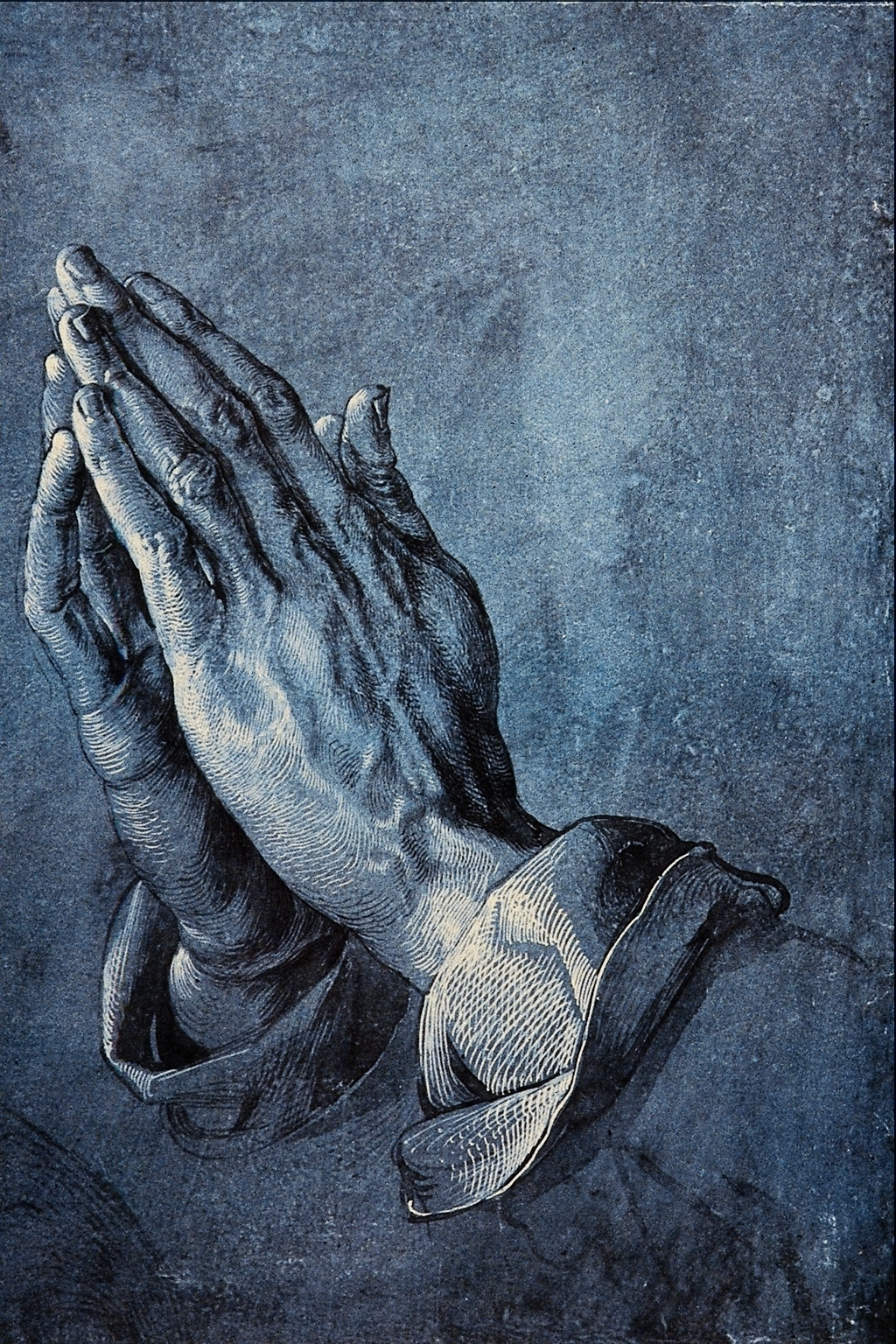
My Christian hero, the Swiss theologian Karl Barth once said: “To clasp the hands in prayer is the beginning of an uprising against the world.” When we follow Jesus and allow prayer to shape our lives like it shaped his, we will begin to stand against the ways of the world. Prayer refocuses our perspective on the ways of God so that the kingdom can remain manifest among us. Learning to pray is much more than just learning a prayer, and we cannot simply learn to pray by learning to say specific words, but the repetition of such words are part of the discipline of prayer. Sometimes we don’t realize it, but every time we read the words of scripture we are praying. Every time we sing the words from our hymnal we are praying. Every time we greet others around us in love we are praying. Living a life of prayer is not easy, but it is more fruitful than we can possibly imagine.
Jesus’ own prayer life was obviously important to the disciples, and should be important to us. We learn from Luke 11 that prayer is about bringing to God our deepest needs and most perplexing trials and tribulations. Prayer is about waiting there in the midst of unknowing for light, love, and strength from the God who made each one of us. Prayer is the recognition and presentation of our lives before him as a holy and living sacrifice. Prayer is the understanding that true Christian living depends not so much on what we do and say, but rather what we allow God to do in and through us. Lord, teach us to pray.
Amen.

 think and let think