Judges 4.4-9
At that time Deborah, a prophetess, wife of Lappidoth, was judging Israel. She used to sit under the palm of Deborah between Ramah and Behtel in the hill country of Ephraim; and the Israelites came up to her for judgment. She sent and summoned Barak son of Abinoam from Kedesh in Naphtali, and said to him, “The Lord, the God of Israel, commands you, ‘Go, take position at Mount Tabor, brining ten thousand from the tribe of Naphtali and the tribe of Zebulun. I will draw out Sisera, the general of Jabin’s army, to meet you by the Wadi Kishon with his chariots and his troops; and I will give him into your hand.’” Barak said to her, “If you go with me, I will go; but if you will not go with me, I will not go.” And she said, “I will surely go with you; nevertheless, the road on which you are going will not lead to your glory, for the Lord will sell Sisera into the hand of a woman.” Then Deborah got up and went with Barak to Kedesh.

Today marks the second part of our Sermon Series on Women of Faith. Throughout the last year or so I have been excited to hear questions in, and outside of, church regarding the role women play in both the Old and New Testaments. This series is focused on exploring some of the great women of faith from the Bible, particularly those who are not regularly mentioned from the pulpit. So, here we are, may God bless our time together as we explore two more women with dynamic and powerful faith.
Deborah was a judge over Israel. She had a wide range of responsibilities with her position; deciding controversies, announcing verdicts, and implementing judgments. For her to have been given, and honored with, this responsibility is exceptionally rare for a woman in the Old Testament. Moreover, she is remembered as one of the finest rulers: she is sought out for her counsel, she is referred to as a prophetess and mother of Israel, she boldly proclaims the Word of the Lord, and there are no controversies surrounding her rule.
The Israelites are once again in bondage in their own land, and they beg God to deliver them from oppression. For the past 20 years the people have suffered under the vicious hand of Jabin and his general Sisera. The Lord then moved Deborah to call upon Barak, an Israelite general, to go to war with 10,000 men against the mighty Sisera. Barak, however, is reluctant to do so, even with the promise of the Lord’s presence, he knows the kind of weaponry and army that Sisera has, and feels that this might be a suicide mission. Barak refuses to go to war unless Deborah goes with him.
One of the great generals of God’s people is afraid to follow the Lord’s command unless a woman goes with him.
So Deborah agrees to travel with Barak but warns him that the battle will not bring him glory, because the Lord will deliver the evil Sisera into the hands of a woman.
Thats where out scripture reading ends for the day, but of course that is not the end of the story. If you keep reading Judges 4 you learn that Barak summoned the 10,000 warriors and traveled to Mount Tabor. When Sisera learned of Barak’s movement he called out all his chariots of iron and all of his troops to go to war. The battle ensues and the Lord threw Sisera and all his army into a panic before the Israelites. Sisera retreated from the battle, but the entirety of his army fell at the hand of Barak and the Israelites.
Sisera fled to a nearby village and was met by a woman named Jael outside of her tent. She implored him to come inside where she would hide him and take care of him. In the tent she covered him with a rug and offered him milk to drink. After he fell asleep she took a tent peg in one hand and a hammer in the other, went softly to Sisera, and drove the tent peg into his temple, until it went down into the ground and he died. Only later did Barak arrive in the village surprised to discover that Sisera had been killed, still stuck to the ground by the tent peg.
It would seem to me, therefore, that the message from our scripture today is to be very careful about accepting invitations into the tents of strange women, particularly if they have extra tent pegs lying around.
I offer this in the name of the Father, the Son, and the Holy Spirit. Amen…
Just kidding.
What a crazy and awesome story. It plays out like a movie; Barak is told that he will receive no glory but he heads into battle anyway. Deborah promises him that the Lord will deliver Sisera into the hands of a woman, and we assume that means the Lord will hand the evil general over to Deborah.
The scene then shifts from the giant battlefield to the interior of a small tent with the candles burning in the corner. Perhaps still nursing his wounds from the battle Jael offers Sisera comfort and safety. Under the warmth of the carpet, filled with the cool milk from the caring woman, Sisera drifted off to sleep.
When suddenly Jael drives the tent peg through his skull leaving his lifeless body stuck to the ground like a tent in a wind storm.
So what are we to make of these dynamic women of faith, both Deborah and Jael? What do they teach us about our faith today?

Women are powerful.
The story begins with Deborah and Barak, the female is obviously stronger than the male. As I mentioned before, the assumption of leadership by a woman is extraordinary during this time and something that we should not overlook. Deborah is a priestess and a judge over God’s people, she contained insight, perspective, and knowledge far beyond the average person, and held an awareness of the movements of God’s spirit. Though it is not written in scripture, she appears to be a woman of prayer, regularly in communion with the divine, someone who let her faith lead her, rather than the other way around.
Deborah was not the domestic type of woman that so many women are made out to be today. Yes she was married, but she committed herself to God’s people, to helping, guiding, leading, and shaping them. She was not relegated to a sphere of domicile power, but was intimately involved in the lives of others, respected for her wisdom, and sought after for judgment. It is no small thing that when she tells Barak to fight for God’s people, he was unwilling to do so without her. Women are powerful, and therefore deserve more respect than is often given.
Without Deborah, Barak would never have had the confidence and courage to lead the army into battle. This is not the same thing as “behind every great man is an even greater woman.” Deborah was a great woman. Her role was not to make men look better, or stay hidden at home to take care of other responsibilities, she was a profound individual full of power and glory, one who stands as an example for how we should view women today.
In ministry women are still facing challenges to be taken seriously and respected in their vocation. In saddens me to hear stories from my female peers who are often neglected and ignored because they are women. Too often I hear about church attendance declining significantly on the Sundays that the female pastor is slated to preach, or funeral directors refusing to believe that a female pastor has been called to proclaim someone’s life, death, and resurrection, or men making inappropriate comments to women in the ministry.
In particular I can remember receiving a page from one of my female colleagues at Duke University Hospital that a patient wanted a different pastor to visit. The patient was an older woman who had recently arrived and when I entered her room I wanted to find out why she needed a different chaplain. Had my friend said something inappropriate? Did she offend the woman laying in the hospital bed? The patient’s response was simple and sweeping: “Women are not meant to be pastors!”
Deborah stands in stark contrast to the negative perspectives of women in ministry, and outside of service in the church. Women can be, and are, just as powerful as men. They can live and lead like Deborah with power, respect, and wisdom. We just need to have our eyes opened to the ways that God would have us see one another, neither male nor female, but made one in Jesus Christ.
In addition to the call to see women in a new light, the stories of Deborah and Jael remind us that having faith is complicated. We cannot compress what we believe into a tweet or an announcement on the marquee in front of church. The Good News cannot be compartmentalized onto a bumper sticker or a tee-shirt logo. Our faith is dynamic, organic, and complicated.
Jael striking Sisera dead with a tent peg is a frightening end to an otherwise typical story in the Old Testament. It had astounded faithful people for centuries; even John Wesley expressed his ethical qualms about Jael’s murderous actions in Judges 4 and wondered if this was divinely inspired, or written by someone who was subject to mistake.
However, God’s ways are sometimes like that; they are beyond explanation and justification. Considering the calls to love our neighbor and turn the other cheek, this story from Judges 4 seems contradictory compared with Christ’s commands in the New Testament. Yet we affirm this as God’s Word, that even in this story we receive an element of God’s ways with God’s people.
God, in scripture and in life, works in ways that surprise us. God delivers the people from the murderous Sisera with a tent peg from a deceitful woman. God calls a young shepherd to defeat the mighty Goliath and lead his people, only to fall to the temptation of lust in Bathsheba. God saved the two spies who entered Jericho through a harlot named Rahab who hid them on her roof. And God chose to save all of us through a carpenter who was nailed to the cross.
We affirm many things about God through worship. But one of the things that we neglect to mention, is that God is strange. God’s ways are not our ways. We cannot, and should not, presume to know why God does what God does.
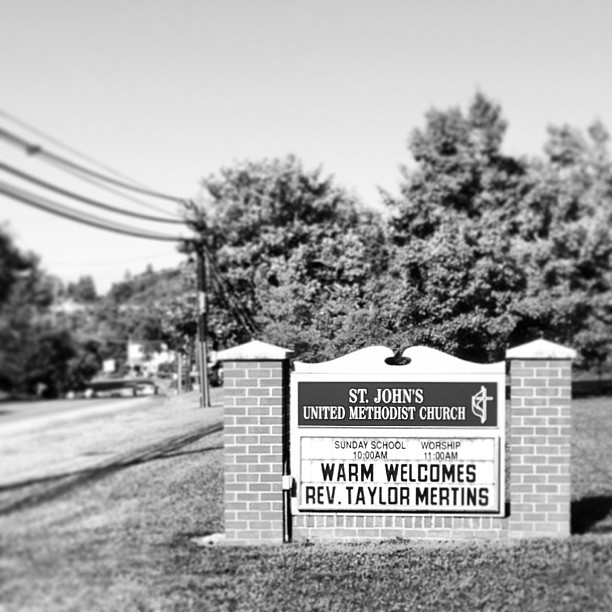
A year and a half ago, I thought I was supposed to be an associate pastor at one of the larger churches in the Virginia Conference. After going straight from college to seminary and then into the ministry I believed it might be a good thing for me to follow under the leadership of a seasoned senior pastor who could help me learn the most fruitful ways of doing church. Knowing that I was going to propose to Lindsey, and hoping she would say yes, I figured that working in a larger area would give her a greater opportunity for finding a job in social work. I had it all planned out in my head, exactly how I would follow God’s call on my life.
And then I received a phone call: “Taylor, we’re taking your name off the associate list. We believe that your gifts and graces fit best with serving as the pastor of St. John’s United Methodist Church in Staunton, Virginia. The bishop has appointed you, and we are praying for your ministry.”
As a 25 year old coming straight out of seminary, I never imagined that this would be the church that I was serving. I thought that I had it all figured out.
But God’s ways are not my ways. Our God loves to surprise us and save us in ways that we cannot imagine. I’m still trying to work out why God chose to send me here, but every day that I serve as the pastor of this church is a constant reminder that I am exactly where I am supposed to be. Because whether you know it or not, you have saved me in ways that I cannot even begin to describe.
Women are powerful and being faithful is complicated. Deborah and Jael remind us that the ways of the world are not the ways of God. That we are called to a new perspective on how to view one another: male-female, black-white, gay-straight, young-old, we are all God’s children full of value and worth. That God works in ways that are unexplainable and bizarre, calling people like you and me to serve our community side-by-side.
I’ll admit that its frightening and disconcerting, but sometimes God needs a tent peg to jolt, shock, and knock some sense into us.
Amen.






 think and let think