Wake Up! – Sermon on Romans 13.11-14

Romans 13.11-14

Besides this, you know what time it is, how it is now the moment for you to wake from sleep. For salvation is nearer to us now than when we became believers; the night is far gone, the day is near. Let us then lay aside the works of darkness and put on the armor of light; let us live honorably as in the day, not in reveling and drunkenness, not in debauchery and licentiousness, not in quarreling and jealousy. Instead, put on the Lord Jesus Christ, and make no provision for the flesh, to gratify its desires.

00036884_h

On April 4th, 1742, Charles Wesley came up for appointment as university preacher in St. Mary’s in London. Charles preached from Ephesians 5.14 which reads, “Awake, thou that sleepest, and arise from the dead, and Christ shall give thee light.”

Now, just for context sake, Charles Wesley was the younger brother of John Wesley, the primary founder of the Methodist renewal movement that eventually led to the formation of the United Methodist Church. Both brothers believed that, at the time, the Church of England was losing a sense of purpose and needed to be renewed. They were strongly rooted within their church structure, but they considered their ministries to be caught up in spreading scriptural holiness throughout the land. While John was known for his organization and preaching, Charles was known for his ability to write hymns; some of his more celebrated hymns are sung on a regular basis in many churches: Christ the Lord is Risen Today, Come Thou Long Expected Jesus, Hark! the Herald Angels Sing, O for a Thousand Tongues to Sing, to name a few.

So, Charles found himself invited to preach in front of a university audience that he largely believed had lost sight of what it meant to be Christian in the world. Those in attendance that day were far more consumed with the “academic pursuits” of Christianity rather than a deep and inward sense of what it meant to be forgiven and loved.

Like many young and naive pastors, Charles preached a sermon filled with a barrage of frightening assumptions and left many in attendance frustrated, angry, and ignorant.

ArtMuseum-Awake-thou-that-sleepest

Here are a few of his lines, adapted for our contemporary period: Wake up! Everyone of you, wake up out of your dreams of worldly happiness. What is the state of your soul? If God required you to die right now while I am preaching, are you ready to meet death and judgement? Have you fought the good fight and kept the faith? Have you secured the one thing needful? Have you recovered the image of God, even righteousness and true holiness? Are you clothed in Christ? Do you know that God dwells in you by his Spirit that he has given to you? Have you received the Holy Spirit? Or do you even know if there is a Holy Spirit at all? If any of these questions offend you, be assured that you are not a Christian nor do you desire to be one. Indeed, your very prayers have been turned into sin; and you have definitively mocked God this very day by praying for the inspiration of his Holy Spirit when you did not even believe that such a thing existed!

Needless to say, this was Charles’ first, and very last, occasion for preaching there.

Though Charles chose to preach from Paul’s letter to the church in Ephesus, Paul also wrote in a similar vein to the church in Rome: “Besides this, you know what time it is, how it is now the moment for you to wake from sleep!” What is the “this” that he is talking about? Love is the fulfillment of the Law. So, besides knowing that love is the fulfillment of the law, it is now time for us to wake up! For salvation is nearer to us now than when we became believers; the night is far gone, the day is near. Let us then lay aside the works of darkness and put on the armor of light; let us live honorably as in the day, not in reveling and drunkenness, not in debauchery and licentiousness, not in quarreling and jealousy. Instead, put on the Lord Jesus Christ, and make no provision for the flesh, to gratify its desires.

A-Thanksgiving-meal-has-at-least-3000-calories

Coming off of a major holiday weekend where we have all gratified our desires with mountains of mashed potatoes, rivers of gravy, quarries of cranberries, and seas of stuffing, where many of us were filled with debauchery and quarreling as we competed for the best holiday shopping prices on Black Friday, where we are now more focused on Santa Claus than Jesus Christ… it is very difficult for a young foolish pastor like myself to preach this text without ruffling some feathers. I used to laugh when I read Charles Wesley’s sermon “Awake, thou that sleepest” but now I’m beginning to understand how important it was for him to preach those words.

ap_black_friday_21_dm_121123_wg

Today is the first Sunday of Advent, the beginning of the Christian year. Just as we came to a conclusion with Christ the King Sunday last week, today we begin by looking forward, with expectation, to the birth and arrival of our King. But here’s the great paradox, even though we are looking forward to Christmas, it feels like we’re stuck looking to the past. In many areas of church life this is a plague that has permeated throughout a multitude of ministries, relationships, and conversations. We talk about where we are as a church, what we want to do, but far too many of our imaginations are trapped by the past. 

If, as Paul argues, love is the fulfillment of the law in he past, then love is most assuredly also the appropriate mode of action in the present.

Being Christian is all about love in action; not just a reflection on the past, but also a waking up to the present and the future. 

For disciples of Jesus Christ, one of the hardest things to wrap our heads around is “time.” We are a people who regularly remember the past, in order to live into the present, while also looking forward to God’s promises. We are a people rooted in time, removed from time, and unaware of God’s time. Our past is constantly invading the present, and the future has already met with the present in the presence of the Holy Spirit within the faithful community.

If your head is spinning, don’t worry. It should be.

God-in-time

God’s future casts a light into the present and provides the illumination of the reality by which we are all called to live. Because God has promised to come again and make all things new, a new heaven and a new earth where death will be no more, death will die, then we are called to live into God’s future reality in the present. We are called to love in order to fulfill the Law.

What makes us unique as a people is precisely the fact that God has invaded our present with the Spirit, with his Son who walked among us, with his Word, with his sacraments, that we are a distinctive people with expectations of how the world needs to be.

For us, the time is now! Wake up! 

As Christians we are not to be content with passively accepting injustices and evils in the world. Our faith demands that we reach out in love to combat the sinfulness of the world. How often do we think about our obligations to love outside of our families and our church community? What could this world look like if we seriously considered loving all, and all means ALL, of God’s creatures?

We are creatures of the present, though we are so consumed with our pasts. Our text today encourages us to look to the future in order to know how to act. As Paul wrote elsewhere in Romans, do not be conformed to this world, but be transformed by the renewing of your minds. Discover newness in your lives which the future will bring.

Wake up! We are no longer burdened by living for ourselves, but we are privileged to live for God, we are a people who obey his will for our lives. That is what Paul means when he says we are to clothe ourselves in the Lord Jesus Christ. Its what he means by putting off the darkness and putting on the armor of light!

Because of Christ’s redemptive act on a cross in a place called The Skull we have all been liberated from the burdens of a sinful past. We strive forth with confident steps into a future that is always bringing us closer and closer to the fulfillment of God’s redemptive plan for the entirety of creation. We are here as a people of anticipation, here the first Sunday of advent, remembering while anticipating Christ’s in breaking in the world in order to bring about God’s kingdom on Earth.

Wake up! This moment is the eternal moment – the now – when the past and the future stand still, when the past ceases its going, and the future its coming. This moment is not a time that comes and goes, it is God’s eternal moment, a spot of clarity amidst the ridiculous chaos of our lives.

This passage from Paul, read for us this first Sunday of Advent, deepens our understanding of the future whose coming we celebrate both in the birth and in the return of Jesus Christ.

So, how can we wake up from the sleep that we are caught up in? How can we love in such a degree so as to fulfill the law?

Love is always the essentially revolutionary action.

We love the way that Christ loved, and still loves us…

We can reach out to the lonely in our community, those who do not have a family to share this holiday season with. We can gather together in the front of the church selling Christmas trees while demonstrating Christ’s love in the world through the way we reach out to those who stop by. We can participate in quilt for a cause, letting our fingers and needles and thread create a tangible sense of love for individuals in our community. We can donate money for the Children from Social Services who we have adopted for Christmas presents this year, reminding them that nothing will ever separate them from the love of God in Jesus Christ.

We can open our eyes to the injustices within our local community, and abroad, and be willing to speak out against the disparity present. We can love the unlovable, reconcile with friends and family from whom we have been separated, and we can provide a little warmth this coldest time of the year.

Our love for others, creation, and God is never just a concrete act, something that once began and continues on a course. Our love is the Beginning, the Miracle, the Creation in every moment of time, it sets our hearts aflame for Christ Jesus and allows us to be his body for the world.

And so, though paradoxical, what we are doing, the ways that we embody love, can be no more than point to the victory which has occurred, does occur, and will occur in Jesus Christ. Love directs us to the one whose very birth we now await and anticipate. Love awaits the ends of darkness which is the Beginning of the light of the world.

Wake up! You all know what time it is, and it is time for us to wake from our sleep. This is the beginning, another chance to start again. Whatever baggage you are carrying, whatever sin you believe is too harsh to be forgiven, whatever frustration you are dealing with in your life, today is a new beginning. We have gathered together as a community to rid ourselves of the darkness in our lives. We are here to care for one another. You are not alone. You are part of a community of faith that loves you because God loves us. Put on the armor of light. Prepare yourselves to be surprised by God’s grace in the world.

Wake up! Put on the Lord Jesus Christ. Do not be consumed by your past, but with excited expectation live in the present and anticipate God’s future for you.

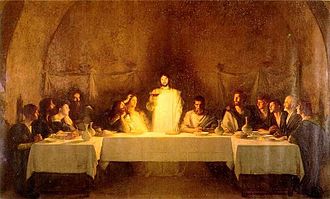
This table is our Beginning. For it is here that we gather to confess our faults, receive forgiveness, reconcile with our community, and feast at Christ’s table. This place is where past, present, and future all wind themselves together. Christ’s table is the matrix of time; it is where we remember God’s mighty acts, anticipate his birth and coming again, and live into the new reality of love, mercy and forgiveness.

Wake up! God is waiting for you.

Amen.

00036884_h

Dinner in the Kingdom – Sermon on Luke 14.1, 7-14

Dinner in the Kingdom

Luke 14.1, 7-14

On one occasion when Jesus was going to the house of a leader of the Pharisees to eat a meal on the Sabbath, they were watching him closely. When he noticed how the guests chose the places of honor, he told them a parable. “When you are invited by someone to a wedding banquet, do not sit down at the place of honor, in case someone more distinguished than you has been invited by your host; and the host who invited both of you may come and say to you, ‘Give this person your place,’ and then in disgrace you would start to take the lowest place. But when you are invited, go and sit down at the lowest place, so that when your host comes, he may say to you, ‘Friend, move up higher’; then you will be honored in the presence of all who sit at the table with you. For all who exalt themselves will be humbled, and those who humble themselves will be exalted.” He said also to the one who had invited him, ‘When you give a luncheon or a dinner, do not invite your friends or your brothers or your relatives or rich neighbors, in case they may invite you in return, and you would be repaid. But when you give a banquet, invite the poor, the crippled, the lame, and the blind. And you will be blessed, because they cannot repay you, for you will be repaid at the resurrection of the righteous.


A few years ago, I sat in the depth of a couch listening to one of my best friends named Josh [you can check out his blog here] talk about our assignment for the week. A number of us had been gathering on a regular basis in a sort-of “spiritual discipline accountability group.” Every week we read through a chapter from James Bryan Smith’s The Good and Beautiful Life, discussed what we had learned, prayed, and then talked about our assignment for the next week. To be honest, the assignments were what I enjoyed most about the group because every week we were given a new challenge regarding our faith lives that we could live out.

37

For instance one week we discussed the super-abundance of technological distractions in our lives and our challenge was to go on a “media-fast.” This meant that for 48 hours we were to try our best to put our cell phones away, rid ourselves of Facebook and twitter, keep the television turned off, and the magazines closed. For those two days we would distance ourselves from the distractions in our lives.

Most of our assignments were straightforward, and the results predictable. By fasting from media, we would inevitably spend more time with God and realize how much time we waste every single day. When we spent the week praying for our enemies, we would realize how connected we really are as the body of Christ, etc.

However, when I sat on the couch that night a few years ago, we were given a task that I thought would be too easy. “This week,” my friend read aloud, “you are to give away possessions to people. (Easy, I remembered thinking to myself) But here’s the catch,” he continued, “you have to do it in secret. This doesn’t mean you need to go out and buy something nice for someone, but truly give away something that you love without any expectation of receiving anything in turn.”

Giving and receiving gifts can both be a joy and a challenge. We live in culture so saturated in capitalism that nearly everything we do is based on a “giving-receiving model.” When someone offers to pay for our lunch, the conversation usually continues with, I’ll get the next one. When we give someone a gift, whether we admit it to ourselves or not, we hope that we will receive something just as nice in return, eventually. We no longer know how to receive gifts with true gratitude because before we even enjoy whatever has been given, we feel indebted and begin to plan on giving something back in return.

And so it came to pass one evening that Jesus went to the house of a leader of the Pharisees to eat dinner. As everyone was getting settled, sitting down in their chairs, filling up their glasses of wine, Jesus looked around and noticed how the invited guests were choosing the places of honor. He cleared his throat, and started to tell those with ears to hear, a parable: “when you are invited by someone to a banquet, do not sit down in the best places, in case someone more distinguished than you arrives and then the host will have to tell you to go sit somewhere else. Instead, you should sit in the lowest place, so that when the host sees you they will say, “my friend, move up higher, take one of the better seats.” For all who exalt themselves will be humbled, and those who humble themselves will be exalted.”

eucharist

Jesus loves to use the mundane, the everyday, to help convey the depth of God’s kingdom. He uses the common experiences of people, the home or marketplace, farms and fishing boats, to reveal aspects of the character of his listeners, while also demonstrating the way of life in the kingdom of God. The Kingdom of God is like a mustard seed, the Kingdom is like a sower going out to sow, the Kingdom is like a dinner party. So the first part of our passage today is therefore fairly straightforward: Stay humble. When you get invited places, do not assume that you are worthy of the best seat, but seek the lowest.

But Jesus continues on beyond the parable by addressing the one who had invited him: “When you have people over for a lunch or dinner, do not invite your friends or your brothers or your relatives or your rich neighbors, who can all return the favor of your invitation. Instead, when you’re hosting a party invite the poor, the crippled, the lame, and the blind. And you will be blessed, because they cannot repay you, for you will be repaid at the resurrection of the righteous.”

It is very easy to read this passage from scripture and limit the meaning to social justice and ethics. In fact most of the commentaries written on this part of Luke 14 constrain the interpretation to simple ethical contributions. However, Luke gives us plenty of evidence to show that the real subject at hand is the Kingdom of God.

From the beginning of the passage Luke has given us a clue that there is more at stake here than etiquette; Jesus is telling a parable; Jesus is calling for kingdom behavior.

For the first part of the parable we do well to remember to resist the temptation to use humility as a means of receiving benefits. Taking the low seat because one is humble is one thing; taking the low seat as a way to move up is another. This is about maintaining our humility so that we embody the kind of life Jesus led and therefore receive exaltation in our humility.

As Jesus continues by addressing the host we can all imagine the wonderful elements that come with hosting a party. Inviting others embodies friendliness, generosity, graciousness, and concern for the comfort of others. However all of us know the ugly face of generosity that binds us when gifts come with strings attached. Just as in Jesus’ time, hosts often expect a return on their generosity toward others and therefore only invite people who are able to return the favor. But in the kingdom, God is the host, and who can truly repay God?

When we started our week of giving away possessions I was truly excited. I love giving gifts to people, and like the host in our parable I love inviting people over for dinner. I started scheming and planning on how I could start to give away my things to my friends. I analyzed them individually and started to think about who could use certain things. I went first to my collection of vinyl records and books, pulled out some of my very favorites, wrapped them up, and delivered them in secret without any indication that I had been the one to do so. I hid their gifts by their front doors, in the academic boxes at school, and I even left a few on the hoods of cars. Now to be clear, these were not just simple things that I had collected and would be willing to give away, but they were truly sentimental items that I had grown very attached to. I can remember wrapping up my first iTouch, my favorite Jazz LP from Dave Brubeck, and the first theological work I ever read from Karl Barth. These weren’t just  “things” but were part of who I am. In the days that followed after the surprise deliveries I felt absolutely miserable.

The hard part was not parting with the objects, but it was doing it in obscurity. I wanted all of my friends to know that I was the one who gave them their gifts. Keeping my mouth shut was so very difficult for me, because I wanted credit for the good deeds I had done. I thought that I wanted them to know how much time and energy I had put into their surprises, but what I really wanted was a little praise for what I had done. I realized that I was just like the host of the party in our scripture today; I was doing something nice to mask my own desire for affirmation.

But in the kingdom of God, things work differently.

kingdomofheaven3

The story from scripture today is about God’s continued commitment to make us into people who can be depended upon to love strangers since we have learned, in Christ, what its like to be a stranger and be loved, even when we least deserve it. Preachers often list off virtues for people to emulate but there is only one true virtue: the lowly acknowledgment of God. Preachers also often list off sins to be avoided, but there is only one true sin: self-worship, our attempt to set ourselves at the center of the world, and the center of God’s table.

Jesus confronts us this morning: Who are you inviting over? To whom are you showing hospitality? Are you having over the same old people who can continue to pay you back for what you’re doing? Or are you reaching out to the last, least, and the lost?

To entertain for those with whom we are most comfortable is to set one’s own circle as the center of the universe; it is selfish. To entertain people beyond our comfort zone is to remember that God sees humanity as one family and that his love runs most quickly to those who are most in need.

Jesus is the one who chooses us, not the other way around. Jesus is not calling us here to provide for the needs of the poor and the disabled; He very simply asks us to invite them over for dinner. True hospitality is not having one another over on Friday night, but welcoming those who are in no position to host us in return.

This week we cannot rationalize ourselves out of the text and we cannot use metaphors or other interpretative elements to make it say something different. Luke 14 is not just about “loving” people, because Jesus didn’t get killed for loving… a lot more is at stake than just being nice. God is pulling us out of our comfort and complacency to live radically transformed lives. It does not matter whether you 71 or 17, our lives have been transformed in Jesus Christ and it is never too late to rediscover that transformation.

Christ is the host of this party. This is not St. John’s table, or my table, or even our table, but it belongs to Christ. None of us deserve to be invited. We regularly forget the goodness of God in our lives, we ignore the commands to love the unloved, and we fall short of his glory over and over. Yet, here we are. We come to this table with empty hands and hungry hearts, needing God to do for us that which we cannot do for ourselves.

Christ freed, and continues to free us from the expectations of the world. We no longer have to follow along with everyone else but instead get to live new and exciting lives. Who do you know that needs to feel a little more love?

Christ has invited you to his table. Who are you inviting to yours?

Amen.