But I Say… – Sermon on Matthew 5.21-26

Matthew 5.21-26

You have heard that it was said to those of ancient times, ‘You shall not murder’; and ‘whoever murders shall be liable to judgment. ‘But I say to you that if you are angry with a brother or a sister, you will be liable to judgment; and if you insult a brother or sister, you will be liable to the council; and if you say, ‘You fool,’ you will be liable to the hell of fire. So when you are offering your gift at the altar, if you remember that your brother or sister has something against you, leave your gift there before the altar and go; first be reconciled to your brother and sister, and then come and offer your gift. Come to terms quickly with your accuser while you are on they way to court with him, or your accuser may hand you over to the judge, and the judge to the guard, and you will be thrown into prison. Truly I tell you, you will never get out until you have paid the last penny.


Unless your righteousness exceeds that of the scribes and the Pharisees, you will never enter the kingdom of heaven.

Lets assume that all of us are here this morning because we want to be good people. We see what our lives look like on a daily basis, and we recognize Sunday mornings as opportunities to better ourselves, to hear about the kind of people we are supposed to be.

Lets also assume that we are already fairly decent people. I mean look at us. We are sitting here in church on Sunday morning, thats certainly doing better than the people who are still sleeping in at home, curled up under their soft and warm blankets.

som05_calvinandhobbes_ch870114

Becoming a better person is what Christianity is all about, isn’t it? One of the main functions of any religion is to be shaped and molded into something greater than we currently are. This journey of faith is aimed at reconstructing ourselves so that we might resemble Jesus in the way that we live in the world.

But, the trouble for us who know a little bit about Jesus is that we know it was the good people, the scribes and the Pharisees, the ones who obeyed all the laws, the ones who, like us, showed up for worship on time, the people who gave fervently to the temple, who remained faithful to their spouses, who loved the Lord their God with all their heart, who knew all the scriptures, who walked humbly with God, those people were the ones who eventually yelled, “Crucify him!” 

What drove them to such disregard for the Messiah who walked among them? What could have made them move from strict religious adherence, to crowds thirsty for punishment?Well, one answer is the scripture that we have today.

We find Jesus here in the middle of the Sermon on the Mount. Let me set up the trajectory: Jesus was born in Bethlehem, escaped to Egypt with Mary and Joseph, returned to Nazareth, was baptized by his cousin John in the river Jordan, was cast into the wilderness by the Spirit to be tempted by the devil for 40 days and nights, began his Galilean ministry, called his first disciples, and then gave his Sermon on the Mount.

This sermon marks the beginning of Jesus’ mission to God’s people. The words of the sermon will come to dictate who Jesus will serve, how he will share God’s grace with the people, and why he was dragged to the cross.
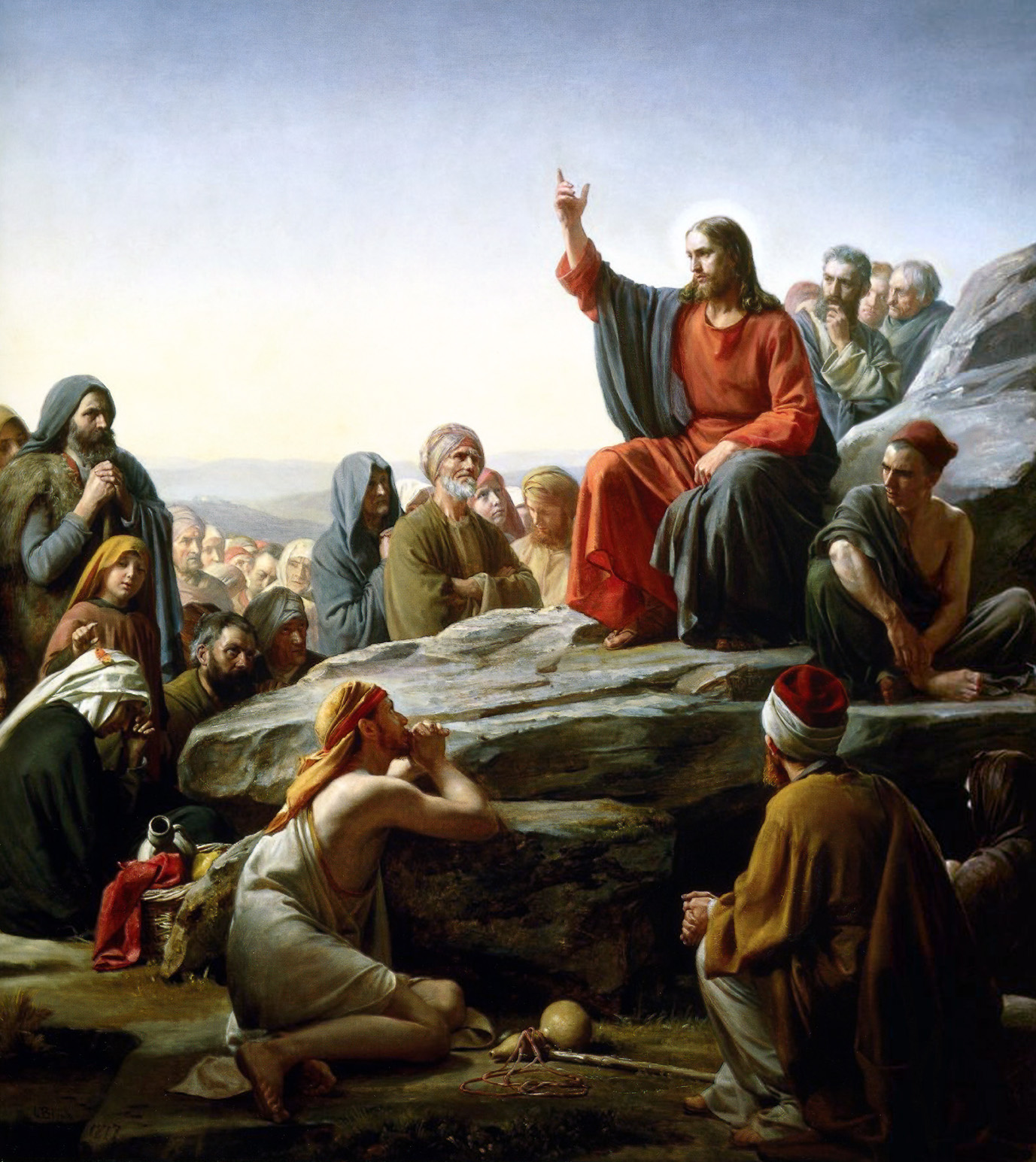
The Sermon on the Mount Carl Bloch, 1890

The sermon begins like all good sermons, Jesus jumps right to the point: Blessed are the poor in spirit, for theirs is the kingdom of heaven. Blessed are those who mourn, for they will be comforted. Blessed are the meek, for they will inherit the earth, and so forth.

With the people no doubt scratching their heads regarding whatever this inversion of the world’s dynamics was supposed to mean, Jesus moves forward, “You all are the salt of the earth, you are the light of the world. Do not think that I have come to abolish the law or the prophets; I have come not to abolish but to fulfill.”

The sermon concludes with Jesus’ reinterpretation of the Mosaic ten commandments, which is where our scripture begins today:

You have heard it that it was said to those of ancient times, ‘You shall not murder’; and ‘whoever murders shall be liable to judgment.’ But I say to you that if you are angry with a brother or a sister, you will be liable to judgment; and if you insult a brother or a sister, you will be liable to the council; and if you say, ‘You fool’ you will be liable to the hell of fire.

What a sermon this is shaping out to be.

Jesus’ teaching is stricter than the law itself. He will go on to proclaim do not get angry, do not lust, do not swear, do not seek revenge, and do not hate your enemy. He takes the law and make it even harder to obey.

Under the old law only murder and other extreme offenses were guilty of death, but under Jesus’ understanding angry temper is to be similarly judged. And he doesn’t stop there! Even those who would call others, “stupid” or “fool” are worthy of judgment by the court.

For Jesus, anger is just as bad as murder. Killing is not done by knives, and guns, and fists alone, but by the angry words muttered between friends, or the casual indifference between classmates that often makes people feel less than human.

Jesus looked out at the crowd and saw people worthy of love. His sermon is not just a message for Christians to follow regarding other Christians, but its a call to recognize the inherent value in all people. In Jesus’ day there was a custom of placing a large gold coin beneath the mainmast of most sailing vessels. For those who knew, this meant that even a wreck had value. Jesus recognized that value in all people, and called those with ears to hear to a life of grace, mercy, and love toward all people everywhere.

“You have heard it was said to those of ancient times… but I say to you…” Thats a classic Jesus move. It is possible to be so good, and right all the time, that you are wrong. You can be so religious that you miss the point of religion. Legalistic adherence to the law can begin to overshadow the importance of love and grace in your daily living. Overvaluing the law can lead to a faith that is cold, calculated, dry, and dull instead of a faith that is warm, wide, fun, and forgiving.

Jesus continues, “So when you are offering your gift at the altar (when you decide to place your offering in the plate) if you remember that your brother or sister has something against you, leave your gift there before the altar and go; first be reconciled to your brother and sister, and then come and offer your gift. Come to terms quickly with your accuser while you are on the way to court with him, or your accuser may hand you over to the judge, and the judge to the guard, and you will be thrown into prison. Truly I tell you, you will never get out until you have paid the last penny.

A professor of mine in seminary told a story about a church in Africa that took this command quite seriously. Every Sunday morning the people would make their way to the church located in the middle of the village. Some with sleep still in their eyes would drag their lethargic bodies down the dusty road, continuing the same march they made every week.

At the bottom of the steps leading into the small sanctuary, the local pastor would be smiling from ear to ear greeting everyone as they came forward, however the doors would remain locked. The crowd would grow and grow until everyone from the village was present, anxiously waiting outside the church.

“Look around you,” the preacher’s voice would echo, “who do you need to reconcile with? Who have you betrayed since last we met? Go and find your brothers and sisters, make peace with one another. Until you do, these doors will remain locked.

For the next twenty minutes, all of the African congregants would slowly make their way throughout the crowds searching for those who they had wronged, and who had wronged them. Now this wasn’t a town where you could just stand around and pretend that everything had been perfect since last Sunday. Everyone knew everyones’ business. That meant that they truly had to make peace with the collective church. Without the reconciliation, the people had no business entering the church to worship God. Only after the pastor was satisfied that everyone had been merciful with one another, were the doors opened and worship continued.

Some might say that Jesus’ command that someone should leave their gift at the altar to reconcile with his brother or sister is a depreciation of worship; however, it is actually an exaltation of worship. Just as it happened for that African church, God sees our inmost motives, and we are called to worship God in truth. If we have baggage with others in the community, we mock God by coming before the altar instead of first reconciling ourselves with others. God is concerned with our lives and our worship; we cannot ignore one while participating in the other.

I thought about doing something radical this morning. After reading the scripture for Sunday, and remembering the story from my professor, I wondered what it would have been like to stand outside those doors preventing all of you from entering today. But, after having shoveled at the parsonage and the church the last few days in the cold, I thought better of it. Nevertheless, what would our worship in this place look like, if first we made peace with those in the pews, rather than anonymously continuing down our faith journeys all alone?

1531994_199633020231001_10668999_o

What Jesus presented to the crowd, what Jesus presents to us this morning is not so much a new law to be strictly observed, but instead a new way of living our lives. Jesus makes his point dramatically in order for a change of heart to take place.

Jesus is here with us this morning, addressing us as he did to that crowd so long ago: You already know that you are forbidden to murder anyone, but now I’m telling you that you are forbidden to become angry with anyone. Call someone a fool and you’ll be worthy of punishment. Do you truly want to be good? Don’t just keep the law like the “good” Christians, go beyond the law.

Challenge yourselves to be greater than following guidelines and lists. Strive to love those around you to such a degree that the world will be transformed into the kingdom of God.

As a professor of mine once said, we are so accustomed to coming to a church like this and, if we should struggle and stumble with a passage like this one, it usually takes no more than 15 minutes for a skillful preacher, using the skills of story-telling, diversion, and trite formulaic expressions to explain it away. To reassure all of us that a nice person like Jesus never would have had a reason to say something tough to good people like us.

I know of no way to do that with this text. No amount of pop-psychology or narratival reductionism can remove the true message of Jesus’ words. The tougher the text, the more likely  it was to have come straight from the lips of Jesus. Being a Christian is no easy thing. It requires us to love greatly, and to forgive deeply.

Now more than ever we need to reclaim the high call of Jesus’ sermon. Young people today find and seek validation in their peers and parents that, when not offered, leads to self-destructive habits. Just think of the cases of bullying that have recently dominated significant media attention. Words and actions are powerful things. We often do not realize how powerful we can be with our words, and how destructive we can be if we are not careful.

Love is the key to all the commands of scripture, particularly Jesus’ sermon on the mount.

holy-life-tiles

Today, Jesus’ sermon is as hard to swallow as it was 2,000 years ago. You have heard that it was said to those of ancient times, “Do this and don’t do that,” but what Jesus says to us is to do more, go beyond the law, strive for something incredible, work for the kingdom, let God’s Word be incarnate in your lives, imagine a more graceful and purposeful life, seek out the last, least, and lost, be better than good, be holy as your heavenly father is holy.

Amen.


(I am thankful for Will Willimon’s sermon “Being Good” for inspiring parts of the above message)


On Real Religion – Sermon on Micah 6.1-8

Micah 6.1-8

Hear what the Lord says: Rise, plead your case before the mountains, and let the hills hear your voice. Hear, you mountains, the controversy of the Lord, and you enduring foundations of the earth; for the Lord has a controversy with his people, and he will contend with Israel. “O my people, what have I done to you? In what have I wearied you? Answer me! For I brought you up from the land of Egypt, and redeemed you from the house of slavery; and I sent you Moses, Aaron, and Miriam. O my people, remember now what King Balak of Moab devised, what Balaam son of Beor answered him, and what happened from Shittim to Gilgal, that you may know the saving acts of the Lord.” “With what shall I come before the Lord, and bow myself before God on high? Shall I come before him with burnt offerings, with calves a year old? Will the Lord be pleased with thousands of rams, with ten thousands of rivers of oil? Shall I give my firstborn for my transgression, the fruit of my body for the sin of my soul?” He has told you, O mortal, what is good; and what does the Lord require of you but to do justice, and to love kindness, and to walk humbly with your God?

4944299081_d37e065a78_z

What does the Lord require of you but to do justice, and to love kindness, and to walk humbly with your God?

Pastor, preacher, reverend; titles that I’m still not used to. After only having served this church for seven months, it never ceases to amaze me how many people in the community already identify me through my vocation. I will be sitting at the Bistro downtown ready to order dinner with Lindsey when the waitress begins by asking, “What can I get for you reverend?” Or when I’m sitting behind my computer at Coffee On The Corner my coffee is accompanied with a “here you go preacher.”

Its my own fault really. I love to tell people what I do. Whenever I meet someone new in town, I’m always eager to share with them my excitement at having been appointed to St. John’s.

This past week, I was visiting one of my favorite shops downtown (that will remain nameless) when I was greeted with the familiar title: Pastor. The owner and I have a fairly decent relationship and our conversation flows smoothly whenever we’re together. As he was ringing me up, we exchanged the regular pleasantries, talking about the cold weather and other such things, until he asked me about the church. I told him about how remarkably forgiving many of the congregants are regarding my sermons, and how thankful I am for their willingness to join me in this adventure we call “church.” Thats when the conversation got serious.

“Well, I’m happy you’re enjoying it,” He said, “But church is just not the thing for me.”

Aside: I almost never ask anyone about church, and yet, people always bring up their attendance, or lack their of, in conversations.

By his tone and inflection, it was clear that he wanted to say more about the subject, so I inquired as to why church is not the thing for him.

“I used to go all the time,” he began. “I’ve popped around between different denominations, I was even an elder for a little while, but about ten years ago I lost faith in the church. We were doing all the right things, we had hundreds of people in worship every Sunday but we never did anything for the community. Everything the church did was so inwardly focused. Debates about the wallpaper, the type of bread for communion, and timing for Sunday services dominated all of our conversations. Whenever I tried to raise a need within the community that the church could meet it was brushed aside as being insignificant. Finally, at a council meeting, I could no longer contain myself. After years of watching this “perfect church” ignore the desperate needs of the people outside the building, I stood up in the front of the leadership and declared, “I think when Jesus said, ‘Feed my sheep,’ he really meant to feed his sheep.” I have not been to a church since.”


In the sixth chapter of Micah, the prophet relays God’s controversy with his people. “O my people, what have I done to you? In what way have I wearied you? Answer me! For I brought you up from the land of Egypt, and redeemed you from the house of slavery, and I sent you Moses, Aaron, and Miriam. O my people, remember now what King Balak of Moab devised, what Balaam son of Beor answered him, and what happened from Shittim to Gilgal, that you may know the saving acts of the Lord.”

At that time in Israel’s history, the people had grown weary and bored with their God. They were just going through the motions when it came to worshipping the good God who had been at the center of their very lives for so long.

How could they have become bored with God? He had delivered the people from their oppressors, raised up mighty leaders, sent truthful prophets, and brought all the people to a full awareness of his righteousness. Yet, they had forsaken him. They lived immersed in the love of God, yet were blind to much, if not most, of it.

Micah then describes “real religion” as opposed to the ways to Israelites were behaving: “With what shall I come before the Lord, and bow myself before God on high? Shall I come before him with burnt offerings, with calves a year old? Will the Lord be pleased with thousands of rams, with ten thousands of rivers of oil? Shall I give my firstborn for my transgression, the fruit of my body for the sin of my soul? He has told you, O mortal, what is good. and what does the Lord require of you but to do justice, and to love kindness, and to walk humbly with your God?

Micah presents the simple essentials of real religion in a verse that has taken its place among the most favored of scripture. What does the Lord require of you but to do justice, love kindness, and to walk humbly with your God? Real religion is predicated on the lived reality of discipleship that changes everything.

God made it known to the Israelites the proper and good response to their Lord. The people are required to practice justice, to seek equality between themselves and others; to love kindness, to maintain a loyal commitment to God and others; and to walk humbly with their God, to live transformed lives conformed to the image of God. Real religion is a journey of faith working by love leading to holiness of heart and life.

So, where are we with God? Have we grown tired and weary of the God we have come to worship? Are we attending church, practicing our faith, and loving others out of obligation or excitement? What do we think the Lord requires of us?

Is our relationship with God determined by our attendance at church, coming to worship at 11am every Sunday, singing a couple hymns, hearing scripture read aloud, and listening to a 15 minute sermon? Are we simply going through the motions of faith, or does our faith shape the way we act outside of this building?

During the time of Micah, God no longer wanted the sacrifice of animals, burnt offerings, and rivers of oil. Instead he wanted what he already showed to be good: justice, kindness, and humility.

And when we read that list of what God does not want, it makes the threefold expectation seem easy. The real demands of God however, are both moral and spiritual, and the proper worship of God is a life obedient to them. Without justice, kindness, and humility, any of our practices in church can wound our faith. Instead of creating worthy habits for life, we appear to be bargaining with God to take something less than he actually wants of us. If our faith can be compartmentalized into one hour a week, if our faith is limited to church worship alone, than we desperately need to hear Micah’s word.

Like the ancient Israelites, we live and die immersed in the love of God. Yet, how often are we blind to much, if not most, of it?

Micah begged the people to exhibit true faith, true worship, and true morality that will come to completion in true behavior. What we believe shapes how we behave. 

However, proper morality is not a substitute for religion. Its not just about “being a good person.” Outward conduct is essential for the life of faith, but it always depends on the inward character that is shaped by the gathering community of faith.

Justice, kindness, and humility might sound easy and comfortable to those who have never tried them, but the overwhelming truth is that these three practices are far more costly than thousands of rams, ten thousands of rivers of oil, or a more contemporary allusion might be that truly practicing justice, kindness, and humility will always be harder than giving numerous possessions away in order to somehow appease God.

If this church takes seriously our commitment to forming disciples of Jesus Christ for the transformation of the world, then we need learn to translate mercy into our regular daily deeds through a close, nurturing, and personal journey of faith with God. The Lord demands our lives, our love, our trust, and our loyalty.

When driving around Staunton, it is nearly impossible to miss the cacophony of churches scratched across the landscape. In my life, I have never lived in a place with so many steeples. In fact, during one of my first weeks here someone told me that Staunton has more churches per capita than anywhere in the United States. I have no idea how to confirm whether or not this is true, but I wouldn’t be surprised if it is.

In my short time here I have created relationships with some of the other clergy in town; I’ve gone out to lunch, initiated a lectionary based breakfast group, and shared numerous cups of coffee. Do you know what the first question is almost every time I meet a different pastor? “How many people do you have in worship?”

This week, while reading over Micah, I realized that getting asked about worship attendance is close to what the Israelites must have felt when someone asked, “how many rams did you sacrifice this week, how many river of oil did you present to God?”

Really? Of all the things that we could possibly talk about, the first question is always about church attendance. I wonder why we aren’t talking about ways that we can practice justice, love kindness, and walk humbly with God.

Why are we all so consumed with the numbers instead of planning ways to serve our community? And I’ll admit that I am certainly guilty of this practice. When I am asked about worship, I proudly respond about the growth of our church and the warm and inviting atmosphere that one encounters when walking through the door. But I have to be reminded too, I have to ask myself, ‘What does the Lord require?’ Does God want us to grow this church and fill it to the brim to the point where we no longer know who we are worshipping with? Or is God calling us to do justice, to love kindness, and walk humbly? Not that they are mutually exclusive, but until our focus is more on living our faith, rather than filling our building, our building will never be filled.

So, how can we practice justice as individuals and as a church? We can open our eyes to the needs of our community. We can seek out the last, least, and lost, to give them the one true gift worth sharing: love. We can stand up against the small and large injustices that occur everyday, whether its an unfair judgement in the work place, or racist comments, or belittling words between spouses. We can practice justice by living out our faith in the world.

How can we love kindness as individuals and as a church? We can initiate relationships with strangers knowing that God has done the same for us. We can show our love to our families and friends by making the extra phone call to just say “Hi.” We can truly greet one another when we gather in worship, not just the same people we talk with every week, but particularly those who are still strangers to us. We can show our loving kindness but living out our faith in the world.

How can we walk humbly with our God? We can recognize that God is not only concerned with our religious rituals, but calls for us to live out faith beyond these walls. We can admit that we have, and will continue to, fall short of God’s glory. We can find salvation and redemption through our faith in God, and God’s faith in us. We can come forward to the table and receive the bread and wine humbly, knowing that we have done nothing to deserve it. We can walk humbly with our God by living out our faith in the world.

What does the Lord require of us? To do justice, to love kindness, and to walk humbly with God.

Amen.

Three Envelopes – Sermon on Luke 17.1-6

Luke 17.1-6

Jesus said to his disciples, “Occasions for stumbling are bound to come, but woe to anyone by whom they come! It would be better for you if a millstone were hung around your neck and you were thrown into the sea than for you to cause one of these little ones to stumble. Be on your guard! If another disciple sins, you must rebuke the offender, and if there is repentance, you must forgive. And if the same person sins against you seven times a day, and turns back to you seven times and says, “I repent,” you must forgive.” The apostles said to the Lord, “Increase our faith!” The Lord replied, “If you had faith the size of a mustard seed, you could say to this mulberry tree, ‘Be uprooted and planted in the sea,’ and it would obey you.

Jesus says, “If another disciple sins, you must rebuke the offender, and if there is repentance, you must forgive.”

photo-006

On his very first Sunday at his very first church, a young pastor was appropriately nervous. He tried to make sure all the elements of worship had been taken care of: enough ushers to take up the offertory, a volunteer to lead the children’s message, and a witty (but to the point) sermon that helps to convey the gospel. All things considered the service went very well and the congregation was remarkably kind in the comments immediately following worship. “Maybe this isn’t going to be so hard after all,” the young reverend thought.

And so, after ditching his robe in the office, he locked up the building and made his way into the parking lot. There standing beside an old pick up truck was an older man who seemed more worn and tired than his vehicle. “Great” the pastor thought, “I haven’t even been here for one Sunday and I’ve got people out in the parking lot waiting for something.”

The older man walked quickly across the lot with determination and stopped right in front of the novice preacher. “I know I’m not supposed to do this,” he grumbled, “but I’m the pastor that you’re replacing. I’m not here to tell you what to do, or to warn you about certain people, or even what to preach about. I just wanted you to know that in your office desk I have placed three envelopes numbered accordingly. You look like your fresh out of seminary, so you probably wont even need them. But, just in case: If things ever get really tough open the first envelope.” And with that he turned around, got in the truck, and drove off never to be seen again.

three-envelopes

The first nine months in the church went by like a breeze. This was the honeymoon period that the new pastor had heard about in seminary. The laity were quick to volunteer, and excited about the prospects of starting new programs and opportunities. Church attendance grew a little, but more importantly it did not decline. And the best of all, people were getting along with one another! There was no bickering, no gossip behind closed doors, no confrontations. The young man thought he had it made!

But then, as if it happened over night, everything fell apart. Disagreements about the nursery led to many volunteers no longer attending church, frustrations with the facilities led to disgruntled shufflings during the worship services, and the chair of the church council resigned because his chili did not win during the church chili cook-off. Try as he might, the new pastor could not change anything. He attempted to have meetings with individuals and groups to help create reconciliation, he added more communion services, and he prayed fervently for the church but nothing worked.

One day, while working in his office, he came across the three letters from the former pastor. Seeing as how he was quickly running out of ideas, he presently opened envelope number one and found these words from the former pastor: “I’m so sorry that its come to this. If you have opened the first envelope things have become fairly tumultuous. My advice: Blame it all on me. I’m long gone and most of those people will never see me again. Blame me from the pulpit, in conversations, wherever you see fit and I promise, things will get better.”

Though initially nervous, the young pastor was thrilled to discover that it actually worked. He got up in the pulpit the following Sunday and preached a condemning sermon about the former pastor. “All this fighting, all these disagreements… they’re his fault! He didn’t love you enough, he didn’t pray enough, and he didn’t proclaim the gospel well enough.”

And it worked! People started loving one another again. Attendance picked back up. And there was a positive buzz in the worship space every Sunday morning. However, within a few months, they were back to their same fights and disagreements. It seems that the plan had worked, but it was only a temporary fix for a much bigger problem.

The young pastor then decided it was time for envelope number two: “Blame it all on them! I know this sounds crazy but try it. Show them the error of their ways, that their sins have blinded them from the gospel, and they need to repent. Trust me, things will get better.”

The following Sunday the young pastor stood in the pulpit and preached the most fire and brimstone sermon the church had ever heard. People were quaking in the pews, afraid that the floors would open up, pulling them to the deep pit below. They were confronted with their sinfulness and everyone left in silence.

Again, for whatever reason it worked! The pastor was so thrilled with his ability to so quickly turn his congregation around and make them a people of love rather than hate.

But it was not to be. Before too long they were back to their familiar shenanigans, arguing about Christmas tree sales and Spaghetti dinners, ignorant of the needs of one another, and generally displeased with all things church.

Feeling nearly defeated, the young pastor held on to a smidgen of hope while cradling the third and final envelope. “This one has to work” he thought, “this is my last chance.” And so, upon opening the letter, these were the words he found: “start preparing three envelopes.”

______

Sadly, over the last century, this is how church has been played out in a lot of communities, particularly those of the United Methodist persuasion. Doing church often feels more like a roller coaster ride than a community sustained by love and forgiveness. Fights break about between congregants, arguments over scheduling and planning dominate most conversations, and old grudges are sustained throughout decades. Moreover, pastoral changes occur in an almost rhythmic fashion when things become particularly tough and a congregation is given the opportunity to start all over again.

Jesus-Picture-Last-Supper-With-Disciples-Painting

In our scripture this morning, Jesus paints a very different picture of what it means to be the body of Christ…

Jesus said to his disciples, “Arguments, disagreements, fights, they’re all bound to come, but don’t you dare be the ones to bring about these problems! It would be better for you if your feet were cemented in a bucket and you were thrown into the lake, than for you to be the cause of this frustration! Pay attention! If someone in the church sins, you must confront them, and if there is repentance, you must forgive. Even if that same person bothers you seven times a day, and turns back seven time to apologize, you must forgive.” Then the apostles responded to their Lord, “Please increase our faith!” But Christ responded, “If you even have a smidgen of faith, faith the size of a mustard seed, you could say to all the trees in your yard, “be uprooted and thrown into the sea,” and they would obey you.”

Now, I think all of here can sympathize with the people who look at Jesus and see only a noble teacher, or only the bearer of ethics, or only a political revolutionary. After all, who Jesus was, what he was trying to accomplish, was far from self-evident. There were people who stood in Jesus’ midst and said, “Truly this is God’s son,” but there appear to be more people who said, “this guy is nuts!” (Willimon, Collected Sermons, 206)

Did you hear what Jesus said to his disciples? “It would be better for you if a millstone were hung around your neck and you were thrown into the sea than for you to cause one of these little ones to stumble.” Really Jesus?

As I’ve remarked on another occasion, there are many passages in scripture that are never read aloud in church, and this is one of them. It makes sense to me why its not part of the lectionary: Jesus is pretty upfront about what it means to be in community, the ramifications of such, and how it gets played out.

Time and time again Jesus said things we wish he had not. I’m not sure of the full ramifications of “hate your mother” or “go and sell everything and give to the poor,” or “turn the other cheek”… Well, to be honest, I do know what he meant when he said those things, but I don’t like it! For most of us, it isn’t that we’ve listened to Jesus and found him perplexing; it’s that we’ve listened to him and found him to be too difficult. (Willimon, Collected Sermons, 207)

Contrary to the church in the story I started with, Jesus calls his community to enter into confrontation, when necessary, while being prepared to forgive. Jesus’ followers are not to stand at a distance from the sinner, observing from safety, but are instead called to actively seek the sinner’s restoration. Rather than being a community where everything is solved from the pulpit, the community of faith according to Christ is one that is lived out between the pews.

Far too often have churches relied on blaming someone or something to solve the surface level problems. Though it was an exaggeration, many churches do in fact function under new leadership by destroying the former pastor. Similarly, many pastors stand in the power of the pulpit casting a shadow across the entire congregation saying you are wrong and I am right. Neither of these practices accomplishes anything, other than a pastor having to start writing his or her own three letters.

One of the ways that we can live into the type of community Christ called us into, rather than one of our own devices, it to remember our Wesleyan roots. John Wesley, and his Methodist movement, always emphasized the responsibility of Christian believers to discipline one another. As the movement spread and Methodist societies/groups began to sprout up, Wesley implored them to begin their weekly meetings by asking each other: “What known sins have you committed since our last meeting?” or “How is it with you soul?”

The Wesleyan movement was largely successful because of this type of practice. Rather than church simply being a thing to do, Wesley rediscovered the importance of living in a community that held one another accountable to the gospel of our Lord.

Now let me be clear, though Wesley had the right point, I’m not advocating for us to greet each other with “so Ken, what sins did you commit this week?” every Sunday. However, I believe we need to reclaim Christ’s call for us to love one another so deeply that we become genuinely concerned with the well being of our brothers and sisters in Christ.

Sometimes this type of faithfulness and forgiveness feels impossible. To continually love someone so deeply in spite of his or her shortcomings is not easy. Yet, with God all things are possible. God raised a man from the dead. Even our small faith cancels out the impossible; our faith lays hold of the God with whom nothing is impossible, and it is God who empowers the life of discipleship. All it takes is a smidgen, the tiniest amount, of faith to give rise to practices even more extraordinary than we can possibly imagine.

Therefore to do this, to follow Christ’s call from the scripture today is not in any way extraordinary; rather, it is simply part of the daily life of those whose lives are oriented around the majesty and mercy of God.

We are NOT a church of three envelopes! Look around the sanctuary, no literally look around at those in worship, we are all brothers and sisters in Christ, we are the fellow disciples that Christ speaks to from the scripture today. Living the way that Christ has prepared for us will be difficult, but our faith, even at its weakest moments, is enough to sustain us as a whole. There might be people in this sanctuary who frustrate you, who get under your skin, and bother you tremendously. There might be people who are bringing down those around them and causing them to stumble. There might be people here that you have never said a word to. Our church is the place where we have the freedom to speak the truth toward one another out of love, the type of place where we forgive when repentance is present even if someone sins seven times against us a day.

communion_elements

In a few moments all of you will be invited to Christ’s table to receive his body and blood. This celebration encompasses for us the entirety of what it means to be Christ’s church. We all fall short of God’s glory and he still waits for us with open arms, beckoning us to join him at the table. As brothers and sisters in Christ we are privileged to nurture one another in faith, to respond with repentance when confronted with our shortcomings, and to be forgiven and continuously reconciled unto one another.

So as we prepare to feast together, remember that living in a community of faith and repentance was so important to Christ that, for him, it was worth dying for.

Amen.

(preached at St. John’s UMC on 10/6/13)