Following Christ Does Not Fix Your Problems: Sermon on 2 Corinthians 5.11-17

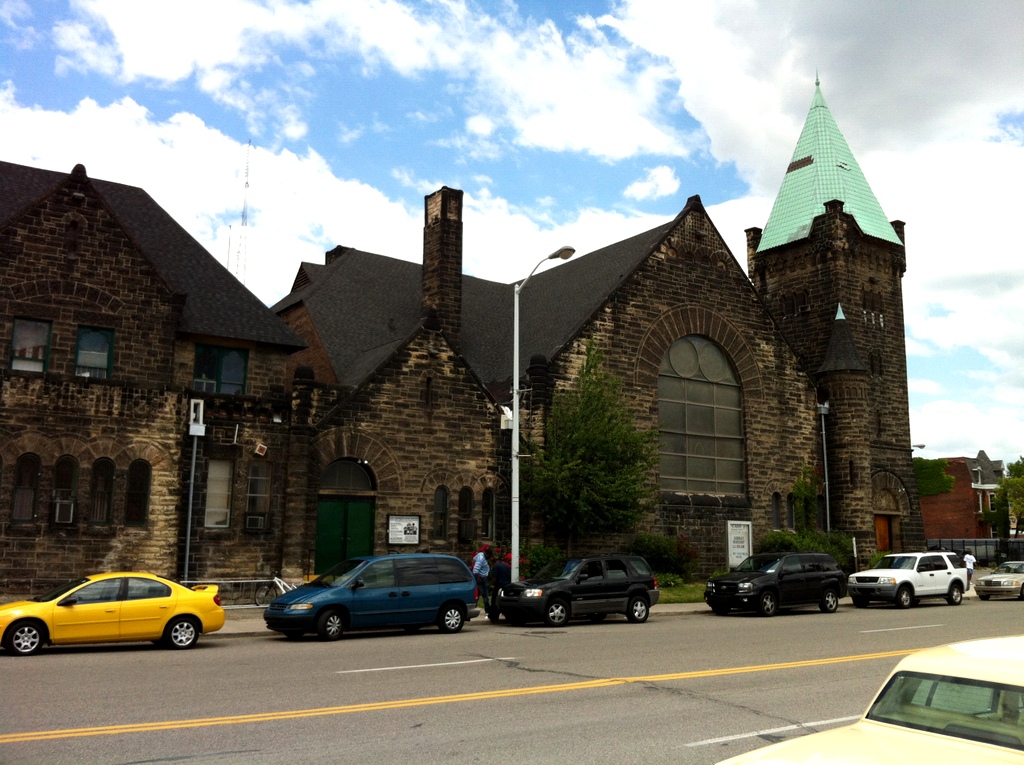
(Preached on June 10, 2012 at Cass UMC in Detroit, Michigan)
2 Corinthians 5.11-17

Therefore, knowing the fear of the Lord, we try to persuade others; but we ourselves are well known to God, and I hope that we are also well known to your consciences. We are not commending ourselves to you again, but giving you an opportunity to boast about us, so that you may be able to answer those who boast in outward appearance and not in the heart. For if we are beside ourselves, it is for God; if we are in our right mind, it is for you. For the love of Christ urges us on, because we are convinced that one has died for all; therefore all have died. And he died for all so that those who live might live no longer for themselves, but for him who died and was raised for them. From now on, therefore, we regard no one from a human point of view; even though we once knew Christ from a human point of view, we know him no longer in that way. So if anyone is in Christ, there is a new creation: everything has become new!

Prayer

The night was cold. My mother had remarked earlier that I was foolish to not bring a coat with me, and I knew she was right, but for some reason the frigid air was a welcome relief to my body. My footsteps stretched forth into the evening air hollow and empty, and I knew that I was alone. The sidewalk squares kept moving underneath my feet until I suddenly became immobile. The moving images of the late cold night abruptly stopped and I saw my breath in front of me. Unaware of what was about to happen, something pulled me down to my knees on the cold hard concrete and I began to pray like I never had before.

Earlier in the week Anna Ringer had died in a car accident. She was a beautiful and loving teenager who had the majority of her life still in front of her when it was taken from her. That cold night when I found myself walking alone, my friends and I had been mourning the loss of Anna. The evening had felt like a blur to me, it was Christmas time so everyone was wearing red and green, but I can barely remember who was there, or what we had talked about. What I do remember was that everyone came to me asking about what was going to happen to Anna now that she was dead. Though I had grown up in the church, I was ill equipped to answer the question, but I tried my best over and over again.

I had left the gathering that night without really saying goodbye to anyone; I floated out of the back door consumed in my own thoughts before I realized that I was actually going anywhere. And when I found myself on my knees under the cold blanket of the night, I began to pray to God.

I remained motionless as long as I needed to express everything to God that I needed him to know, and when I stood up I knew that God was calling me to the ministry and everything in my life would change.

Have you ever really felt transformed? Have you ever felt as if everything had been stripped away and you were a completely new person? Have you ever woken up one morning and everything was different? Maybe you felt that way when you got your first paycheck, or when you had your first child, or when you fell in love for the first time. There was clearly a moment, putting that first paycheck into your wallet, or cradling your child in your arms, or kissing your love for the first time, when you knew that nothing would ever be the same. It’s that feeling that Paul is talking about in his second letter to the Corinthians.

Written around 55 AD, 2nd Corinthians is filled with appeals, exhortations, threats, attacks, self-defense, self-praise, and irony. It is a confusing letter and presents a difficult argument to follow through continually. In the passage read this morning however, Paul is blunt and straightforward with his thoughts. The first point he makes is that…

“If we have been acting crazy, or ridiculous, or strange it is for God”

Being a Christian means willing to be considered crazy. Just think about it… We gather together regularly to partake in a meal of Jesus’ flesh and blood, we pray for our enemies, we serve the poor when we ourselves are often poor, we believe that because Jesus died for us we will be raised into eternal life. I can assure you that Paul was indeed crazy, or at least as crazy as any Christian is supposed to be. He insists in his 2nd letter to the Corinthians that there has only been one motive in all his work – to serve God and to help those in Corinth. When I think about Paul’s life, it makes sense that he would need to defend his sanity and motivations to the church. Remember, this is the man who had a stable and comfortable living persecuting the Christians, who then dropped everything and began to propagate the message that he was trying to destroy… there was a time when he had judged Jesus Christ by human standards, and in those days he had set out to blast the followers and to eliminate the Christian faith from the earth. Now his standards have changed. Now, having been in Christ the man who sought to rid the world of Jesus Christ was transformed to live his life to glorify the Lord. He had his own moment like I did on the sidewalk, where we both knew that nothing would ever be the same.

The second thing that Paul tells the Corinthians, and us, is that “Christ died, and therefore all have died.”

Let me say that again, Christ died, and therefore all have died… This is the plainest sentence in the bible that fully embodies the consequences of Christ’s death. Just as in the one Adam all have sinned, so Christ as representative for humanity died and therefore we have all died. So if we have all already died, what happens now? Paul tells us, that Christ died for all that those who live might live no longer for themselves. As 2nd Timothy 2.11 tells us: If we died with him, we shall also live with him; If we endure, we shall also reign with him”

We, as human beings, have value because Christ died for us. Whether or not people have responded to the grace of God, whether people pray at their beds at night or not, Christ died for everyone and are treasured by God. Everyone has value. Right now in this room I am standing here to assure you that you have value, that God has breathed into you the breath of life, that God truly loves you, and that we must all love one another. It is in our commitment to live for one another, just as Christ lived to die for us, that the new creation comes into being.

The final and third point Paul makes is that “If anyone is in Christ, there is a new creation.”

Many Christians have heard this sentence over the centuries and have believed that it is referring to a personal change in Christians. That if you accept Christ you will be made anew. However, just because you accept Christ you are not guaranteed a better life. Being in Christ does not mean that you will be given a job, or that your sickness will go away, or that suffering will cease. Paul does not say, “If anyone is in Christ, they are a new creation,” instead he says “If anyone is in Christ, there is a new creation.” This is not just about a personal change, but a transformation of the entire created order.

I know that I began this morning by talking about my personal call, the beginning of my walk with God toward ministry. In many ways it is very similar to what happened to Paul, but it is not what Paul is talking about in 2nd Corinthians. It is instead the reason why he and I feel called to the ministry at all.

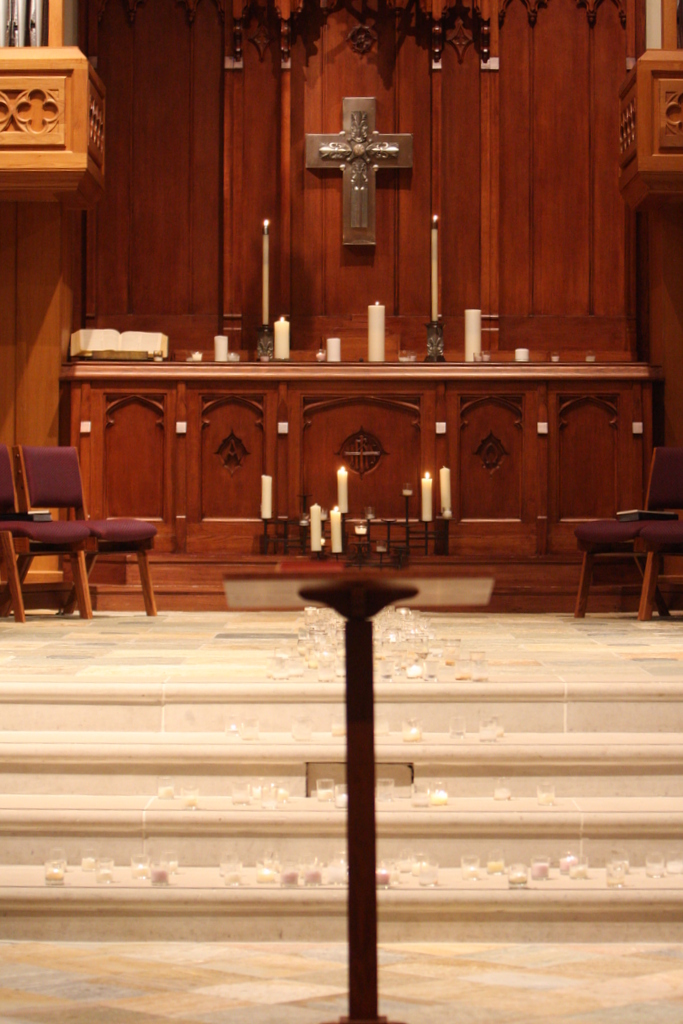
If we are in Christ there is a new creation; when we gather together this morning we are participating in the new created order of the kingdom of God. We are affirming that Christ has offered us a place where the entire world can be, and has already begun to be, transformed. CASS United Methodist Church and CASS Community Social Services are responses to the new created order established by Christ. When you take down this cross above my head and drag it through the streets of Detroit you are initiating the new creation. You are participating in the greatest gift ever given to humanity. You are making possible the existence of this reality.
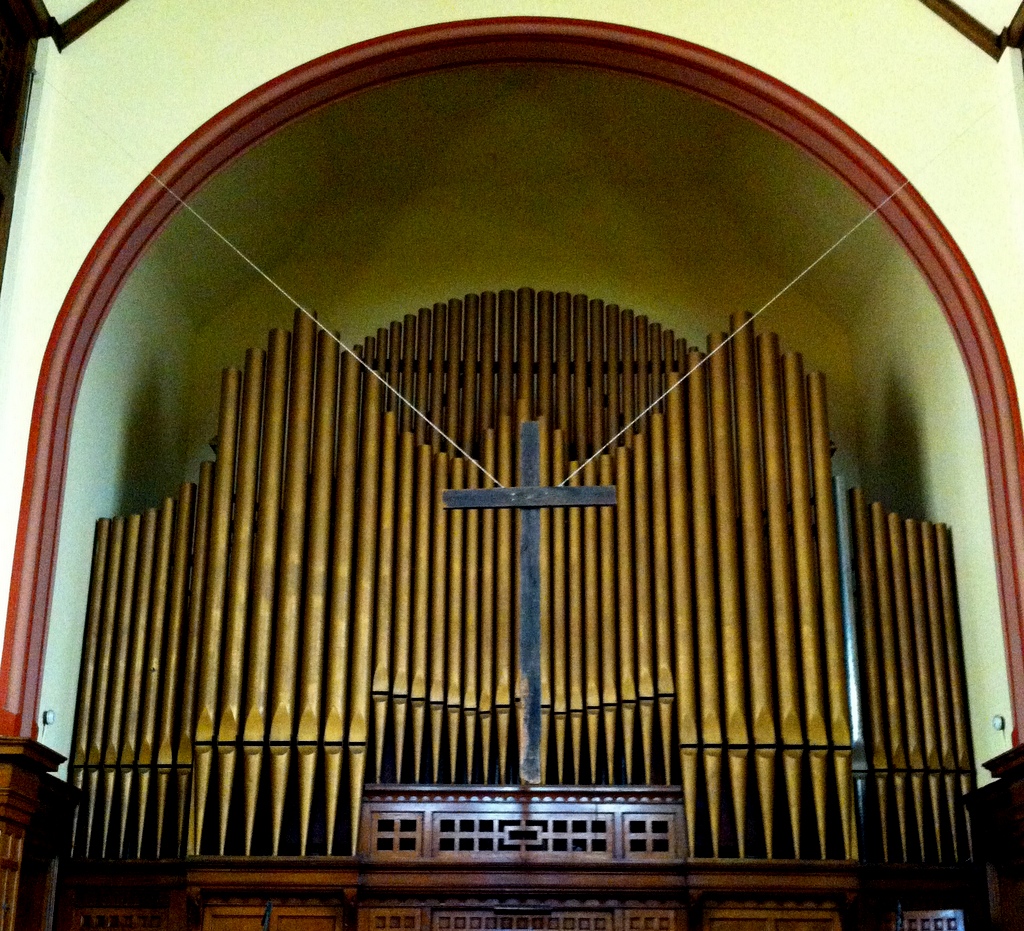
I have to warn you again that being in Christ will not fix all your problems; it will not give you a lucrative career, it will not provide you with a home, nor will it cure your diseases. Instead, being in Christ helps to create a new community, one like CASS, where the new creation can take place. That cold night when I prayed on my knees and responded to God’s call on my life, I did so because I believe in the good news of Jesus Christ. That the new creation is possible: where those who suffer can be taken care of, where the homeless can be given shelter, where the hungry can be given food, and where we can learn to live for one another.

Amen.

What Does This Babbler Want To Say? – Sermon on Acts 17.16-32

(Preached on July 15, 2012 at the Traditional Services at FUMC Birmingham)

Acts 17.16-32

While Paul was waiting for them in Athens, he was deeply distressed to see that the city was full of idols. So he argued in the synagogue with the Jews and devout persons, and also in the marketplace every day with those who happened to be there. Also some Epicureans and Stoic philosophers debated with him. Some said, “What does this babbler want to say?” Others said, “He seems to be a proclaimer of foreign divinities.” (This was because he was telling the good news about Jesus and the resurrection.) So they took him and brought him to the Areopagus and asked him, “May we know what this new teaching is that you are presenting? It sounds rather strange to us, so we would like to know what it means.” Now all the Athenians and the foreigners living there would spend their time in nothing but telling or hearing something new. Then Paul stood in front of the Areopagus and said, “Athenians, I see how extremely religious you are in every way. For as I went through the city and looked carefully at the objects of your worship, I found among them an altar with the inscription, “To an unknown god.” What therefore you worship as unknown, this I proclaim to you. The God who made the world and everything in it, he who is Lord of heaven and earth, does not live in shrines made by human hands, nor is he served by human hands, as though he needed anything, since he himself gives to all mortals life and breath and all things. From one ancestor he made all nations to inhabit the whole earth, and he allotted the times of their existence and the boundaries of the places where they would live, so that they would search for God and perhaps grope for him and find him – though indeed he is not far from each one of us. For ‘In him we live and move and have our being’; as even some of your own poets have said, ‘For we too are his offspring.’ Since we are God’s offspring, we ought not to think that the deity is like gold, or silver, or stone, an image formed by the art and imagination of mortals. While God has overlooked the times of human ignorance, now he commands all people everywhere to repent, because he has fixed a day on which he will have the world judged in righteousness by a man whom he has appointed, and of this he has given assurance to all by raising him from the dead.” When they heard of the resurrection of the dead, some scoffed; but others said, “We will hear you again about this.” At that point Paul left them. But some of them joined him and became believers, including Dionysius the Areopagite and a woman named Damaris, and others with them.

The weight of his own soul dragged behind him as he made his way through the city. It was now impossible to avoid the insults that were being relentlessly flung toward him: “What does this babbler want to say?” he heard them whispering behind his back, “He must be one of those who proclaims the foreign gods!”

He had spent the better part of the week waiting for his friends, and had had his soul crushed by the prevalence of idols strung haphazardly throughout the area. So, as was his custom, he made his way to the local synagogue to argue with the leading men. Beyond the walls of the synagogue he continued to debate with the elders of the city, many learned and important men, and he preached that which he knew to be true; as a result the city began to gossip of his proclamations: “What does this babbler want to say?”

He continued to wind his way through the curving corridors of Athens with his favorite story bouncing around his mind: Remembering every detail as it had been passed onto him – the way the water reflected the sun the day the heavens opened up, the stunned faces of family and friends after he had brought sight back to Bartimaeus, the feeling of cool water on their feet went he bent down to wash them… the same story that had gotten him in trouble again. After some time his fame spread around Athens in such a way that he was taken to the Areopagus to explain the new teaching he had been proclaiming.

“O people of Athens,” he shouted without trepidation, “it is clear to me how very religious you are in every way. I have spent much time exploring the detailed objects of your worship, and I was pleased to discover an altar dedicated to an unknown god!” The men of the Aeropagus smiled smugly with the approval of this young foreigner. But before they could truly congratulate themselves the man interrupted their musings – “What you choose to worship as unknown, this I proclaim to you! The God who made the world and everything in it, he who is Lord of heaven and earth, the one in whom we live and move and have our being, he who has fixed a day on which he will have the world judged in righteousness by a man whom he has appointed, and of this he has given assurance to all by raising him from the dead!” Immediately when the men of the Aeropagus heard of the resurrection of the dead some began to ignore him; but others said, “we will hear you again about this.” From his proclamations in the Areopagus some people from Athens began to join Paul and his quest to spread the good news of Jesus Christ.

What is it that makes a good story? Is it the abundance of detail, allowing the hearers to fully immerse themselves within the narrative? Is it live-action, or incredible irony, or beautiful love, or merciful forgiveness? Is it that little something that can resonate within every human being? Is it the way you tell it, or the simple facts of what happened? What is it that makes a good story?

One of my favorite things to do when I meet people for the first time is to ask them to tell me a story – a particular story, the story about how they met their spouse. Immediately upon entering Birmingham I put my favorite question into practice and quickly learned a lot about a lot of you. I have had the privilege to hear about a man, who working in a busy firm, called the cutest secretary, the one with the nicest legs as he put it, to go out on a date with him and she replied, “sure, but which one are you again?” Or there was the story about the girl who was shy in college and sitting with all her girlfriends at lunch watched transfixed as the most popular guy at school walked across the cafeteria to ask her out to dinner. The couple that had been friends for so long, in fact they rather enjoyed going on double dates with other people, until they eventually realized they had been in love the whole time. Or the man who was looking to worship at a Presbyterian church and accidentally walked into this church and met his wife that first morning when she poured him coffee in Fellowship Hall. Or the man and woman who after high school, met at a high school basketball game because there was nothing better to do in their town. Or the couple that met in a spousal grief group here at the church after having both lost their first partners.

I love to ask people to tell me this story, because they always tell it so well. They can remember the outfits they were wearing, the weather outside, and the other people who were present. They can describe the most vivid detail about that lovely first smile they saw, or the way their fingers felt when they wove them together for the first time. I have greatly enjoyed witnessing people laugh, cry, argue, and agree on these stories.

But sometimes I think about the Gospel story and I wonder how that connects to us. I freely admit that when I ask how you met your husband or wife I am not expecting anyone to start talking about Moses or Abraham or the Holy Spirit or Jesus or the Areopagus. But the Gospel story should be one that we know just as well. Many of you have been coming to church for your entire lives, and even those of you who have only recently begun to attend church, we gather together every week to retell the gospel story. Every Advent and every Easter we gather in such a way as to retell the birth, life, death, and resurrection of Jesus Christ. We cannot escape the story because it is our own.

I ask people about how they met, because it teaches me about whom they are. It helps to reveal parts and aspects of personality that would otherwise remain hidden, it sheds light on what brings people joy and how they connect to everything around them. But in the same way, the Gospel is who we are. It is as much a part of our personalities and joy and interconnections as the story about how we meet our spouses.

When Paul was called before the Areopagus in Athens, he was charged to tell the elites about “this new teaching.” This was nothing new for Paul. Acts tells us that after his conversion on the road to Damascus he stayed with the disciples and immediately began to proclaim Jesus in the synagogues saying, “He is the Son of God.” He went from a Christian-oppressor, to Christ-proclaimer. He was confronted by Jesus on the road and traded in his weapons of death, for the instruments of faith. The change in vocation from persecutor to apostle resulted in Paul dedicating the rest of his life to serving Christ. Just as with the Disciples, Jesus turned his world upside down. Paul quickly immersed himself into the life of Jesus and spread the story with vigor and passion. He later traveled to Jerusalem to learn from the apostles and continued to speak boldly about the Son of Man. The Holy Spirit then called Paul to Cyprus, Antioch, Iconium, Lystra, Athens, Corinth, and Rome all while he continued to spread the good news. It eventually became impossible for him to go anywhere without living out the story of Jesus Christ through his interactions and proclamations.

We should know the story of Jesus Christ in the same way Paul proclaimed it in Athens. I wonder if instead of asking how each of you met, I asked you to tell me the story of Jesus. Now I appreciate the loaded quality of that question because I am a seminarian and I’m supposed to know the scriptures. But if we take seriously our calling as Christians shouldn’t we be ready to stand before our own Aeropagus ready to proclaim Jesus? When Paul stood before that council he told them his favorite story – the same story we tell here every week:

That Jesus Christ was brought into the world as God incarnate; Born to the Virgin Mary in Bethlehem; reared in Nazareth; Baptized by John in the River Jordan; Called his disciples to drop everything and follow him; performed miracles by feeding the hungry, healing the sick, casting out the demons, clothing the naked; Told parables and stories about the kingdom of God; Turned the world upside down; Preached in Galilee; Prayed in Gethsemane; Suffered on Cavalry; and raised triumphantly; The good news of Jesus Christ.

You know this story, you’ve heard told over and over again. The challenge with the gospel is not one of knowledge. I have been so impressed with the amount of biblical and theological clarity in this church all summer – you know the story. The challenge with the gospel is that it requires us to reorient how we think and how we live. Confessing Jesus Christ as Lord and proclaiming the good news means that all other competing loyalties and practices must be set aside in order to begin a new life with him – That is why we gather together every week. We pray and we listen and we sing and we worship to help reorient our lives to God: “O for a thousand tongues to sing my great redeemer’s praise, the glories of my God and King, the triumphs of his grace! My gracious Master and my God assist me to proclaim, to spread through all the earth abroad the honors of thy name!

This morning as we gather together I want to be very clear with you, that I am not asking us to take up a modern Evangelistic agenda. I am not asking you to go knocking you on the doors of your neighbors to tell them the story of Jesus. I am not telling you to sit your children down and talk to them about ancient Palestine. But, I am asking us to think about how we should live our lives in such a way that the Gospel is fundamental for understanding who we are, just as fundamental as the story of how we met each other.


How would anyone know you are a Christian?


Maybe you have a cross on your necklace, or you pray together before you eat your meals at restaurants. I want people to know we are Christians by our love, by the way we talk and move and live. Paul tells us today that God is the one in whom we live and move and have our being. I want to show that in the way that I live my life.

If we take seriously what the scriptures tell us, the gospel is part of the very fiber of our being, it is inseparable from us the moment that God breathed into the breath of life. We are connected to it through the water in our baptism, through the bread and wine in our communion. It is in the hymns we sing and the prayers we pray. It is in our offerings and our service. It is in the mission programs and the committee meetings. The gospel is who we are!

Paul was willing to walk before the Areopagus in Athens because he believed in the good news. He understood the necessity of taking up the story of Jesus and living into it himself. It was his hope to show how God is not far from each one of us, that from our one ancestor God made all nations to inhabit the whole earth, and that God has given assurance to all by raising Jesus from the dead.

Walking into this building is itself an act of faith and courage, being a Christian is no longer revered as it once was. It is often mocked through the media and considered naïve by many. Coming to church now carries with it a stigma unknown throughout the history of Christendom. Truly I tell you, living out the gospel as you own story requires more bravery than anything else I know. It requires us to stand before the Areopagus every day of our lives.

What does this babbler want to say: Jesus the Christ preached in Galilee, prayed in Gethsemane, suffered on Cavalry, and was raised triumphantly. That is our story.

Amen.

Leaving The Cave – Sermon on 1 Samuel 24.1-7

(Preached on July 18 at the Wednesday Morning Service at FUMC Birmingham)

1 Samuel 24.1-7

When Saul returned from following the Philistines, he was told, “David is in the wilderness of Engedi.” Then Saul took three thousand chosen men out of all Israel, and went to look for David and his men in the direction of the Rocks of the Wild Goats. He came to the sheepfolds beside the road, where there was a cave; and Saul went in to relieve himself. Now David and his men were sitting in the innermost parts of the cave. The men of David said to him, “Here is the day of which the Lord said to you, “I will give your enemy into your hand, and you shall do to him as it seems good to you.” Then David went and stealthily cut off a corner of Saul’s cloak. Afterward David was stricken to the heart because he had cut off a corner of Saul’s cloak. He said to his men, “The Lord forbid that I should do this thing to my lord, the Lord’s anointed, to raise my hand against him; for he is the Lord’s anointed.” So David scolded his men severely and did not permit them to attack Saul. Then Saul got up and left the cave, and went on his way.

The cave was cold and dark. His fingers tapped lightly on the pommel of his sword in rhythm with his beating heart. The man who had threatened his life sat frighteningly vulnerable before him in the shadows. It would take only the simplest move, the slightest flick of the wrist and everything would change. As he unsheathed his sword his eyes fell upon the thinning hair of the man; he was close enough to sense the shaking anxiety within him and he brought his sword above his head to strike him down.

Just minutes before, he was sitting patiently with his cohort of loyal men surrounding him, yet the sight of a frail man’s body at the lightened end of the tunnel was enough to make the sweat begin to bead on his forehead. “Is that really him?” he thought to himself. His men crept closer and whispered to him, “Here is the day of which the Lord said that he would give your enemy into your hand, and you shall do to him as it seems good.” When the king finally sat down to relieve himself, near the entrance of the cave, David tightly gripped his weapon in one hand and began the quiet crawl towards his enemy. While he deliberately dragged himself across the cold damp floor, the memories of the past materialized in his mind.

He remembered the day so long ago that the prophet Samuel came to Bethlehem and poured the oil over his head and he felt the spirit of the Lord come upon him; that particular moment where his life took on a new path leading him eventually to the cave. He pondered about the first time he met the king who was now silently waiting in front of him- Saul was tormented beyond comprehension until the call went out for someone to come and play the lyre to sooth him. “I was the one,” he thought to himself, “I was the one called to help Saul and now look at what he has done to me! – Or the day of the great battle between the Israelites and the Philistines, I was the one who went forward to fight the mighty Goliath, I was the one who saved Saul and the kingdom from destruction!”

David’s pace continued slowly until the figure of Saul sat sharply before him. The days of flight had taken their toll on David. He had done so much for Saul and the kingdom, yet nothing could quench the wrath of Saul and David was forced to live as a fugitive. With his hand gripped tightly around Saul’s certain doom, David took his last step toward inevitability. Yet, in that moment, looking down upon Saul’s thinning hair, David was unable to do it. He crouched slowly down, and instead of taking Saul’s life; he took the corner off of his cloak with his sword and returned to his comrades.

After Saul finally left the cave, David made his way out into the brilliantly blazing sunlight. “My lord the king!” David cried out while prostrating himself on the ground. “Why do you listen to the words of those who say, “David seeks to do you harm? This very day your eyes have seen how the Lord gave you into my hand in the cave; and some urged me to kill you, but I spared you. I said, ‘I will not raise my hand against my lord; for he is the Lord’s anointed.’ See, my father, see the corner of your cloak in my hand; see this and know for certain that I have not sinned against you, though you are hunting me to take my life. May the Lord judge between me and you!”

“David?” Saul questioned. “You are more righteous than I, for you have repaid me good, whereas I have repaid you evil. Now I know that you shall surely be king, and that the kingdom of Israel shall be established in your hand.”

Although I doubt that many of us will have our enemies delivered before us in a damp dark cave, I think this morning’s passage from 1 Samuel truly resonates within us. How many times in our lives, perhaps in our careers or within our families, have we felt like David? I think it is so easy to commiserate with him in this story because we have all had moments where it seems like there is nothing we can do to fix the past.

If you will permit me to tell another story… When I was a sophomore in undergrad, my maternal grandfather came to visit me at school. While growing up he had always lived far away and we rarely spent time together, so knowing that he was coming to see me at school was a real treat. Upon his arrival we went out to a nice restaurant in Harrisonburg, Virginia in order to catch up and enjoy one another’s company. I was anxious in excited anticipation, but it became apparent that my grandfather had a specific purpose for our reunion. After we ordered our food, my grandfather made it very clear to me that he was disappointed in my desire to pursue a vocation in ministry. He claimed that Christianity had done more evil for the world than good, and that if I followed through with my education I would be wasting my life.

Ever since that night I shamefully admit that I have avoided my grandfather. Our little communication dropped to basically nothing. And we are at the point now where I think we are both too proud to admit that we have handled the situation terribly.

Just as with the relationship between David and Saul, my grandfather and I are in a difficult place. As I read the scripture over the last few days all I could think about was calling my grandfather and apologizing, apologizing for not loving him even though he doesn’t love what I do. So a few days ago I reached out, I made contact, and I apologized. I confronted my Saul in the sunlight beyond the entrance to the cave.

In giving his Son up to the cross, God reconciled humanity unto himself. God reached out to us, and beckoned us back within his saving embrace. Through the death and resurrection of his Son, God also reconciled each one of us to each other. For through one man, all will be saved; if Jesus forgave those who betrayed him, if David could forgive Saul, think about what we can be capable of. As you leave this morning I want you to think about the Sauls in your life. What would it take for you to reach out to that person? What would it take to confront that thing in your life that you cannot get past? As with Saul and David, and my Grandfather and I, it’s up to us to take the first step out of the dark cave and into the brilliant sun.

Amen.

The End? – Sermon on Mark 16.1-8

Mark 16.1-8:

“When the Sabbath was over, Mary Magdalene, and Mary the mother of James, and Salome bought spices, so that they might go and anoint him. And very early on the first day of the week, when the sun had risen, they went to the tomb. They had been saying to one another, “Who will roll away the stone for us from the entrance to the tomb?” When they looked up, they saw that the stone, which was very large, had already been rolled back. As they entered the tomb, they saw a young man, dressed in a white robe, sitting on the right side; and they were alarmed, But he said to them, “Do not be alarmed; you are looking for Jesus of Nazareth, who was crucified. He has been raised; he is not here. Look, there is the place they laid him. But go, tell his disciples and Peter that he is going ahead of you to Galilee; there you will see him, just as he told you.” So they went out and fled from the tomb, for terror and amazement had seized them; and they said nothing to anyone, for they were afraid”

The day broke gray and dull. The two Marys and Salome methodically packed the spices they purchased from the marketplace, and began the journey to the tomb. Leaving early, they had hoped to beat the heat of the sun, but as it rose the sweat began to bead on their skin. Their walk was slow, arduous, and particularly silent until Salome cleared her throat, “who roll away the stone for us from the entrance of the tomb?” Without responding, the women kept walking in silence, the events from the previous days still spinning chaotically in their minds. When they finally arrived at their destination, they stood amazed before the tomb, noticing that the stone had already been rolled back. Now fearful after discovering the large stone having been moved, they cautiously entered the tomb in order to anoint his body. Before their eyes could adjust to the darkness under the ground the hair on the back of their necks rose sharply as they noticed a young man, an angel, clothed in a white robe sitting on the right side. When the young man opened his mouth, the words resonated throughout the tomb, “Do not be alarmed; you are looking for Jesus of Nazareth, who was crucified. He has been raised; he is not here. Look there is the place they laid him. But go, tell his disciples and Peter that he is going ahead of you to Galilee; there you will see him, just as he told you.” His last words trailed off and were barely audible to the women because they had fled from the tomb in fear as the angel spoke to them. Terror and amazement had taken hold of them, and the chaotic notions in their heads had now taken hold on a single concept: fear. And they said nothing to anyone about what they had seen and heard, for they were continually afraid. The end. The end? Is this really the end? How can Mark possibly think this is the end of the story? There seems to be no resolution, there isn’t even a resurrection appearance from Jesus, how then can this be the end?

For 16 chapters Mark has narrated the story of Jesus the Christ, the Son of Man and Son of God only to come to a conclusion with: and they said nothing to anyone, for they were afraid. The final verse in the gospel has frustrated Christians over the millennia, leading many scholars to posit three interpretations: 1) This is not the end of the story because some of the earliest manuscripts happened to be ripped at exactly the same spot and we have lost Mark’s original ending forever; 2) This is not the end of the story because Mark somehow became incapacitated after he wrote these last words and was unable to finish, some claim that he had a heart attack with the quill in his hand; and 3) This is in fact the true end to the gospel. I believe in the latter proposal; that Mark knew exactly what he was doing when he ended.

This is a strange end, it leaves us the readers feeling uncomfortable, but so does much of the gospel! Mark is the evangelist who can paint a picture of a naked man fleeing the garden of Gethsemane; an episode so weird that Matthew and Luke chose to omit it (14.51). Mark is also the writer who portrays Jesus getting angry with a man who asks to be cured, and then throws him out after he healed him (1.41) Mark is the storyteller who shows Jesus cursing a fig tree simply because he does not find the expected fruit on it (11.12). And finally, Mark’s gospel is the one filled with Jesus performing countless miracles and signs of his messiahship only to continually forbid anyone from telling anything about what they have seen. Indeed this is a strange ending to a strange gospel.

Perhaps more unsettling than the peculiar and abrupt ending, is the fact that Mark chooses to finish the story with fear…

Three days before the women traveled to the tomb to anoint Jesus’ body, he had been marched up to Golgotha in order to be crucified. He was nailed to the hard wood of the cross and raised up for all to see. This was when the darkness came pouring out over the land. The day of Jesus’ crucifixion was the darkest day, the day that saw night twice. But now, on Easter morning, we are told that the sun has risen, perfectly timed with Jesus’ resurrection; the sun is supposed to show how the darkness of the crucifixion has been reversed. He is risen. Hallelujah! …But the women do not shout out in joy, instead they run away in fear. What then are we to make of this fear?

Throughout the Gospel there is a change within Jesus’ disciples whereby they move from obedience and courage, to fear and anxiety. When Jesus first saw Peter and Andrew fishing on the sea, he simply called to them and they left everything to follow him. The longer the disciples spent time with Jesus however, the more nervous they became; when at first they were content to listen and learn, they soon began to question their Lord. Even though they had dropped everything for Jesus, in the end they were unwilling to pick up their crosses to follow him because they were afraid. It is amazing that Jesus explained everything to them time and time again, yet they remained ignorant to what was taking place. Fear can be a blinding force if left to its own devices.

More powerful than the disciples’ fear are the times when Jesus was afraid. In Gethsemane Jesus was faced with the initial rejections of his disciples; he asked them to stay awake with him particularly in the waning hours of the night when he began to feel distressed, grieved, and agitated; He threw himself to the ground and prayed to God, yet, his disciples could not keep awake one hour. In the same way, as he marched up to Golgotha his disciples and closest companions had abandoned him. As he looked down from the cross with his life fading, Jesus exhibited the greatest moment of fear in his earthly life: Eloi Eloi Lama Sabachtanei?! My God my God why have you forsaken me?! … Just like the abrupt ending of the gospel, the moments where Jesus was afraid make us uncomfortable:

Last semester I took a class here at Duke Divinity with one of the leading world scholars on the Gospel of Mark. As we approached the end of the semester, and therefore the end of the Gospel, we spent one of our lectures discussing the moments of discomfort within the narrative. As we parsed through the Greek sentences describing the scene in the garden and the cry of dereliction from the cross, my professor became very frustrated and animated. We had spent the majority of the class trying to explain why Jesus might have acted or spoke the way he did and finally my professor could no longer take it. “It’s right here in black and white,” he said, “I don’t understand why you and so many scholars have spent their entire careers trying to soften or rationalize Jesus’ fears and frustrations. Why are we so afraid of Jesus’ fear? These moments, when Jesus is in the garden and when he hangs on the cross, they are my favorite moments in the entire Gospel! Do you know why? Because when Jesus weeps on his hands and knees in the garden, and sobs from the peak of the cross, that’s when Jesus is just like me…”

What I think my professor was trying to get at is the importance of what Jesus accomplishes through the cross. In perhaps his most deeply human moment, Jesus cried out in fear and anger from the cross because he had to. As the church fathers used to say, “what has not been assumed cannot be redeemed.” Jesus had to take on every human quality, even fear, in order to redeem humanity through his death. Let me put it this way: Jesus cried out in fear in his death, so that we don’t ever have to be afraid again.

I don’t know what you’re afraid of right now. Maybe you’re like Mary Magdalene and you feel like your life has been wasted and you’re not worthy of being loved. Perhaps you’re more like Peter and you think that you have been following Christ so perfectly all your life yet you continually fall short, and sometimes even deny him. I don’t know what you’re afraid of, but I do know that you no longer have any reason to fear.

The fleeing women at the end of the gospel present us with a vexing situation. Even though they had heard Jesus predict his death and resurrection, and even though the angel tells them that the promise has now come to fruition, they still run away from the marvelous news of the resurrection. I think what the women show us, is how not to react. I believe that Mark tells us about their fear to show us how faithful disciples need to have an opposite reaction: instead of running away, we should stand firm and proclaim the good news of Jesus Christ no matter what the cost.

I am not saying that fear will never strike us again; in fact I’m positive that it will. But, God’s gift of Christ on the cross has defeated sin, death, and fear. Fear cannot be the end of Jesus’ story.

As we come to the end of Mark’s account of the life of Jesus Christ, I think it is important to notice that there actually is no end. When we look back to the inception of the gospel, “the beginning of the good news of Jesus Christ,” we can see how the story in fact begins. But here we are two thousand years later, taking part in the good news of Jesus Christ. Our call as Christians is to take up where Mark left off.

This is the end of Mark’s story because it is the beginning of our discipleship.

Amen.

Thankful for Something Terrible – Sermon on Romans 5.1-11

Thankful For Something Terrible

Romans 5.1-11: Therefore, since we are justified by faith, we have peace with God through our Lord Jesus Christ, through whom we have obtained access to this grace in which we stand; and we boast in our hope of sharing the glory of God. And not only that, but we also boast in our sufferings, knowing that suffering produces endurance, and endurance produces character, and character produces hope, and hope does not disappoint us, because God’s love has been poured into our hearts through the Holy Spirit that has been given to us. For while we were still weak, at the right time Christ died for the ungodly. Indeed, rarely will anyone die for a righteous person – though perhaps for a good person someone might actually dare to die. But God proves his love for us in that while we still were sinners Christ died for us. Much more surely then, now that we have been justified by his blood, will we be saved through him from the wrath of God. For if while we were enemies, we were reconciled to God through the death of his Son, much more surely, having been reconciled, will we be saved by his life. But more than that, we even boast in God through our Lord Jesus Christ, through whom we have now received reconciliation.

“We boast in our sufferings, knowing that suffering produces endurance, and endurance produces character, and character produces hope, and hope does not disappoint us…”

Light poured in through the windows and heat radiated off of nearly every surface. The room felt suffocated yet contained a sort of brilliance. Decorative lamps, family photos, and comfortable furniture filled the space, but it was clear that everything had recently been re-arranged. Formerly a living room, the indents of old couches still remained in the carpet but had been replaced by a single cream colored lazy boy fully extended in the middle of the room. Enveloped in the chair was a little man, dressed comfortably with one of those airplane pillows tucked neatly behind his neck. As he softly snored in the afternoon warmth, his mouth was curved into a smile as if it was a permanent feature of his life, chiseled in by God from the very beginning.

Next to me sat a long-haired brilliantly bearded man on the verge of tears, hoping to keep everything together. “Dad,” he said, “Dad, wake up now, there’s someone here to see you. This here is Taylor, the intern staying with us this summer.” The little old man’s eyes began to lift, and he looked about in the room for this visitor. His eyes, clear and sharp, rested on mine penetrating deeper than I had expected. The smile from his sleep was gone, replaced by a brilliant grin that was infectious. I sat patiently smiling and staring back when he finally opened his mouth and disoriented me far more than the heat seeping through the windows: “Taylor, this cancer has been the best thing that ever happened to me.”

Rev. Willie Mac Tribble was dying of a brain tumor. He had given his life over to God’s call and was a United Methodist pastor who served ten churches over 40 years, but now every waking moment was a test of his strength, endurance, and courage. Simple movements resulted in lightning bolts of pain throughout his nervous system. Without his wife’s help everyday he would have been unable to get dressed, shaved, eat, or do much of anything. And here he was, nearing the end of his journey, thankful for something terrible.

In his letter to the church in Rome, Paul discusses the questions of salvation and justification as made possible through faith in Jesus Christ. In the reading from this morning however, Paul moves on from these questions to the consequences of faith in Christ Jesus. He emphasizes God’s love, Jesus as mediator of that love, and the reconciliation produced by that love. For Paul there was no greater sign of love than God in Jesus Christ dying on the cross for us while we were still sinners. Many of these words come to us at no surprise, we have heard this read aloud, preached upon, sung about, it even makes up part of the liturgy for the Lord’s Supper.

But perhaps most surprising in these eleven verses in chapter 5 is Paul’s discussion of the paradox of suffering that produces hope. Now the progression of suffering to endurance, character, and hope is something not unfamiliar to our modern culture. It is easy to pick up a book, search the Internet, or turn on the TV to a miraculous story of suffering that led to a renewal of life. Just think of Nelson Mandela who served 27 years in prison before serving as President of South Africa in the 1990s. Or just last week I watched a special program on ESPN about Kyle Maynard, a congenital amputee (born without arms or legs) who recently climbed Mount Kilimanjaro. Or maybe something a little closer to home: A few days ago I invited some of my friends here at school to gather in celebration of one of my favorite musicals. For two hours my companions suffered through Ted Neely’s falsetto portrayal of Jesus in Jesus Christ Superstar. They endured the theologically unsettling, harmonically frustrating, musical. They developed a new found sense of character defined by the rock anthems of the 1970s. And finally they found hope; hope that I would never make them watch it again. These stories are inspiring, laughable, tear jerking, and moving, but they fall short of Paul’s point.

Paul tell us that we boast in our sufferings, KNOWING that suffering produces endurance, and endurance produces character, and character produces hope, and hope does not disappoint us. But do we really KNOW this to be true? Does the man who recently lost his job and is no longer able to support his family KNOW what suffering produces? Does the child diagnosed with Leukemia KNOW what the suffering of Chemotherapy produces? Does the woman who found her teenager hanging by a belt around their neck KNOW what suffering produces? Where is the hope at the end of Paul’s homilectical device for those overwhelmed by suffering?

When we suffer, our pain is the only thing we see, the only thing we KNOW. We become blind to the glories of God’s creation because pain overshadows everything else. We are suffocated by what we cannot control.

What Paul is really talking about is a profoundly new reality; One where our hope is born out of our sufferings, not for anything that we can do, but for what someone already did.

Because of Jesus on the Cross:

We have been justified by faith, we have peace with God, we boast in the hope of sharing the glory of God, God proved God’s love for us, we will be saved from the wrath of God, we were reconciled to God, we were saved. Paul wrote these words in the first century because the church in Rome needed to hear them. So too, the church of the 21st century needs to hear these words.

God’s gift of Jesus on the cross and the outpouring of the Holy Spirit changed the dynamic of the world. Where else can we find this new reality if not the church?

When we gather, whether on Sunday mornings or during the week in Goodson chapel, I notice all these people who seem to have it all together. I think of the families who sit neatly together in their pews with the children dressed properly, hair combed, diligently working on their connect-the-dot Kids Bulletins. I consider my classmates who sit with palms outstretched, eyes wide, mouth curved into a smile, ready and eager to worship the Lord. I even reflect on our professors often knowing more about the scriptures than those up in the pulpit preaching yet still glorify the Lord in worship. I look around and sometimes I wonder what I can do to start looking like, acting like, praising like these people. The problem is that no one really has it all together. We all can get the kids ready for church, throw out our hands in praise, and study the scripture before the sermon, but this is only a façade. We think the church is the place where everyone should be perfect, all of the time. We spend our time in church pretending nothing is wrong in our lives.

In fact, I think we all pretend like our sufferings don’t exist.  Consider the call for Joys and Concerns in smaller congregations. How many times have you ever heard someone confess his or her own suffering and ask for help? In the churches I have worshipped in, we spend that time praying for someone’s neighbor named Bobby who broke his arm riding his bike, or an anonymous friend who lost their job. Why are we so afraid to name our sufferings?

Perhaps we are afraid because the church has become a marketplace for the exchange of trivial platitudes such as: “Oh don’t you worry about that, God has a plan for you,” or “As long as you believe, God will make all things right.” Or even: “I’ll be praying for you…”

In many ways the pews of our churches have become walls isolating us from the truths of one another’s lives, leaving us content to shake hands and forget about each other until next Sunday.

We have accepted the narrative of individuality where we are supposed to be isolated and alienated from one another. However, the Christian life demands that all humans are not essentially individuals, but are rather one. Being created in the image of God indicates how we participate in one another through our participation in God, for the image of god is the same in each of us. We have been baptized into ONE body!

The fact that we exist so individually, seeking to protect ourselves from other people, unwilling to confess our pain, is a sign that something has gone terribly wrong…

“Taylor,” Mac said, “this cancer has been the best thing that ever happened to me. For the first time in years people have been anxious to come visit with me. My sons and daughter, who would call once in a while, have been driving in to see me regularly. I’ve had old confirmands from decades past seek me out in these last days. Old parishioners have stopped picking up the phone to call, and instead get in their cars to come see me. I’ve never been so blessed in all my life”

Mac’s hope was not grounded in simple and kind platitudes. He recognized the gift of life and was honored by the visits from his past. Every time I talked with Mac, the pain of cancer was replaced by an admirable amount of endurance. I knew he was in pain, but all I could see was his character; character defined by a life of service to God. He had hope, not necessarily in the cancer being eliminated, but a hope in things to come. He believed in the message of the church to the world, the life, death, and resurrection of Jesus Christ. But most of all, Mac believed in love. For a man who spent his entire life loving others, it was fitting that towards the end, love was poured upon him in droves.

Christians must relearn to live in such a way that suffering is no longer ignored. We must not be afraid to admit in honesty how we are in pain. We are responsible to our brothers and sisters to help them endure through suffering. The pews of our churches must no longer be walls that divide us, but rather avenues that carry us to one another. When someone suffers the church must be the place where suffering can be named.

Mid toil and tribulation and tumult of our war,

We wait the consummation of peace forever more;

Till with the vision glorious our longing eyes are blest,

And the great church victorious shall be the church as rest.

We now on earth have union with God the Three in One,

And share though faith communion with those whose rest is won.

Oh, happy ones, and holy! Lord give us race that we,

Like them, the meek and lowly, on high may dwell with thee.

20 minutes after I left my Field-Ed placement on my final Sunday in Bryson City, Mac passed away. For five hours I drove across North Carolina remembering all the conversations and anecdotes I had had with Mac when we met. Yet, the one image that stuck with me on that drive, and one that I still think about everyday, was Mac’s smiling face. When I close my eyes now and imagine Mac comfortably resting in the afternoon sun, I know he was smiling because he had hope. The hope of sharing in the glory of God.

It was Christ who first suffered on the hard wood of the cross, endured through the agony of death, defined his character by love, all done in the name of hope. We must learn to boast in something that is wholly beyond our own powers: hope in God; hope in salvation. The church must become a place where our exultation is done for and in something beyond our own ability. By doing this, we will not let suffering and pain have the final word, but rather faith and hope in the God who delivered himself onto the cross while we were still sinners. Indeed, hope does not disappoint.

Amen.

Mark 16.8

Joel Marcus’ interpretation on the end of Mark’s Gospel:

Image

“Since Mark does not wrap up all the loose ends, we have no alternative but to return to the inception of his narrative, “the beginning of the good news of Jesus Christ” (Mark 1.1), and to start to read it again as our story. Mark’s gospel is just the beginning of the good news, because Jesus’ story has become ours, and we take it up where Mark leaves off.”

(Joel Marcus, Anchor Bible Commentary vol. 27a Mark 8-16, page 1096)

Image

Sermon on 1 Kings 6:1-13

1 Kings 6:1-13

“In the four hundred eightieth year after the Israelites came out of the land of Egypt, in the fourth year of Solomon’s reign over Israel, in the month of Ziv, which is the second month, he began to build the house of the Lord. The house that King Solomon built for the Lord was sixty cubits long, twenty cubits wide, and thirty cubits high. The vestibule in front of the nave of the house was twenty cubits wide, across the width of the house. Its depth was ten cubits in front of the house. For the house he made windows with recessed frames. He also built a structure against the wall of the house, running around the walls of the house, both the nave and the inner sanctuary; and he made side chambers all around. The lowest story was five cubits wide, the middle one was six cubits wide, and the third was seven cubits wide; for around the outside of the house he made offsets on the wall in order that the supporting beams should not be inserted into the walls of the house. The house was built with stone furnished at the quarry, so that neither hammer nor ax now any tool of iron was heard in the Temple while it was being built. The entrance for the middle story was on the south side of the house: one went up by the winding stairs to the middle story, and from the middle story to the third. So he built the house and finished it; he roofed the house with beams and planks of cedar. He built the structure against the whole house, each story five cubits high, and it was joined to the house with timbers of cedar. Now the word of the Lord came to Solomon, “Concerning this house that you are building, if you will walk in my statutes, obey my ordinances, and keep all my commandments by walking in them, then I will establish my promise with you, which I made to your father David. I will dwell among the children of Israel, and will not forsake my people Israel.”

Our scripture lesson this morning from the 6th chapter of the 1st Book of Kings appears nowhere in our lectionary. The lectionary, as many of you know, is a three-year cycle of scriptural readings used throughout numerous denominations. It is a wonderful tool that allows the church to examine much of the bible over three years, but it does not contain or examine the totality of the Biblical corpus. One of the passages missing from the lectionary is the entirety of 1 Kings 6 that details the construction of the Temple around the 10th century BC. When Jason contacted me at the beginning of the summer, asking me to preach this Labor day weekend, I was thrilled knowing that I would have the opportunity to share God’s word with my home church. But with his invitation came a caveat: you must pick a random, little known story from the Old Testament. So I figured that not only would I pick a random little known passage about the construction of the Temple, but also I would find one that is never read in churches according to the Lectionary. This is God’s Word for us. It contains the brilliance of creation, the formation of life, the grief of loss, and the necessity of love. Even in the mundane, God acts abundantly in our lives.

The Lord be with you.

Gracious God, may word the words of my mouth and the meditations of my heart be acceptable in thy sight, O Lord our Rock and our Redeemer. Amen.

Four hundred and eighty years after the Israelites had made their way out of Egypt, in the second year of Solomon’s Kingdom, the construction of the Temple in Jerusalem began. According to 1 Kings the Temple was to be built with cedar and cypress timber, great stones were to be quarried to lay the foundation, the inner altar was to be overlaid with gold, the inner sanctuary contained two cherubim of olivewood, each ten CUBITS high, etc. All in all, it took 7 years to complete the construction of the place that was to play an incredibly pivotal role in Israel’s future. When reading through this passage in 1st Kings it is as if the construction of the Temple marks the fulfillment of the Exodus story. The grandeur and level of detail in the biblical record is amazingly precise. This was not just an altar built in the wilderness to consecrate and celebrate a moment in the history of Israel, this was a Temple worthy of the Lord who had delivered His people from Egypt and established them in the Promised Land. In fact Solomon declares in the previous chapter that his father David could not build a house for the name of the Lord his God because of the warfare with his enemies that surrounded him. Solomon began construction because God had given him rest on every side; there were neither adversaries nor misfortune. Finally Israel had ascended to the level God had ordained for them.

This past year, my first of three working towards my Masters at Duke Divinity School was amazing. I took classes in Koine Greek, Church History [from Pentecost to the present day], the Old and New Testaments, and Forming Disciples in the Wesleyan Tradition. One of the primary emphases of Duke Divinity School is to fully immerse one’s self in the biblical, social, and theological works of which we are learning. In conjunction with our course load we are also required to meet regularly with spiritual formation groups. To balance our academic work we are required to work at a field-placements during the summers to give us the best education we can receive. One of the things that Duke offered me this past year, which has a direct connection with today’s scripture, was the DiVE tank. DiVE stands for Duke immersive Virtual Environment, a 6 sided virtual reality theater. All six surfaces, the four walls, ceiling and floor, are used as screens onto which computer graphics are displayed. For virtual worlds designed for this system, it is a fully immersive room in which the individual walks into the world, is surrounded by the display and is capable of interacting with virtual objects in the world. While studying the Old Testament, each student in my year was invited to an hour-long session in the DiVE tank where we would virtually explore the Temple from the time of Solomon. Thanks to the incredible detail provided by the writer of 1 Kings, researchers and computer programmers were able to reconstruct the biblical temple in a virtual medium whereby we, 3,000 year later, could travel through the Temple and see what it would have looked like. Upon entering the DiVE tank with some of my peers, my first impression was of the majesty of the Temple, especially in light of its surroundings. The Temple stood erect in a large open place, being built of massive stones, all lending to the perception that God was to dwell in this place indefinitely. We traveled through the outer perimeter examining the details within each room until we made our way to the holy of holies. There sat the Arc of the Covenant, surrounded by two cherubim each 15 feet tall by 10 feet wide. Even in a virtually projected reality, the experience of the Temple left me with Goosebumps. The Temple was a dark and mysterious structure, conductive to a sense of awe. It stood in a large open place, signifying its unique reflection of God. After being in the DiVE tank I began to understand how those walls seemed to guarantee that God would never wish to depart from Jerusalem.

Unfortunately they also encouraged those who saw them a few millennia ago to rely more on the outward symbols of God’s presence than on the pious performance of his commandments and the heartfelt loyalty to his covenant that his prophets continually demanded.

Solomon was able to create a situation, through the construction of the Temple, in which everything was already given, in which no more futures could be envisioned. He established a controlled, static religion through which God and the Temple became part of the royal landscape. The sovereignty of God was fully subordinated to the purposes of the king who compartmentalized the Lord into a building. This was the greatest sin committed by Solomon, he attempted to take the God of omnipotence, omnipresence and omniscience and limit him to a building on top of a hill. There was no longer a notion of God’s freedom to act out against the status quo. God had been affectively placed “on call” where access to him was controlled by the royal court. Passion had been removed from its connection to God.

It became obvious, therefore why the prophet Jeremiah would one day lash out against the Israelites screaming: “Do not trust in these deceptive words: This is the temple of Yahweh, the temple of Yahweh, the temple of Yahweh!” The Israelites had been so duped by the monarchy to believe that the temple contained more power than God himself! The prophet Jeremiah was given the unenviable task of reforming a nation who had placed all hope in a building rather than the mercies, love, depth, and brilliance of a living and magnificent God.

In Walter Brueggemann’s book Prophetic Imagination he draws connections between the reign of Solomon and our current Post-modern culture. Just as with the time of Solomon we live in an economic situation of affluence in which we are so well off that pain is not noticed and we can eat our way around it. Just as with the time of Solomon we see politics of oppression in which the cries of the marginal are not heard or are dismissed.

Brueggemann leaves it there, but I would go so far as to say that just as with the time of Solomon, WE find ourselves with a religion where God has been compartmentalized into our churches.

Let me explain. I love the church. I love this church. But I’m afraid of us believing that we can only find God in this building. Or maybe even worse, I’m afraid that we might only live out our faith when we are in this building. I’m sorry to have to tell you this, but it is not enough for US to just show up to church every week. I say US because this most assuredly applies to me as well. It is very easy being a Christian while at Divinity School. I am constantly surrounded by majestic buildings, scripture quoted above archways, like minded peers whose lives are oriented around the Gospel, learned professors who are known throughout the world, and a collective identity fixed towards the fulfillment of the Christian message. It truly is a wonderful atmosphere through which to learn about the Lord, the Word, and the World. The problem is, as soon as you get off campus, it’s so easy to forget your Christian identity.

Just this past Friday, I called Jason to complain about one of my classes this fall. Greek Exegesis of the Gospel according to Mark, where this week I have to translate the first 15 verses of Mark 1, read my professors introduction to the Anchor Bible Commentary to Mark [~100 pages] and read William Wrede’s The Messianic Secret to then write a 2,000 word review of the book. All of which are due by Thursday. When in actuality I have the greatest job in the world. I get to spend hours everyday learning and reflecting on the glory of God. This is not something to complain about, it is something to celebrate.

We are called to live out our faith in the world. Whether that means living out the Gospel outside the walls of Duke Divinity School, or simply loving our neighbors as ourselves. The role of the church is to reveal the Word of God so that we might know God. We then, in church, respond to God through worship. Finally we must take what we learn about God and proclaim it through our living! We come to know God through our lived experiences within the walls and especially outside of the walls of the church. Being a Christian is not a one-hour a week endeavor; it is about dying to the old self and being clothed in the new self where Christ is all and in all! [Col. 3] It’s about presenting ourselves as a living sacrifice, holy and acceptable to God. It’s about not being conformed to this world, but being transformed by the renewing of our minds [Romans 12]

God is not hidden in this building. Yes, God is reflected and resonated through aspects of our church. But we do not come here to find God alone, but to experience God and live out our lives through God as soon as we leave.

“Enter to worship; leave to serve.” This is a common phrase found on signs posted in and around churches. Doing the first part “enter to worship,” that parts easy. It’s leaving the church to serve the word of God, that’s the hard part.

In a few moments all of you will be invited to partake in the Eucharist. This practice of participation in the Lord’s Table is one that has been taking place for centuries. When we come to the altar to receive the bread and juice, we are not coming to simply be forgiven or joined together with other Christians. We are receiving the grace of God through the Holy Spirit so that we might leave this place being filled with that same grace.

We have the responsibility to proclaim and live out the Word of God in our lives.

In the adapted words of Cleophas LaRue, a homiletics professor at Princeton Theological Seminary:

Live out the Gospel when you are up and when you are down, when all is well and when all is hell, live out the Gospel when you are received and when you are nowhere believed, Live out the Gospel until sinners are justified, until the devil is terrified, until Jesus is magnified, and until God is satisfied!

In the name of the Father, Son, and Holy Spirit. Amen.

Sermon on Matthew 14:22-33

Sermon on Matthew 14:22-33

Immediately he made the disciples get into the boat and go on ahead to the other side, while he dismissed the crowds. And after he had dismissed the crowds, he went up to the mountain by himself to pray. When evening came he was there alone.

Jesus had just learned of the death of his cousin, friend, and fellow-minister John the Baptist. In wake of this news Jesus tried to get away from the crowds that had been following so that He might have some time alone. Yet, as is the case in the Gospel according to Matthew, as Jesus attempts to draw away from the crowd they continue to follow. Jesus commanded them to sit in the grass and after teaching them for hours and hours he prayed over the famous loaves and fishes that fed the multitudes. Our scripture lesson this morning takes place immediately after the feeding of the 5,000. Christ dismissed the crowds to their homes and compelled the disciples to get into their boat so that He might have some time to be alone. Jesus then went up to the mountain by himself to pray.

In our modern culture it is next to impossible to be alone or silent. Everywhere we look there is something to connect us with other people; Televisions, computers, cell phones. Silence […] makes us uncomfortable. And I believe that silence makes us uncomfortable because it reminds us of what it means to be alone. But, sometimes loneliness is necessary to meet God face to face.

There is an Old Testament story about the prophet Elijah who fled to Mount Horeb after killing the prophets of Baal. Elijah feared for his life and was hiding in a cave when the word of the Lord appeared to him and said, “What are you doing here Elijah?” God then commanded Elijah to go out and stand on the mountain for the Lord was about to pass by. Now there was a great wind, so strong that it was splitting mountains and breaking rocks in pieces before the Lord, but the Lord was not in the wind; and after the wind there was an earthquake, but the Lord was not in the earthquake; and after the earthquake a fire, but the Lord was not in the fire; and after the fire a sound of sheer silence, and there was the Lord.

People today often expect God to come in the spectacular, but God speaks loudest in the silence. In Elijah’s loneliness he was able to meet God on the mountain in silence. So too, Jesus, after feeding the 5,000 was able to meet his Father on top of the mountain by himself in silence.

We fear what it means to be alone, but truly I tell you, you are never alone. God abides with you in all that you do. The hard part is for us to slow down, quiet ourselves, and listen in the silence for the presence of God.

It was in a silent moment on Fort Hunt Road in Alexandria, Virginia late one December evening when I prayed to God and my call story began.

Jesus was intent on retreating away from his disciples so that he might be renewed for God’s will. In the mad rush of the death of John and the feeding of the 5,000 Jesus needed rest. True living is an alternation between rest and work, prayer and daily living.

I urge you to find silence in your life. Listen for God in those moments. You will be surprised by what you hear…

But by this time the boat, battered by the waves, was far from the land, for the wind was against them. And early in the morning he came walking toward them on the sea. But when the disciples saw him walking on the sea, they were terrified, saying, “It is a ghost!” And they cried out in fear.

Jesus had ordered his disciples and friends to enter the boat. The storm came not because the disciples had sinned or embarked on some foolish conquest, but while they were obeying Christ’s command. This is an important lesson for us. Storms come to the wicked just as much as they come to the righteous. Following Christ is a hard and difficult task, one that is often met with storms and tribulations. Being a Christian is about being responsible to your call even when the storms roll in. In this mystery of life we are often helpless without help from God. We find this help in Jesus Christ. Perhaps this is the reason storms come, because we are helpless and they help to orient us to Christ. It is easy to be afraid when the wind of life tortures you just as the disciples were terrified on the boat…

But immediately Jesus spoke to them and said, “Take heart, I am; do no be afraid.”

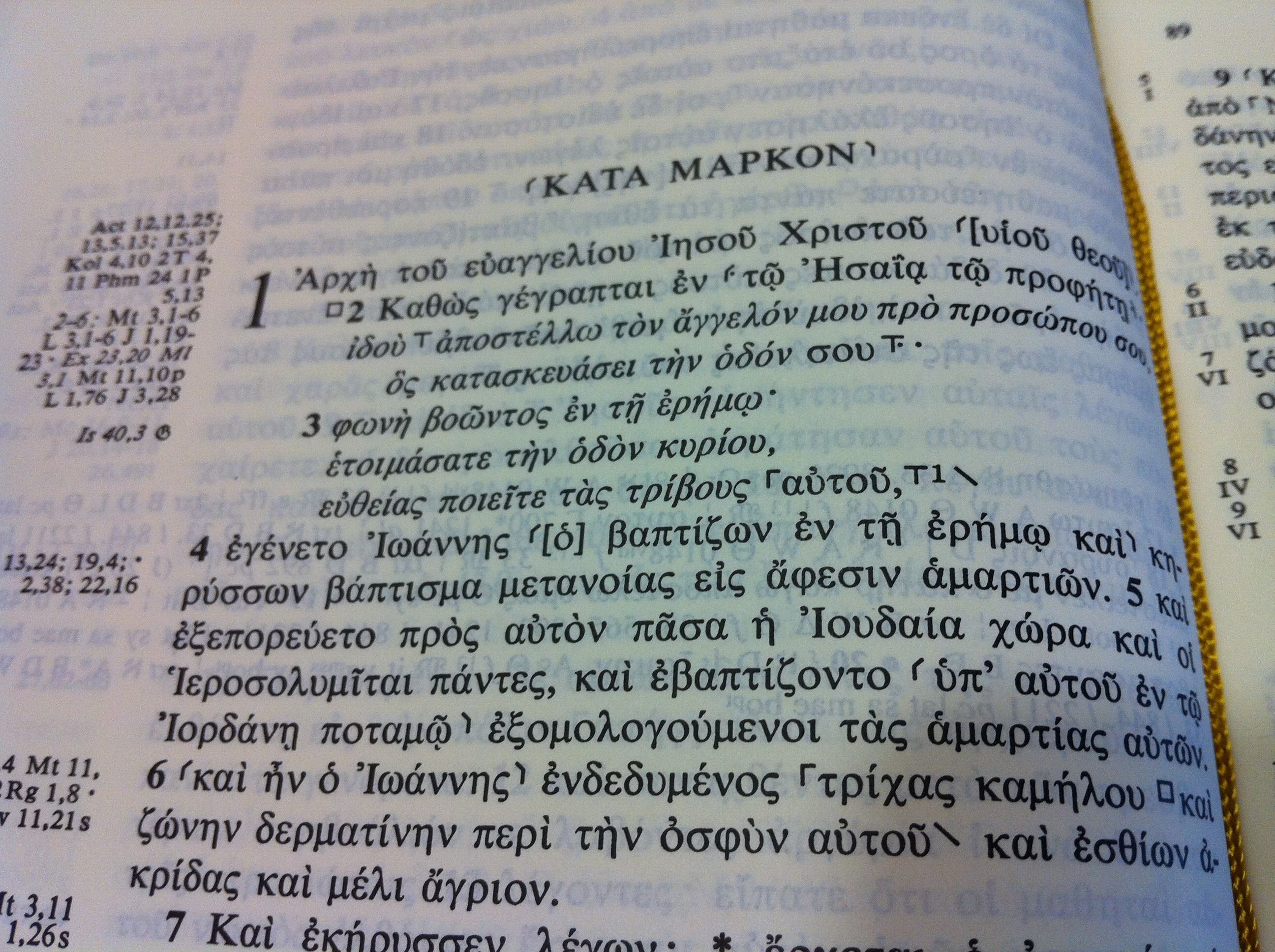
Upon first inspection it may appear that Jesus was just trying to reassure the disciples that he was not a ghost. “It’s okay guys, don’t worry, it’s just me Jesus, chill out.” But this is not what Jesus said. Rather, he said, Take heart, I am. This “I am” is not only a clarification of who was walking on the water, but rather a direct connection to God Himself. In Greek the “I am” is rendered as ἐγώ εἰμι a specific reference to the Great I Am of the Old Testament when Moses met God in the burning Bush. Throughout the scriptures, the ἐγώ εἰμι is used for the self-disclosure of God. In the Gospel according to John, when the soldiers came to arrest Jesus in the Garden of Gethsemane they asked for Jesus, to which Jesus replied ἐγώ εἰμι and immediately they all, the disciples and the soldiers together, fell to the ground before him. ἐγώ εἰμι is a powerful expression throughout the Gospels and cannot be over-looked. When the disciples feared for their lives Jesus reassured them that they need not worry because He Is.

Peter answered him, “Lord, if it is you command me to come to you on the water.” He said, “Come.” So Peter got out of the boat, started walking on the water, and came toward Jesus. But when he noticed the strong wind, he became frightened, and beginning to sink he cried out, “Lord, save me!” Jesus immediately reached out his right hand and caught him, saying to him, “You of little faith, why did you doubt?”

Eager Peter, ready to answer all of Jesus’ questions and prove his devotion often leapt before he looked. I will not call this a naive faith, but Peter certainly trusted in his own ability more than Jesus’. So, why is it that Peter’s faith failed him and he began to sink? He certainly believed he could do it, or he wouldn’t have gotten out of the boat. It is precisely when Peter’s takes his eyes and orientation OFF of Christ that he begins to sink. Faith is at its very strongest when its eyes are fixed on Christ.

A few weeks ago I heard a remarkable sermon here at Bryson City UMC by Wilma Reppert about orienting our life around Jesus. She used a story about horizon driving to demonstrate how through orientation on Christ our lives might be more fulfilling. She could not have been more right. In fact, Peter would have done better that day on the water if he had heard Wilma’s sermon before he walked out to Jesus. Where Peter’s faith was weakened and distracted, Christ’s faith was unaltered. Christ immediately reached out to Peter to catch him before he sank.

This is the exact same way that Christ exists with us today. Truly I tell you storms are brewing and Christ is still calling to us saying, “Come.” When we take our eyes off of Jesus we might begin to sink into the destructive power of the world, but Christ’s faith in US in unchangeable. He will always stand there on the water with his outstretched hand, waiting for us to recognize our connection with Peter.

When they got into the boat, the wind ceased. And those in the boat worshipped him, saying, “Truly you are the Son of God.”

Here again we can see how God speaks to us in the silence. I imagine that the storm was a terrifying thing for the disciples to experience, but I guarantee that the calm that was instituted after the storm, the silence after the wind, was profoundly more tangible for the disciples. It was in the silence after the storm that God’s presence through Jesus Christ was made manifest. Jesus had already called attention to his divine nature through his ἐγώ εἰμι, but the calm water after Peter’s episode must have been the final proof necessary. Matthew tells us that the disciples worshipped Jesus once He and Peter returned to the boat. In Greek the word is προσεκύνησαν, which does mean worship, but also carries the connotation of prostrating oneself in reverence. This is the exact same thing that happened in John’s Gospel in the Garden. When Jesus says ἐγώ εἰμι they all προσεκύνησαν, fell before him.

The disciples finally got it. They finally realized just whom it was that they were following. This was not just a man who had to the ability to work miracles and tell incredible stories. This man is the Son of God. This man is ἐγώ εἰμι.

In a few minutes you will be invited to participate in the Lord’s Supper. If you take anything away from this sermon I hope it is this: The Eucharist is one of, if not the most, fundamental ways of understanding whom Jesus is. It is our way of walking to Jesus out on the water. As you prepare to receive the meal, consider how paralleled our story is with the scripture lesson today. I am sure that many of us want Jesus to appear in our lives through a magnificent fashion, just like Elijah. I am sure that some of us try so desperately to hear God and are often met with silence. I am sure that some of us have doubts. But we also have faith, faith in the message, life, death, and resurrection of Jesus Christ.

This is why we gather together as a community, to live into the new reality of Jesus Christ, through the Kingdom of God. We follow Christ because he stands before us walking on the water asking us to come.

Take Heart my brothers and sisters. Jesus IS! Do not be afraid.

Truly He is the Son of God

I offer this to you in the name of the Father, the Son, and the Holy Spirit. Amen.

Sermon on Matthew 11:16-19, 25-30

Sermon on Matthew 11:16-19, 25-30 from July 3rd 2011 at the River of Life service on the Nantahala

Matthew 11:16-19, 25-30

“But to what will I compare this generation? It is like children sitting in the marketplaces and calling to one another, “We played the flute for you, and you did not dance; we wailed, and you did not mourn.” For John came neither eating nor drinking, and they say, “He has a demon”; the Son of Man came eating and drinking, and they say, “Look, a glutton and a drunkard, a friend of tax collectors and sinners!” Yet wisdom is vindicated by her deeds.

At that time Jesus said, I thank you, Father, Lord of heaven and earth, because you have hidden these things from the wise and the intelligent and have revealed them to infants; yes, Father, for such is your gracious will. All things have been handed over to me by my Father; and no one knows the Son except the Father, and no one knows the Father except the Son and anyone to whom the Son chooses to reveal him.

Come to me, all you that are weary and are carrying heavy burdens, and I will give you rest. Take my yoke upon you, and learn from me; for I am gentle and humble in heart, and you will find rest for your souls. For my yoke is easy, and my burden is light.”


Sermon: The Yoke of Jesus

“For my yoke is easy, and my burden is light”

I don’t know about you, but I’m having a difficult time with the end of this passage. “Take my yoke upon you, because its easy and light” Maybe when Jesus was addressing the crowds that day he forgot about so many of the other things he had been preaching about…

“Blessed are you when people revile you and persecute you and utter all kinds of evil against you on my behalf”

“If your right eye cause you to sin, tear it out and throw it away”

“Do not resist an evildoer, if anyone strikes you on the right cheek, turn the other also”

“Love your enemies and pray for those who persecute you”

Doing all that seems pretty hard to me, and those verses are only from one chapter in Matthew’s Gospel… So how is it that in today’s passage Jesus tells us that His yoke is easy and light?

Before we try and wrestle with that question, let us first look at what a yoke is. In its most basic form a yoke is a piece of wood that hangs around the necks of animals as they carry a plow through fields, or the shoulders of a human as they carry objects. Throughout the OT, a yoke was used metaphorically to explain certain Jewish customs. Following the Law, or the Torah, was described as wearing a yoke; it was difficult but it had rewards. The people of the OT lived in a nearly complete agriculturally based economy, and the image of the yoke was one that everyone could associate with. They would have been able to tangibly imagine the yoke of the oxen carrying a plow through a field, or remember the feeling of the wood digging into their back as they carried buckets of water. Though the yokes produced some level of suffering, they were also responsible for accomplishing something, for instance a plowed field ready for planting or water for the family.

For a modern rendering of a “yoke” we might consider our email inboxes. Email is necessary for accomplishing many tasks, but at times it can be such a burden, sifting through all your messages, responding to those that are most necessary, and worrying about those we keep putting off. Just like the yoke of the Old Testament, I think we can all tangibly imagine our inboxes and the stress that often accompanies them.

So, back to Jesus then, how can his “yoke” be easy? Imagine Jesus emailing you and asking if you have been turning the other cheek, giving away your possessions, and loving your enemies. Would you be able to respond with assurance, or would you let that email simmer in your inbox for a while?

The wearing of the yoke, as viewed in the OT, was the outward sign of an inward relationship. By obeying the laws of the covenant: circumcision, dietary laws, animal sacrifice, and so forth, each person was testifying to the inward life of holiness with God. In this morning’s passage, Jesus is offering a different yoke than the harsh legalistic system of Torah.

Jesus came to know his father the way any good Son does; not by studying books about him, but by living in his presence, listening for his voice, and learning from him as an apprentice does from his master, by watching and imitating. When Jesus addressed the crowds that day he had already discovered that the wise and learned were getting nowhere, and the ordinary people, in fact the less than ordinary: sinners, tax collectors, were discovering God simply by following Him.

This is a radical shift in perception from the metaphors of the O.T. Jesus’ yoke comes from his mercy and love, rather than strict obedience to law codes. In this way Jesus presents a wonderful paradox; by placing on our shoulders the yoke of Christ we are given a profound freedom. The burden that Christ wanted to free his followers from is the burden of religion. The Jewish people of Jesus’ day predicated their lives on obedience to the Torah. They lived and breathed the Hebrew Scriptures and lived by and through them. Your relationship with God was defined by how you followed the rules. Throughout the Gospels we see evidence of this: most of the questions asked of Jesus reflect this mentality. Teacher, what is the greatest of the commandments? Teacher, how might I inherit eternal life? Teacher, how can we sit at you right and left in your kingdom? Though he had continually answered their questions, they never seem to quite get it. Finally, after rebuking them for ignorantly missing the point, Jesus tells the crowds “Take my yoke upon you, and learn from me; for I am gentle and humble in heart, and you will find rest for your souls.” Simple.

Just as Jesus hoped to free his followers from the burden of religion in the first century, I think his message is still incredibly pertinent today.


Now I know that this sounds ridiculous, because if Christianity is a religion, then why would Jesus want to free us from it?

Today, people are still living out their Christian lives based upon a legalistic system. I cannot tell you how many people ask me nearly the same questions asked of Jesus in the Gospels: Taylor, what do I have to do to get Jesus to love me? Taylor, how am I supposed to pray? Taylor, how can I get into heaven? All these questions are based on the assumption that there is a finite list of duties necessary to be completed for fruition.

Religions, in this light, are based upon laws and affirmations. They demand ritual activities, dogmatics, and strict moral obedience. The laws of religions are they greatest attempt that mankind has ever made in the hope of overcoming anxiety and fear by promising immortality for following guidelines. Religions are often created to help explain the unexplainable. This is exactly what Christ wants to free us from, but it is also very difficult to let go of. It is easy to follow a checklist version of religion, maintaining a “perfect” life based upon following rules and creeds, but it is absolutely impossible to follow all of them. We see this everywhere, in every religion, groups of people under innumerable laws, which they cannot fulfill. They either flee from these rules, or they change them to fit their situation. This is why the church is not universal. We have accepted a legalistic version of Christianity at the expense of destroying the very fabric of what it meant to be Christian: lived reality.

Christianity is not supposed to be a religion. Following Jesus is not about following guidelines or rules but living into a new reality. We follow Christ not because he established a new religion, but because He is the end of religion. He transcends religion. He is above religion. Christ did not come to institute new laws, but to fulfill the law. We spread the call of Christ not for ourselves, but rather so that we can exist beyond ourselves.

We must recognize that following Christ is more about “being” than it is about “doing.” Action follows being. Try to imagine a world where souls were really at rest, imagine the amount of good that could flow forth from people whose souls were finally unburdened, imagine the stress of your life floating away.


Two summers ago I took a group of college students to Taize, and Ecumenical Monastery in Burgundy, France. Taize is a place where thousands of young people gather every summer to experience a monastic lifestyle. When we arrived, there were 5,000 other young adults from all over Europe camping out in the French countryside.

The only requirement of the people staying at Taize, is to participate in the prayerful worship services three times a day: morning, noon, and night. We would enter a sanctuary and sing from a hymnal written in every language imaginable so that each person could understand the words and participate with the whole. After spending a few days at the monastery one of my goods friends pulled me aside after the morning worship and said to me, “Taylor, do you know why I like it here so much? I like it here because no one is telling me what to do. There is no preacher in a pulpit shaking his finger at me or trying to cram some moral code down my throat. I know the stories about Jesus, and this to me feels like what it should be. I like it here because I simply get to be.”

Now, I’m not advocating for us to institute a life of monasticism in our lives, but I think we can learn a lot from the Taize community. For them, the emphasis is on one’s being. They spends their time in daily worship so that they might reorient their being, and from that a new creative life flows forth. Taize is a uniquely wonderful place, but we can also bring it to our own lives.

Truly I tell you, it will be difficult following Christ. Putting on his yoke is just like taking up your own cross to follow him; sometimes it will hurt and it will be hard. But, when Jesus calls us to come to him when we are weary with heavy burdens, he is not only calling us to Himself, but to the living community of his body, the church. When I say church here, I don’t mean big steeples or even Slow Joe’s café; I mean the people you are sitting next to. One of the most revolutionary parts of Jesus’ ministry was calling us to live for one another. He did not call us to Christianity, but he called us to a new sense of being.

You don’t need to wise and intelligent to find Jesus. You don’t need to be a theologian or scholar to know who He is. No amount of knowledge or intellect will ever compare to the rest that we can find through faith in Jesus. Following Christ is about humbling yourself like a child, living into a new and blessed reality, looking upon the world in an unbiased manner, loving those around you, and experiencing God as you experience life.

Come to Jesus.

If you are weary and carrying heavy burdens, bring them to Christ.

Forget everything; doctrines, creeds, beliefs, doubts, achievements, failures

Take a breath and consider your “being”

Nothing is demanded of you, no conceptions of God, and no goodness in yourselves, not your being religious, not your being a Christian, not your being intelligent, and not your being moral. But what is demanded is only your being open and willing to accept what is given to you, a new being, the being of love and justice and truth, as it is manifest in Jesus whose yoke is easy and whose burden is light.

John Wesley, from whom came United Methodism, preached a sermon in London once about “the one thing needful.”

The one thing needful, Wesley said, was the restoration of the image of God that was implanted within each of us in our unique lives. I can think of no greater way to restore the one thing needful, the image of God in our lives, than finding rest in Jesus.

I offer this to you in the name of the Father, the Son, and the Holy Spirit.

Amen.

Thoughts on Ulysses by James Joyce

I love to read.

I love to read classics.

I love to go to used bookstores, purchase books from my favorite authors, and add them to my collection.


For some time now I have been keeping a “Bucket-List of Books to Read” and Ulysses by James Joyce has always been at the top of the list. Every time I read one of those lists of “100 Books to Read Before You Die,” I always found Ulysses near the top, and decided that I needed to conquer this behemoth.

My copy of Ulysses is 783 pages long, and is filled with Joyce’s infamous stream-of-consciousness writing style. The novel follows the protagonist Leopold Bloom through Dublin on a normal day [June 16th, 1904].

I started to read Ulysses during one of my first days at my appointed Summer-Internship and finished it in three weeks. Below I will describe some of my interpretations of the book and present some memorable passages.


Warning: If you have any desire to ever read Ulysses, there will be spoilers in the next few paragraphs. They will not necessarily ruin the book for you; in fact, they might actually help you decipher Joyce’s difficult prose. But, fair warning nonetheless.


Ulysses is a very difficult book to read.

In 1933, the Honorable John M. Woolsey famously lifted the ban on the publication of Ulysses in the United States and had this to say about the novel:

“I have read Ulysses once in its entirety and I have read those passages of which the Government particularly complains several times. In fact, for many weeks, my spare time has been devoted to the consideration of the decision, which my duty would require me to make in this matter. Ulysses is not an easy book to read or to understand. […] It is brilliant and dull, intelligible and obscure by turns. In many places it seems to me to be disgusting, but although it contains, as I have mentioned previously, many words usually considered dirty, I have not found anything that I consider to be dirt for dirt’s sake. Each word of the book contributes like a bit of mosaic to the detail of the picture that Joyce is seeking to construct for his readers.”[Excerpts from The United States District Court, Southern District of New York: United States of America Libelant v. One Book called “Ulysses” Random House, Inc., Claimant. Opinion A. 110-59]


I read this selection from Judge Woolsey before I began to read the novel, and after finishing it I realized how right he was. At times the narrative was incredibly brilliant and simultaneously dull. It contained disgusting passages that were painful to push through, supported by sections of beautiful and descriptive prose. There were countless times where I was convinced that I understood the narrative flow only to realize that I was completely blind to the actual story, and there were stretches of pages [sometimes 40 or 50 pages] where I had absolutely no idea what was actually taking place. Joyce’s style of writing weaves in between his characters in such a flawless manner that one become lost in the sea of language and it becomes difficult to discern each character’s thoughts, actions, and spoken words. Reading Ulysses was a long a difficult process. I became incredibly attached to the flawed protagonist Leopold Bloom and was deeply hurt by the novel’s conclusion. After spending so much time, and brainpower, attempting to discern Joyce’s writing technique I began to deeply appreciate the narrative. It took a week or so, and a couple hundred pages, for me to suddenly comprehend the novel’s flow.

For as difficult as it was to understand and complete the book, it was by far one of the greatest pieces of literature I have ever read. Joyce’s parodies, puns, and prose create the most magnificent mural of a monotonous day in the life of Leopold Bloom. The reader learns not only of the rich narrative detail of Bloom’s typical day, but we are also invited into the mind of this character, learning his thoughts, desires, failures, and musings. He is assuredly flawed. Through his thoughts and interactions it is clear that Bloom is weak, obsessive, broken, and lost to the temptations of life. But, I grew attached to him. I rooted for him. From his decision to purchase a pork kidney for breakfast to his erratic night under the influence of Absinthe, Bloom was a rich character that I loved following.


Ulysses is a book that most people should try to read. It will be difficult, but the rewards are wonderful. Since completing the book, I have not been able to quit thinking about it, and upon completion the story as a whole actually makes sense.


Below I have listed some of the more memorable passages from Ulysses:


One of the hardest passages:


“Bronze by gold heard the hoofirons, steelrining imperthnthn thnthnthn.

Chips, picking chips off rocky thumbnail, chips. Horrid! And gold flushed more.

A husky fifenote blew.

Blew. Blue bloom is on the

Gold pinnacled hair.

A jumping rose on satiny breasts of satin, rose of Castille.

Trilling, trilling: Idolores

Peep! Who’s in the … peerofgold?

Tink cried to bronze in pity.

And a call, pure, long and throbbing. Lonngindying call.

Decoy. Soft word. But look! The bright stars fade. O rose!

Notes chirruping answer. Castille. The morn is breaking.

Jingle jingle jaunted jingling.

Coin rang. Clock clacked.

Avowal. Sonnez. I could. Rebound of garter. Not leave thee. Smack. La Cloche! Thigh smack. Avowal. Warm. Sweetheart, goodbye!

Jingle. Bloo.

Bloomed crashing chords. When love absorbs. War! War! The tympanum.

A sail! A veil awave upon the waves.

Lost. Throstle fluted. All is lost now.

Horn. Hawthorn.

When first he saw. Alas!

Full tup. Full throb.

Warbling. Ah, lure! Alluring.

Martha! Come!

Clapclop. Clipclap. Clappyclap.

Goodgod henev reheard inall.

Deaf bald Pat brought pad knife took up.

A moonlight nightcall: far: far.

I feel so sad. P.S. So lonely blooming.

Listen!

The spiked and winding cold seahorn. Have you the? Each and for other plash and silent roar.

Pearls: when she. Liszt’s rhapsodies. Hissss.

You don’t?

Did not: no, no: believe: Lidlyd. With a cock with a carra.

Black.

Deepsounding. Do, Ben, do.

Wait while you wait. Hee hee. Wait while you hee.

But wait!

Low in dark middle earth. Embedded ore.

Naminedamine. All gone. All fallen.

Tiny, her tremulous fernfoils of maidenhair.

Amen! He gnashed in fury.

Fro. To, fro. A baton cool protruding.

Bronzelydia by Minagold.

By bronze, by gold, in oceangreen of shadow. Bloom. Old Bloom.

Onerapped, one tapped with a carra, with a cock.

Pray for him! Pray, good people!

His gouty fingers nakkering.

Big Benaben. Big Benben.

Last rose Castile of summer left bloom I feel so sad and alone.

Pwee! Little wind piped wee.

True men. Lid Ker Cow De and Doll. Ay, ay. Like you men. Will lift your tschink with tschunk.

Fff! Oo!

Where bronze from anear? Where gold from afar? Where hoofs?

Rrrpr. Kraa. Kraandl.

Then, not till then. My eppripfftaph. Be pfrwritt.

Done.

Begin!”


Favorite Lines:


History, Stephen said, is a nightmare from which I am trying to awake.


A man of genius makes no mistakes. His errors are volitional and are the portals of discovery.


Love loves to love love.


But it’s no use, says he. Force, hatred, history, all that. That’s not life for men and women, insult and hatred. And everybody knows that it’s the very opposite of that that is really life. What? says Alf. Love, says Bloom. I mean the opposite of hatred.