Devotional – Matthew 14.28-31

Devotional:

Matthew 14.28-31

Peter answered him, “Lord, if it is you, command me to come to you on the water.” He said, “Come.” So Peter got out of the boat, started walking on the water, and came toward Jesus. But when he noticed the strong wind, he became frightened, and beginning to sink, he cried out, “Lord, save me!” Jesus immediately reached out his hand and caught him, saying to him, “You of little faith, why did you doubt?”

Weekly Devotional Image

I love asking questions. Whether I’m sitting around the dining room table with family and friends or I am holding a ladder so that a middle-school student can paint a ceiling in West Virginia; asking questions is something that brings me joy. Of course there are the standard and typical “What’s your favorite movie?” and “What was the last good book that you read?” and even “If you could go on vacation anywhere, where would you go?” I love asking these types of questions because they afford an opportunity for everyone to respond and it often sparks a much longer and deeper conversation.

For as much as I love to ask questions, there is one in particular that I enjoy asking more than any other: “Who from the Bible do you most identify with?” I last asked this question of a handful of middle school students on our recent mission trip and it was so exciting to see them ponder over the question and eventually offer their response. However, when some of them were unable to answer the question I made it my mission to learn enough about each of them to tell them who I thought they reminded me of from the Bible by the end of the week.

walkingonwater9eh

In my life I identify most with the apostle Peter. I was not called out of a simple career to leave everything and follow Christ, I have not had a defining moment where I denied Christ three times, but when it comes to Peter’s personality I line up completely. Like Peter, I always have an answer to every question, I often volunteer for leadership positions, and I regularly speak on behalf of many others. Moreover I see the connections between myself and Peter most vibrantly in the story of Peter getting off the boat to walk with his Lord. When I feel that God is asking me to do something I usually do whatever it takes to jump right in, yet sometimes when I have already left the boat I notice the strong winds of life that make me doubt what I have done. I, like Peter, need to hear Jesus’ question over and over: “You of little faith, why did you doubt?

As we prepare to take steps into a new week I encourage you to reflect on who you identify with from the Bible. Do you feel like David, small but able to accomplish great things? Do you feel like Martha, always busy and working hard to take care of all the chores? Or do you feel like me, which is to say, do you feel like Peter, ready and willing to rush into anything for God? Who from the Bible do you most identify with?

Stuck With God’s Love – Sermon on Romans 8.31-39

Romans 8.31-39

What then are we to say about these things? If God is for us, who is against us? He who did not withhold his own Son, but gave him up for all of us, will he not with him also give us everything else? Who will bring any charge against God’s elect? It is God who justifies. Who is to condemn? It is Christ Jesus, who died, yes, who was raised, who is at the right hand of God, who indeed intercedes for us. Who will separate us from the love of Christ? Will hardship, or distress, or persecution, or famine, or nakedness, or peril, or sword? As it is written, “For your sake we are being killed all day long; we are accounted as sheep to be slaughtered.” No, in all these thing we are more than conquerors through him who loved us. For I am convinced that neither death, nor life, nor angels, nor rulers, nor things present, nor things to come, nor powers, nor height, nor depth, nor anything else in all creation, will be able to separate us from the love of God in Christ Jesus our Lord.

10556522_260783347449301_8976828776060006461_n

I sat in the back of a room filled with sweaty and smelly teenagers. Between the superabundance of Axe Body Spray, the overly-exaggerated expressions of trying to outshine everyone else, and the constant hum of giggling, sighing, and hair flipping, I finally realized what I had gotten myself into: A middle school mission trip to Raleigh County, West Virginia.

We left immediately following worship last Sunday; after talking about Jesus’ parable of the weeds and the wheat I changed out of my robe, rushed home to grab my bags and eat lunch, to return to our parking lot to disembark for West Virginia. Standing by my car I was less than thrilled to discover that our youth were limited in their enthusiasm for our week of service and prayer. Then again, who could blame them? We were about to leave the comforts of Staunton, our families and friends, to sleep on the floors of an old elementary school, preparing all of our own meals, leaving for the bulk of the day to serve the needs of the community, and then to gather every evening in a room full of hormone wrestling middle schoolers.

Untitled

Jesus is our demonstration” was the theme for our week. The first night we read about Jesus’ final evening with his disciples when he knelt on the floor and washed their feet. While our youth were nervously creating new friendships with the 60 other youth in attendance, we discussed what it meant for Jesus to do something like that for his friends.  As we learned about the conditions of the first century, how dirty the disciples’ feet must have been, I scanned the room to see how the information was being received. Honestly, most of them weren’t paying attention. It was our first night, many of us had been traveling all day to get there, and the idea of washing someone else’s feet can be terrifying to a middle schooler.

The evening concluded with individual church time as we further elaborated on the ideas we had discussed that evening. When it became clear that the evening’s theological reflections were not completely cemented in our minds, I decided to change the subject and ask a question of everyone from our group: What are you most excited about and what are you most nervous about this week… Our kids were all excited about serving God and neighbor, but almost every person in that room expressed reservations about mixing together with the other churches; our group was much smaller than the others and our kids were mostly introverted. In their responses I heard, beneath their words, a fear that even with their desire to help, God might not be with them. So, before heading to bed we prayed together for the coming week and for our ability to be in ministry with others.

If God is for us, who is against us? 

That first night, it really felt as if God was not with us. In the boys’ room the smells and sounds were already becoming nauseously palpable when I finally had to shout, with vigor and volume, that it was now time for bed. I learned in the morning that the girls’ room was just as bad if not worse; between the gossiping and giggling our females were unable to sleep through most of the night.

However, throughout the first real day of work that question of God’s presence quickly moved from our limited perspective, to the reality of the people we were serving. Where was God in all of this? As the boys helped organize a Salvation Army Thrift Store and the girls sat with underprivileged children attempting to help them read, we all experienced moments of wondering about the goodness of God. I saw youth stand in silent and frightening awe before a warehouse filled with trash unlike they had ever seen before, I saw youth watching the people who filled the Thrift Store the moment it opened to examine the new items that had come in during the weekend. Were these people really blessed by the grace of God?

10498465_260247174169585_6070330076264503799_o

Who will separate us from the love of Christ? Will hardship, or distress, or persecution, or famine, or nakedness, or peril, or sword?

As the week continued and we spent more time with people in the local community it became harder and harder to see God’s love in their lives. My group, ironically named Mountain Mamas after a line the John Denver song about West Virginia, served a man named Robert whose house was situated in an abandoned neighborhood surrounded by houses that were being taken over by the local vegetation. The first two days we were unable to spend time with him as he had many errands to run but he nevertheless trusted our youth to paint his interior walls and ceiling. Would any of you trust a group of 12, 13, and 14 year olds to paint the inside of your house?

Robert had fallen on both hardship and distress. After years of a seemingly decent marriage his wife had abandoned him to live a life of solitude in a house paradoxically filled with pictures of his entire family. When we finished the ceiling in his kitchen, and began to paint the walls of his living room, Robert was finally able to spend some time with our group as we worked in his house. He often quietly observed from the corner letting the kids do their own thing, but at certain moments he would remove himself from the work space and retreat to his yard.

On one such occasion, toward the end of the week when I felt that I could leave the youth with the paint cans unsupervised, an act of immense trust, I followed Robert outside. I discovered him standing in the front yard looking at the patchy grass between his feet unaware of my presence. “Robert, is everything okay?” I asked. He slowly looked up from the ground and I saw tears welling up in his eyes as his lip began to quiver. “You all don’t know how much this means to me,” he began, “I feel like I’ve been given another chance. It hasn’t always made sense to me, but it seems like I had to fall to the very deepest pit before I could see the light again. You all have given me hope, a new claim on life, and I am so thankful.

When he felt abandoned, when the hardship and distress had brought him to the lowest time of his life, God sent us to serve Robert. God sent a bunch of crazy young Christians to Raleigh County, West Virginia so that we, like Paul, could triumphantly declare a resounding NO. In all these things, in the tremendous valleys of life, when we feel abandoned and alone, we are more than conquerors through Him who loved us. For a few brief moments, we got to be Christ’s body for Robert reminding him of his worth, his value, and his importance.

Paul wrote to the church in Rome to remind them that God is for us. Whatever happens to us that we might imagine as God’s rejection – trials or tribulation, persecution or hunger, hardship or distress – have lost their power to mean that, because God is for us.

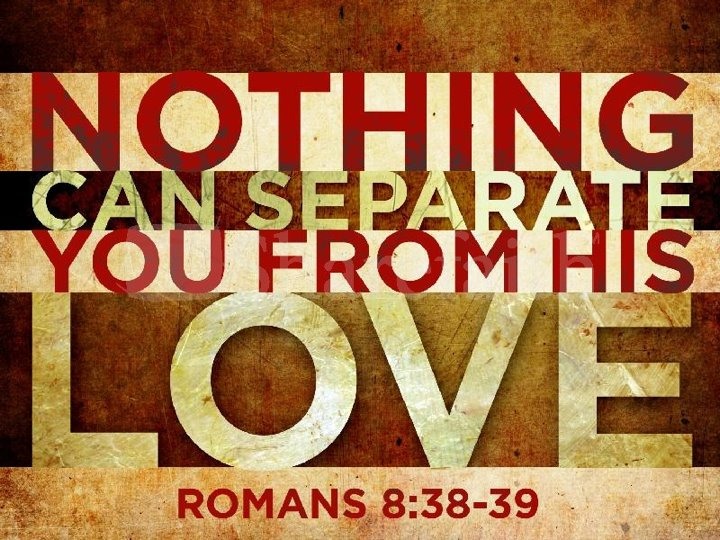
nothing can seperate you from His love

Suffering and destitution are not God’s last Word. God raised Christ from the dead reminding us forever and ever that death is not the end, we are not abandoned by the God who breathed life into us. God’s care for people like us is shown in the power he gives, through his love and grace, to overcome all dangers, all feelings of loss, and all loneliness.

It was our privilege to be Christ’s body for Robert this week. I am incredibly thankful for the opportunity we had to serve his needs, to serve the needs of the children in the reading program, and remind all of them of their worth.

However, a strange thing happened during our trip. Even in the midst of helping love on the last, the least, and the lost, I discovered that some from our group were wrestling with some of these things in their own lives. Every evening while we gathered as a church group I was given glimpses of the struggles and valleys in the lives of our people. They might not have the same physical struggles as the people we served, but it was clear that they were unsure of God’s love in their lives.

For I am convinced that neither death, nor life, nor angels, nor rulers, nor things present, nor things to come, nor powers, nor height, nor depth, nor anything else in all creation will be able to separate us from the love of God in Christ Jesus our Lord.

On our last evening together our church group gathered in a small conference room, sitting in a circle on the floor with the lights dimmed while contemporary Christian music lightly played in the background. A chair was placed in the middle of the circle with a basin of water waiting near the legs. One at a time I invited every member of our group to sit in the chair and we took turns washing one another’s feet. Truly I tell you, there are few things in life as humbling and life-giving as washing, and having your feet washed, by a brother or sister in faith. One by one every member in our group sat in the chair and after their feet were washed we surrounded them and placed our hands on them and prayed for them.

Almighty God, thank you for the gift of Chris in our lives. It has been a tremendous joy to see the way you have moved through him this week as he lead and guided us. For the many ways that he serves you as a father, a husband, a teacher, and a friend with give you thanks.

Great God thank you for your wonderful disciple Luke. We praise your name for this young man that you have shaped. His faith is so real and tangible that it gives me hope for your kingdom. He is a blessing to my life and I give you thanks for sending him here this week.

Father of mercy, thank you for your loving servant Tucker. He has so selflessly served the needs of others this week from scrubbing the floor of Robert’s house to befriending some of the outcasts from other churches. He lives out his faith in wonderful and amazing ways. This week could not have been as incredible without him and we are so thankful for all that you are doing through him.

God of grace thank you for Courtney. As she has served the needs of this community we have seen you at work through her. We are blessed by her honesty and willingness to address the truth of our lives. She works hard for the needs of others and so faithfully lives out the call to love you and her neighbor. What a blessing she is to me and my life, thank you for calling her to lead the life that she has faithfully followed.

Most merciful God thank you for the gift of Willow. As a young woman she has so captivated our hearts this week through her commitment to your kingdom. She is so full of light and vibrancy that she changes every life she touches. Our lives would be so dim and lifeless without her and it has been a joy to watch you work through her this week. Thank you for sending Willow into our lives.

Great God thank you for Grace. She is so clearly not a weed but a wheat of faith. Firmly rooted in your love and mercy she has been your Son’s body this week for others and for us. She is a constant reminder of the way you love us, because she places other people’s needs in front of her own. What a joy it is to call her my friend. We are so thankful for all that you have done and will continue to do through her.

It was through tears, through the water of foot washing, and through the faith of prayer that we told everyone in our group what Paul was trying to tell the people in Rome: You are magnificent and God loves you.

Do you know how magnificent you are? Have you ever been able to see yourself the way God sees you? Nothing can separate us from God’s love. Not our doubts, not our failures, not our shortcomings, not our sins, not our disappointments; we are stuck with God’s love. 

You are wonderful and unique, full of grace and glory. God has done, is doing, and will continue to do marvelous things through you. My friends I am convinced that neither death, nor life, nor angels, nor rulers, nor things present, nor things to come, nor powers, nor height, nor depth, nor anything else in all creation will be able to separate us from the love of God in Christ Jesus our Lord.

You are loved, you are wonderful, and you are magnificent.

Amen.

Jesus Said What? – A Thanksgiving Sermon on John 6.25-35

(preached at Cherryvale UMC in Staunton, VA on 11/27/13)

John 6.25-35

When they found him on the other side of the sea, they said to him, “Rabbi, when did you come here?” Jesus answered them, “Very truly, I tell you, you are looking for me, not because you saw signs, but because you are your fill of the loaves. Do not work for the food that perishes, but for the food that endures for eternal life, which the Son of Man will give you. For it is on him that God the Father has set his seal.” Then they said to him, “What must we do to perform the works of God? Jesus answered them, “This is the work of God, that you believe in him whom he has sent” So they said to him, “What sign are you going to give us then, so that we might see it and believe you? What work are you performing? Our ancestors ate the manna in the wilderness; as it is written, ‘He gave them bread from heaven to eat.’” Then Jesus said to them, “Very truly, I tell you, it was not Moses who gave you the bread from heaven, but it is my Father who gives you the true bread from heaven. For the bread of God is that which comes down from heaven and gives life to the world.” They said to him, “Sir, give us this bread always.” Jesus said to them, “I am the bread of life. Whoever comes to me will never be hungry, and whoever believes in me will never be thirsty.”
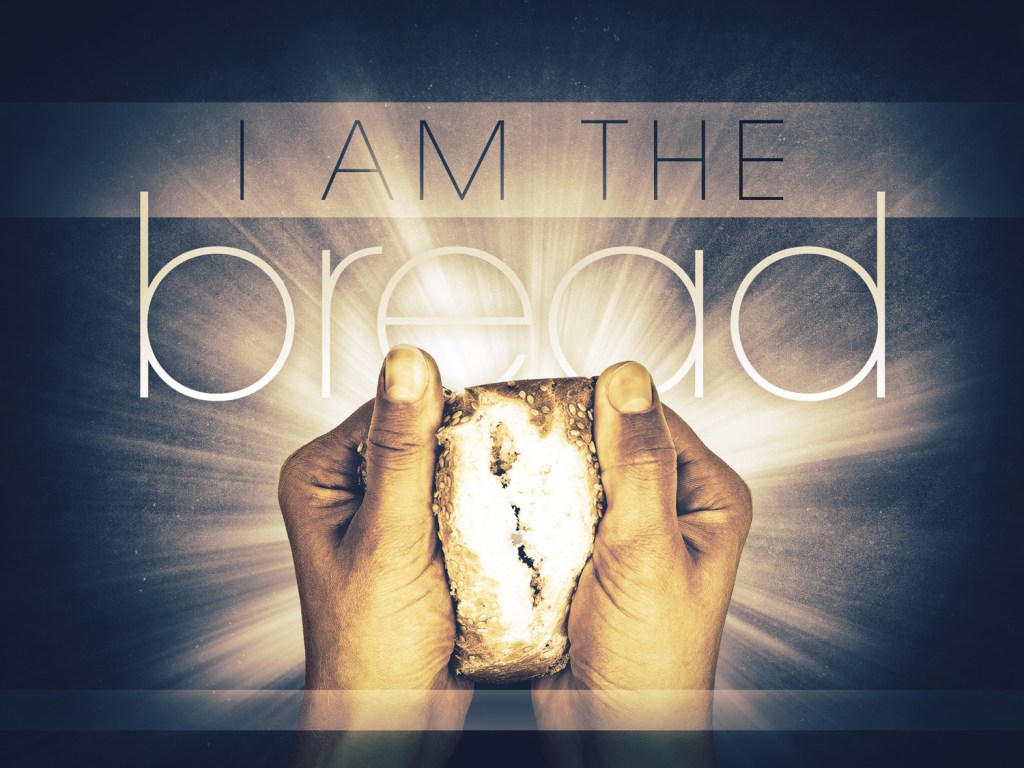
Jesus said to them, “I am the bread of life. Whoever comes to me will never be hungry, and whoever believes in me will never be thirsty.”

00029400_h

After miraculously feeding 5,000 people, the crowd stayed on the other side of the sea. Though they had been properly fed by the Word, the loaves, and the fishes, when they discovered that this miracle man was nowhere to be found, they got into the boats and went to Capernaum looking for Jesus.

When they finally caught up with him on the other side, they called out, “Teacher, where did you come from?!?” Jesus responded, “Very truly, I tell you, you are looking for me for the wrong reasons, you came here not looking for signs, but because I gave you enough to eat yesterday. Do not work for the food that spoils, but instead for the food that endures for eternal life, which the Son of Man will give you. For it is on him that God the Father has set his seal.”

“Okay, okay, so what do we have to do in order to perform the works of God?

Jesus answered simply, “This is the work of God, that you believe in him whom he has sent.”

“Well, who do you think you are Jesus of Nazareth? What sort of sign are you going to perform? Why should we listen to you? How can you prove what you are saying to us? Sure, yesterday you fed all of us, made something out of nothing, but so did Moses in the wilderness. Why should we turn away from him, to you?”

“Very truly, I tell you, it wasn’t Moses who gave you the bread from heaven, the manna, but it is my Father who gives you the true bread from heaven. For the bread of God is that which comes down from heaven and gives life to the world.”

“Now Jesus that sounds pretty good to us, we would like some of that bread!”
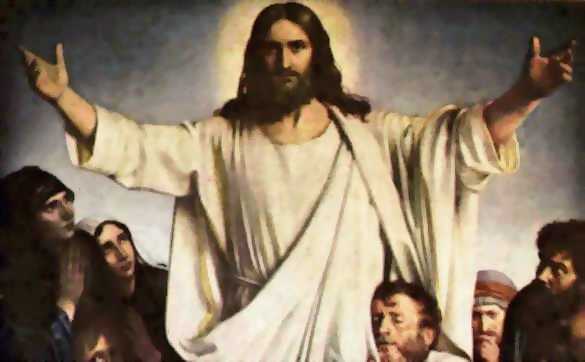
jeswelcom

“No, you don’t get it. I AM THE BREAD OF LIFE. Whoever comes to me will never be hungry, and whoever believes in me will never be thirsty.”

One of the great paradoxes of what it means to be Christian, is that we already know the end of the story while we’re stuck in the middle of it. Because we read from God’s word in order to remember the mighty acts of God in the world, we are all well versed on what happens in conclusion. Therefore it becomes nearly impossible for us to imagine the depth and meaning of these narratives in and of themselves.

Try with me, if you can, to imagine that you are there among the crowd. Yesterday you were blown away by this nothing of a man who made something out of nothing. As you stood in line with your stomach rumbling, you were given more fish and bread than you had ever seen in your life. Now, you were so hungry that you ate until your stomach was about to explode, (just like many of us will do tomorrow…) and the next day, the miracle man was gone. As your hunger started to creep back up, you agreed with those around you to go looking for this Jesus.

So here you are, gathered together to hear him speak once again. Some of the people in the front challenged him about Moses’ miracle in the wilderness, something about Manna, but you just want him to provide some more food. So as Jesus begins to describe this true bread from heaven that gives life to the world, your mouth begins to water. You imagine a glowing loaf cooked perfectly, warm and moist on the inside, with just enough crust on the outside. You join the chorus around you, “Give us some of that bread Jesus! We want that always!” And Jesus responds, “I am the bread of life.”

For us, the temptation to jump to the end of the story is great. We hear “bread of life” and we think about Holy Communion, we think about the last supper that Jesus shared with his disciples, we think about the crucifixion and the resurrection. And though it is important to know the end of the story, we’re not there yet.

I imagine that many who had gathered together that day were very confused. “What did he say? He’s the bread of life? What in the world could that mean?”

They don’t get it. The crowds that had witnessed Jesus’ miracle the day before knew exactly what they wanted, but thats not what Jesus is offering.

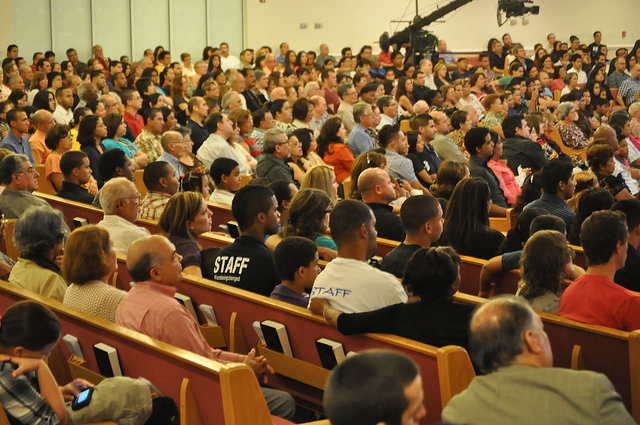
Today too many of us give the impression that numbers and popularity and packed pews are all important and sufficient in themselves. Many churches seem willing to accept people on any terms, if only they will come at all. How interesting is it then, that Christ would only accept the crowds on his terms, and would not want them upon any others. It hurt and frustrated him that they were merely interested in his ability to provide an easing of material difficulties or an increase in their comforts. “You came to me only for the chance of loaves and fish.”
8105338460_5b6fa706bf_z

Similarly, in our contemporary culture people are hugely interested in the by-products of Christianity, but hardly at all in Christianity itself. Crowds of folk are constantly looking for whatever they can get out of church and worship. They are primarily interested in the kind of faith that will give them bread and fish, bigger homes, shorter hours, better health, happier families. Today Christ looks into the depth of our hearts and triumphantly declares, “there are far better and more satisfying things within your reach than you have realized.”

The whole exchange begins with an accusation by Jesus regarding the crowds’ overwhelming desire and interest in full stomachs, instead of the power of theologically oriented signs. Jesus proposes to give them enduring food and not the kind they consumed the day before. The exchange then elicits a question from the crowd about the “works of God” which Jesus reduces to one, namely belief; belief “in him whom he has sent.”

What is belief? What does belief mean for each of you? Are we called to believe in God, in Jesus Christ, in the Holy Spirit? Is belief about accepting the bible as truth? Can we boil down our belief to something like the Apostles’ Creed?

Often times belief in Christian living is compartmentalized into believing that God simply exists.

The kind of belief that Jesus talks about with the crowds in John 6 is a different kind of belief. Belief is more than mental affirmation, belief is a world view, belief is a paradigm shift, belief is about a redefinition of reality.

What we believe, shapes how we behave.

Everything about what we do begins with belief; we believe in Jesus Christ and the things for which he stands, the way and the truth and the life he teaches us, the God whom he reveals to us, the grace and faith he came to offer us, the victory over death which he makes possible even for the least likely of us, the kingdom of God that he inaugurates for us. 

Okay Jesus, you want us to believe, to drop everything, to change our lives, to pick up our own crosses, to follow you. But why? Moses fed us with the manna in the wilderness, what can your belief offer us?

Moses was Moses, a mighty servant and steward of the Lord. Yet what Moses gave to the wandering Israelites was not the bread from heaven; it is God the Father who gives you the bread from heaven, and that is being offered to you this day. What Moses provided, rather what God provided through Moses, was merely food. What Jesus offers the crowd is the almighty God.

Tomorrow, millions will gather together with friends and family to celebrate the wonderful holiday of Thanksgiving. Crowds will develop in all of the airports, the roads will be filled with traffic, and kitchens will be teaming with individuals trying to concoct the perfect mashed potato – turkey – gravy – cranberry – stuffing combination of all time. After exchanging pleasant and cliche reflections on what we are most thankful for this year, most of us will partake to ridiculous degrees on the food set before us. Mountains of mashed potatoes will be eroded with rivers of gravy. Quarries of cranberry salad will rival seas of stuffing.

A-Thanksgiving-meal-has-at-least-3000-calories

Perhaps most frightening is the fact that within 24 hours, we can go from thanking God for all the blessing in our lives, to fighting one another at Best Buy in order to purchase something to fill our insatiable appetite.

ap_black_friday_21_dm_121123_wg

We know what we want, but thats not what Jesus is offering.

I like to think that, as the church, we have matured from our fragile days of discipleship in the first century. I like to believe that because we know the end of the story, we are better prepared to heed Jesus’ call to a life in the kingdom. I like to imagine that, as moderns, we are ready to take up our crosses in brilliant fashion and follow Jesus into glory.

But the truth is, we are still standing in that crowd asking Jesus for the bread.

We struggle so desperately to find meaning in our lives through failed relationships, the accumulation of material possessions, and vocational discernment. We hear the word of the Lord in scripture, and then quickly fall back away into the shadow of our lives. We thank God for our families and then bicker and fight as if they were not precious gifts in our lives.

Just as He did that day in the crowd, Christ looks out to all of us this thanksgiving season and offers us something more fulfilling than anything else. “I am the bread of life, whoever comes to me will never be hungry, and whoever believes in me will never be thirsty.”

“I am the bread of life”; search throughout the scriptures, I challenge you to find something equally simple and profound in summarizing the Good News. This the gospel of Jesus Christ at its very finest! How ample in its sweep, how generous in its description, how impossible to evade. This is a passage to which we can all cling in the darkest moments in our lives. With this one sentence we discover an everlasting hope that will endure all things.

“I am the bread of life”; Jesus Christ is as important to us as the very food we eat. Indeed, Christ is more important to us than food. No amount of food or drink or any material thing will ever fill us the way that Christ does. Through the bread of life that Christ offers we receive strength to live out our faith, we are sustained and nurtured and loved in all things.

“I am the bread of life”; The triune God is an end to all the craving and discontent in our lives. The bread of life roots our identities in the one from whom all blessings flow, the maker in whom we live and move and have our being.

lord__s_supper_by_bclary-d37hhzp

In a few moments all of you will be invited to Christ’s table to partake of him through the bread and the wine. Just as Jesus stood before the crowd to proclaim his identity as the bread of life, Jesus once gathered with his disciples to remember the stories of God in the world and share one final meal.

What are you thankful for this year? How have you been trying to fill the voids in your life? If you want to be filled, if you want to find a sustenance in your life, if you desire to have your life transformed, if you need to be made whole, if you want to discover purpose and faithfulness in your life, if you desire to know God, if you hope to find peace in your lives, then come. Come to Christ’s table. Feast on the true bread from heaven, believe in Jesus Christ, and be filled by the Spirit.

Amen.

00029400_h